Introduction
Kūrma (Sanskrit: कूर्म, IAST: Kūrma, “tortoise”) is the second of the ten principal avatāras (daśāvatāra) of Lord Viṣṇu, the Supreme Preserver of the cosmos in Hindu theology. In this incarnation, the Lord assumed the form of a colossal divine tortoise — sometimes depicted as a fully zoomorphic turtle of cosmic proportions, sometimes as a magnificent half-human, half-tortoise being — to serve as the foundation upon which Mount Mandara rested during the great Samudra Manthana (Sanskrit: समुद्र मन्थन, “the Churning of the Ocean of Milk”), one of the most celebrated and symbolically rich episodes in all of Hindu mythology (Wikipedia, “Kurma”; Britannica, “Kurma”).
The Kūrma avatāra narrative is far more than a colourful mythological tale. It addresses fundamental questions about the relationship between the divine and the demonic, the nature of cosmic sacrifice, the origin of both nectar and poison in the universe, and the role of the Supreme Being as the silent, unseen foundation upon which all activity — whether creative or destructive — ultimately rests. The story appears in multiple Purāṇic texts, most prominently in the Bhāgavata Purāṇa (Canto 8, Chapters 5–12), the Viṣṇu Purāṇa (Book 1, Chapter 9), the Matsya Purāṇa, and the Kūrma Purāṇa — a Mahāpurāṇa that takes its very name from this avatāra.
The Cosmic Context: Why the Ocean Had to Be Churned
The Curse of Durvāsas
The Samudra Manthana does not begin with divine ambition but with divine calamity. According to the Bhāgavata Purāṇa (8.5–6), the story opens with a curse. The irascible sage Durvāsas — an aṃśa (partial incarnation) of Lord Śiva, renowned for his fearsome temper — once offered a garland of celestial flowers to Indra, the king of the Devas (gods). Intoxicated with pride and power, Indra carelessly placed the garland on the trunk of his elephant Airāvata, which trampled and discarded it. Enraged by this insult to a sacred offering, Durvāsas cursed Indra and all the Devas: “May Lakṣmī, the goddess of fortune, abandon you! May your glory, strength, and prosperity be destroyed!” (Vedabase, Bhāgavata Purāṇa 8.5).
The curse took immediate effect. Śrī Lakṣmī departed from the celestial realms, and with her departure, the Devas lost their vitality, lustre, and power. The Asuras (demons), led by their king Bali, seized the opportunity to wage war against the weakened gods and drove them from the heavens. Desperate and defeated, the Devas sought refuge with Lord Viṣṇu, who advised them to form a temporary alliance with the Asuras to churn the Kṣīrasāgara (Ocean of Milk) and obtain Amṛta — the nectar of immortality — which alone could restore their power.
The Grand Alliance
Viṣṇu counselled diplomacy: the Devas should approach the Asuras not with hostility but with the promise of sharing the Amṛta. Both parties would need to cooperate for the churning, for neither alone possessed sufficient strength for so cosmic an undertaking. The Devas, swallowing their pride, negotiated with the Asuras. The stage was thus set for the greatest collaborative — and ultimately competitive — endeavour in Hindu cosmology (Viṣṇu Purāṇa 1.9; WisdomLib).
The Samudra Manthana: The Churning of the Ocean of Milk
The Churning Apparatus
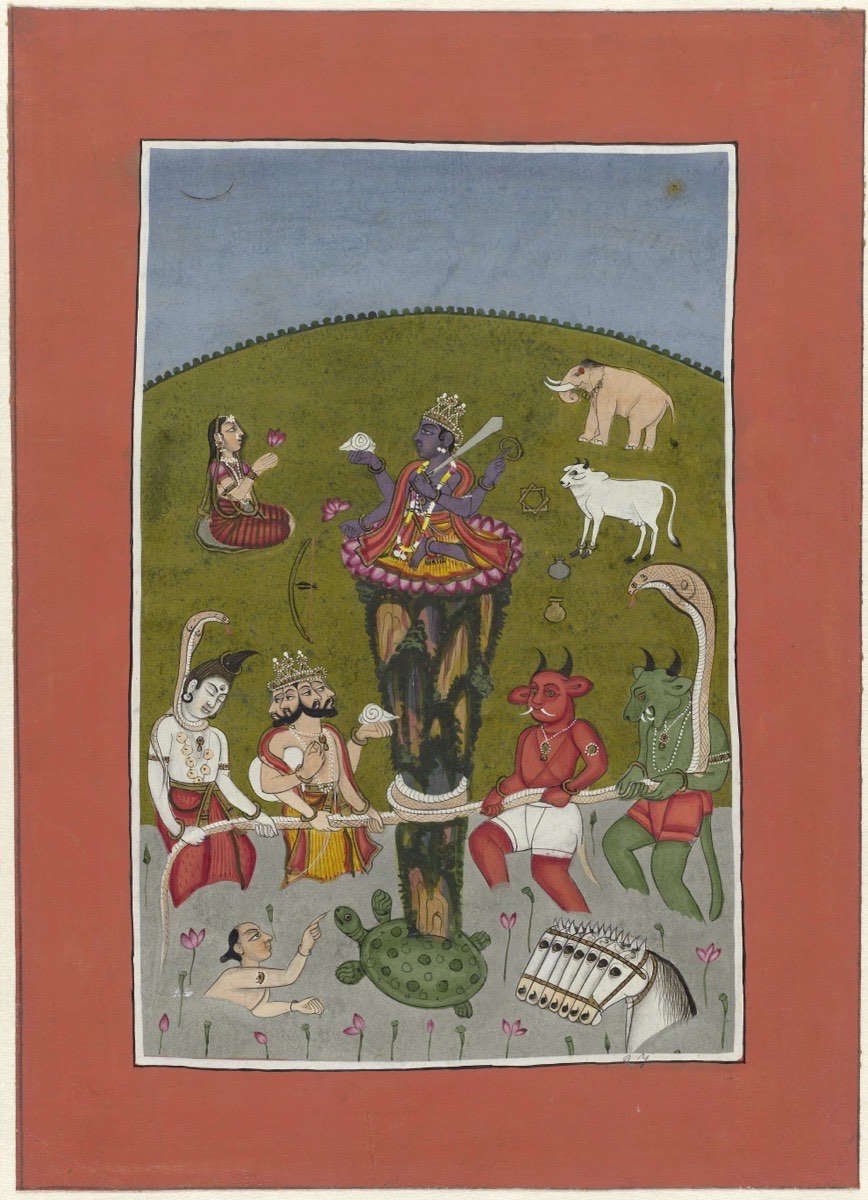
The mechanics of the Samudra Manthana are described with vivid specificity across the Purāṇic texts. The Kṣīrasāgara — the primordial Ocean of Milk, one of the seven cosmic oceans that concentrically surround the central continent of Jambūdvīpa in Hindu cosmography — served as the medium to be churned. Mount Mandara (Mandara Parvata), a colossal mountain, was uprooted and placed in the ocean to serve as the churning rod (manthāna). The great serpent Vāsuki, king of the Nāgas, was coiled around the mountain to serve as the churning rope (netra).
The Devas took hold of Vāsuki’s tail, and the Asuras grasped his head. As they pulled alternately — the Asuras drawing the serpent’s hood towards themselves, the Devas pulling the tail — Mount Mandara rotated in the ocean, generating the friction and force necessary to churn the cosmic waters (Wikipedia, “Samudra manthan”).
The Crisis: Mount Mandara Sinks
But there was an immediate problem. As soon as the churning began, the immense weight of Mount Mandara — a mountain of cosmic proportions — caused it to sink into the soft ocean floor. Without a stable base, the mountain plunged downward, threatening to bore through the ocean bed itself. The entire enterprise faced catastrophic failure before it had truly begun.
Lord Viṣṇu as Kūrma: The Divine Foundation
It was at this critical juncture that Lord Viṣṇu incarnated as Kūrma — a tortoise of inconceivable magnitude. The Bhāgavata Purāṇa (8.7) describes the Lord diving into the Ocean of Milk and positioning Himself beneath Mount Mandara. His vast tortoise shell, described as extending over one hundred thousand yojanas (a yojana being approximately 8–13 kilometres), became the stable platform upon which the mountain rested and rotated.
The Bhāgavata Purāṇa (8.7.9–10) states:
“The Supreme Personality of Godhead, Ajita, grasped the mountain from above with His other form as an extraordinarily huge tortoise. And on the surface of the shell of the tortoise, Mount Mandara rotated as though it were rotating on a jewel-surfaced turntable.”
The Kūrma bore the crushing weight of the mountain and the violent friction of its rotation without flinching. The Viṣṇu Purāṇa (1.9) elaborates that the Lord not only supported the mountain from below but simultaneously sat atop the mountain in His divine form, steadying it from above, while also pervading the bodies of both the Devas and Asuras with His energy, giving them the supernatural strength to continue pulling Vāsuki for the duration of the churning.
This multi-fold presence — as the foundation below, the stabiliser above, and the animating energy within both teams — is a theological statement of extraordinary depth: Viṣṇu is simultaneously the ground of being, the regulating order, and the vital force that empowers all action in the cosmos (WisdomLib, Viṣṇu Purāṇa).
The Fourteen Treasures (Caturdaśa Ratna)
As the churning proceeded, a succession of extraordinary beings and objects emerged from the Ocean of Milk. The Purāṇic texts enumerate fourteen treasures (caturdaśa ratna), though the exact list varies slightly between sources. The most commonly cited treasures include:
- Halāhala (or Kālakūṭa) — the deadly poison that emerged first, threatening to destroy all creation (see the next section)
- Kāmadhenu (Surabhi) — the wish-fulfilling celestial cow, given to the sages
- Uccaiḥśravas — the divine seven-headed white horse, claimed by the Asura king Bali
- Airāvata — the four-tusked white elephant, taken by Indra
- Kaustubha — the most precious jewel in the universe, adorning Lord Viṣṇu’s chest
- Pārijāta — the celestial coral tree with ever-fragrant flowers, planted in Indra’s garden
- Apsarās — celestial nymphs of surpassing beauty, who became dancers in Indra’s court
- Lakṣmī (Śrī) — the goddess of fortune, wealth, and beauty, who chose Lord Viṣṇu as her eternal consort
- Vāruṇī (Surā) — the goddess of wine, accepted by the Asuras
- Dhanvantari — the divine physician, the founder of Āyurveda, who emerged bearing the pot (kalaśa) of Amṛta
- Candra (the Moon) — taken by Lord Śiva to adorn His matted locks
- Śaṅkha — the divine conch, taken by Viṣṇu
- Kalpavṛkṣa — the wish-fulfilling tree
- Amṛta — the nectar of immortality, the ultimate prize of the churning
The emergence of Lakṣmī from the ocean is among the most beloved episodes in Hindu devotional tradition. She arose from the milky waters seated upon a lotus, radiant and resplendent, and after surveying all the assembled beings — Devas, Asuras, sages, and celestials — she chose Lord Viṣṇu as her husband, placing a garland of victory around His neck. This mythic event is the origin of the title Kṣīrasāgarakanyakā (“Daughter of the Ocean of Milk”) applied to Lakṣmī, and it is celebrated during Dīpāvalī (Diwali) and Lakṣmī Pūjā across the Hindu world.
The Halāhala Poison and Lord Śiva’s Sacrifice
Before the treasures could emerge, the ocean yielded something terrifying: Halāhala (also called Kālakūṭa), a poison of such catastrophic potency that it threatened to annihilate the three worlds. The toxic fumes spread across the cosmos, darkening the skies and suffocating all living beings. Neither the Devas nor the Asuras could withstand its deadly vapour.
In their desperation, all beings turned to Lord Śiva (Mahādeva), the great ascetic who alone possessed the power to neutralise such a cosmic threat. Moved by compassion for all creation, Śiva gathered the Halāhala in His palms and drank it. His consort, the goddess Pārvatī (in some versions identified as Satī), seized His throat to prevent the poison from descending into His stomach. The Halāhala lodged in Śiva’s throat, turning it a deep blue-black — and from that day, Mahādeva has borne the epithet Nīlakaṇṭha (“the Blue-Throated One”).
This episode is profoundly significant in Hindu theology: it establishes Śiva as the ultimate protector who absorbs the toxicity of the universe within Himself, transforming what would be universal destruction into a mark of divine beauty. The Halāhala episode also demonstrates the complementary roles of Viṣṇu and Śiva in cosmic preservation — Viṣṇu provides the foundation and strategic guidance, while Śiva performs the supreme act of self-sacrifice.
Textual Sources
The Bhāgavata Purāṇa (Canto 8)
The most comprehensive and devotionally influential account of the Kūrma avatāra and the Samudra Manthana appears in the Śrīmad Bhāgavata Purāṇa, Canto 8, spanning Chapters 5 through 12. This text provides the fullest narrative arc: from Durvāsas’s curse through the diplomatic alliance, the churning itself, the emergence of the treasures, the Halāhala crisis, and the subsequent conflict over the Amṛta distribution — which leads to the Mohinī avatāra, Viṣṇu’s enchanting female form, who distributes the nectar exclusively to the Devas through divine cunning (Vedabase, Bhāgavata Purāṇa 8.7).
The Viṣṇu Purāṇa (Book 1, Chapter 9)
The Viṣṇu Purāṇa presents a somewhat more concise account but adds the theologically crucial detail that Viṣṇu was simultaneously present in multiple forms during the churning: as Kūrma below, as a divine presence atop the mountain, and as the energy pervading both the Devas and Asuras. This threefold presence is a key statement of Vaiṣṇava theology — the Lord is the efficient cause, the material cause, and the sustaining cause of all cosmic activity (WisdomLib, Viṣṇu Purāṇa).
The Kūrma Purāṇa
The Kūrma Purāṇa — one of the eighteen Mahāpurāṇas — takes its name directly from this avatāra and is framed as a discourse of Lord Viṣṇu in His tortoise form. Containing approximately 17,000 verses across two sections (Pūrvavibhāga and Uttaravibhāga), it covers not only the Samudra Manthana narrative but also extensive teachings on dharma, cosmology, pilgrimage (tīrtha-māhātmya), and devotional practice. The Kūrma Purāṇa is classified as a sāttvika (mode of goodness) Purāṇa, associated with Viṣṇu (WisdomLib, Kūrma Purāṇa).
The Mahābhārata (Ādi Parva)
The earliest extended narrative of the Samudra Manthana appears in the Mahābhārata, Ādi Parva, Chapters 15–17 (also known as the Āstīka Parva). While this account does not explicitly name the Kūrma avatāra with the same devotional elaboration as the Purāṇas, it provides the foundational narrative structure that the Purāṇic texts later developed and theologised.
Iconography and Visual Tradition
The Classical Iconographic Forms
Kūrma is represented in Indian art in two principal forms:
-
Fully zoomorphic (complete tortoise form): A colossal tortoise bearing Mount Mandara upon its shell, with the serpent Vāsuki coiled around the mountain and the Devas and Asuras pulling from either side. This panoramic composition is favoured in relief sculpture, particularly in Khmer art (the famous Angkor Wat bas-relief) and in Pallava and Chola temple panels.
-
Therianthropomorphic (half-human, half-tortoise form): The upper body of Viṣṇu — with four arms bearing His characteristic attributes (cakra/discus, śaṅkha/conch, gadā/mace, and padma/lotus), wearing a tall kirīṭa-mukuṭa (conical crown) and royal ornaments — emerging from the lower body of a massive tortoise. This form emphasises the divine identity within the animal incarnation and became standard in medieval Indian miniature painting traditions.
Miniature Painting Traditions
The Samudra Manthana became one of the most popular subjects in Indian miniature painting, particularly in the Pahari schools (Kangra, Basohli, Chamba) and Rajasthani ateliers (Mewar, Bundi, Jaipur). These paintings typically present the full panoramic scene: Mount Mandara at centre, Vāsuki spiralling around it, the Devas and Asuras pulling from opposite sides, and the tortoise (sometimes visible, sometimes submerged) beneath. The Rijksmuseum in Amsterdam preserves an important Indian miniature depicting the Kūrma avatāra within the Samudra Manthana composition.
Temple Sculpture
The Samudra Manthana relief at Angkor Wat (12th century, Cambodia) is perhaps the most monumental depiction of this episode in all of Asian art — a 49-metre-long bas-relief on the East Gallery of the third enclosure, depicting 88 Devas and 92 Asuras pulling Vāsuki around Mount Mandara, with the great Kūrma visible below. Though located in a Cambodian temple, this masterwork testifies to the pan-Asian influence of the Kūrma mythology.
In India, notable Samudra Manthana panels appear at the Dashavatara Temple, Deogarh (6th century, Gupta period), Badami Cave Temples (6th century, Chalukya), and numerous Hoysala temples at Belur and Halebidu (12th–13th century).
Temples Dedicated to Kūrma
Śrī Kūrmam Temple, Andhra Pradesh
The most important temple exclusively dedicated to the Kūrma avatāra is the Śrī Kūrmam Temple (also spelled Srikurmam) in Srikakulam district, Andhra Pradesh. This ancient temple, believed to date from at least the 9th–10th century CE, enshrines a deity of Lord Viṣṇu in the Kūrma form — one of the very few temples in India where the tortoise avatāra is the primary deity of worship rather than an ancillary panel in a Dashavatara series (Wikipedia, “Srikurmam”).
The temple is built in the Kaliṅga architectural style and is an important pilgrimage site for Vaiṣṇava devotees, particularly followers of the Śrī Vaiṣṇava tradition. The presiding deity is called Śrī Kūrmanātha, and the goddess here is Kūrmanāyakī. The temple’s sthala purāṇa (local sacred history) records that the great Vaiṣṇava ācārya Rāmānuja (11th–12th century CE) visited Śrī Kūrmam and established the Śrī Vaiṣṇava mode of worship here.
Kurmai Temple, Telangana
The village of Kurmai in Mahabubnagar district, Telangana, also hosts a temple associated with the Kūrma avatāra. While smaller and less widely known than Śrī Kūrmam, this temple preserves local traditions of Kūrma worship that date back several centuries.
Theological Significance
The Silent Foundation of the Cosmos
The most profound theological teaching of the Kūrma avatāra is the concept of the divine as the unseen, silent foundation that supports all cosmic activity. The tortoise does not actively churn; it does not compete with the Devas or the Asuras; it does not claim any of the treasures. It simply bears the weight — patiently, immovably, without complaint or acknowledgement. The mountain rotates upon its back, generating heat and friction, yet the Kūrma remains unmoved.
This is a powerful metaphor for the nature of Brahman as understood in Vaiṣṇava theology: the Supreme Being is not merely the active agent who performs spectacular interventions (as in the Narasiṃha or Rāma avatāras) but also the passive, all-supporting ground of being — the foundation without which no activity, no creation, no existence would be possible. The Kūrma avatāra teaches that God is as much present in silent, patient endurance as in dramatic, heroic action.
The Daśāvatāra Sequence and Evolutionary Symbolism
Kūrma’s position as the second avatāra — following Matsya (fish) and preceding Varāha (boar) — has been widely discussed in the context of the remarkable parallel between the daśāvatāra sequence and biological evolution. If Matsya represents aquatic life, Kūrma represents the amphibian stage — the transitional form that can exist both in water and on land. The tortoise emerges from the ocean, bears the mountain on land (or in the shallows), and operates in both elements.
This progression from fish to amphibian to terrestrial mammal (Varāha, the boar) to transitional man-animal form (Narasiṃha, the man-lion) to dwarf human (Vāmana) traces a trajectory that modern observers have compared to the evolutionary movement from sea to shore to land. While Hindu tradition understands this sequence in theological and cosmological terms rather than biological ones, the parallel — first noted by nineteenth-century scholars — remains one of the most striking intellectual correspondences between ancient mythological thought and modern scientific understanding.
The Necessity of Divine–Demonic Cooperation
The Samudra Manthana is unique among Hindu mythological episodes in that it requires the cooperation of both Devas and Asuras. Neither side can accomplish the churning alone. This carries a profound philosophical implication: in the cosmic order, both the divine (constructive) and the demonic (destructive) forces are necessary for creation. The treasures of the universe — wealth, beauty, knowledge, immortality — emerge only when opposing forces work in dynamic tension.
This teaching resonates with the Hindu philosophical concept of dvandva (the pairs of opposites) and the recognition that creation itself arises from the interplay of complementary forces: light and darkness, order and chaos, preservation and dissolution.
Kūrma in Regional Traditions
South Indian Traditions
In the Śrī Vaiṣṇava tradition of Tamil Nadu and Andhra Pradesh, the Kūrma avatāra holds special significance as one of the vibhava (descending) forms of Viṣṇu enumerated in the theology of the Āḻvārs (Tamil Vaiṣṇava poet-saints). The great hymnal corpus of the Divya Prabandham (4,000 verses) includes references to Kūrma among the avatāras celebrated in praise of Viṣṇu.
Southeast Asian Traditions
The Kūrma avatāra and the Samudra Manthana exerted an enormous influence on the art and architecture of Southeast Asia, particularly in the Hindu-Buddhist kingdoms of Cambodia, Thailand, and Java. The monumental bas-relief at Angkor Wat is the most famous example, but the motif also appears at Angkor Thom (the Bayon temple), at the Prambanan temple complex in Java, and in Thai royal iconography, where the sculpture group at Suvarnabhumi Airport in Bangkok recreates the churning scene on a grand scale.
Bengali Traditions
In Bengal, the Kūrma avatāra appears prominently in the terracotta temple panels of Bishnupur (Viṣṇupur), where the Malla dynasty kings (16th–18th century) commissioned elaborate Dashavatara panels on the facades of temples such as the Jor Bangla Temple and the Madan Mohan Temple. The Samudra Manthana is a favourite subject of these terracotta reliefs, rendered with remarkable narrative detail.
Worship and Living Tradition
While standalone Kūrma temples are relatively rare compared to temples dedicated to Rāma or Kṛṣṇa, the tortoise avatāra is universally represented in Dashavatara panels found in Vaiṣṇava temples across India and Southeast Asia. In many temples, small stone or metal tortoise figures are placed at the base of dhvajastambhas (flag-pillars) or near the main sanctum as symbolic representations of Kūrma supporting the cosmic order.
In traditional Vaiṣṇava daily worship, the Kūrma is invoked as part of the daśāvatāra stotra (hymn to the ten avatāras). The Daśāvatāra Stotra attributed to the poet Jayadeva (12th century, author of the Gīta Govinda) includes a verse celebrating Kūrma:
“O Keśava! O Lord of the universe! O Lord Hari who have assumed the form of a tortoise! All glories to You! The great Mount Mandara rests upon the broad expanse of Your back as a most excellent ornament.”
In the broad sweep of the daśāvatāra, Kūrma occupies a position of quiet grandeur. Where Matsya dramatically swam through the deluge and Narasiṃha burst forth from a pillar in fury, the tortoise simply endured — bearing the weight of an entire cosmic enterprise upon its back, asking nothing, claiming nothing, enabling everything. In this silent, selfless act of cosmic service, Hindu theology finds one of its most powerful images of the divine: not the God who thunders and commands, but the God who supports, sustains, and makes all things possible through patient, unyielding love.