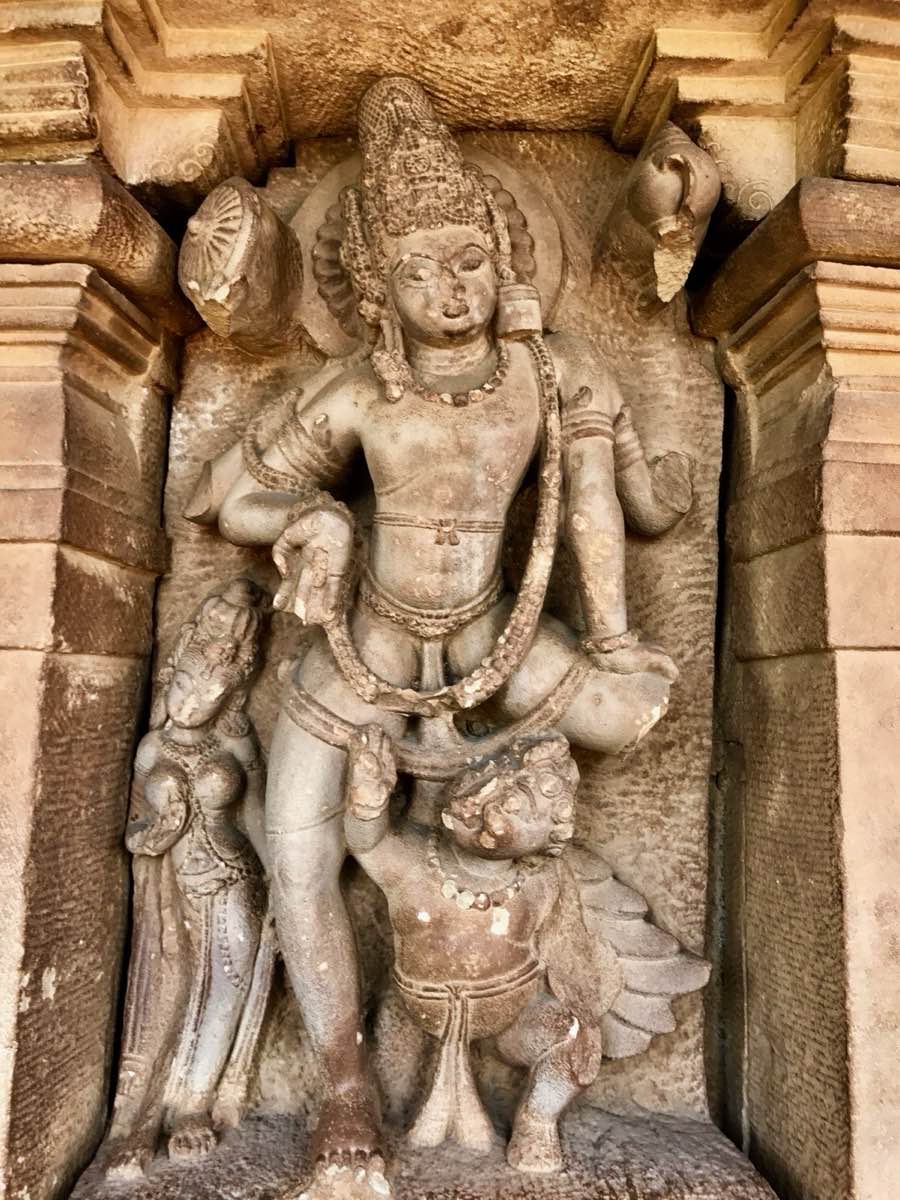
Garuḍa (गरुड, “Devourer”), also known as Suparṇa (“Beautiful-winged”), Vainateya (“Son of Vinatā”), and Viṣṇuvāhana (“Vehicle of Viṣṇu”), is the divine eagle — the king of all birds and the eternal mount of Lord Viṣṇu. Garuḍa is one of the most powerful and revered beings in Hindu mythology: immense enough to blot out the sun, swift enough to outrace the wind, and devoted enough to carry the Supreme Lord across the cosmos. His image appears not only throughout India but across the entire Hindu-Buddhist cultural sphere of Southeast Asia, from Indonesia to Thailand, Cambodia to Myanmar, making him one of the most widely recognized symbols in Asian civilization.
Birth and Parentage
The story of Garuḍa’s birth, narrated in extraordinary detail in the Mahābhārata (Ādi Parva, Chapters 14-34), is one of the great adventure narratives of Hindu scripture.
The Two Wives of Kaśyapa
The sage Kaśyapa Prajāpati had two wives among his thirteen consorts who play central roles in Garuḍa’s story: Vinatā and Kadrū. Kaśyapa granted each wife a boon. Kadrū chose to be the mother of a thousand serpents (nāgas), while Vinatā asked for only two sons, but each more powerful than all of Kadrū’s offspring combined.
Kadrū produced a thousand eggs from which hatched the Nāga race — including Śeṣa (Ananta), Vāsuki, and Takṣaka. Vinatā also produced two eggs, but they required an extraordinarily long incubation period. After five hundred years, impatient, Vinatā broke open one egg prematurely and found inside an incompletely formed being — Aruṇa — who was radiant but had only a developed upper body. Aruṇa cursed his mother for her impatience and rose to become the charioteer of Sūrya (the Sun God), the personification of dawn. He warned Vinatā not to break the second egg and to wait another five hundred years.
The Cosmic Emergence
When the second egg finally hatched after the full thousand years, Garuḍa emerged in a blaze of glory so intense that the gods themselves mistook him for Agni (the fire god). The Mahābhārata (Ādi Parva 1.23) describes his emergence:
“His body blazed like the fire at the end of a Yuga. His wings spread across the sky, and the wind from their beating caused mountains to tremble. All creatures were terrified by his splendor.”
The gods, believing the cosmic fire of dissolution had begun prematurely, approached Agni for explanation. Agni directed them to the newborn Garuḍa, and when the gods praised him, Garuḍa contracted his radiance out of humility, revealing his true form — a magnificent eagle of incomparable beauty and power.
Freeing His Mother: The Quest for Amṛta
The central narrative of Garuḍa’s early life — and one of the most action-packed stories in all of Hindu mythology — is his quest to free his mother Vinatā from slavery to Kadrū.
The Wager and Enslavement
Vinatā and Kadrū made a fateful wager about the color of the celestial horse Uccaiḥśravā, born from the churning of the ocean (Samudra Manthana). Vinatā said the horse was entirely white; Kadrū claimed it had black hairs in its tail. They agreed that the loser would become the servant of the winner.
Kadrū, knowing she was wrong, ordered her serpent sons to entwine themselves in the horse’s tail, creating the appearance of black hairs. Through this deception, Vinatā lost the wager and became Kadrū’s slave. The noble Vinatā and her son Garuḍa were subjected to humiliating servitude under the Nāgas.
The Serpents’ Demand
When Garuḍa asked the Nāgas what price would free his mother, they demanded the impossible: he must bring them amṛta — the nectar of immortality — from the heavens, where it was guarded by the gods themselves behind rings of fire, a spinning wheel of razor-sharp blades, and two enormous serpent guardians.
The Celestial Battle
Garuḍa’s assault on heaven is described in the Ādi Parva (Chapters 29-33) with cinematic vividness. Before his journey, his mother Vinatā blessed him, and the sage Kaśyapa directed him to first consume a great elephant and tortoise (who were actually two feuding sages cursed to those forms) to fuel his strength.
Thus fortified, Garuḍa stormed heaven:
- He quenched the fire ring by swallowing the waters of many rivers and spraying them upon the flames
- He slipped through the razor wheel by shrinking his body to an infinitesimally small size
- He defeated the serpent guardians in fierce combat, blinding them with wing-blown dust
- He seized the amṛta pot and flew away without drinking a single drop himself
So impressed was Lord Viṣṇu by Garuḍa’s selfless devotion and extraordinary power that He appeared before Garuḍa and offered him a boon. Garuḍa asked to be placed above Viṣṇu — and the Lord granted this by making Garuḍa the emblem on His flagstaff, while simultaneously asking Garuḍa to become His eternal mount. Garuḍa, recognizing Viṣṇu’s supreme divinity, joyfully accepted.
Indra, king of the gods, also attacked Garuḍa to recover the amṛta. But even Indra’s thunderbolt could not harm Garuḍa — it merely dislodged a single feather, which was so beautiful that Indra was humbled. They made a pact: Garuḍa would deliver the amṛta to the Nāgas but help Indra recover it before the serpents could drink it. This was accomplished — the Nāgas were tricked into bathing before drinking, and Indra swept away the amṛta. But the serpents had licked the sharp kuśa grass on which the pot had been placed, which is why snakes have forked tongues to this day.
Garuḍa as Viṣṇu’s Vāhana
The relationship between Garuḍa and Viṣṇu is not that of a mere vehicle and rider but a profound spiritual bond of devotion and grace. In Vaiṣṇava theology, Garuḍa is considered a nitya-sūri — an eternally liberated soul in the service of the Lord.
When Viṣṇu rides forth on Garuḍa, the image represents the Supreme Lord mounted upon the Vedas themselves — for Garuḍa is identified with the Sāma Veda chants, and his wings symbolize the sacred meters (chandas) of Vedic hymns. The Suparṇādhyāya, an ancient Vedic text, praises the divine eagle as the embodiment of Vedic knowledge.
In iconography, Viṣṇu is invariably depicted riding Garuḍa when He descends to intervene in worldly affairs — rescuing Gajendra the elephant king, carrying the cosmic disc Sudarśana, and flying across the ocean. The Garuḍa-dhvaja (Garuḍa flag) is the emblem of Viṣṇu and appears on temples and royal insignia throughout the Hindu world.
The Garuḍa Purāṇa
The Garuḍa Purāṇa is one of the eighteen Mahāpurāṇas and is structured as a conversation between Viṣṇu and Garuḍa. It is particularly renowned for its Pretakhaṇḍa (section on the afterlife), which describes in vivid detail the journey of the soul after death, the consequences of karma, and the rituals to be performed for the deceased.
The text is divided into three sections:
- Ācāra Khaṇḍa: Dharma, ethics, and religious observances
- Preta Khaṇḍa: Death, afterlife, funerary rites, and cosmography of the netherworld
- Brahma Khaṇḍa: Spiritual knowledge, yoga, and liberation
Because of its extensive treatment of death and afterlife, the Garuḍa Purāṇa is traditionally recited during the thirteen-day mourning period (Trayodaśa or Garuḍa Purāṇa Śravaṇa) following a Hindu death. This association has made it one of the most practically important Purāṇas in Hindu funerary traditions.
The Eternal Enemy of Serpents
Garuḍa’s enmity with serpents (nāgas) is one of the most enduring themes in Hindu mythology and is rooted in the slavery his mother endured at Kadrū’s hands. He is the supreme nāga-hantā (serpent-destroyer), and his very presence terrifies the serpent race.
The Bhāgavata Purāṇa (6.8.34) describes Garuḍa as the supreme protection against snake venom and serpent-related dangers. The Garuḍa mantra is chanted as an antidote to snakebite, and Garuḍa shrines are found throughout India where people pray for protection from serpents.
The cosmic dynamic between Garuḍa and the Nāgas represents the eternal tension between the celestial (represented by the eagle, a creature of the sky) and the chthonic (represented by the serpent, a creature of the earth). Yet this enmity is not absolute — Viṣṇu Himself reclines upon the cosmic serpent Śeṣa while riding Garuḍa, demonstrating that both forces are ultimately reconciled in the divine.
Symbolism in Hindu Thought
Garuḍa carries profound symbolic meaning across multiple dimensions:
Speed and Devotional Urgency
As the fastest being in creation, Garuḍa symbolizes the urgency with which the Lord responds to His devotees’ cries. When Gajendra the elephant king called out to Viṣṇu in his moment of crisis, it was on Garuḍa that the Lord instantly flew to rescue him — demonstrating that divine grace, once invoked, arrives with the speed of Garuḍa’s wings.
The Vedas as Vehicle of the Divine
The identification of Garuḍa with the Vedas teaches that sacred knowledge is the “vehicle” that brings God into the world. Just as Garuḍa carries Viṣṇu, the Vedas carry the presence and teaching of the divine to human consciousness.
Triumph of Devotion over Self-Interest
During the amṛta quest, Garuḍa had the nectar of immortality in his possession but did not drink a single drop. His selfless action — undertaking the most dangerous mission in cosmic history solely for his mother’s freedom — represents the highest form of bhakti: devotion that seeks nothing for itself.
The Transcendence of Ego
Garuḍa is powerful enough to challenge the gods themselves, yet he willingly becomes the “seat” upon which Viṣṇu sits. This surrender of the most powerful being to the Most High is a profound statement about the nature of true strength: it lies not in dominion but in service.
Garuḍa in Southeast Asian Cultures
Perhaps no Hindu deity has traveled as far as Garuḍa. His image is central to the cultures of Southeast Asia:
- Indonesia: Garuḍa is the national emblem (Garuda Pancasila), the name of the national airline, and a pervasive symbol in Balinese Hindu culture. Ancient Javanese temples like Prambanan feature magnificent Garuḍa sculptures.
- Thailand: The Garuda (ครุฑ, Khrut) is the royal symbol, used on official documents and as the emblem of the Thai royal family. Temples across Thailand display Garuḍa imagery prominently.
- Cambodia: Garuḍa appears extensively in Angkor Wat and other Khmer temples, often shown in combat with Nāgas — symbolizing the cosmic balance of opposing forces.
- Myanmar: The Garuḍa (Galoun) appears in Burmese mythology and temple architecture.
This pan-Asian presence makes Garuḍa one of the most widely recognized mythological beings on earth, spanning cultures from the Indian subcontinent to the Pacific Islands.
Temples and Worship
Garuḍa is worshipped both independently and as part of Viṣṇu temple complexes:
- A Garuḍa-stambha (Garuḍa pillar) stands before virtually every Viṣṇu temple in India, with a kneeling Garuḍa facing the sanctum
- Garuḍa Kṣetras (sacred sites) include temples across Andhra Pradesh, Tamil Nadu, and Karnataka
- The Heliodorus Pillar at Vidisha (113 BCE) is one of the earliest known Garuḍa-dhvaja, erected by an Indo-Greek ambassador who became a Vaiṣṇava devotee
- Garuḍa Pañcamī (the fifth day of the bright half of Śrāvaṇa month) is observed with special prayers to Garuḍa for protection from serpent-related afflictions
Philosophical Significance
Garuḍa represents the principle that true freedom comes through selfless devotion. Born into a situation of bondage (his mother’s enslavement), he fought not for personal power but for liberation — and in doing so, attained the highest position in the cosmos: eternal companionship with the Supreme Lord.
His story teaches that the greatest strength is found not in domination but in service, that the most powerful wings are those that carry another, and that even the nectar of immortality is worth less than the freedom of those we love.
For Hindu devotees, every Garuḍa-stambha standing before a Viṣṇu temple is a reminder: the Lord’s grace arrives on the wings of devotion, swifter than thought, mightier than thunder, and more beautiful than the dawn.