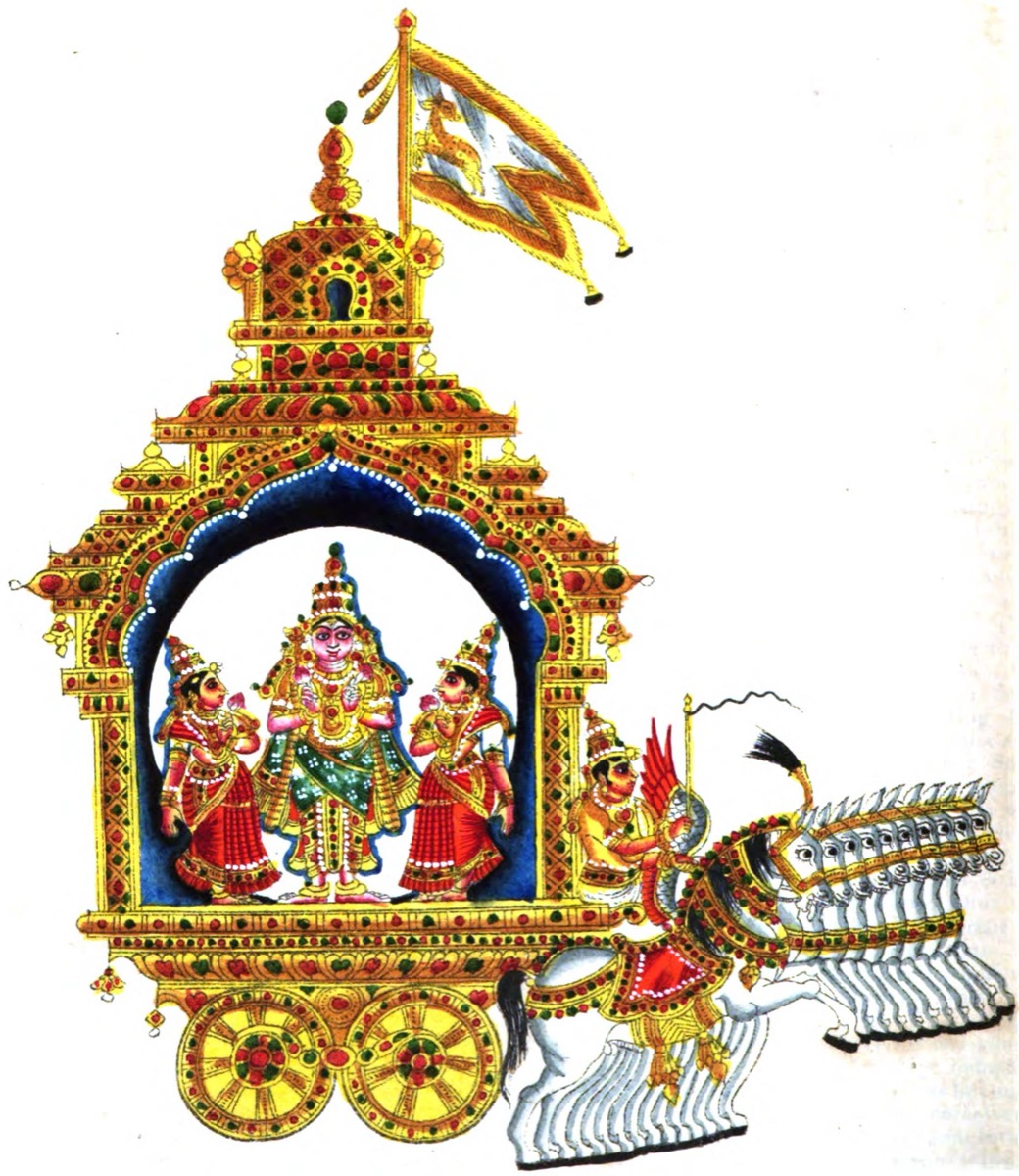
Candra, the luminous Moon God, holds a position of singular beauty and complexity in Hindu mythology. Known also as Soma, Indu, Niśākara (maker of the night), and Śaśāṅka (hare-marked one), he is at once a Vedic deity of divine inspiration, a Navagraha governing the mind and emotions, the progenitor of an entire royal dynasty, and an ornament upon Lord Śiva’s matted locks. His silver light, which waxes and wanes in an eternal rhythm, has inspired some of the most profound theological reflections in Hindu thought — on impermanence, renewal, devotion, and the interplay of karma with divine grace.
Vedic Origins: Soma, the Sacred Elixir
In the Ṛgveda, the Moon is celebrated primarily as Soma — a deity inseparable from the sacred plant-juice pressed during Vedic rituals. The entire ninth maṇḍala of the Ṛgveda (114 hymns) is devoted to Soma Pavamāna, the “self-purifying” Soma. These hymns do not merely describe a ritual beverage; they exalt Soma as a cosmic principle:
“Flow, Soma, in thy most exalted glory; for thou art Lord of all the world, the finder of riches.” (Ṛgveda 9.97.41)
Soma is called the friend of Indra, the nourisher of the gods, and the sustainer of ṛta (cosmic order). The Ṛgveda identifies him as dwelling in the heavens — “Soma, the Moon, the King” (Ṛgveda 10.85.2) — establishing the explicit equation between the ritual deity and the celestial body. The Taittirīya Saṁhitā further declares that the Moon is the cup of Soma from which the gods drink, and that it wanes because the gods consume it, only to be refilled by the Sun’s rays.
The Śatapatha Brāhmaṇa (1.6.4) elaborates this cosmology: Soma was placed in the sky by the gods after the sacrifice, and the waxing Moon represents the gods refilling the vessel, while the waning Moon shows them drinking from it. This ritual-cosmological identification gives the Moon a centrality in Vedic religion that few other celestial bodies possess.
The Samudra Manthana: Birth from the Cosmic Ocean
The Purāṇic tradition offers a dramatic origin narrative. According to the Viṣṇu Purāṇa (Book I, Chapters 9–10) and the Bhāgavata Purāṇa (8.5–8.12), when the Devas and Asuras churned the cosmic Ocean of Milk (Kṣīrasāgara) using Mount Mandara as the churning rod and Vāsuki the serpent as the rope, fourteen precious treasures (ratnas) emerged. Among these was Candra himself, radiant with cool silver light, whom Lord Śiva claimed and placed upon his head.
Other accounts in the Matsya Purāṇa and Padma Purāṇa describe Candra as the son of the sage Atri and his wife Anasūyā. The Brahmāṇḍa Purāṇa narrates that Atri performed severe penance, and from his eyes fell tears of joy so luminous that they illuminated the ten directions; Brahmā gathered this radiance and fashioned it into Candra. Both traditions — oceanic emergence and sage-born brilliance — converge on the same truth: the Moon’s light is divine, purifying, and intimately connected with cosmic creative processes.
Marriage to the Twenty-Seven Nakṣatras
One of the most beloved narratives surrounding Candra concerns his marriage to the twenty-seven daughters of Dakṣa Prajāpati, who personify the twenty-seven nakṣatras (lunar mansions). The Viṣṇu Purāṇa (Book IV, Chapter 6) and Matsya Purāṇa relate that Dakṣa gave his twenty-seven daughters — Aśvinī, Bharaṇī, Kṛttikā, Rohiṇī, and the rest — in marriage to Candra on the condition that he would treat them all with equal affection.
However, Candra became infatuated with Rohiṇī, the most beautiful among them, and neglected the other twenty-six wives. The abandoned sisters complained bitterly to their father. Despite repeated warnings, Candra could not bring himself to leave Rohiṇī’s company.
Dakṣa’s Curse: The Waxing and the Waning
Enraged by his son-in-law’s disregard, Dakṣa cursed Candra: “You shall waste away, losing your lustre day by day, until you vanish entirely.” As the curse took effect, the Moon began to fade. Darkness spread across the night sky, and all beings — gods, sages, and mortals — were distressed. Medicinal herbs that depended on moonlight began to wither.
The Śiva Purāṇa and Liṅga Purāṇa narrate that the afflicted Candra, on the counsel of Brahmā, journeyed to Prabhāsa Tīrtha (modern Somnāth in Gujarat), where he performed intense penance and worshipped Lord Śiva with the Mahāmṛtyuñjaya Mantra. Pleased by his devotion, Śiva partially lifted the curse: “You shall wax for fifteen days and wane for fifteen days, in an eternal cycle.” This is why the Moon grows from new moon (amāvasyā) to full moon (pūrṇimā) and then diminishes again — an astronomical phenomenon given profound spiritual meaning.
In gratitude, Candra installed the first Jyotirliṅga at Prabhāsa, which became the celebrated Somnātha Temple — “Lord of Soma (the Moon).” To this day, the Somnātha Temple in Gujarat is revered as the first of the twelve Jyotirliṅgas, and its very name immortalises Candra’s devotion to Śiva.
Candra on Śiva’s Head: Candraśekhara
The image of the crescent Moon adorning Śiva’s matted locks is one of the most iconic in Hindu iconography. Śiva is called Candraśekhara (“one who bears the Moon as a crest-jewel”) and Soma-sūrya-agni-locana (“one whose eyes are Moon, Sun, and Fire”). The Śiva Purāṇa explains that when Śiva wore the Moon upon his head, it was both an act of compassion — rescuing Candra from the full force of Dakṣa’s curse — and a cosmic statement: the Moon, representing the mind (manas), finds stillness only when placed at the feet (or head) of the Supreme.
The theological implication is profound. In Śaiva philosophy, the Moon symbolises the mind’s fluctuations — its constant waxing and waning between desire and renunciation, joy and sorrow. By placing the Moon on his head, Śiva demonstrates mastery over the mind. Devotees who worship Candraśekhara seek this very boon: the calming of mental turbulence through divine grace.
Iconography and Attributes
Traditional iconography, as codified in texts such as the Bṛhat Saṁhitā of Varāhamihira and the Viṣṇudharmottara Purāṇa (Part III), depicts Candra with the following attributes:
- Complexion: White or pale gold, radiating cool lustre (śītalāṁśu — “one of cool rays”)
- Limbs: Two arms, holding a lotus (padma) in one hand and a mace (gadā) in the other
- Crown: Adorned with a crescent moon diadem
- Vehicle (vāhana): A chariot drawn by ten white horses (or sometimes an antelope, mṛga), representing the ten directions illuminated by moonlight
- Chariot: Three-wheeled, traversing the night sky
- Garments: White silk robes, symbolising purity and sattva (luminosity)
- Consorts: Rohiṇī (favoured wife) and Tārā (in some traditions, abducted from Bṛhaspati)
The painting from The Complete Hindoo Pantheon (c. 1842) shown above beautifully captures this classical depiction: Candra seated in an ornate golden chariot with attendants, drawn by multiple white horses, with a charioteer at the reins.
The Tārā Episode and the Birth of Budha
A dramatic Purāṇic episode further illustrates Candra’s complex character. The Bhāgavata Purāṇa (9.14) and Viṣṇu Purāṇa (Book IV) narrate that Candra, intoxicated by his own beauty after the Rājasuya Yajña, abducted Tārā, the wife of Bṛhaspati (Jupiter, preceptor of the Devas). This provoked a cosmic war — the Devas siding with Bṛhaspati and the Asuras with Candra — until Brahmā intervened and commanded Candra to return Tārā.
When Tārā returned, she was with child. The son born was Budha (the planet Mercury), who became the progenitor of the Lunar Dynasty. Bṛhaspati initially refused to accept the child, but when Brahmā himself asked Tārā whose son this was, she confessed: “He is Candra’s son.” Budha married Iḷā (the daughter of Manu), and their son was Purūravas, the founder of the Candra Vaṁśa (Lunar Dynasty).
The Candra Vaṁśa: Lunar Dynasty
The Candra Vaṁśa is one of the two great royal dynasties of Indian tradition (the other being the Sūrya Vaṁśa, the Solar Dynasty of Lord Rāma). The lineage runs: Candra → Budha → Purūravas → Āyus → Nahuṣa → Yayāti → Puru → … → Bharata → … → the Kauravas and Pāṇḍavas.
Thus, the great heroes of the Mahābhārata — Arjuna, Bhīma, Yudhiṣṭhira, and even Kṛṣṇa (through the Yādava line of Yadu, another son of Yayāti) — trace their ancestry to the Moon God. The Viṣṇu Purāṇa (Book IV) devotes extensive chapters to this genealogy, establishing Candra as the ultimate ancestor of some of the most celebrated figures in Hindu sacred history.
Navagraha: Candra Among the Nine Planets
In the Hindu astrological system (Jyotiṣa Śāstra), Candra is one of the Navagraha — the nine celestial bodies that influence human destiny. He rules Monday (Somavāra, literally “Soma’s day”), governs the zodiac sign of Karkaṭa (Cancer), and is exalted in Vṛṣabha (Taurus, specifically in Rohiṇī nakṣatra — his beloved wife).
According to the Bṛhat Parāśara Horā Śāstra, the foundational text of Vedic astrology, Candra governs:
- The mind (manas): Emotional responses, mental disposition, psychological well-being
- The mother: Maternal relationships and nurturing
- Fluids: Water, blood, bodily fluids, the tides
- Fertility: Agriculture, growth cycles, conception
- Beauty and charm: Physical attractiveness, artistic sensibility
A strong Moon in one’s horoscope (janma kuṇḍalī) confers emotional stability, compassion, creativity, and good relationships. A weak or afflicted Moon can indicate mental anxiety, depression, instability, and difficulties with the mother. Remedies for a weak Moon include wearing pearls (muktā), offering white flowers, chanting the Candra Bīja Mantra (Oṁ Śrāṁ Śrīṁ Śrauṁ Saḥ Candrāya Namaḥ), and fasting on Mondays.
Somavāra Worship and Traditions
Monday (Somavāra) is sacred to both Candra and Śiva. Devotees observe Somavāra Vrata (Monday fasting) across India, particularly during the holy month of Śrāvaṇa (July–August), when the Śrāvaṇa Somavāra Vrata is especially potent. Worshippers fast, offer bilvapatra (bael leaves) and milk to Śiva liṅgas, and chant the Soma Sūkta or Candraṣṭaka.
The Soma Pradoṣa Vrata, observed when Pradoṣa falls on a Monday, is considered exceptionally auspicious. Devotees worship Śiva as Candraśekhara and pray for mental peace, emotional healing, and the blessings of good progeny.
Karva Chauth and Candra
Karva Chauth is among the most widely observed fasts connected to the Moon. Married Hindu women in North India fast from sunrise to moonrise, praying for the longevity and well-being of their husbands. The fast is broken only upon sighting the Moon through a sieve (chalanī) and then looking at the husband’s face.
The Karva Chauth Kathā narrates the story of Queen Vīravatī, who broke her fast by mistaking a fire behind a tree for the Moon, and her husband immediately fell gravely ill. Only when she discovered her error and re-observed the fast with true devotion to Candra did her husband recover. The ritual thus centres on the Moon as a witness to marital devotion and a bestower of blessings.
Candra in Jyotiṣa: The Cosmic Mind
In Vedic astrology, the Moon’s position at the time of birth determines the Janma Rāśi (Moon sign), which many Indian astrologers consider more significant than the Sun sign used in Western astrology. The Bṛhat Jātaka of Varāhamihira states that the Moon’s strength determines the overall vitality of the horoscope.
The Daśā system (planetary period system) most commonly used in Jyotiṣa is the Viṁśottarī Daśā, which begins calculation from the Moon’s nakṣatra at birth. Thus, the Moon effectively governs the timing of all major life events according to this system. Candra’s Mahādaśā lasts ten years and brings focus on emotions, domestic life, public reputation, and inner transformation.
The Moon also governs the Tithi system — the lunar day that determines the auspiciousness of nearly every Hindu ritual, festival, and sacrament. From Ekādaśī fasts to Pūrṇimā celebrations, from the timing of weddings to death rites, the Moon’s phase is the master clock of Hindu religious life.
Legacy: The Eternal Luminary
Candra’s significance in Hindu tradition is as pervasive as moonlight itself. He is simultaneously a Vedic sacrificial deity (Soma), a Purāṇic figure of romantic intensity and divine devotion, an astronomical body governing time and agriculture, a Navagraha influencing individual destiny, and a symbol of the restless mind that finds peace only in the divine. His eternal cycle of waxing and waning teaches one of Hinduism’s most fundamental lessons: that decline is never permanent, that darkness always yields to light, and that even the cursed can be redeemed through devotion.
As the Candra Kavacam declares: “He who meditates upon the Moon with devotion is freed from all afflictions of the mind, blessed with beauty, prosperity, and the grace of Lord Śiva.” In temples, homes, and the night sky above, Candra continues to illuminate the path of the devoted, just as he has for millennia.