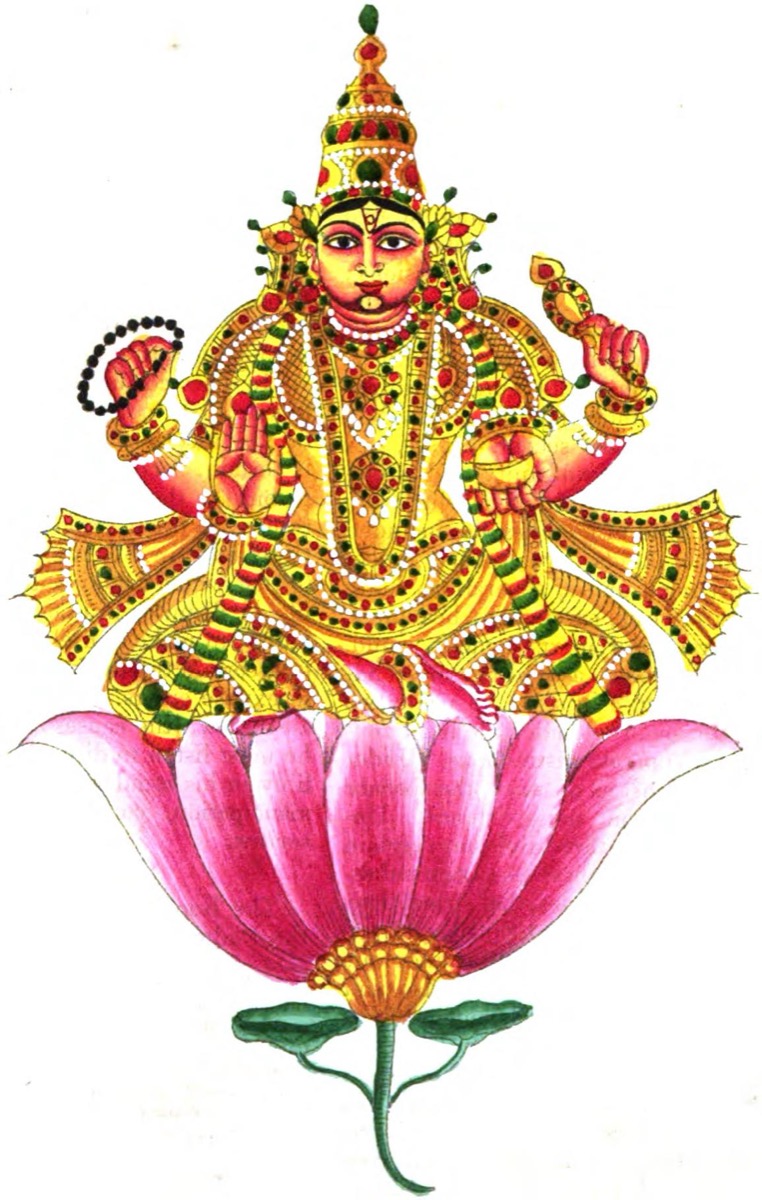
Bṛhaspati, the luminous Guru of the Devas, occupies a singular position in Hindu theology as the divine embodiment of wisdom, sacred speech, and spiritual authority. Known also as Brahmaṇaspati (“Lord of Sacred Prayer”) in the oldest layers of the Ṛgveda, he is the heavenly archetype of the purohita — the priestly counsellor whose guidance sustains cosmic order. As the preceptor who illuminates the path of dharma for the celestial gods, Bṛhaspati represents the principle that knowledge, rightly wielded, is the supreme power in the universe. His later identification with the planet Jupiter (Guru Graha) extended his influence from the Vedic fire altar into the vast domain of Hindu astrology, where he governs wisdom, prosperity, and spiritual growth to this day.
Vedic Origins: Brahmaṇaspati in the Ṛgveda
Bṛhaspati is among the most ancient deities of the Hindu pantheon, celebrated in eleven dedicated hymns of the Ṛgveda. The name Bṛhaspati derives from bṛhat (“great,” “vast,” “sacred utterance”) and pati (“lord”), meaning “Lord of the Vast” or “Lord of Sacred Speech.” In the earliest hymns, he appears under the nearly synonymous name Brahmaṇaspati — “Lord of Brahman” — where brahman refers to the sacred word, the prayer-formula that sustains the cosmic order.
The most celebrated Bṛhaspati hymn is Ṛgveda 2.23, a ten-verse composition attributed to the ṛṣi Gṛtsamada. This hymn opens with the invocation:
“Gaṇānāṁ tvā gaṇapatiṁ havāmahe kavīṁ kavīnām upamaśravastamam / jyeṣṭharājaṁ brahmaṇāṁ brahmaṇas pata ā naḥ śṛṇvann ūtibhiḥ sīda sādanam” — “We invoke you, Lord of the hosts, wisest of the wise, supreme king of sacred prayers. O Brahmaṇaspati, hear us and take your seat with blessings.” (Ṛgveda 2.23.1)
This verse is significant because it addresses Bṛhaspati as Gaṇapati (“Lord of the hosts”), a title later transferred to the elephant-headed Gaṇeśa, suggesting an ancient ritual connection between the two figures.
Additional hymns to Bṛhaspati appear throughout the Ṛgveda: RV 1.18, 1.40, 1.190, 2.24, 2.25, 2.26, 4.50, 6.73, 7.97, and 10.68. These hymns celebrate him as the one who shatters the strongholds of darkness, recovers stolen cattle (symbolic of divine light and speech), and leads the gods to victory over their cosmic adversaries. In Ṛgveda 2.23.3, he is described as the one who “drives away the darkness” (tamaḥ) and “shatters the enclosures” (vala) behind which the forces of ignorance conceal the treasures of light and truth.
Verse 5 of the same hymn declares his protective power: “No harm, no difficulty from any quarter, no malicious spirits nor deceivers can prevail over the one whom you protect, O Brahmaṇaspati” (RV 2.23.5). This establishes Bṛhaspati not merely as a priest but as a cosmic guardian whose sacred speech functions as a shield against adharma.
Family and Lineage: Son of Aṅgiras
Bṛhaspati belongs to the illustrious Āṅgirasa lineage. He is the son of the sage Aṅgiras, one of the seven primordial ṛṣis (Saptarṣi) born from the creative fire of Brahmā. The Ṛgveda frequently calls Bṛhaspati by the patronymic Āṅgirasa, linking him to the clan of fire-priests who discovered and tended the sacred fires. His brothers include Utathya and Saṁvartana.
Bṛhaspati’s primary wife is Tārā (literally “star”), the radiant goddess who personifies the stellar heavens. Through Tārā, he fathered seven sons and a daughter. He also had a wife named Śubhā, who bore him seven daughters. Among his most celebrated sons is Kacha, whose dramatic mission to the hermitage of Śukrācārya forms one of the great narratives of the Mahābhārata. Through his brother Utathya’s wife Māmatā, Bṛhaspati also fathered the renowned sage Bharadvāja, progenitor of one of the most important Vedic gotra lineages and a pivotal figure in both the Ṛgveda and the Rāmāyaṇa.
The Tārakāmaya War: Bṛhaspati, Tārā, and Chandra
One of the most dramatic episodes involving Bṛhaspati is the Tārakāmaya (“war over [the love of] Tārā”), recounted in the Padma Purāṇa, Viṣṇu Purāṇa, and other texts. This narrative — counted as the fifth great war between the Devas and the Asuras — begins when Soma (Chandra, the Moon God) becomes infatuated with Bṛhaspati’s wife Tārā and abducts her.
Bṛhaspati demanded the return of his wife, but Soma refused. The conflict escalated into a cosmic war: Indra and Śiva rallied the Devas to fight on behalf of their Guru, while the Asuras and their preceptor Śukrācārya allied with Soma. The battle raged with devastating celestial weapons, until Brahmā himself descended to the battlefield and commanded Soma to return Tārā to Bṛhaspati.
Upon her return, Tārā gave birth to a child of extraordinary beauty and intelligence. Both Soma and Bṛhaspati claimed paternity. When pressed by Brahmā, Tārā confessed that the child was Soma’s son. The boy was named Budha (the planet Mercury), who would later marry Ilā and found the Chandravamśa (Lunar Dynasty) — the royal lineage that includes the Pāṇḍavas and Kauravas of the Mahābhārata.
This myth encodes profound theological themes: the tension between intellectual authority (Bṛhaspati) and emotional allure (Soma/Chandra), the cosmic consequences of transgressing dharma, and the way even divine conflicts generate new creation — for the Lunar Dynasty produced some of the greatest heroes and kings of Indian tradition.
Kacha and the Quest for Sañjīvanī Vidyā
Perhaps the most beloved narrative involving Bṛhaspati is the story of his son Kacha, told in the Ādi Parva of the Mahābhārata (chapters 71–76). The Devas, repeatedly defeated in battle against the Asuras, recognised that the enemy’s superiority lay in the possession of the Mṛtasañjīvanī Vidyā — the secret knowledge of reviving the dead — held exclusively by the Asura preceptor Śukrācārya. Bṛhaspati devised a plan: his own son Kacha would go to Śukrācārya’s hermitage as a disciple, serve him faithfully, and acquire the forbidden knowledge.
Kacha served Śukrācārya for a thousand years, winning the teacher’s trust and the love of his daughter Devayānī. But the Asuras grew suspicious and killed Kacha — not once, but three times. Each time, Śukrācārya used his knowledge to revive the young disciple at Devayānī’s tearful pleading. In a final, desperate attempt, the Asuras killed Kacha, cremated his body, mixed his ashes into Śukrācārya’s wine, and served it to the unsuspecting Guru.
When Devayānī again beseeched her father, Śukrācārya realised Kacha was alive inside him. Knowing that restoring Kacha would require his own death, Śukrācārya first taught Kacha the Sañjīvanī Vidyā through telepathic transmission. Kacha then burst forth from his Guru’s body, killing Śukrācārya — and immediately used his newly acquired knowledge to revive him. The mission was accomplished: Bṛhaspati’s son had secured the great equaliser for the Devas.
However, when Devayānī confessed her love for Kacha and proposed marriage, he refused, explaining that having been reborn from her father’s body, he was now her brother in spiritual kinship. The heartbroken Devayānī cursed him: the Sañjīvanī Vidyā would never work when Kacha himself attempted to use it. Kacha counter-cursed that no brāhmaṇa would ever marry Devayānī. Both curses proved tragically prophetic.
The Rivalry with Śukrācārya
The antagonism between Bṛhaspati and Śukrācārya (Venus) is one of the defining dualities of Hindu mythology. According to tradition, both studied under the same guru — the sage Aṅgiras, who was also Bṛhaspati’s father. Śukrācārya, feeling slighted by Aṅgiras’s favouritism towards his own son, departed and eventually became the preceptor of the Asuras.
This rivalry mirrors the cosmic struggle between Devas and Asuras, dharma and adharma. Bṛhaspati counsels the gods with wisdom rooted in Vedic orthodoxy; Śukrācārya guides the demons with equal or even superior occult knowledge, including the Sañjīvanī Vidyā. Together, they represent two modes of intelligence — the sacerdotal and the practical, the orthodox and the heterodox — locked in perpetual cosmic tension. Astronomically, this rivalry is reflected in the opposing movements of Jupiter (Bṛhaspati) and Venus (Śukra) across the zodiac.
Bṛhaspati in the Mahābhārata
Beyond the Kacha narrative, Bṛhaspati figures prominently in the Śānti Parva of the Mahābhārata, where his teachings on statecraft, dharma, and political philosophy are attributed to the “School of Bṛhaspati.” The Arthaśāstra tradition credits Bṛhaspati with founding one of the major schools of political thought, which held that there are fundamentally only two sciences: the science of government (daṇḍanīti) and the science of economics (vārtā — agriculture, cattle-rearing, and trade).
Bṛhaspati also appears as the wise counsellor of Indra throughout the epic, advising the king of the gods on strategy, diplomacy, and the proper observance of dharma. His teachings emphasise that a ruler’s power rests not merely on military strength but on the wisdom to discern right action, the counsel of learned advisors, and the performance of righteous duties.
The Bṛhaspati Sūtra
The Bṛhaspati Sūtra, an ancient text on political science and statecraft, is attributed to the school of Bṛhaspati. Surviving in fragmentary form, this text represents one of the earliest systematic treatments of rājanīti (political science) in Indian intellectual history. It covers topics including the duties of kings, taxation, administration of justice, diplomacy, and the relationship between the ruler and the priestly class.
Interestingly, the name Bṛhaspati is also associated with the Cārvāka/Lokāyata school of materialist philosophy. Ancient Indian texts sometimes attribute the founding of this sceptical, anti-ritualist tradition to a figure named Bṛhaspati — possibly a different individual from the Vedic deity, or perhaps a mythological projection of the idea that even the Guru of the Gods recognised the limitations of ritual orthodoxy. The Arthaśāstra of Kauṭilya explicitly lists the “School of Bṛhaspati” alongside those of Manu, Uśanas (Śukrācārya), and others as a foundational tradition of political thought.
Association with Jupiter and Navagraha Worship
In the post-Vedic period, Bṛhaspati became firmly identified with the planet Jupiter (Guru Graha), the largest and most benevolent of the Navagraha (nine planetary deities). As a Navagraha, Bṛhaspati governs wisdom, learning, spirituality, progeny, fortune, and expansion. He is considered the most auspicious of all the planetary influences.
Thursday — known as Bṛhaspatīvāra or Guruvāra in Sanskrit — is dedicated to his worship. On this day, devotees wear yellow clothing, offer yellow flowers, chickpeas (chana dāl), turmeric, and yellow lentils (moong dāl), and chant mantras such as:
“Oṁ Gurave Namaḥ” “Oṁ Bṛm Bṛhaspataye Namaḥ” “Oṁ Grāṁ Grīṁ Grauṁ Saḥ Guruve Namaḥ”
The Yellow Sapphire (Puṣyarāga/Pukhraj) is the gemstone associated with Jupiter in Vedic astrology. Wearing it is believed to enhance wisdom, attract prosperity, and strengthen Jupiter’s positive influence in one’s horoscope.
In astrological terms, a well-placed Jupiter bestows education, moral character, prosperity, good children, and spiritual inclination. A weakened or afflicted Jupiter can lead to financial difficulties, lack of wisdom, and obstacles in education. The transit of Jupiter through the zodiac signs, known as Guru Peyarchi, is one of the most significant astrological events, observed with elaborate rituals across India.
Iconography
Bṛhaspati is depicted with a golden complexion (suvarṇa-varṇa), dressed in yellow garments that reflect his association with Jupiter’s golden radiance. He is typically portrayed as a four-armed deity seated upon a lotus, holding:
- A māla (rosary) for japa and meditation
- A kamaṇḍalu (water vessel) symbolising ascetic discipline
- A daṇḍa (staff or rod) representing authority and punishment (daṇḍanīti)
- A pustaka (book) or lotus, signifying sacred knowledge
He rides a magnificent golden chariot drawn by eight horses, each representing one of the eight directional guardians or the eight facets of learning — from logic and rhetoric to philosophy and ethics. The number eight (aṣṭa) symbolises cosmic balance and the comprehensive scope of his wisdom.
In some depictions, particularly in South Indian Navagraha panels, Bṛhaspati is shown seated on a lotus or standing, with two hands in the abhaya (fearlessness) and varada (boon-giving) mudrās, radiating benevolence and scholarly grace.
Temples and Worship Centres
The most important temple dedicated to Bṛhaspati as a Navagraha deity is the Apatsahayesvarar Temple in Alangudi, Tiruvarur district, Tamil Nadu. This is one of the nine Navagraha Sthalams — a circuit of temples in Tamil Nadu each dedicated to one of the nine planetary deities. At Alangudi, the presiding deity is Lord Śiva worshipped as Apatsahayeśvara (“saviour in times of distress”), and Bṛhaspati (Guru Bhagavān) is worshipped as the planetary deity.
According to temple mythology, the site gained its name when Śiva consumed the halāhala poison during the churning of the cosmic ocean, earning the title “Abathsahayeswarar” (“saviour”). The temple is one of the 275 Pāḍal Petra Sthalams praised in the hymns of the Nāyanmār saints.
Devotees visit on Thursdays to seek blessings for:
- Academic success and wisdom
- Career advancement
- Prosperous marriage and good progeny
- Relief from the unfavourable effects of Jupiter in one’s horoscope
The Guru Peyarchi festival, marking Jupiter’s transition between zodiac signs, is celebrated with great fervour at Alangudi, attracting thousands of devotees. Offerings include chickpeas, yellow cloth, yellow flowers, white jasmine (veḷḷa mullai), and the lighting of twenty-four ghee lamps with twenty-four circumambulations of the Śiva shrine.
Other notable sites for Bṛhaspati worship include Navagraha panels at the Konārak Sun Temple (Odisha), the Navagraha temples of Assam, and Bṛhaspati shrines within major temple complexes such as those at Kanchipuram and Kumbakonam.
Bṛhaspati in Daily Life and Festivals
Bṛhaspati’s influence pervades the rhythms of everyday Hindu life. The very word Guru — now a global term for teacher and spiritual guide — derives from the tradition of honouring Bṛhaspati as the supreme Guru. Guru Pūrṇimā, celebrated on the full moon of the month of Āṣāḍha (June–July), honours all spiritual teachers, with Bṛhaspati as the divine archetype. On this day, disciples express reverence for their gurus through worship, offerings, and the recitation of texts such as the Guru Gītā.
Thursday fasting (Bṛhaspativāra vrata) is widely observed across India, particularly by those seeking educational success, career growth, or relief from Jupiter-related astrological afflictions. The vrata involves wearing yellow, consuming a single vegetarian meal (often including chickpeas and jaggery), and listening to or reading the Bṛhaspati Kathā — a devotional narrative extolling the deity’s blessings.
Theological Significance
Bṛhaspati embodies several interlocking theological principles. First, he represents the supremacy of knowledge (jñāna) over mere physical or material power. In the Vedic worldview, it is the purohita — the priest who commands sacred speech — who ultimately determines the outcome of cosmic battles, not the warrior alone. Second, Bṛhaspati exemplifies the ideal of the teacher-student relationship (guru-śiṣya paramparā), the transmission of sacred knowledge across generations that forms the backbone of Hindu spiritual life. Third, his association with Jupiter — the planet of expansion, benevolence, and higher learning — connects earthly wisdom traditions with celestial mechanics, reflecting the Hindu conviction that the microcosm of human knowledge mirrors the macrocosm of cosmic order.
As the Ṛgveda proclaims: “No harm from any quarter can touch the one whom you protect, O Brahmaṇaspati” (RV 2.23.5). In this promise lies the enduring appeal of Bṛhaspati — the assurance that wisdom, rightly sought and faithfully transmitted, is the ultimate refuge in a cosmos of constant change.