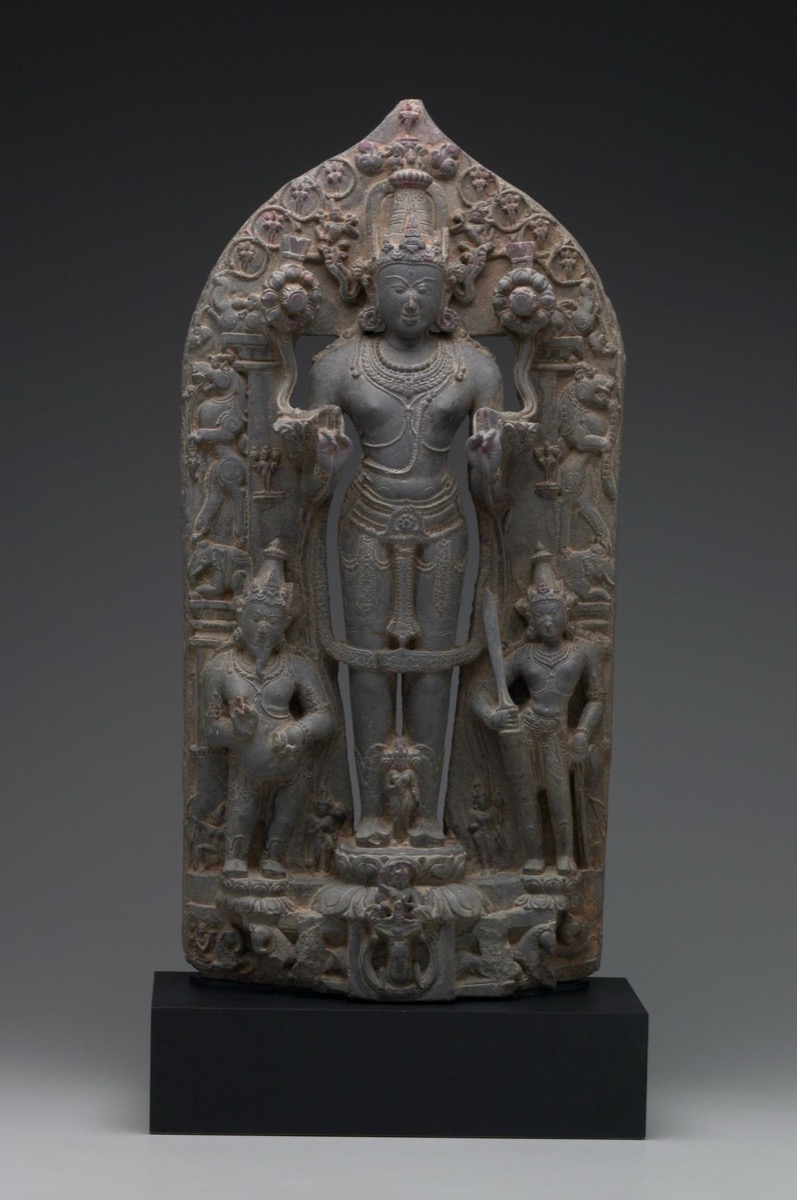
Sūrya, the resplendent Sun God, occupies a position of extraordinary pre-eminence in Hindu scripture and worship. As the visible manifestation of the divine, the source of light, life, and cosmic order, Sūrya is among the oldest deities celebrated in the Vedic hymns. His radiance illuminates not merely the physical world but the inner landscape of the soul — the Ṛgveda declares him the eye of Mitra and Varuṇa, the soul of all that moves and stands still (Ṛgveda 1.115.1). From ancient Vedic fire altars to the magnificent Konārk Sun Temple, from the daily practice of Sūrya Namaskāra to the folk devotion of Chhath Pūjā, the worship of Sūrya weaves an unbroken thread through the fabric of Hindu civilisation.
Vedic Origins: The Hymns to Sūrya
Sūrya is one of the most frequently invoked deities of the Ṛgveda, where entire sūktas (hymns) celebrate his glory. The Sūrya Sūkta (Ṛgveda 1.115) declares:
“The Sun has risen, bringing light to the worlds; the eye of Mitra, Varuṇa, and Agni. He has filled heaven, earth, and the mid-region — Sūrya is the ātman (soul) of all that moves and all that stands.” (Ṛgveda 1.115.1)
In the Vedic cosmology, Sūrya belongs to the triad of principal deities governing the three realms: Agni (fire) presides over the earth, Vāyu/Indra over the atmosphere, and Sūrya over the heavens. As the lord of the celestial sphere, Sūrya was regarded as the supreme witness (sākṣī) of all human actions — a belief that endures in the practice of taking oaths facing the sun.
The Ṛgveda addresses Sūrya by multiple names, each revealing a distinct aspect:
- Sūrya — from the root svar- (“to shine”), the effulgent one.
- Savitṛ — the impeller, the vivifying force who stimulates all life. The famous Gāyatrī Mantra (Ṛgveda 3.62.10) is addressed to Savitṛ: “Oṁ bhūr bhuvaḥ svaḥ / tat savitur vareṇyaṁ / bhargo devasya dhīmahi / dhiyo yo naḥ prachodayāt” — “We meditate upon the glorious splendour of Savitṛ; may he illuminate our intellects.”
- Āditya — “son of Aditi,” the primordial cosmic mother. Sūrya is the chief of the twelve Ādityas, each presiding over one month of the solar year.
- Bhāskara — “the maker of light.”
- Divākara — “the maker of day.”
- Vivasvān (Vivasvat) — the progenitor. In Vedic genealogy, Vivasvān is the father of Vaivasvata Manu, the first man and progenitor of the solar dynasty (Sūryavaṃśa), and of Yama, the god of death and dharma.
- Mitra — in his aspect as the beneficent friend and upholder of cosmic law (ṛta).
Sūrya in the Epics and Purāṇas
The Mahābhārata and the Purāṇas greatly expand upon Sūrya’s mythology. In the Mahābhārata, Sūrya is the divine father of Karṇa, the great warrior. The maiden Kuntī, having received a boon from the sage Durvāsā, invoked Sūrya and bore a son endowed with divine armour (kavaca) and earrings (kuṇḍala) that rendered him nearly invincible. The tragic story of Karṇa — abandoned at birth, raised by a charioteer, and ultimately slain in the Kurukṣetra war — is inseparable from his solar heritage and the protective love of his celestial father.
In the Rāmāyaṇa, the sage Agastya teaches Lord Rāma the Āditya Hṛdayam on the battlefield of Laṅkā, a powerful hymn glorifying Sūrya as the destroyer of all enemies, the bestower of victory, and the essence of all the gods:
“He is Brahmā, Viṣṇu, Śiva, Skanda, Prajāpati. He is Indra, Kubera, Kāla, Yama, Soma, and the lord of waters. He is the maker of seasons, the storehouse of light, the source of all.” (Vālmīki Rāmāyaṇa, Yuddha Kāṇḍa, 107.14–24)
The Bhāgavata Purāṇa and Viṣṇu Purāṇa describe Sūrya’s cosmic function in detail. He traverses the heavens in a magnificent chariot driven by his charioteer Aruṇa (the reddish dawn), drawn by seven horses representing the seven days of the week, the seven colours of the visible spectrum, and the seven metres (chandas) of the Vedas. His chariot wheel represents the cycle of the year.
The Sūrya Purāṇa and sections of the Bhavishya Purāṇa are texts specifically dedicated to Sūrya worship, detailing rituals, mantras, and the genealogy of the solar dynasty.
Iconography: The Chariot of Seven Horses
Sūrya’s iconography is among the most distinctive in the Hindu pantheon. Classical depictions show him:
- Riding a chariot drawn by seven horses (sometimes shown as a single horse with seven heads), symbolizing the seven days, seven rays, seven Vedic metres, and seven colours.
- Holding two lotus flowers — one in each hand — representing the life-giving and purifying nature of solar energy.
- Wearing tall boots — a distinctive feature unique among Hindu deities, suggesting Central Asian or Iranian influences from the ancient Maga Brāhmaṇa tradition of Sūrya worship.
- Flanked by attendants — typically Daṇḍī and Piṅgala (representing the pen and record-keeping of time), and sometimes his two queens Saṃjñā (consciousness) and Chāyā (shadow).
- A halo of brilliant rays emanating from his body, often twelve rays representing the twelve months.
- Charioteer Aruṇa — the legless dawn god who sits facing away from the direction of travel, symbolizing the reddish light that precedes the full brilliance of the sun.
The 11th-century sculpture from Northern India (now at the Yale University Art Gallery) exemplifies this iconography, showing Sūrya flanked by the eleven other Ādityas and attendant figures, holding lotuses, and wearing the characteristic boots.
The Konārk Sun Temple
The crowning architectural tribute to Sūrya is the Konārk Sun Temple in Odisha, built by King Narasiṃhadeva I of the Eastern Gaṅga dynasty around 1250 CE. Conceived as a colossal stone chariot of the Sun God, the temple is a UNESCO World Heritage Site and one of the most remarkable achievements of Indian architecture.
The entire structure is designed as Sūrya’s celestial chariot:
- Twenty-four elaborately carved stone wheels (approximately 3 metres in diameter) line the base, representing the hours of the day and functioning as precise sundials.
- Seven sculptured horses draw the chariot toward the east, greeting the rising sun.
- Three monumental images of Sūrya face three directions — the morning sun (south-east), noon sun (south), and setting sun (west) — each depicted with distinct expressions ranging from youthful vigour to serene maturity.
The main Sūrya image, standing 3.38 metres tall, depicts the deity wearing boots and holding lotuses, carved from chlorite stone with astonishing anatomical precision. The temple’s alignment ensures that the first rays of the morning sun illuminate the sanctum, a testament to the astronomical knowledge of its builders.
The Gāyatrī Mantra and Sūrya Upāsanā
The Gāyatrī Mantra (Ṛgveda 3.62.10), recited daily by millions of Hindus during the sandhyāvandana (twilight prayers), is fundamentally a prayer to Sūrya in his aspect as Savitṛ. It is the most revered mantra of Vedic tradition:
“Oṁ bhūr bhuvaḥ svaḥ / tat savitur vareṇyaṁ / bhargo devasya dhīmahi / dhiyo yo naḥ prachodayāt”
The mantra encodes a profound cosmological vision: the three vyāhṛtis (bhūḥ, bhuvaḥ, svaḥ) represent the three worlds; “savituḥ” identifies the deity as the cosmic impeller; “bhargaḥ” denotes his self-luminous splendour; and the prayer asks him to stimulate (prachodayāt) the intellect (dhiyaḥ) of the worshipper. The Chāndogya Upaniṣad (3.12.1–5) calls the Gāyatrī the essence of all the Vedas, and its connection to Sūrya makes solar worship the daily spiritual practice of every practising Hindu.
The Āditya Hṛdayam and the Sūrya Aṣṭottara-śatanāma (108 names of Sūrya) remain important devotional texts recited for health, spiritual illumination, and the removal of afflictions.
Sūrya Namaskāra
Sūrya Namaskāra (Sun Salutation) is a sequence of twelve yogic postures performed facing the rising sun, each accompanied by a specific mantra invoking one of the twelve names of Sūrya:
- Oṁ Mitrāya namaḥ — Salutations to the Friend of all
- Oṁ Ravaye namaḥ — to the Shining One
- Oṁ Sūryāya namaḥ — to the Impeller of activity
- Oṁ Bhānave namaḥ — to the Illuminator
- Oṁ Khagāya namaḥ — to the One who moves through the sky
- Oṁ Pūṣṇe namaḥ — to the Nourisher
- Oṁ Hiraṇyagarbhāya namaḥ — to the Golden Cosmic Self
- Oṁ Marīcaye namaḥ — to the Lord of the Dawn
- Oṁ Ādityāya namaḥ — to the Son of Aditi
- Oṁ Savitre namaḥ — to the Stimulator of life
- Oṁ Arkāya namaḥ — to the One worthy of praise
- Oṁ Bhāskarāya namaḥ — to the Giver of light
This practice unites physical exercise, prāṇāyāma (breath control), and mantra recitation into a single devotional act. The Yoga Ratnākara and other traditional texts prescribe Sūrya Namaskāra for physical vitality, mental clarity, and spiritual purification.
Chhath Pūjā: The Great Folk Festival of the Sun
Chhath Pūjā is one of the most ancient and rigorous Hindu festivals, dedicated exclusively to Sūrya and his consort Ūṣā (the dawn). Celebrated primarily in Bihār, Jhārkhaṇḍ, eastern Uttar Pradesh, and the Madhesh region of Nepal, Chhath predates Vedic textual traditions and is believed to have roots in the proto-Vedic sun worship of the Gangetic plains.
The festival spans four days of intense austerity:
- Nahāy-Khāy — ritual bathing and purification, eating only one meal.
- Kharanā — a day-long fast broken only after sunset offerings.
- Sandhyā Arghya — the climactic evening, when devotees stand waist-deep in rivers or ponds and offer arghya (oblations of water, milk, and fruits) to the setting sun.
- Ūṣā Arghya — the final morning offering to the rising sun, after which the 36-hour waterless fast is broken.
Chhath Pūjā is remarkable for being performed without priests or temple infrastructure — devotees worship the sun directly, standing in water with offerings held aloft on woven bamboo trays (sūp). The festival emphasises self-purification, gratitude for the life-sustaining sun, and prayers for the well-being of one’s family. It is one of the few Hindu observances where the setting sun is worshipped with equal reverence as the rising sun, symbolising respect for decline and renewal alike.
Sūrya in Jyotiṣa (Vedic Astrology)
In Jyotiṣa (Hindu astrology), Sūrya presides over the navagraha (nine celestial bodies) as their king. He governs the zodiac sign of Siṃha (Leo), and his position in a person’s birth chart is said to determine vitality, authority, self-confidence, and one’s relationship with one’s father. The Sūrya Siddhānta, one of the oldest surviving astronomical texts (c. 4th–5th century CE), codifies the mathematics of solar motion and forms the foundation of the Hindu calendar (pañcāṅga).
Sūrya temples across India — including Moḍherā (Gujarat), Konārk (Odisha), Mārtaṇḍa (Kashmir), and Sūryanār Kōvil (Tamil Nadu) — were built not only as places of worship but as astronomical observatories, aligning with solstices and equinoxes.
Philosophical Significance
Sūrya represents a constellation of philosophical ideas central to Hindu thought:
- Ātman as self-luminous: Just as the sun illuminates all things without being affected by what it illuminates, the ātman (Self) is the witness-consciousness that is never tainted by the objects it perceives. The Kaṭha Upaniṣad (2.2.15) states: “Na tatra sūryo bhāti, na candra-tārakaṁ” — “There the sun does not shine, nor moon, nor stars” — pointing to a reality beyond even Sūrya.
- Dharma and cosmic order: Sūrya’s unwavering daily journey embodies ṛta (cosmic order) and dharma — the principle that the universe operates through lawful regularity.
- Equality and impartiality: The sun shines equally upon all beings, high and low, pure and impure — an embodiment of divine impartiality that the Bhagavad Gītā (5.18) echoes: the wise see equally a learned brāhmaṇa, a cow, an elephant, a dog, and an outcaste.
- Prāṇa and life force: The Praśna Upaniṣad (1.4–6) identifies Sūrya with prāṇa itself — the vital breath that sustains all living beings.
From the most ancient Vedic hymns to the living traditions of Chhath Pūjā and daily Sūrya Namaskāra, the worship of Sūrya affirms a fundamental Hindu insight: the divine is not remote or hidden, but blazes forth each morning across the sky, sustaining all life, witnessing all deeds, and inviting every being to awaken into the light of consciousness.