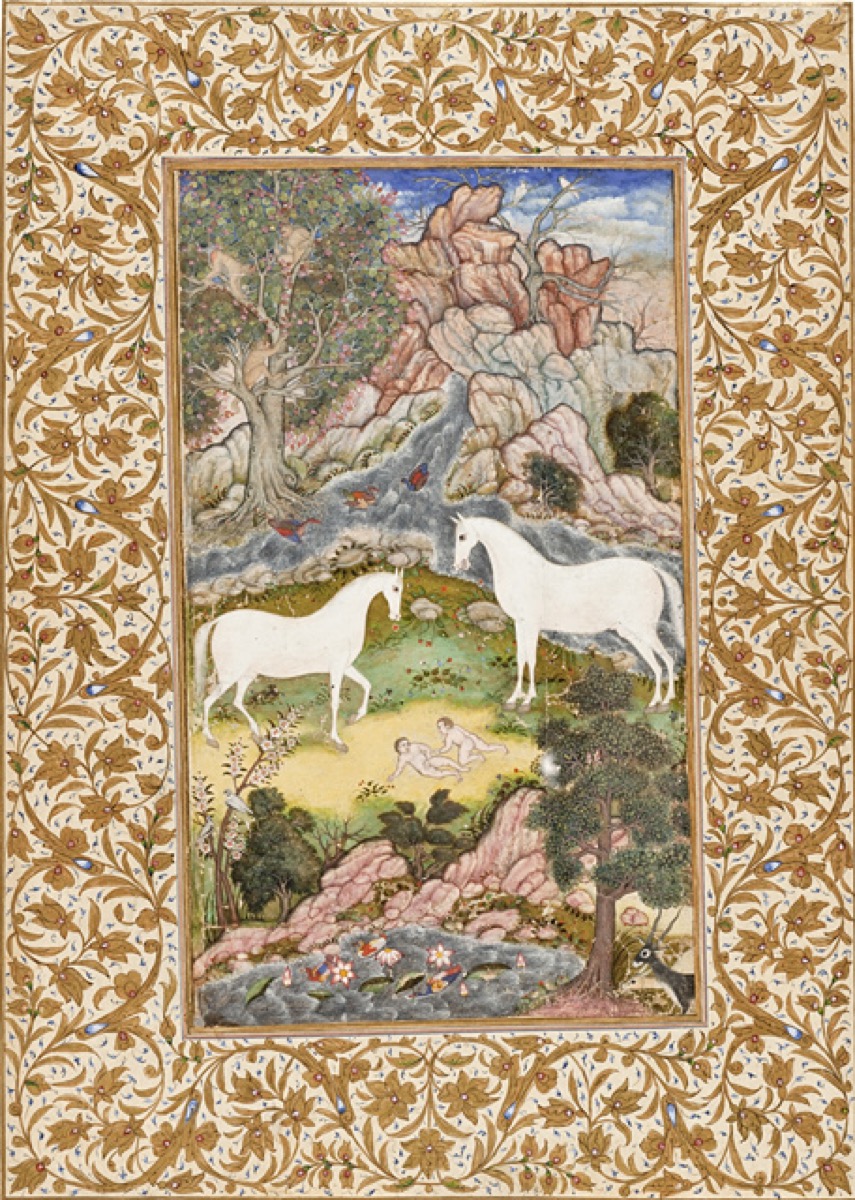
The Aśvinī Kumāras, known also as the Aśvins (अश्विनौ), stand among the most celebrated and frequently invoked deities of the Vedic pantheon. These radiant divine twins — called Nāsatya and Dasra — are the physicians of the gods (Deva Vaidya), the heralds of dawn, and the embodiment of youthful compassion. No other pair of deities in the Ṛgveda receives such sustained and affectionate praise: with 376 individual mentions and 57 dedicated hymns — including the magnificent sequence of Ṛgveda 1.116 through 1.120 — the Aśvins occupy the fourth position among all Vedic deities in terms of hymns addressed to them, following only Indra, Agni, and Soma.
Their name derives from the Sanskrit word aśva (horse), reflecting their inseparable association with horses, speed, and the luminous energy of the morning sky. Forever youthful, handsome, golden-complexioned, and tireless, the Aśvins race across the heavens in a chariot of splendour, scattering the darkness of night and bringing healing, rescue, and hope to gods and mortals alike.
Parentage: Sons of Sūrya and Saraṇyū
The origin of the Aśvins is intimately bound to the mythology of the sun. According to the Ṛgveda and the later Purāṇas, the twins are the sons of Sūrya (the Sun God, also called Vivasvān) and his wife Saraṇyū (also known as Saṃjñā), the daughter of the divine architect Tvaṣṭṛ (Viśvakarmā).
The Bṛhaddevatā and Mārkaṇḍeya Purāṇa narrate the poignant tale of their birth. Saraṇyū, unable to endure the blazing radiance of her husband Sūrya, fashioned a shadow-double of herself named Chāyā and fled into the northern forests, taking the form of a mare (aśvinī). When Sūrya discovered the deception, he pursued Saraṇyū and, assuming the form of a stallion (aśva), united with her. From this equine union were born the twin Aśvins — hence their epithet Aśvinī Kumāras, literally “the sons of the mare.” This equine origin is reflected in some iconographic traditions where the Aśvins are depicted with horse-heads upon human bodies.
Their sister is Uṣā (Dawn), and through their father Vivasvān they are brothers to Yama (the god of death) and Manu (the progenitor of humanity). The Aśvins are thus solar deities par excellence — born from the union of sun and light, heralding the dawn, and dispelling the darkness that precedes the new day.
Nāsatya and Dasra: The Two Names
Each twin bears a distinct name that reveals a facet of their divine character. Nāsatya (नासत्य) is generally understood to derive from na-asatya (“not untrue”), meaning “the truthful one” or “the saviour who ensures safe return.” The name appears 99 times in the Ṛgveda alone. Dasra (दस्र) means “the wonder-worker,” “the destroyer of ailments,” or “the one who gives enlightened help.”
In later literature, Nāsatya and Dasra are sometimes differentiated: one twin is associated with healing and gentleness, the other with strength and martial prowess — a duality that mirrors the broader symbolism of the divine twins across Indo-European cultures. In the Mahābhārata, when the Aśvins father the Pāṇḍava twins through Mādrī, Nakula is considered the son of Nāsatya and Sahadeva the son of Dasra.
The Aśvins in the Ṛgveda: 57 Hymns of Praise
The sheer volume of Ṛgvedic material devoted to the Aśvins is extraordinary. The principal hymns addressed to them include Ṛgveda 1.3, 1.22, 1.34, 1.46–47, 1.112, 1.116–120, 1.157–158, 1.180–184, 3.58, 4.43–45, 5.73–78, 6.62–63, 7.67–74, 8.5, 8.8–10, 8.22, 8.26, 8.35, 8.57, 8.73, 8.85–87, 10.24, 10.39–41, and 10.143.
The great Aśvin-sūktas of the first Maṇḍala — particularly 1.116, 1.117, and 1.118 — are remarkable catalogues of the twins’ benevolent deeds, recounting in rapid succession the dozens of mortals and sages they rescued, healed, and restored. Ṛgveda 1.116 alone enumerates over twenty distinct acts of divine intervention.
The poet of Ṛgveda 1.46.2 invokes them at dawn:
“Ā́ yātaṁ nāsatyā, gantam arvāk — Come hither, O Nāsatyas, come to us with your aids.”
In Ṛgveda 1.3.3, the seers call upon them alongside Indra and the Viśvedevas:
“Aśvinā purudaṁsasā, narā śavīrayā dhiyā — O Aśvins of manifold deeds, heroic ones, come with strengthening thought.”
These hymns celebrate the Aśvins not merely as healers but as cosmic rescuers who pluck the drowning from the sea, restore sight to the blind, grant children to the barren, and bring food to the starving. Their generosity knows no boundary of class or station — they help kings and commoners, sages and warriors, animals and humans with equal compassion.
The Chariot of the Aśvins
One of the most vivid and recurrent images in the Ṛgvedic Aśvin-hymns is their magnificent chariot. Described as three-wheeled (tricakra), golden, and swifter than thought, this chariot is drawn variously by horses, birds (swans or falcons), or even asses. It traverses all three realms — heaven, atmosphere, and earth — in a single day.
The chariot is laden with honey (madhu), healing herbs, and gifts for the afflicted. In Ṛgveda 1.47.2, the seer describes it:
“Your chariot, that comes laden with honey, rich in treasures, swift as thought — harness it, O Aśvins, for the journey.”
This golden chariot, arriving at the moment between darkness and dawn, became the signature emblem of the Aśvins. The Taittirīya Saṃhitā further specifies that their chariot moves so swiftly that it encircles the entire universe in a moment — a speed befitting the physicians who must reach the suffering without delay.
Legendary Healing Miracles
The Aśvins’ healing exploits form the narrative core of the Ṛgvedic hymns dedicated to them and constitute some of the most ancient recorded medical narratives in human civilisation.
The Rejuvenation of Chyavana
The most celebrated of all Aśvin-legends is the restoration of the aged sage Chyavana to youth and vigour. According to the account in Ṛgveda 1.116.10 and elaborated in the Śatapatha Brāhmaṇa (4.1.5) and Mahābhārata (Vana Parva, chapters 122–125), the sage Chyavana had grown decrepit with extreme old age. His young and devoted wife Sukanyā, daughter of King Śaryāti, remained faithful to him.
When the Aśvins encountered the beautiful Sukanyā and proposed to her, she refused their advances but challenged them: if they truly possessed divine healing powers, let them restore her husband’s youth. The twins accepted. They led Chyavana to a sacred lake, and all three — the two Aśvins and the aged sage — immersed themselves in the waters. When they emerged, all three appeared identical in youth and beauty. Sukanyā, through the power of her devotion (pātivratya), recognised her husband among the three identical figures.
In gratitude, Chyavana performed a soma sacrifice and offered the Aśvins a share of the soma libation — an act that provoked Indra’s fury, as the king of the gods had previously excluded the Aśvins from the soma ritual, deeming them “too close to mortals” to partake of the divine elixir. Chyavana’s defiance established the Aśvins’ right to the soma offering for all time.
The Iron Leg of Viśpalā
In one of the most astonishing passages of the Ṛgveda, the Aśvins provide a prosthetic iron leg to the warrior queen Viśpalā, who lost her leg in the nocturnal battle of Khela. Ṛgveda 1.116.15 declares:
“You fitted Viśpalā with an iron leg, O Aśvins, so that she might walk and run again in battle.”
This narrative, referenced also in Ṛgveda 1.117.11 and 1.118.8, constitutes one of the earliest recorded accounts of prosthetic surgery in world literature — a remarkable testament to the Vedic imagination of medical possibility.
The Healing of Ṛjrāśva’s Blindness
Ṛjrāśva was a man who, out of compassion, had fed a hundred sheep to a she-wolf. His enraged father blinded him as punishment. The Aśvins restored his sight — an act praised in Ṛgveda 1.116.16 and 1.117.17. This act of restoring vision to the unjustly blinded echoes through later Hindu medical and devotional traditions.
Rescuing Bhujyu from the Sea
The rescue of Bhujyu, son of Tugra, is recounted in multiple hymns (Ṛgveda 1.116.3–5, 1.117.14–15, 1.119.4). Abandoned in mid-ocean during a storm, Bhujyu was saved by the Aśvins, who sent their flying chariot or a great ship with a hundred oars to retrieve him from the boundless waters. This rescue-at-sea narrative appears in at least seven different Ṛgvedic hymns.
Reviving Vandana
The sage Vandana, wasting away with disease on what was expected to be his deathbed, was cured by the Aśvins so thoroughly that he rose to see the sun again and became a celebrated poet (kavi). This miracle is noted in Ṛgveda 1.117.5 and 10.39.8.
The Madhu-vidyā and Dadhyañc
The Aśvins’ quest for the secret Madhu-vidyā (“Honey Doctrine”) from the sage Dadhyañc (Dadhīchi) is one of the most dramatic narratives of the Ṛgveda. Indra had forbidden Dadhyañc from teaching this sacred knowledge to anyone, threatening to behead him if he did. The Aśvins devised an ingenious solution: they replaced Dadhyañc’s head with that of a horse. When Indra duly struck off the horse-head, the Aśvins restored Dadhyañc’s original head, and in the process obtained the Madhu-vidyā — the esoteric knowledge of the unity of all things through the metaphor of honey. This episode is referenced in Ṛgveda 1.116.12 and 1.117.22, and the Bṛhadāraṇyaka Upaniṣad (2.5) elaborates the Madhu-vidyā into a profound philosophical teaching.
The Aśvins and the Soma Controversy
A fascinating thread running through the Ṛgvedic Aśvin-hymns is their contested right to partake of the soma offering. Indra repeatedly excluded the Aśvins from the soma sacrifice, regarding them as contaminated by their extensive contact with mortals and their half-celestial, half-earthly nature.
The Aśvins’ champions in this struggle were the mortal sages they had healed — above all Chyavana, who defied Indra by offering them soma at King Śaryāti’s sacrifice. When Indra raised his thunderbolt (vajra) in rage, Chyavana conjured a terrible demon named Mada (Intoxication) who threatened to swallow Indra whole. Indra relented, and the Aśvins’ right to the soma was established. This narrative, told in detail in the Mahābhārata (Vana Parva 122–125) and the Śatapatha Brāhmaṇa, reveals the Aśvins’ liminal position — divine yet accessible, celestial yet deeply engaged with the human world.
Heralds of Dawn: The Aśvins and Uṣā
The Aśvins are intimately associated with the transition from night to day. They are the personification of morning twilight — the first light that appears before their sister Uṣā (Dawn) fully reveals herself. The Ṛgvedic poets consistently invoke them at the prātaḥsavana (morning pressing of soma), and their chariot is said to traverse the sky just before sunrise, scattering the dew and dispelling the last shadows of night.
This liminal temporal position — neither fully night nor fully day — mirrors their ontological liminality. The Aśvins bridge the divine and the human, the celestial and the terrestrial, health and disease, old age and youth. They are the deities of transitions, thresholds, and the hopeful moment when darkness gives way to light.
Fathers of Nakula and Sahadeva
In the Mahābhārata, the Aśvins’ most enduring legacy in the epic tradition is their role as the divine fathers of the youngest two Pāṇḍava princes. When Mādrī, the second wife of King Pāṇḍu, invoked the Aśvins using the divine mantra given by Kuntī, the twin gods appeared and blessed her with twin sons: Nakula (son of Nāsatya) and Sahadeva (son of Dasra).
True to their divine parentage, Nakula was renowned as the most handsome man in the world and an unparalleled master of horses and equine medicine (aśva-vidyā) — a direct inheritance from his horse-associated divine fathers. Sahadeva was celebrated for his wisdom, knowledge of astrology, and skill with the sword. Together, the Pāṇḍava twins embodied the complementary qualities of the Aśvins: beauty and wisdom, physical grace and intellectual depth.
Comparative Mythology: The Aśvins and the Indo-European Divine Twins
The Aśvins belong to one of the most widespread mythological archetypes in Indo-European tradition — the Divine Twins. Their parallels with the Greek Dioscuri (Castor and Pollux) are extensive and well-documented by comparative mythologists since the nineteenth century.
Like the Aśvins, the Dioscuri are:
- Twin sons of a sky/sun deity — the Aśvins are Divó Nápātā (“grandsons of Heaven”); the Dioscuri are Diós kouroi (“sons of Zeus”).
- Associated with horses — the Aśvins derive their name from aśva (horse); Castor is famed as a horse-tamer.
- Rescuers at sea — both pairs save mortals from shipwreck and peril.
- Healers — the Aśvins are divine physicians; in some traditions, one Dioscurus is associated with medicine.
- Connected with the dawn — both pairs appear at twilight and are linked to the morning star.
Similar divine twin figures appear in Lithuanian mythology as the Ašvieniai (Dievo sūneliai, “sons of God”), in Latvian tradition as the Dieva dēli, and in Norse mythology where scholars have proposed parallels with the Alcis mentioned by Tacitus. This cross-cultural pattern points to a Proto-Indo-European twin deity reconstructed by scholars as *Diwós Sūnū (“Sons of the Sky God”) — a fundamental mythological archetype from which the Aśvins and their cognates descend.
The Aśvinī Nakṣatra
In Vedic and classical Indian astronomy, the first of the twenty-seven nakṣatras (lunar mansions) is named Aśvinī in honour of the divine twins. It corresponds to the stars Beta (β) and Gamma (γ) Arietis — the head of the constellation Aries — and spans from 0° to 13°20’ of the sidereal zodiac.
Those born under the Aśvinī nakṣatra are said to inherit the qualities of the twin physicians: vitality, a pioneering spirit, natural inclination toward healing, physical beauty, and swift decisiveness. The ruling planetary body is Ketu (the south lunar node), adding a mystical and transformative dimension. The symbol of the nakṣatra is a horse’s head — once again linking the celestial configuration to the equine mythology of the Aśvins.
Iconography and Worship
Unlike the great temple deities of later Hinduism, the Aśvins have relatively few independent temples or sculptural traditions. Their worship belongs primarily to the Vedic ritual sphere — the prātaḥsavana (morning soma pressing) and the Aśvina-śastra recitations. However, sculptures of the Aśvins appear on the gopurams of the Chidambaram Naṭarāja Temple (12th century CE) in Tamil Nadu, depicted as youthful twin figures flanking other Vedic deities.
In traditional iconography, the Aśvins are portrayed as eternally youthful, golden-complexioned men, sometimes with horse-heads, riding their three-wheeled chariot laden with healing herbs and honey. They carry lotuses (puṣkarasrajau — “wreathed in lotuses” is one of their Vedic epithets) and occasionally medical instruments.
The Mughal-era Harivāṃśa manuscripts (c. 1585–1590), such as the celebrated LACMA folio depicting the “Birth of the Celestial Twins,” present the Aśvins within the visual vocabulary of Indo-Persian miniature painting — a testament to the enduring narrative power of these figures across cultural and artistic traditions.
Legacy in Indian Medicine
The Aśvins’ association with medicine extends far beyond mythology. They are regarded as the divine originators of Āyurveda, and the formulation of Chyavanaprāśa — the renowned herbal tonic still widely consumed in India today — is traditionally attributed to them. According to the legend, they prepared this rejuvenating mixture of āmalakī (Indian gooseberry), ghee, sesame oil, and dozens of herbs for the aged Chyavana at his hermitage.
The Caraka Saṃhitā, one of the foundational texts of Āyurveda, acknowledges the divine twins as predecessors in the healing tradition. The concept of physician as compassionate rescuer — arriving swiftly, healing without discrimination, and asking for nothing in return — finds its archetype in the Aśvins.
In the broader cultural memory of India, the Aśvinī Kumāras represent the conviction that healing is a divine act, that the relief of suffering is among the highest expressions of cosmic order (ṛta), and that even the gods themselves must include the compassionate physician at their table. Their story — from the horse-born twins who race ahead of the dawn to the divine doctors who restore sight to the blind and youth to the aged — remains one of the most luminous chapters of Vedic spirituality.