Introduction
Agni (Sanskrit: अग्नि, “fire”) is one of the most important and ancient deities of the Hindu tradition. In the Ṛgveda — the oldest of the four Vedas, composed between approximately 1700 and 1100 BCE — Agni is the second most frequently invoked deity after Indra, with nearly 200 hymns (sūktas) addressed directly to him and his name appearing in numerous other contexts throughout the scripture. The very first verse of the Ṛgveda opens with his invocation: Agnim īḷe purohitaṁ yajñasya devam ṛtvijam — “I praise Agni, the chosen priest, god, minister of sacrifice” (Ṛgveda 1.1.1), establishing from the outset his primacy in Vedic worship.
Unlike many deities whose significance waxes and wanes across the epochs of Hindu literature, Agni has maintained a continuous and indispensable role in Hindu religious life from the earliest Vedic period to the present day. He is the fire that consecrates the Hindu marriage (vivāha), that sanctifies the newborn (jātakarma), that purifies the dead through cremation (antyeṣṭi), and that carries every oblation from the sacrificial altar to the celestial realm. As the Encyclopaedia Britannica observes, Agni is “the vital spark of life” in Hindu thought, and his worship “consists of all the oblations” offered in the sacred fire (Britannica, “Agni”).
Etymology and Cosmic Identity
The Sanskrit word agni derives from the Proto-Indo-European root h₁egni-, cognate with the Latin ignis (“fire”), Lithuanian ugnis, and Old Slavonic ognjĭ. This shared linguistic ancestry reveals that the worship of fire as a divine force predates the separation of the Indo-European peoples and stretches back into deep prehistory (Wikipedia, “Agni”).
In Vedic cosmology, Agni is not merely a personification of terrestrial fire. He is understood to exist simultaneously in three cosmic realms: on earth as the sacrificial fire and the fire of the hearth (gārhapatya); in the atmosphere as lightning (vidyut); and in the sky as the sun (sūrya). This triple nature is expressed repeatedly in Vedic literature. The Ṛgveda declares: trīṇi jānā pari viśvāni veda — “He knows all three generations [of beings]” (Ṛgveda 10.88.10), referring to Agni’s omnipresence across the three worlds (New World Encyclopedia, “Agni”).
This tripartite existence makes Agni the supreme connecting principle of the Vedic cosmos — the deity who links the mortal realm to the divine, the terrestrial to the celestial, the visible to the invisible. He is devatā dvāra — the gateway to the gods.
Mythology and Birth Narratives
The Many Births of Agni
Vedic mythology describes Agni as having multiple origins, reflecting his ubiquitous presence. He is said to be born from water, from wood (through friction), from stone (through flint-strike), from the sky (as lightning), and from the sun. The Ṛgveda speaks of Agni as apāṁ garbha — “the embryo of the waters” (Ṛgveda 3.1.12–13), a paradoxical image that captures the Vedic understanding of fire as latent within all matter, awaiting release.
The most ritually significant birth is Agni’s emergence from the two fire-sticks (araṇi) during the Vedic fire-kindling ceremony. The Ṛgveda describes this as a sacred birth: mātariśvā mathnan — Mātariśvan (the divine wind) churned Agni forth from the two sticks, just as a child is born from its parents (Ṛgveda 1.71.4). This act of fire-kindling is itself a creative, quasi-divine event in the Vedic worldview.
Agni and the Bhṛgu Clan
An important mythological cycle connects Agni with the Bhṛgu clan of sages. According to one tradition preserved in the Ṛgveda and later elaborated in the Brāhmaṇas, the sage Bhṛgu (or his descendant Mātariśvan) brought Agni from heaven to earth for the benefit of humankind — a motif strikingly parallel to the Greek myth of Prometheus bringing fire to mortals (World History Encyclopedia, “Agni”). In another version, Agni once hid himself in the waters out of fear or exhaustion, and the gods, led by Bhṛgu, found him and persuaded him to return to his duties as the divine priest (Ṛgveda 10.51–53).
Marriage to Svāhā
In the Purāṇic literature, Agni’s consort is Svāhā, a goddess whose name is the ritual exclamation uttered with every oblation poured into the sacred fire. The Bhāgavata Purāṇa (4.1.60) and other texts relate that Svāhā fell in love with Agni and assumed the forms of the wives of the Saptarṣi (Seven Sages) in order to be near him. From their union were born three sons: Pāvaka (“the purifier”), Pāvamāna (“the purifying”), and Śuci (“purity”) — names that reflect the essential quality of fire as the agent of cosmic and ritual purification (Encyclopedia.com, “Agni”).
Roles and Functions
The Divine Priest (Purohita)
Agni’s most important function is that of purohita — the priest of the gods. In the Vedic sacrificial system (yajña), Agni serves as the mediator between the human and divine realms. When a priest pours ghee, soma, or other offerings into the sacred fire while reciting mantras, it is Agni who carries those offerings upward to the gods. Without Agni, no sacrifice can reach its intended recipients; he is the indispensable intermediary, the “mouth of the gods” (devānāṁ mukham).
The Ṛgveda addresses Agni in this capacity with remarkable intimacy: tvaṁ no agne sa u devó agne — “You, O Agni, are a god for us” (Ṛgveda 1.1.5). The relationship between the human worshipper and Agni is not one of distant awe but of intimate trust — Agni is the household god, the guest in every home, the family priest.
The Messenger (Dūta)
Closely related to his priestly function is Agni’s role as dūta — the divine messenger. Because fire transforms solid matter into smoke that rises to the sky, Agni was understood as the carrier who delivers messages and offerings between the two worlds. The Ṛgveda calls him devānām dūtaḥ — “messenger of the gods” (Ṛgveda 1.12.1), and this function made him essential to every ritual act of communication with the divine.
The Witness (Sākṣin)
Agni serves as the eternal witness to sacred vows and covenants. In the Hindu marriage ceremony, the couple performs saptapadī — the seven steps — and circumambulates the sacred fire (agni parikramā), with Agni serving as the divine witness to their vows. This role extends to oaths, treaties, and all binding commitments in the Vedic and later Hindu tradition.
The Purifier (Pāvaka)
Fire destroys impurities and transforms matter from one state to another. In the Vedic worldview, this physical property was understood spiritually: Agni purifies sins, removes moral and ritual pollution, and transforms the profane into the sacred. The cremation fire (citāgni) releases the soul from the body and carries it to the realm of the ancestors (pitṛloka), making Agni the agent of the ultimate purification — death and liberation.
The Three Sacrificial Fires
The Vedic sacrificial system employed three sacred fires, each associated with a different aspect of Agni:
-
Gārhapatya (the householder’s fire): The primary domestic fire, maintained continuously in the home. It represented the earth and was the fire from which the other two were kindled.
-
Āhavanīya (the offertorial fire): The fire into which oblations were poured during Vedic sacrifices. It represented heaven and was the fire that carried offerings to the gods.
-
Dakṣiṇāgni (the southern fire): Associated with protection against evil spirits and with the world of the ancestors. It represented the intermediate space (antarikṣa).
Together, these three fires formed the sacred triad that constituted the Vedic altar (vedi), and their maintenance and correct ritual use were among the most important duties of the Vedic householder and priest (Hindu Website, “Agni”).
Iconography
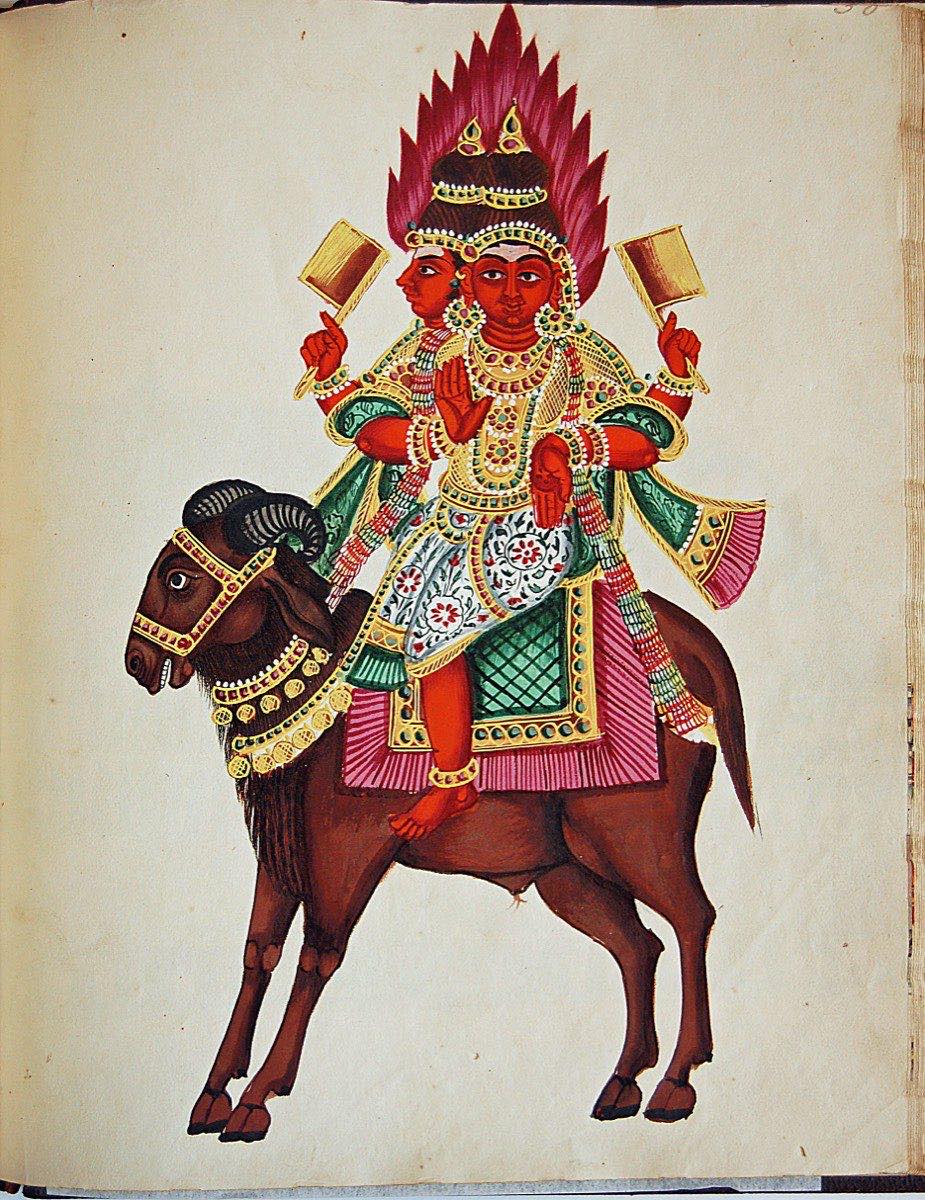
In visual depictions, Agni is characteristically shown as a red or flame-coloured deity with two faces — one benevolent and one fierce — representing the dual nature of fire as both life-giving and destructive. Traditional iconography assigns him seven tongues of flame (sapta jihvāḥ), with which he licks the oblations; these are named in the Muṇḍaka Upaniṣad (1.2.4) as Kālī (black), Karālī (terrifying), Manojavā (swift as thought), Sulohitā (very red), Sudhūmravarṇā (smoke-coloured), Sphuliṅginī (crackling), and Viśvarucī (universally beautiful).
He is typically depicted riding his vāhana (mount), a ram or goat, and carrying a fan, a ladle (sruk), and a flaming javelin or torch. He may be shown with four arms or seven arms (representing the seven flames), and sometimes with three legs representing the three worlds he inhabits. His banner bears the image of smoke (dhūmaketu), and he is sometimes adorned with a garland of fruit, symbolising the offerings placed in the fire (World History Encyclopedia, “Agni”).
Agni in the Upaniṣads
In the philosophical texts of the Upaniṣads, Agni transitions from a primarily ritual deity to a symbol of deeper metaphysical truths. The Chāndogya Upaniṣad (4.10–13) presents the Upakosala Vidyā, in which the three sacrificial fires themselves become teachers, instructing the student Upakosala about the nature of Brahman. Agni reveals himself as the light that pervades all things — not merely physical fire but the inner luminosity of consciousness.
The Kaṭha Upaniṣad (1.1.13–18) contains the famous Nāciketāgni teaching, in which Yama (Death) instructs the young Naciketas in the construction of a special fire altar (nāciketa agni) that leads to immortality. This passage represents one of the earliest Upaniṣadic discussions of the relationship between ritual action and spiritual knowledge.
The Muṇḍaka Upaniṣad (1.2.4) names the seven tongues of Agni and describes the correct performance of the fire sacrifice, while also pointing beyond ritual to the higher knowledge (parā vidyā) of Brahman — a characteristic Upaniṣadic move that honours the Vedic fire cult while transcending it.
Agni in the Epics and Purāṇas
The Mahābhārata
In the Mahābhārata, Agni features prominently in the Khāṇḍava-dahana episode (Ādi Parva, chapters 215–225), in which he consumes the Khāṇḍava forest with the help of Arjuna and Kṛṣṇa. Agni approaches them in disguise, suffering from indigestion caused by excessive ghee offerings, and asks for their help in consuming the forest so he may be restored to health. This narrative reflects the Vedic understanding of fire as a living being that must be “fed” with offerings.
The Purāṇic Agni
In the Purāṇas, Agni is listed as one of the Aṣṭadikpālas — the eight guardians of the directions — serving as the lord of the southeast (āgneya). The Viṣṇu Purāṇa describes him as one of the five elements (pañcabhūta) that constitute all material reality. The Agni Purāṇa, one of the eighteen major Purāṇas, is traditionally attributed to teachings given by Agni to the sage Vasiṣṭha and covers a vast range of subjects from temple architecture to medicine, indicating the continuing prestige of Agni’s name in the Purāṇic period (Rudraksha Ratna, “Agni Dev”).
Agni in Contemporary Hindu Practice
While the great Vedic fire sacrifices (śrauta yajñas) with their elaborate three-fire system are now rarely performed in full, Agni remains omnipresent in Hindu religious life:
- Vivāha (marriage): The sacred fire is the central feature of every traditional Hindu wedding. The couple circumambulates the fire seven times (saptapadī), and Agni is invoked as the divine witness to their vows.
- Homa/Havan: Fire offerings continue to be performed in temples and homes for purposes ranging from planetary appeasement (graha śānti) to purification and healing.
- Āratī: The waving of lamps before the deity during temple and home worship is a form of Agni worship.
- Antyeṣṭi (cremation): The funeral pyre remains the standard Hindu method of disposing of the body, with Agni carrying the soul to the next realm.
- Dīpa (lamp): The lighting of oil lamps or candles at the household shrine is a daily acknowledgement of Agni’s sacred presence in the home.
- Dīvālī: The festival of lights is, at its deepest level, a celebration of Agni — light triumphing over darkness.
Agni in Comparative Mythology
The worship of fire as a divine being is found across the Indo-European world, and Agni occupies a central place in comparative mythology and religious studies. His cognate in the Iranian (Zoroastrian) tradition is Ātar, the sacred fire that plays a similarly central role in Zoroastrian ritual. The Greek Hephaestus and Prometheus, the Roman Vulcan, and the Norse fire giant Surtr all reflect aspects of the Indo-European fire deity, though none retains the priestly and mediating function of Agni with the same clarity (New World Encyclopedia, “Agni”).
The parallel between the Vedic Agni cult and the Zoroastrian fire cult is particularly significant, as it suggests that the ritual veneration of sacred fire was a core feature of Proto-Indo-Iranian religion, predating the split between the Indian and Iranian branches of the Indo-European family. This makes Agni one of the oldest continuously worshipped divine concepts in human religious history.
Conclusion
Agni is, in many ways, the foundational deity of the Hindu tradition — not the most powerful or the most philosophically exalted, but the most essential. Without Agni, no sacrifice reaches the gods, no marriage is solemnised, no body is released to the next life, no home is complete. He is the fire in the hearth and the fire in the sky, the light of the sun and the flash of lightning, the warmth of the body and the blaze of the cremation pyre.
As the Ṛgveda proclaims in its opening verse: Agnim īḷe purohitaṁ yajñasya devam ṛtvijam, hotāraṁ ratnadhātamam — “I praise Agni, the chosen priest, god, minister of sacrifice, the hotṛ who bestows the greatest treasures” (Ṛgveda 1.1.1). In those words, spoken thousands of years ago and still recited today, lives the enduring flame of one of humanity’s most ancient objects of worship.