Introduction
Indra (Sanskrit: इन्द्र) is the most celebrated deity of the Ṛgveda, the oldest scripture of the Hindu tradition. Of the 1,028 hymns in the Ṛgveda, over 250 are addressed exclusively to Indra, and he is co-invoked in roughly 50 more — making him, by a significant margin, the god to whom the Vedic seers (ṛṣis) turned most frequently in praise, supplication, and awe (Britannica, “Indra”). He is the king of the Devas, the lord of Svarga (heaven), the wielder of the thunderbolt (Vajra), the bringer of rain, the slayer of demons, and the champion of cosmic order (ṛta) against the forces of chaos and obstruction.
In the Vedic world, Indra was the supreme warrior god — a deity of staggering physical power, enormous appetite, and unrivalled martial glory. His defining exploit, the slaying of the cosmic serpent Vṛtra who had imprisoned the world’s waters, is the central creation-combat myth of the Ṛgveda, retold in multiple hymns with dramatic intensity. The Vedic poets celebrated Indra as the liberator of rivers, the establisher of the sun in the sky, and the protector of the Ārya peoples against their enemies.
Yet Indra’s story across the broader sweep of Hindu literature is also one of transformation and relative decline. As the Vedic period gave way to the Upaniṣadic, Epic, and Purāṇic traditions, the Trinity of Brahmā, Viṣṇu, and Śiva rose to theological supremacy, and Indra was gradually repositioned as a powerful but fallible king of heaven — still glorious, but subordinate to the supreme godhead and sometimes humbled for his pride. This complex trajectory makes Indra one of the most fascinating figures in all of Hindu mythology.
Etymology and Titles
The etymology of the name “Indra” has been debated by scholars for over a century. Some derive it from the root ind- meaning “to have great power,” while others connect it to indu (a drop, especially of soma). The word also appears in related Iranian traditions, where Indra appears in the Avesta as a negative figure — a daēva — reflecting the theological divergence between the Vedic and Zoroastrian traditions (Wikipedia, “Indra”).
Indra bears a vast array of epithets in the Vedic and later literature, each reflecting a different aspect of his character and deeds:
- Śakra (“the mighty one”) — his most common post-Vedic name
- Vṛtrahan (“slayer of Vṛtra”) — his defining heroic epithet
- Maghavan (“the bountiful”) — emphasising his generosity to worshippers
- Purandara (“destroyer of citadels”) — from his conquest of demonic fortifications
- Meghavāhana (“rider of the clouds”) — connecting him to rain and storm
- Devapati or Devarāja (“lord/king of the gods”) — his sovereign title
- Vajrapāṇi (“wielder of the Vajra”) — his warrior epithet
- Sahasrākṣa (“thousand-eyed”) — referring to the eyes that cover his body
The Slaying of Vṛtra
The most important myth in the Ṛgveda — and arguably the foundational cosmogonic narrative of early Hindu tradition — is Indra’s battle with Vṛtra (Sanskrit: वृत्र, “the enveloper” or “the obstructor”). This myth is told most elaborately in Ṛgveda 1.32, but references to it pervade the entire text.
The Myth
Vṛtra was a colossal serpent (or dragon, ahi) who had coiled himself around a mountain and imprisoned within it all the waters of the world — the rivers, the rains, the life-sustaining moisture upon which all creation depended. The earth was parched, the rivers were captive, and the cosmic order was paralysed.
None of the gods dared confront Vṛtra. Indra alone, fortified by vast quantities of soma pressed for him by the priests, took up the Vajra — the thunderbolt fashioned for him by the divine craftsman Tvaṣṭṛ — and charged into battle. The Ṛgveda describes the encounter in vivid terms:
ahannahin anvapas tatarda prā vṛtrasya giriṇā apah — “He slew the serpent, released the waters; he cleft the channels of the mountain streams” (Ṛgveda 1.32.1).
Indra struck Vṛtra with the Vajra, smashing open the mountain and releasing the captive rivers, which flowed forth “like lowing cows” rushing to the sea. Vṛtra’s ninety-nine fortresses were shattered; his mother Dānu lay broken beside him. The waters were liberated, the sun rose again, and the cosmic order was restored (Wikipedia, “Rigveda 1.32”).
Cosmic Significance
The slaying of Vṛtra is not merely a heroic adventure but a cosmogonic event — a creation myth in which the world passes from a state of chaotic obstruction to one of dynamic, flowing order. The release of the waters is simultaneously the establishment of the cosmic, agricultural, and sacrificial cycles. Indra is thus not just a warrior but a creator: by defeating chaos, he makes the ordered world possible.
This myth has clear parallels in other Indo-European traditions: the Greek Zeus slaying the serpent Typhon, the Norse Þórr battling the Midgard Serpent Jörmungandr, and the Hittite storm god defeating the dragon Illuyanka. Comparative mythologists identify this as the Proto-Indo-European “dragon-slayer” or “champion vs. chaos-serpent” mytheme, with Indra as its clearest and most elaborately preserved exemplar (Wijsheidsweb, “Indra and Vritra”).
The Vajra
The Vajra (Sanskrit: वज्र) — Indra’s thunderbolt — is the most famous divine weapon in Vedic mythology. It was fashioned by the celestial artisan Tvaṣṭṛ (in some accounts, from the bones of the sage Dadhīci, who sacrificed his body so that the gods might have a weapon capable of slaying Vṛtra). The Vajra is described as irresistible, adamantine, and capable of splitting mountains.
The word vajra itself has become one of the most widely travelled terms in Asian religious vocabulary. In Buddhism, particularly Vajrayāna Buddhism, the vajra becomes the dorje — the diamond thunderbolt that symbolises indestructible truth. The Buddhist appropriation of this Vedic symbol testifies to the enduring power of Indra’s weapon as an icon of spiritual sovereignty (EBSCO, “Indra”).
Indra and Soma
The relationship between Indra and soma — the sacred, intoxicating ritual drink pressed and offered during Vedic sacrifices — is one of the defining features of Ṛgvedic religion. Indra is described as drinking enormous quantities of soma to fortify himself for battle, and the Vedic poets portray him as virtually dependent on it for his superhuman strength.
Numerous hymns describe the reciprocal relationship: the human priests press soma and offer it to Indra through the fire; Indra, strengthened and pleased, grants them rain, victory in battle, cattle, and prosperity. This cycle of offering and divine response is the engine of Vedic religion, and Indra is its principal beneficiary.
pibā somam indra mandatu tvā — “Drink the soma, Indra; may it exhilarate you” (Ṛgveda 1.4.2).
The identity of the soma plant remains one of the great unsolved puzzles of Vedic studies. Candidates have ranged from Ephedra to Amanita muscaria (the fly agaric mushroom), but no scholarly consensus has been reached. What is clear is that soma was understood as a divine substance whose consumption bridged the gap between the human and divine realms — and that Indra, more than any other deity, embodied this transformative power.
Sovereignty over Svarga
Indra rules Svarga (Sanskrit: स्वर्ग), the celestial realm that serves as heaven in Hindu cosmology. His court is described in later texts as a place of extraordinary splendour, populated by the Devas, Apsaras (celestial nymphs), Gandharvas (celestial musicians), and the righteous dead who have earned their place through virtuous lives and proper ritual.
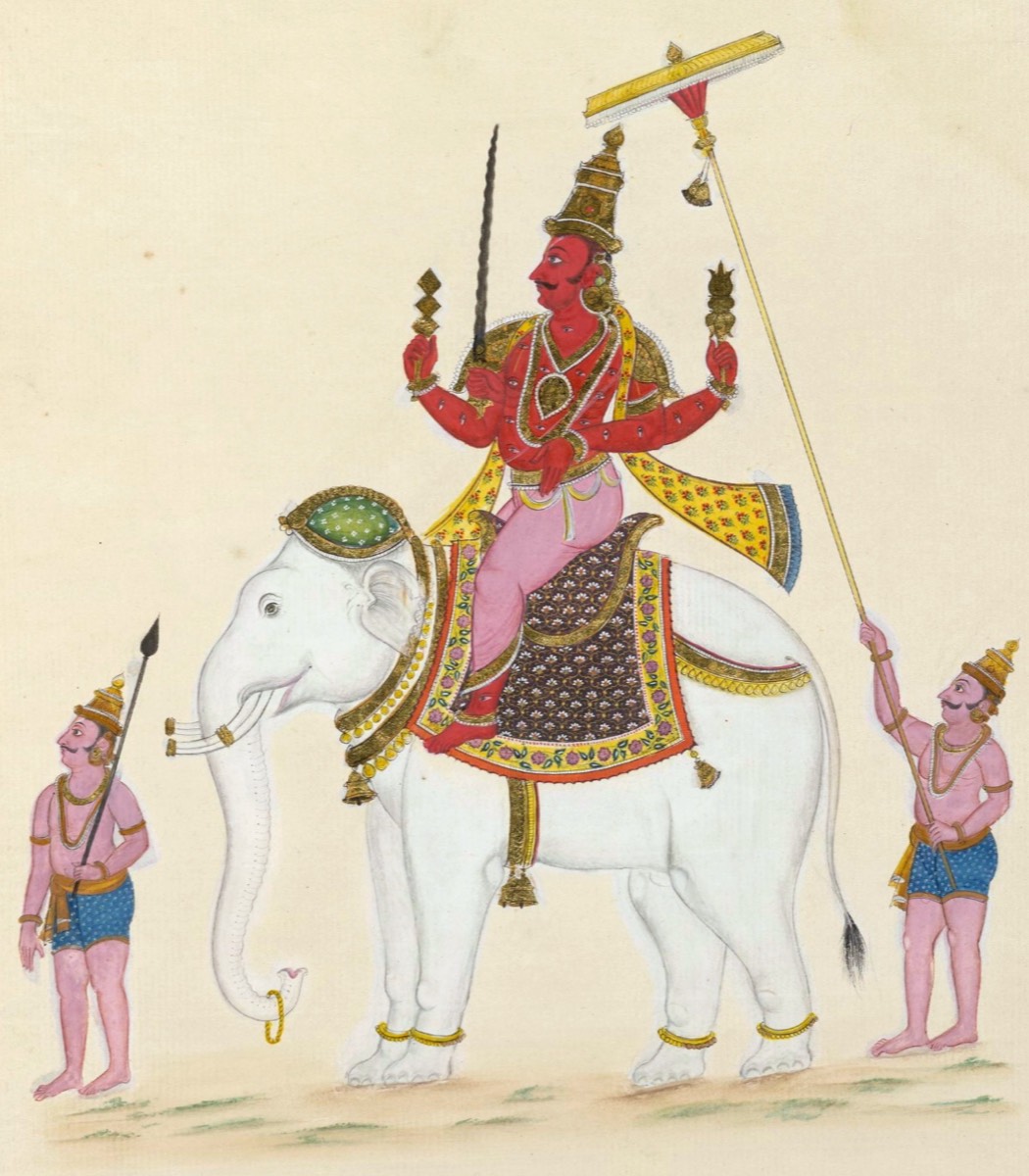
His celestial city is Amarāvatī (“the abode of the immortals”), and his assembly hall, described in the Mahābhārata (Sabhā Parva 7), is a marvel of divine architecture — a thousand yojanas in extent, filled with radiant beings, fragrant breezes, and the music of the Gandharvas. His mount is the great white elephant Airāvata, who emerged from the churning of the cosmic ocean (samudra manthana) and who has four tusks that represent the four directions. His weapon is the Vajra, and his charioteer in Vedic texts is Mātali (Britannica, “Indra”).
Indra in the Epics and Purāṇas
The Mahābhārata
In the Mahābhārata, Indra is the divine father of Arjuna, the great Pāṇḍava warrior, through Queen Kuntī. This parentage is central to the epic’s narrative: Arjuna inherits Indra’s martial prowess and eventually visits his father’s celestial realm during the Vana Parva, where he receives divine weapons including the Pāśupata from Śiva and other celestial arms.
Indra also appears in the Mahābhārata as a deity who can be both generous and devious. In the famous Karṇa narrative, Indra disguises himself as a brāhmaṇa to beg the hero Karṇa for his divine armour and earrings (kavaca-kuṇḍala), knowing that they make Karṇa invulnerable. Karṇa, bound by his vow never to refuse a petitioner, gives them freely — an act of supreme generosity that seals his tragic fate. Indra, moved by Karṇa’s sacrifice, gives him in return the Śakti weapon, which can be used only once (Mahābhārata, Vana Parva 294).
Govardhan Līlā
Perhaps the most theologically significant Purāṇic narrative involving Indra is the Govardhan episode from the Bhāgavata Purāṇa (10.24–25). When the young Kṛṣṇa persuades the cowherd community of Vraja to cease their annual worship of Indra and instead honour the Govardhan hill and their cattle, Indra responds with devastating fury, unleashing the cosmic rainstorm of Sāmvartaka upon the land. Kṛṣṇa calmly lifts the entire Govardhan mountain on his little finger and shelters the people beneath it for seven days. Humbled, Indra descends, prostrates before Kṛṣṇa, and recognises him as the Supreme Lord.
This episode encapsulates the theological transition from Vedic to Purāṇic Hinduism: the supreme Vedic warrior-god is subordinated to the avatāra of Viṣṇu, acknowledging a higher sovereignty.
The Humbling of Indra
The Purāṇic and Epic traditions contain numerous stories in which Indra is humbled, cursed, or defeated — often as a consequence of his arrogance or moral failings:
- The curse of Gautama: Indra seduces Ahalyā, the wife of the sage Gautama, by disguising himself as her husband. When discovered, Gautama curses Indra with a thousand wounds (sahasra-yoni), later softened to a thousand eyes — explaining his epithet “Sahasrākṣa” (Rāmāyaṇa, Bāla Kāṇḍa 48–49).
- Nahuṣa episode: When Indra goes into hiding after slaying the brāhmaṇa demon Vṛtra (in a Purāṇic retelling), the human king Nahuṣa temporarily usurps his throne and is eventually cursed to become a serpent for his hubris (Mahābhārata, Udyoga Parva 11–17).
- Subjugation by Rāvaṇa: In the Rāmāyaṇa tradition, Rāvaṇa’s son Meghanāda defeats and captures Indra in battle, earning the title “Indrajit” (“conqueror of Indra”).
These narratives serve the Purāṇic project of establishing the supremacy of the trimūrti while honouring Indra’s continuing importance as the king of the Devas.
Indra in the Upaniṣads
The Upaniṣads present Indra in a more philosophical light. In the Kena Upaniṣad (3.1–12), Indra is among the gods who fail to recognise the supreme Brahman when it appears before them as a mysterious yakṣa (spirit). Each god tries to demonstrate his power before the yakṣa and fails. When Indra approaches, the yakṣa vanishes, and the goddess Umā (Pārvatī) appears to reveal the truth: it was Brahman who was the source of their victory, not their own power. This narrative is a key Upaniṣadic text on the relationship between the personal gods and the impersonal absolute.
In the Chāndogya Upaniṣad (8.7–12), Indra and the demon king Virocana both seek the teaching of Prajāpati about the nature of the Self (Ātman). Virocana, after a brief instruction, departs satisfied with a shallow understanding (identifying the Self with the body). Indra, however, returns three times for further teaching over a period of 101 years, finally grasping the true nature of the Self as pure consciousness beyond all physical and mental limitations. This passage portrays Indra as a sincere spiritual seeker — a far cry from the proud warrior of the Purāṇas.
Iconography
In art and sculpture, Indra is depicted as a powerful, golden or fair-skinned deity, often shown:
- Riding the great white elephant Airāvata (four-tusked)
- Wielding the Vajra (thunderbolt) in his right hand
- Covered with eyes across his body (a feature especially prominent in South Indian art)
- Wearing royal regalia: crown, jewels, and rich garments befitting the king of heaven
- Accompanied by attendants and sometimes his consort Śacī (Indrāṇī)
In Southeast Asian art — particularly in Cambodia, Thailand, and Indonesia, where Hindu mythology profoundly shaped royal culture — Indra appears frequently in temple reliefs and royal iconography, riding Airāvata and overseeing the cosmic order from his heavenly throne (New World Encyclopedia, “Indra”).
Indra in Broader Asian Traditions
Indra’s influence extends far beyond Hinduism. In Buddhism, he appears as Śakra (Pāli: Sakka), the lord of the Trāyastriṁśa heaven and a devoted protector of the Buddha and the Dharma. In the Pāli Canon, Sakka is depicted as a devout Buddhist layman who has attained the sotāpanna (stream-entry) stage of enlightenment. In Jainism, Indra appears as the king of the gods who celebrates the birth of each Tīrthaṅkara by performing the ritual bathing (abhiṣeka) of the newborn on Mount Meru.
In Thai royal tradition, Indra (known as Phra In) is the guardian deity of the Thai monarchy, and Airāvata (Erawan) is a national symbol. The famous Erawan Shrine in Bangkok is dedicated to this tradition. In Cambodia, the Angkorian kings modelled their sovereignty on Indra’s rule over Svarga, and his image pervades the reliefs of Angkor Wat and the Bayon.
Conclusion
Indra is a deity of epic contrasts — at once the greatest champion of the Vedic cosmos and a figure whose limitations are exposed by later theological developments. In the Ṛgveda, he is unmatched: the dragon-slayer, the storm-bringer, the soma-drinking warrior-king whose Vajra shatters mountains and liberates rivers. In the Upaniṣads, he is a sincere seeker of truth, patient enough to study for a century to understand the Self. In the Purāṇas, he is the proud but fallible king of heaven, humbled by Kṛṣṇa’s little finger and cursed for his moral lapses.
This very complexity makes Indra one of the most compelling figures in Hindu mythology. He embodies the full arc of the tradition’s theological evolution — from the Vedic celebration of heroic power to the Upaniṣadic quest for spiritual knowledge to the Purāṇic affirmation that all power ultimately belongs to the supreme godhead. His story is, in many ways, the story of Hinduism itself: a tradition that honours its ancient roots while continuously reaching for deeper truths.
As the Ṛgveda proclaims: ko adya yuṅkte dhuri gā ṛtasya — “Who today yokes the steeds of cosmic order?” (Ṛgveda 1.105.12). For the Vedic seers, the answer was always Indra — the king of the gods, the lord of the thunderbolt, the champion of ṛta.