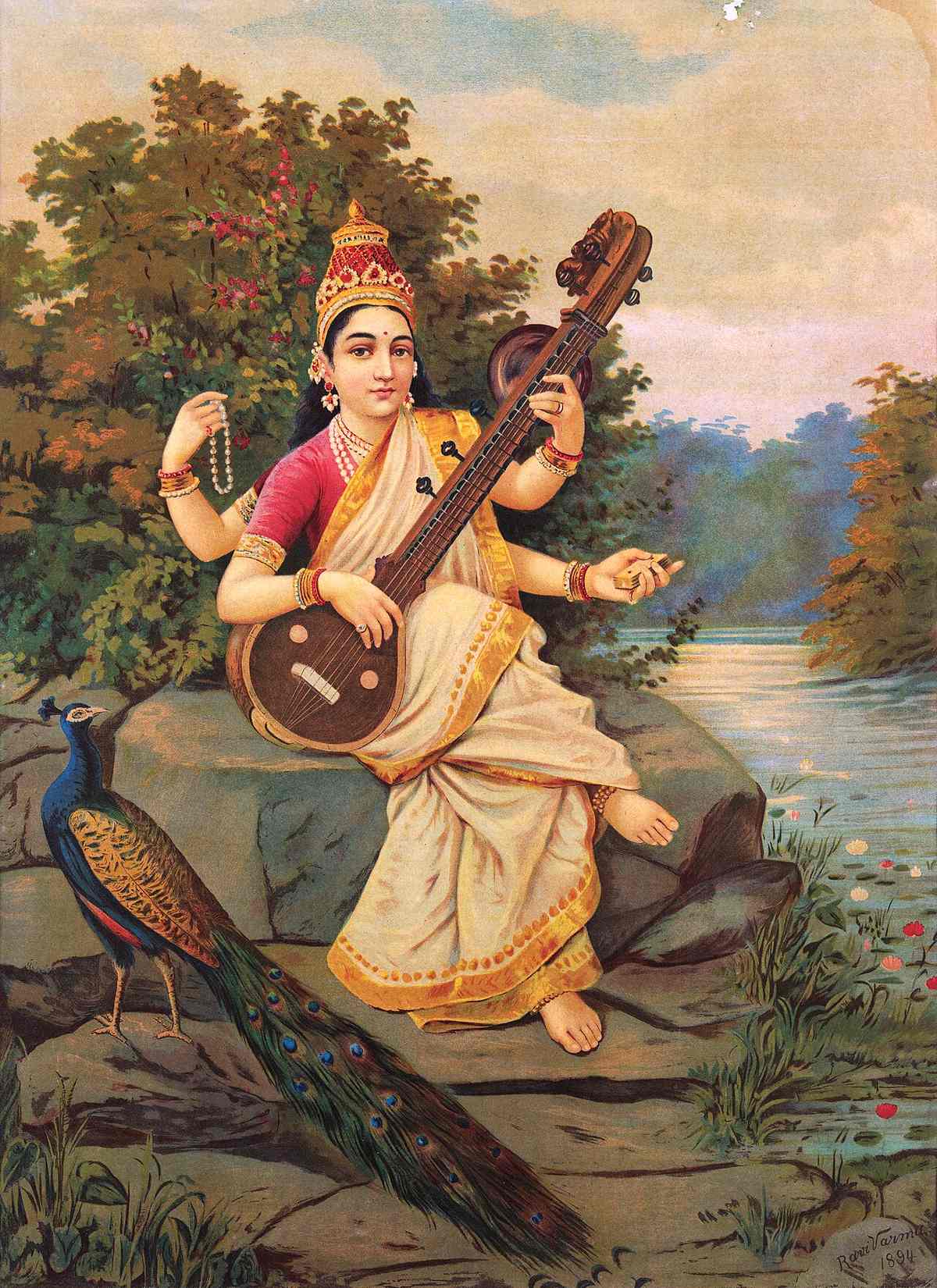
Who Is Sarasvatī?
Sarasvatī (Sanskrit: सरस्वती) is one of the most venerated deities in the Hindu tradition. She is the goddess of knowledge (vidyā), wisdom (prajnā), music (sangīta), the arts (kalā), and speech (vāc). As the consort of Brahmā, the creator god of the Hindu trinity (trimūrti), Sarasvatī embodies the creative intelligence that gives form and meaning to the universe. Without her knowledge and wisdom, creation itself would remain inert and purposeless.
Her name derives from the Sanskrit root saras, meaning “that which flows,” connecting her simultaneously to the flowing waters of the ancient Vedic river and to the flow of knowledge and eloquence. She is also known by many epithets, including Vāgdevī (goddess of speech), Shāradā (giver of essence), Vīṇāpāṇi (holder of the vīṇā), and Hansavāhinī (she whose vehicle is the swan).
Vedic Origins
The River Goddess of the Ṛg Veda
Sarasvatī’s origins reach back to the very earliest layer of Hindu scripture. In the Ṛg Veda (c. 1500-1200 BCE), she is mentioned approximately fifty times, making her one of the most frequently invoked deities in the oldest Vedic hymns. Three hymns are particularly dedicated to her: Ṛg Veda 6.61 (exclusively devoted to Sarasvatī), and 7.95-96, which she shares with her male counterpart Sarasvant (Encyclopaedia Britannica; Sacred Texts, RV 6.61).
In these early hymns, Sarasvatī is primarily celebrated as a mighty river goddess. She is one of the seven sacred rivers (sapta sindhu) of the ancient Vedic homeland. The famous verse Ṛg Veda 2.41.16 praises her as:
Ambitame nādītame dévitame Sarasvatī — “Best of mothers, best of rivers, best of goddesses, Sarasvatī” (Ṛg Veda 2.41.16; Indica Today)
This verse encapsulates her threefold nature: maternal protector, sacred waterway, and divine being. In the early Vedic period, the river and the goddess were inseparable — the physical Sarasvatī river was understood as a manifestation of divine nourishing power.
From River to Goddess of Learning
As the physical Sarasvatī river gradually dried up (modern geological studies place this around 2000-1900 BCE), the goddess increasingly became associated with the inner flow of wisdom and speech. By the time of the later Vedic texts and the Brāhmaṇas, Sarasvatī had merged with Vāc, the Vedic goddess of speech and sacred utterance. This identification is explicit in the Śatapatha Brāhmaṇa, where Vāc-Sarasvatī becomes the power through which sacred hymns are composed and ritual knowledge is transmitted (Wikipedia; World History Encyclopedia).
This transformation — from river deity to the supreme goddess of intellectual and artistic endeavour — is one of the most remarkable evolutions in Hindu religious thought.
Iconography and Symbolism
The Four-Armed Form
In her most widely worshipped form, Sarasvatī is depicted as a luminously beautiful woman dressed in a pure white sārī, seated upon a white lotus (padma) or occasionally upon her sacred mount, the swan (hamsa). Her white garments symbolise sattva — purity, truth, and transcendent knowledge (Wikipedia; Outlook India).
She is most commonly shown with four arms, which symbolically mirror the four heads of her consort Brahmā and represent the four aspects of human personality in learning: manas (mind), buddhi (intellect), citta (imagination and creativity), and ahamkāra (self-awareness) (Wikipedia).
The Sacred Objects
Each hand holds an object of deep symbolic significance:
- The Vīṇā (Indian stringed instrument): Held in her front two hands, the vīṇā represents all creative arts and sciences. It symbolises the harmony and melody that knowledge brings to life.
- The Pustaka (sacred text): A book, often identified with the Vedas, representing universal, eternal, and divine knowledge in all its forms.
- The Mālā (rosary of crystal beads): Represents the power of meditation, inner contemplation, and spiritual discipline.
- The Kamaṇḍalu (water pot): Symbolises the purifying power of discernment — the ability to distinguish truth from falsehood, the essential from the superficial. In some interpretations, it represents soma, the liberating draught that leads to knowledge.
The Hamsa (Swan)
Sarasvatī’s sacred vehicle (vāhana) is the hamsa, the swan or goose. According to tradition, the hamsa possesses the extraordinary ability to separate milk from water when the two are mixed. This quality serves as a profound metaphor: the true seeker of knowledge must learn to discriminate between the eternal and the transient, truth and illusion, the essential and the ornamental (Wikipedia; Vedik Heritage Blog).
Association with Brahmā
Sarasvatī is the consort of Brahmā, the creator of the universe. According to the Matsya Purāṇa and other texts, when Brahmā began the act of creation, the universe was formless and chaotic. Sarasvatī is said to have manifested from Brahmā’s creative energy — some accounts describe her as emerging from his mouth — bringing order through knowledge and speech (Encyclopaedia Britannica; World History Encyclopedia).
Their union symbolises a fundamental philosophical principle: creation (sṛṣṭi) without knowledge (vidyā) is incomplete and directionless. Brahmā represents the creative impulse, while Sarasvatī represents the wisdom that gives that impulse structure and meaning. Together, they embody the inseparable relationship between the power to create and the knowledge to create well.
Sarasvatī Pūjā and Vasanta Pancamī
The principal festival dedicated to Sarasvatī is Vasanta Pancamī (also called Sarasvatī Pūjā or Basant Panchami), celebrated on the fifth day (pancamī) of the bright fortnight of the Hindu month of Māgha (January-February). This day marks the onset of spring (vasanta) and is regarded as the day of Sarasvatī’s manifestation (Drik Panchang).
On Vasanta Pancamī, students, scholars, artists, and musicians offer special worship to Sarasvatī. Books, musical instruments, and tools of learning are placed before her image and sanctified. The colour yellow predominates in the celebrations, symbolising the vibrancy of spring and the blossoming of knowledge.
The ritual of Vidyārambha — the ceremonial introduction of young children to reading and writing — is traditionally performed on this auspicious day. Children write their first letters on rice grains or slate, invoking Sarasvatī’s blessings as they begin their journey of learning.
Sacred Mantras
The Sarasvatī Vandanā
The most widely recited prayer to Sarasvatī is:
Sarasvatī namastubhyam varade kāmarūpiṇī | Vidyārambham kariṣyāmi siddhir bhavatu me sadā ||
“O Goddess Sarasvatī, salutations to you, the bestower of boons and fulfiller of wishes. I begin my studies; may success always be mine.”
The Sarasvatī Gāyatrī Mantra
Om aim vāgdevyai vidmahe jnāna-buddhi-pradāyinyai dhīmahi | Tannaḥ Sarasvatī pracodayāt ||
“We meditate upon the goddess of speech; she who bestows knowledge and intellect — may that Sarasvatī inspire and illuminate us.”
The Bīja Mantra
The seed syllable (bīja) of Sarasvatī is Aim (ऐं). Devotees chant “Om Aim Sarasvatyai Namaḥ” — a compact invocation seeking her blessings for wisdom and eloquence.
These mantras are traditionally chanted 108 times during worship, using a japamālā (prayer rosary) for counting (Temple Purohit; Rudra Life).
Significance in Education and Culture
Sarasvatī holds a unique place in the Hindu worldview as the patron deity of all forms of learning. Every school, college, and library in the Hindu tradition is considered to be under her grace. Before examinations, students across India pray to her for clarity of mind and success in their studies.
Her influence extends well beyond Hinduism. In Buddhism, she appears as a protector of the Dharma, and in Jainism, she is revered as the goddess of knowledge. Her worship also spread to Southeast Asia, Japan (as Benzaiten), and other regions influenced by Indic civilisation (World History Encyclopedia).
In the Indian philosophical tradition, Sarasvatī represents a profound truth: that knowledge is the highest form of wealth (vidyā dhanam sarva dhanāt pradhānam). Unlike material riches, knowledge grows when shared, purifies when practised, and liberates when fully realised. Sarasvatī, the ever-flowing river of wisdom, is the divine embodiment of this eternal principle.