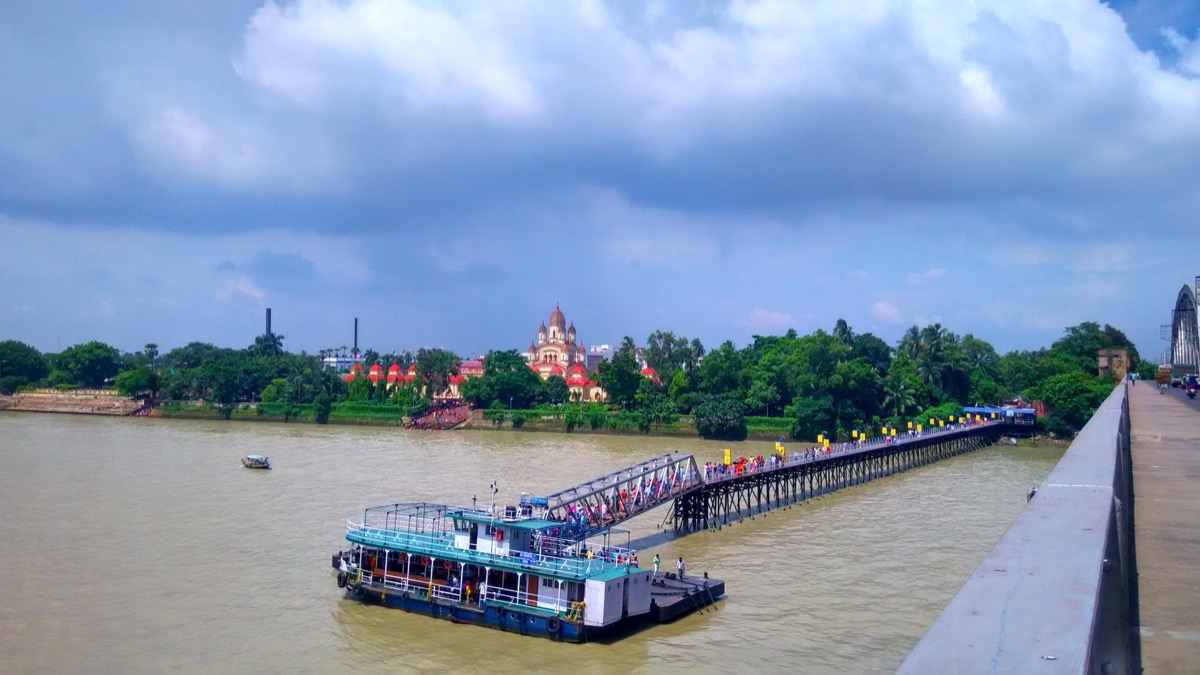
Dakshineswar Kālī Temple (দক্ষিণেশ্বর কালী মন্দির / दक्षिणेश्वर काली मंदिर) rises majestically on the eastern bank of the Hooghly River in Dakshineswar, north of Kolkata, West Bengal. Founded by the legendary philanthropist Rānī Rāshmonī in 1855, this Navaratna (“nine-jewelled”) temple complex is among the most revered pilgrimage sites in eastern India — not only as a powerful seat of Goddess Kālī worship but also as the hallowed ground where Śrī Rāmakṛṣṇa Paramahaṃsa (1836–1886) spent nearly thirty years in intense spiritual practice, attaining realization across multiple religious paths and igniting a spiritual renaissance that would reverberate across the world through his foremost disciple, Svāmī Vivekānanda.
The temple’s presiding deity is Bhavatāriṇī — “She Who Liberates from the Ocean of Worldly Existence” — an aspect of Ādyā Kālī who stands upon the chest of a recumbent Śiva on a thousand-petalled lotus of silver. For millions of devotees, Dakshineswar is not merely a temple but a living spiritual field (kṣetra), charged with the transformative energy of Rāmakṛṣṇa’s sādhanā and the Divine Mother’s eternal presence.
Rānī Rāshmonī and the Founding of the Temple
The story of Dakshineswar begins with Rānī Rāshmonī (1793–1861), a formidable zamindār of the Jānbāzār estate in Calcutta. Born into a humble Kaibarta (fisherman) family, Rāshmonī rose to extraordinary wealth and influence after marrying Rājchandra Dās, and upon his death in 1836, she managed the vast family estate with remarkable acumen and deep devotion to Goddess Kālī.
According to tradition, around 1847, Rānī Rāshmonī prepared for a grand pilgrimage to Kāśī (Vārāṇasī) to worship the Divine Mother. The night before departure, she received a vivid dream-vision in which Goddess Kālī appeared and declared: “There is no need to go to Kāśī. Install My image in a beautiful temple on the banks of the Gaṅgā, and arrange for My worship there. I shall manifest Myself in that image and accept worship at that place.” Profoundly moved, Rānī Rāshmonī abandoned her Kāśī plans and immediately began searching for suitable land along the Hooghly.
She purchased a large plot of approximately 20 acres at the village of Dakshineswar and commenced construction in 1847. The massive project took eight years and cost an estimated nine lakh rupees — a fortune in that era. The temple complex was designed to include a grand Kālī temple, twelve Śiva shrines, a Rādhā-Kṛṣṇa (Viṣṇu) temple, a bathing ghāṭ, flower gardens, and living quarters for priests and devotees.
The Caste Controversy and Consecration
A significant obstacle arose before the consecration. Because Rānī Rāshmonī belonged to the Kaibarta community — classified as Śūdra in the caste hierarchy — orthodox Brāhmaṇas refused to serve as priests or accept food offerings (prasāda) from a temple built by a non-Brāhmaṇa. The controversy threatened the entire enterprise. The solution came through a legal stratagem: Rānī Rāshmonī formally donated the temple and its endowments to her guru, making it technically a Brāhmaṇa’s property. Additionally, Rāmkumār Caṭṭopādhyāya (Śrī Rāmakṛṣṇa’s elder brother), a respected scholar from Kāmārpukur, agreed to serve as head priest, lending further legitimacy.
On 31 May 1855, the auspicious day of Snāna Yātrā (the bathing festival of Lord Jagannātha), the temple was consecrated with elaborate rituals. Over one lakh Brāhmaṇas were invited from across Bengal for the ceremony. The idol of Bhavatāriṇī — carved from black basalt, depicted in the classic form of Kālī standing on Śiva — was installed in the sanctum sanctorum amid Vedic chanting, conch-shell blasts, and the beating of drums.
Navaratna Architecture: The Temple Complex
Dakshineswar Kālī Temple is a masterpiece of 19th-century Bengali temple architecture in the Navaratna (nine-spired) style, which reached its zenith under the patronage of Bengali zamindārs.
The Main Kālī Temple
The three-storeyed, south-facing main temple stands on a raised platform accessible by a grand flight of stairs. It measures approximately 46 feet (14 metres) square at the base and soars to a height of over 100 feet (30 metres). The structure features nine towers (ratna) — four on the first storey, four on the second, and the crowning central spire — each topped with ornate pinnacles in the traditional āṭ-cālā (eight-roofed) Bengal style. The outer walls display decorative terracotta panels and plaster ornamentation typical of the period.
The garbhagṛha (sanctum sanctorum) on the ground floor houses the deity Bhavatāriṇī: a striking black basalt image of Goddess Kālī, approximately three feet tall, standing on the chest of a white marble Śiva lying in a supine position. Both figures rest upon a magnificent thousand-petalled lotus throne made of silver, weighing several hundred kilograms. Kālī is adorned with a garland of skulls, her tongue outstretched, four arms holding a sword, a severed head, and gestures of abhaya (fearlessness) and vara (boon-giving).
The Twelve Śiva Temples
West of the main temple, arranged in two rows of six along the riverfront between the main temple and the bathing ghāṭ, stand twelve identical Śiva shrines. Each is built in the āṭ-cālā (eight-roofed) style characteristic of Bengal, with gracefully curved cornices. Each shrine houses a Śivaliṅga — representing the twelve Jyotirliṅgas of India. The uniformity and symmetry of these twelve temples, with their matching red facades facing east toward the river, create one of the most photographed architectural ensembles in Bengal. Śrī Rāmakṛṣṇa frequently meditated within these shrines during his years of sādhanā.
The Rādhā-Kṛṣṇa Temple (Viṣṇu Temple)
To the northeast of the main Kālī temple stands the Rādhā-Kānta (Rādhā-Kṛṣṇa) temple, also known as the Viṣṇu temple. This shrine houses beautifully crafted images of Rādhā and Kṛṣṇa (known here as Rādhākānta Jiu). The young Rāmakṛṣṇa served as priest of this temple before being appointed to the main Kālī shrine. The Viṣṇava presence within a predominantly Śākta complex reflects the inclusive spiritual vision of Rānī Rāshmonī and foreshadows Rāmakṛṣṇa’s own message of religious harmony.
Śrī Rāmakṛṣṇa Paramahaṃsa: The Soul of Dakshineswar
The temple’s spiritual significance is inseparable from the life and sādhanā of Śrī Rāmakṛṣṇa Paramahaṃsa (Gadādhara Caṭṭopādhyāya, 1836–1886). He arrived at Dakshineswar in 1855 as an assistant to his elder brother Rāmkumār, the head priest. After Rāmkumār’s death in 1856, the young Gadādhara — barely twenty years old — was appointed priest of the Rādhā-Kānta temple, and subsequently became the head priest of the Kālī temple.
The Mad God-Intoxication
What followed was one of the most extraordinary spiritual odysseys in recorded history. Rāmakṛṣṇa developed an overwhelming, all-consuming devotion (bhakti) to Mother Kālī. He would weep for hours, crying out to the Divine Mother with such intensity that devotees and temple officials feared for his sanity. He refused food, abandoned sleep, and spent entire nights in the temple, pleading with Bhavatāriṇī for a direct vision (darśana). As recorded in the Śrī Śrī Rāmakṛṣṇa Kathāmṛta (The Gospel of Śrī Rāmakṛṣṇa), he described the anguish of this period: “I felt as if my heart were being squeezed like a wet towel. I was overpowered with a great restlessness and a fear that it might not be my lot to realize Her in this life.”
His prayers were answered when he experienced his first vision of the Divine Mother — perceiving the entire universe dissolved into an ocean of consciousness, with Kālī as boundless, effulgent light engulfing everything around him. From this point, Rāmakṛṣṇa entered a state of almost continuous God-consciousness, speaking with the Mother as one speaks with a living person.
Sādhanā Across Multiple Paths
Over the next twelve years, Rāmakṛṣṇa systematically practiced the disciplines of virtually every major Hindu path and even explored Islam and Christianity:
- Tāntric sādhanā (c. 1861): Under the guidance of Bhairavī Brāhmaṇī, a wandering female ascetic, Rāmakṛṣṇa completed all sixty-four Tāntric disciplines, attaining success in each.
- Vaiṣṇava sādhanā: He practiced madhura bhāva (the attitude of the divine lover toward Kṛṣṇa), dāsya bhāva (servant to master), and vātsalya bhāva (parent to divine child) under the Vaiṣṇava guru Jatādhārī.
- Advaita Vedānta (c. 1865): The great Nāgā sannyāsī Totāpurī arrived at Dakshineswar and initiated Rāmakṛṣṇa into sannyāsa and the non-dual meditation of Advaita Vedānta. Within three days, Rāmakṛṣṇa attained nirvikalpa samādhi — the highest state of objectless absorption — a feat that had taken Totāpurī forty years.
- Islamic practice (c. 1866): Rāmakṛṣṇa practiced Islamic disciplines and experienced a vision of a radiant divine figure.
- Christian contemplation (c. 1874): After contemplating Christ, he experienced a vision of Jesus merging into his own being.
Each experiment led to the same conclusion: “As many faiths, so many paths” (jato mat, tato path) — the cornerstone of his universal teaching.
The Nahabat: Sāradā Devī’s Sacred Dwelling
The Nahabat (নহবতখানা, music tower) stands to the northeast of the temple complex. Traditionally used for playing ceremonial music (śahanāi) during worship, the ground-floor room of the southern Nahabat became the residence of Sāradā Devī (1853–1920), the wife and spiritual consort of Śrī Rāmakṛṣṇa.
Sāradā Devī lived in this extraordinarily small room — barely large enough for one person to lie down — for extended periods during Rāmakṛṣṇa’s lifetime and after. Despite the cramped quarters, she maintained an exemplary spiritual life, performing intense meditation and selflessly serving the devotees who visited the temple. She would cook for Rāmakṛṣṇa and his disciples, carrying food across the temple grounds. Later venerated as the Holy Mother (Śrī Mā), Sāradā Devī is considered the spiritual mother of the Rāmakṛṣṇa movement. Her tiny room in the Nahabat remains a sacred pilgrimage site, preserved exactly as it was during her lifetime.
The Pañcavatī: Grove of Intense Sādhanā
North of the temple complex lies the Pañcavatī (পঞ্চবটী), a sacred grove planted under Rāmakṛṣṇa’s direction with five species of sacred trees: banyan (vaṭa), peepal (aśvattha), neem (nimba), āmalā (Indian gooseberry), and wood-apple (bilva). The Pañcavatī was patterned after the sacred grove where Lord Rāma dwelt during his forest exile.
This grove became Rāmakṛṣṇa’s primary place of meditation and Tāntric sādhanā. It was here, beneath the ancient trees, that he practiced the most intense disciplines — sometimes sitting motionless for hours, sometimes lost in ecstatic samādhi, sometimes conversing with the Divine Mother as naturally as with a living person. It was in the Pañcavatī that Totāpurī initiated him into sannyāsa and Advaita meditation, and where Rāmakṛṣṇa built a small meditation hut. After his passing, a Śiva temple was erected near the site, and the area was named Śānti Kuṭhī (Abode of Peace).
The Hooghly River Ghāṭ
The magnificent bathing ghāṭ (চাঁদনী ঘাট, Cāndnī Ghāṭ) stretches along the riverfront before the temple complex, providing a broad flight of steps descending to the Hooghly (a distributary of the Gaṅgā). The ghāṭ serves both as a ceremonial bathing place — devotees ritually bathe before entering the temple — and as a ferry landing connecting Dakshineswar to Belur Math on the opposite bank. Śrī Rāmakṛṣṇa spent many evenings on this ghāṭ, gazing at the river, sometimes falling into samādhi at the sight of a flock of cranes passing against the clouds.
The Hooghly River itself is considered a sacred extension of the Gaṅgā, and the ghāṭ at Dakshineswar is one of the most important ritual bathing sites in the Kolkata region. During festivals — especially Kālī Pūjā, Snāna Yātrā, and Makar Saṅkrānti — thousands of devotees descend the steps for purificatory baths.
The Rāmakṛṣṇa–Vivekānanda Connection
Dakshineswar is the cradle of the spiritual relationship between Śrī Rāmakṛṣṇa and Narendranāth Datta (1863–1902), later known as Svāmī Vivekānanda. Their first significant meeting occurred in November 1881, when the eighteen-year-old Narendra, a brilliant student of Scottish Church College and a member of the Brahmo Samāj, visited Dakshineswar.
Rāmakṛṣṇa recognized Narendra immediately as a soul destined for a great mission. The Master tested his foremost disciple through years of rigorous spiritual training at Dakshineswar, transmitting the essence of his realizations. When Narendra initially resisted Rāmakṛṣṇa’s assertion that he had seen God, the Master famously declared: “I see God more clearly than I see you, and I can show Him to you.”
After Rāmakṛṣṇa’s passing in 1886, the young monastic disciples gathered at Baranagar Math, and eventually Vivekānanda carried his master’s universal message to the Parliament of Religions in Chicago (1893), where his opening words — “Sisters and Brothers of America” — electrified the world. The Rāmakṛṣṇa Mission and Belur Math, visible across the Hooghly from Dakshineswar, stand as the institutional fruit of the spiritual seeds planted in this temple.
Daily Worship and Ritual Life
The temple follows a rigorous daily worship schedule rooted in Bengali Śākta tradition:
- Maṅgala Āratī (dawn worship): The day begins before sunrise with the ceremonial waking of Bhavatāriṇī, accompanied by conch shells, bells, and the chanting of hymns.
- Morning darśana: The temple opens to devotees at approximately 6:00 AM, with the first formal pūjā of the day.
- Bhoga (noon offering): Around 12:00 PM, cooked food is offered to the deity. Devotees may partake of the mahāprasāda (blessed food), which typically includes rice, dal, vegetables, and sweets prepared in the temple kitchen.
- Afternoon closure: The temple closes for rest between approximately 12:30 PM and 3:30 PM.
- Sandhyā Āratī (evening worship): The most atmospheric service of the day, performed at dusk with oil lamps, incense, and the resonant sound of dhāk drums. The evening āratī draws large crowds, especially on Tuesdays and Saturdays, considered particularly auspicious for Kālī worship.
- Śayana Āratī (night service): The final worship of the day, after which the deity is ritually put to rest.
Kālī Pūjā and Major Festivals
The most significant festival at Dakshineswar is Kālī Pūjā, celebrated on the amāvasyā (new moon night) of the month of Kārtika (October–November), coinciding with Dīpāvalī in other parts of India. On this night, the temple remains open through the night as tens of thousands of devotees stream in to offer worship. The image of Bhavatāriṇī is specially decorated, elaborate rituals are performed, and the entire complex is illuminated with thousands of oil lamps and electric lights.
Other major celebrations include:
- Snāna Yātrā (May–June): The anniversary of the temple’s consecration.
- Durgā Pūjā (September–October): The great autumn festival of the Goddess.
- Rāmakṛṣṇa Janmotsava: The birthday of Śrī Rāmakṛṣṇa, celebrated with special worship, discourses, and cultural programs.
- Kalpataru Day (1 January): Commemorating the day in 1886 when Rāmakṛṣṇa blessed devotees at the Cossipore garden house, granting their spiritual wishes like a kalpataru (wish-fulfilling tree).
- Sāradā Devī Jayantī: The birthday of the Holy Mother, with special worship at the Nahabat.
Pilgrimage and Visitor Information
Dakshineswar Kālī Temple is one of the most visited sacred sites in India, drawing an estimated five to six million visitors annually. The temple is located approximately 20 kilometres north of central Kolkata.
Getting there:
- Metro: The Dakshineswar Metro station on the Green Line provides the most convenient access.
- Ferry: Regular ferry services connect Dakshineswar Ghāṭ with Belur Math across the river — a scenic and spiritually meaningful journey.
- Road: Auto-rickshaws, taxis, and buses connect Dakshineswar to all parts of Kolkata.
Visitor guidelines:
- There is no entry fee. The temple is open to all, regardless of caste, creed, or religion — fitting Rāmakṛṣṇa’s universal message.
- Photography and mobile phones are not permitted inside the temple sanctum to maintain devotional sanctity.
- Tuesdays and Saturdays see the heaviest crowds, as these days are considered especially auspicious for Kālī worship.
- The ideal time to visit is during the cooler months (October to March), which also coincide with the major festival season.
- The combined pilgrimage of Dakshineswar + Belur Math (connected by ferry) is the quintessential spiritual circuit of Kolkata.
Spiritual Legacy
Dakshineswar Kālī Temple transcends its identity as a single religious monument. It stands as living testimony to the principle that all religions lead to the same truth — the central teaching of Śrī Rāmakṛṣṇa Paramahaṃsa. Within these grounds, a simple village priest systematically practiced the disciplines of Śākta Tantra, Vaiṣṇava bhakti, Advaita Vedānta, Islam, and Christianity, finding the same Divine Reality at the culmination of each path.
The temple also embodies the social vision of Rānī Rāshmonī, who challenged caste orthodoxy by building a magnificent house of God when conventional society denied her the right to do so. Her defiance, combined with Rāmakṛṣṇa’s spiritual universalism and Vivekānanda’s global outreach, makes Dakshineswar a monument not only to devotion but to the radical inclusivity at the heart of the Hindu spiritual tradition.
For the countless devotees who visit each year — from rural Bengali grandmothers to international spiritual seekers — Dakshineswar remains what it has been since 1855: a living threshold between the human and the divine, where the Mother’s grace flows as ceaselessly as the Hooghly at her feet.