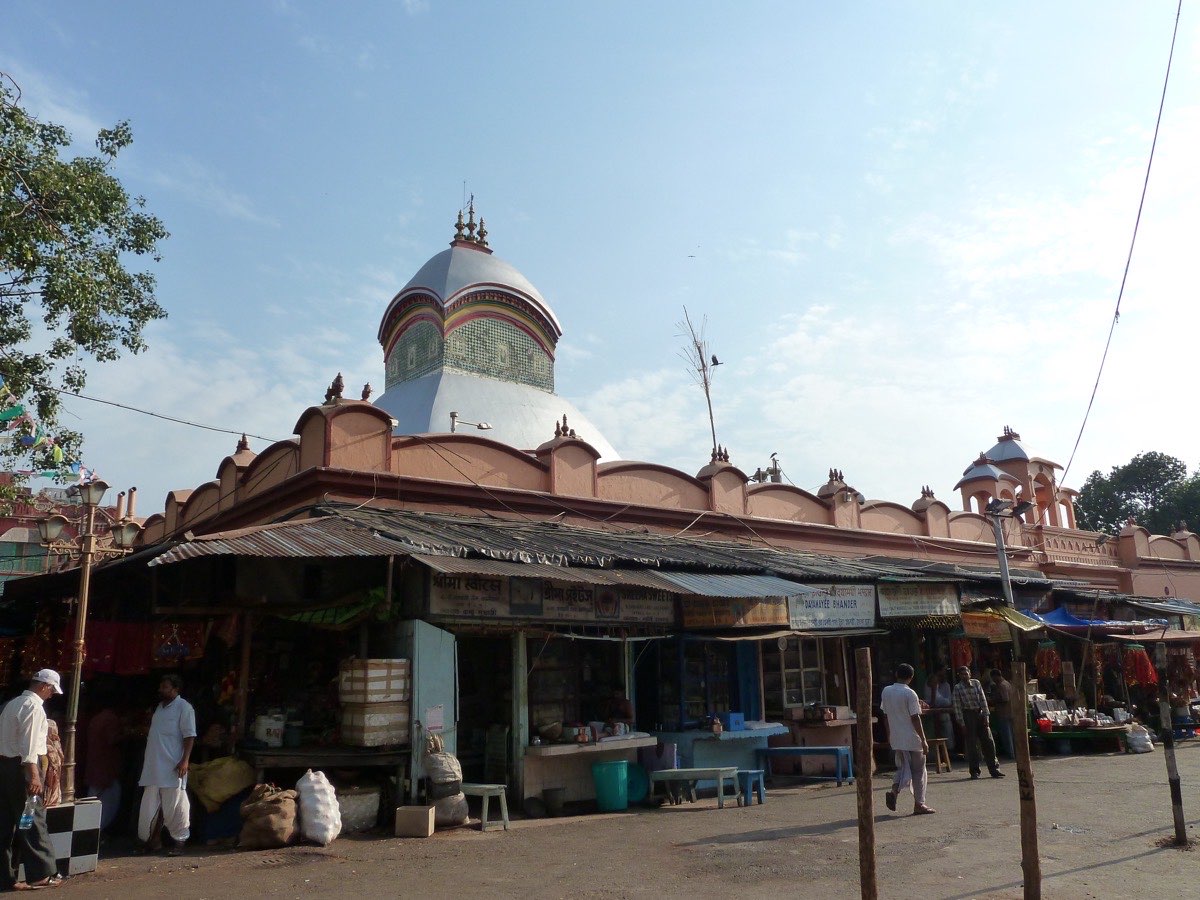
Kālīghāṭ Temple (কালীঘাট মন্দির / कालीघाट मंदिर) stands in the southern heart of Kolkata as one of the most revered Shakti Pīṭhas in all of Hinduism — a site where the divine feminine power (Śakti) manifests with extraordinary intensity. According to the Devī Bhāgavata Purāṇa and the Shakti Pīṭha Stotra, the toes of Goddess Satī’s right foot fell at this sacred spot when Lord Viṣṇu’s Sudarśana Cakra dismembered her body to halt Śiva’s devastating cosmic dance. This ancient site of worship is not merely a temple — it is the very place from which Kolkata itself derives its name, a living testament to the city’s deepest spiritual identity as the land of Goddess Kālī.
The Shakti Pīṭha Legend: Satī’s Toes
The mythological foundation of Kālīghāṭ is rooted in one of Hinduism’s most profound narratives — the self-immolation of Satī and the grief of Lord Śiva. According to the Devī Bhāgavata Purāṇa (7.30) and the Kālikā Purāṇa, when Satī’s father Dakṣa organized a grand yajña but deliberately excluded Śiva, Satī attended uninvited and was so humiliated by her father’s insults to her husband that she immolated herself in the sacrificial fire.
Overwhelmed by inconsolable grief, Śiva lifted Satī’s lifeless body onto his shoulders and began his terrifying Tāṇḍava — a cosmic dance of destruction that threatened to dissolve the entire universe. To prevent this catastrophe, Lord Viṣṇu released his Sudarśana Cakra, which systematically severed Satī’s body into fragments. These sacred fragments fell across the Indian subcontinent, and each spot where a body part landed became a Shakti Pīṭha — a seat of the Goddess’s power.
The Shakti Pīṭha Stotra enumerates 51 such sites, and Kālīghāṭ is identified as the place where the toes of Satī’s right foot (dakṣiṇa pāda aṅguli) fell to earth. The accompanying Bhairava (Śiva’s fierce manifestation who guards each Pīṭha) is Nakuleśvara — whose ancient Śiva liṅga still stands within the temple complex, directly testifying to the antiquity and authenticity of this sacred geography.
From Kālīkṣetra to Calcutta: The Etymology of a City
The history of Kālīghāṭ is inseparable from the history of Kolkata itself. The area was originally known as Kālīkṣetra (কালীক্ষেত্র, “the sacred field of Kālī”), a designation that places it squarely within the classical Hindu geography of tīrtha kṣetras — holy lands sanctified by divine presence.
The name Kālīghāṭ derives from two elements: Kālī (the goddess who resides here) and ghāṭ (the steps leading down to a river or waterbody — in this case, the old channel of the Ādi Gaṅgā, the original course of the Hooghly River). When the British East India Company established its presence in Bengal in the late 17th century, the village names Kālikātā (believed to derive from Kālīkṣetra or Kālīghāṭ), Sutānuṭī, and Govindapura were consolidated into what the British rendered as Calcutta — later officially restored to Kolkata in 2001.
This etymological chain — Kālīkṣetra → Kālīghāṭ → Kālikātā → Calcutta → Kolkata — means that the goddess Kālī, through her ancient temple, literally gave her name to one of the world’s great cities. The temple is thus not merely a place of worship within the city but the very reason the city bears the name it does.
Ancient Origins and the Present Temple (1809)
While the precise antiquity of worship at Kālīghāṭ is impossible to determine with certainty, tradition holds that the site has been a center of goddess worship since time immemorial. The Manasā Maṅgala Kāvya, a medieval Bengali literary text from the 15th–16th century, contains references to Kālīghāṭ as an established sacred site, and the area finds mention in the Ain-i-Akbari (1596 CE), the detailed statistical document compiled by Mughal Emperor Akbar’s court historian Abū al-Faḍl.
Archaeological and literary evidence suggests that a small temple or shrine existed at the site for centuries before the current structure was built. The old temple was a modest structure that served the local community and the steady stream of pilgrims who traveled along the Ādi Gaṅgā to pay homage to the goddess.
The present temple was constructed in 1809 under the patronage of the Sābarṇa Rāya Caudharī (Sabarna Roy Choudhury) family of Bāriśā (Barisha), one of the oldest and most prominent landed families of Bengal. The Sābarṇa Rāya Caudharī family donated 595 bīghās (approximately 200 acres) of land to the temple deity to ensure that worship and service could continue in perpetuity. This act of patronage transformed Kālīghāṭ from a local shrine into a grand temple complex worthy of one of the foremost Shakti Pīṭhas.
The Unique Kālī Mūrti: Three Eyes and a Golden Tongue
The deity at Kālīghāṭ is one of the most iconographically distinctive representations of Goddess Kālī in all of India. Unlike the more commonly seen depictions of Kālī as a full-bodied figure standing upon Lord Śiva, the Kālīghāṭ mūrti is a striking, almost abstract composition crafted from black sandstone (kṛṣṇa pāṣāṇa).
The image was created by two saintly figures — Ātmārām Giri and Brahmānanda Giri — and possesses several remarkable features:
- Three piercing eyes (trinetra), painted in vivid orange-red, representing the sun, moon, and fire — the goddess’s omniscience and her power over past, present, and future
- A protruding tongue made of gold (suvarṇa jihvā), with golden teeth — the most instantly recognizable feature, symbolizing Kālī’s insatiable cosmic hunger and her role as the devourer of time
- Four divine hands (caturbhuja): the left hands hold a scimitar (khaḍga, representing divine knowledge that severs ignorance) and the severed head of the asura Śumbha (representing the destruction of ego); the right hands display the abhaya mudrā (the gesture of fearlessness, assuring protection) and the varada mudrā (the gesture of boon-giving, bestowing grace)
- A large gold nose ring (nolak) that adds to the deity’s imposing visage
The mūrti is adorned daily with garlands of red hibiscus flowers (jabā phūl), which are sacred to Kālī and symbolize the blood-red power of creation and dissolution. The overall effect is of a goddess who is simultaneously terrifying and deeply compassionate — the fierce mother who destroys evil to protect her children.
Temple Architecture: The Bengali Āṭ-Calā Style
The Kālīghāṭ Temple is an outstanding example of the traditional Bengali temple architecture that evolved from the humble mud-and-thatch huts of rural Bengal into grand stone and brick structures. The temple exemplifies the āṭ-calā (“eight-sloped”) style — a structural form unique to Bengal in which the roof consists of two tiers, each with four sloping sides, creating a total of eight slopes (calā literally means “slope” or “roof-face”).
Key architectural features include:
- The truncated dome that crowns the four-sided main structure, a hallmark of the Bengali calā tradition
- Two roofs bearing eight faces total, painted in shiny metallic silver, giving the temple a luminous, otherworldly appearance
- Bright decorative bands of red, yellow, green, and blue at the cornice where the roofs meet the building walls — a distinctively Bengali aesthetic that contrasts with the more austere stone facades of temples in other regions
- The Naṭamandir (the congregational hall for worship and assembly) situated in front of the main shrine, where devotees gather for darśana and ceremonies
This architectural style represents a structural emulation of the joṛ-bāṅglā (joined-hut) form — a distinctly Bengali innovation in which two hut-like structures are joined together, with the characteristic curved cornices that became the signature of Bengal’s temple-building tradition. The Kālīghāṭ Temple stands as one of the finest surviving examples of this style, recognized as a Grade I heritage building by the Kolkata Municipal Corporation, meaning no external alterations to the structure are permitted.
Daily Worship and Ritual Life
Goddess Kālī at Kālīghāṭ is worshipped as a living deity (jāgrata devī) whose daily needs are attended to with meticulous devotion by the temple’s hereditary priests. The ritual day follows a carefully prescribed schedule:
- 4:00 AM — Maṅgala Āratī: The goddess is gently awakened from her divine slumber. Her image is ritually cleaned and freshly decorated with garlands of red hibiscus, vermillion (sindūr), and sandalwood paste
- 5:00 AM — Temple opens: The doors to the garbhagṛha open, and the first devotees enter for darśana
- 5:30–7:00 AM — Nitya Pūjā: The daily worship ceremony, including mantra recitation, flower offerings, and the lighting of oil lamps
- Morning darśana continues until 2:00 PM, when the temple doors close so that the priests can offer the goddess her midday bhoga (consecrated food) in privacy — for even a goddess must eat, and she does so away from the gaze of mortals
- 2:30–3:30 PM — Bhoga distribution: Consecrated food is distributed as prasāda
- 5:00 PM — Temple reopens for afternoon and evening darśana
- 6:30 PM — Sandhyā Āratī: The evening worship ceremony, accompanied by the ringing of bells, blowing of conch shells, and the waving of camphor lamps before the deity
- 10:30 PM — Temple closes (extended to 11:30 PM on weekends and special occasions)
Animal Sacrifice: The Living Tradition of Bali
Kālīghāṭ is one of the most prominent Hindu temples where the ancient practice of animal sacrifice (bali) continues as a regular feature of worship. Goat sacrifice is performed on Tuesdays and Saturdays — days especially sacred to the goddess — using a device called a harikāṭ (a forked wooden instrument designed to hold the animal’s neck in place for a single, swift stroke of the blade).
The theological rationale for bali at Kālīghāṭ draws from the Tāntric understanding of Kālī as the supreme reality who transcends all conventional dualities — including the distinction between life and death, purity and impurity. The Kālikā Purāṇa (chapters 67–71) prescribes animal sacrifice as an offering of the vital force (prāṇa) to the goddess, a ritual return of life-energy to its ultimate source. The offering is understood not as an act of violence but as a sacred transaction in which the animal’s soul is believed to attain liberation (mokṣa) through direct contact with the divine.
During major festivals, particularly Kālī Pūjā and Navarātri, the number of sacrificial offerings increases dramatically. The practice remains controversial in contemporary India, with animal rights organizations calling for its abolition, while traditionalists maintain that it represents an unbroken ritual lineage stretching back millennia.
The Nakuleśvara Śiva Liṅga
Within the Kālīghāṭ temple complex stands the shrine of Nakuleśvara Mahādeva — the Bhairava form of Lord Śiva who serves as the guardian and consort of the goddess at this Shakti Pīṭha. According to the Shakti Pīṭha tradition, each of the 51 sites where a fragment of Satī’s body fell is accompanied by a corresponding Bhairava, and Nakuleśvara is the Bhairava of Kālīghāṭ.
The Nakuleśvara Śiva liṅga is believed to be a svayambhū (self-manifested) liṅga — one that emerged from the earth of its own accord rather than being carved by human hands. This claim of svayambhū origin is a marker of exceptional sanctity in the Śaiva tradition, as it implies that Śiva himself chose to manifest at this location. Devotees typically pay homage at both the Kālī shrine and the Nakuleśvara temple during their pilgrimage, completing the spiritual circuit that honors both the Goddess and her divine consort.
The Kalighat Paṭa Painting School
The Kālīghāṭ Temple gave birth to one of India’s most distinctive and influential art traditions — Kalighat Paṭa painting (Kālīghāṭ paṭacitra) — which flourished in the 19th and early 20th centuries. The tradition was created by paṭuā (scroll painters), skilled artisans who migrated to Kolkata from rural Bengal, particularly from the districts of Midnapore and the 24 Parganas, drawn by the commercial opportunities offered by the bustling pilgrimage trade around the temple.
These painters transformed the older tradition of narrative scroll painting into a new, urban art form characterized by:
- Bold, sweeping outlines drawn with decisive confidence
- Vibrant yet limited color palettes — typically red, blue, yellow, and black
- Minimal or absent backgrounds, focusing all attention on the central figure
- Single-figure compositions rather than the narrative sequences of traditional paṭacitra
While the earliest Kalighat paintings depicted Hindu deities — particularly Kālī, Durgā, Lakṣmī, and scenes from the Rāmāyaṇa — the tradition rapidly evolved into a medium of social commentary. The paṭuā artists turned their brushes on the foibles of colonial-era Bengali society: the pompous bābu (westernized Bengali gentleman) with his English manners, domestic disputes, the hypocrisy of the newly wealthy, and the lives of courtesans. This dual character — devotional and satirical — made Kalighat painting a unique blend of the sacred and the secular.
Today, original Kalighat paintings are prized by museums worldwide, with major collections held by the Victoria and Albert Museum in London, the Indian Museum in Kolkata, and the Philadelphia Museum of Art. The style has been recognized as one of the earliest examples of modern Indian art, bridging the gap between traditional religious painting and contemporary artistic expression.
Mother Teresa and Nirmal Hṛday
In 1952, barely two years after founding the Missionaries of Charity in Kolkata, Mother Teresa established Nirmal Hṛday (“Pure Heart”) — officially known as the Kalighat Home for the Dying Destitutes — in a building adjacent to the Kālīghāṭ Temple complex. The building was a former dharmaśālā (pilgrim rest house) associated with the temple, which the Kolkata Municipal Corporation made available for Mother Teresa’s mission.
Nirmal Hṛday became Mother Teresa’s first and most iconic institution — a place where the destitute, the terminally ill, and the dying were brought from the streets of Kolkata to receive care, dignity, and companionship in their final hours. The proximity to the Kālīghāṭ Temple was deeply symbolic: just as the goddess Kālī presides over death and transformation, the hospice offered a compassionate space for the ultimate human transition.
Remarkably, the establishment of a Christian charitable institution beside one of Hinduism’s holiest sites has never generated significant interfaith friction. Local Hindu communities have largely embraced the mission’s presence, and Nirmal Hṛday’s donors have been predominantly Hindu. This harmonious coexistence stands as a powerful testament to the inclusive spiritual ethos of Kālīghāṭ — a place where the compassion of the divine Mother transcends institutional religious boundaries.
Kālī Pūjā and Festival Traditions
The most spectacular celebration at Kālīghāṭ occurs during Kālī Pūjā, which falls on the new moon night (amāvasyā) of the Hindu month of Kārtika — coinciding with Dīpāvalī (Diwali) in most of India. While northern India celebrates Diwali as the festival of Lakṣmī, Bengal transforms the darkest night of the year into a celebration of Kālī Mā — the goddess who dwells in the darkness beyond darkness.
On Kālī Pūjā night, the Kālīghāṭ Temple becomes the epicenter of an extraordinary outpouring of devotion:
- Thousands of devotees throng the temple through the night, waiting hours for a few seconds of darśana
- Special elaborate pūjā rituals are performed, with the goddess adorned in her finest ornaments and garlands
- Animal sacrifices multiply dramatically, with hundreds of goats offered to the goddess
- The entire Kalighat neighborhood is illuminated with oil lamps, candles, and electric lights, creating a sea of luminosity dedicated to the goddess of darkness
- Tāntric practitioners perform their most intense sādhanā of the year, invoking Kālī’s power at the hour when her cosmic energy is believed to be most accessible
Other significant festivals include Durgā Pūjā (Bengal’s greatest festival, when the temple sees enormous crowds during the Navarātri period), Snāna Yātrā, Poilā Baiśākh (Bengali New Year), and special observances on every Amāvasyā (new moon) and Saṅkrānti (solar transition day).
Kālīghāṭ and Dakṣiṇeśvar: Two Temples, Two Traditions
Visitors to Kolkata sometimes confuse the Kālīghāṭ Temple with the more photogenic Dakṣiṇeśvar Kālī Temple on the banks of the Hooghly River in north Kolkata. While both are devoted to Goddess Kālī, they differ profoundly in age, tradition, and character:
| Feature | Kālīghāṭ | Dakṣiṇeśvar |
|---|---|---|
| Antiquity | Ancient Shakti Pīṭha, worship predating recorded history | Built in 1855 |
| Patron | Sābarṇa Rāya Caudharī family (1809 structure) | Rāṇī Rāsmaṇi |
| Status | One of the 51 Shakti Pīṭhas | Not a Shakti Pīṭha |
| Deity name | Kālī (in her Shakti Pīṭha form) | Bhavataraṇī (“She who liberates from the ocean of existence”) |
| Architecture | Bengali āṭ-calā style | Nava-ratna (nine-spired) style |
| Famous association | Mother Teresa’s Nirmal Hṛday | Svāmī Rāmakṛṣṇa Paramahaṃsa |
| Animal sacrifice | Continues to this day | Discontinued |
Kālīghāṭ is the older, rawer, and more intensely tāntric of the two — a place where the goddess’s fearsome power is honored without softening, where animal sacrifice continues as a daily reality, and where the boundary between the divine and the visceral remains deliberately thin. Dakṣiṇeśvar, by contrast, is the temple of Rāmakṛṣṇa’s ecstatic mysticism — a more sāttvic (harmonious, pure) environment that appeals to a different facet of Bengali devotion.
Pilgrimage Traditions and Practical Devotion
For Bengali Hindus, a pilgrimage to Kālīghāṭ carries deep spiritual significance. The traditional pilgrimage involves:
- Bathing in the Ādi Gaṅgā (the original channel of the Ganges, now largely silted) before entering the temple
- Purchasing offerings from the bustling bazaar that surrounds the temple — red hibiscus garlands, sweets, coconuts, and red cloth
- Darśana of Mā Kālī in the garbhagṛha, where the pujārīs assist devotees in making their offerings
- Worship at the Nakuleśvara Śiva shrine, completing the Shakti Pīṭha circuit
- Receiving prasāda, which typically includes sweets and flowers that have been offered to the deity
- Circumambulation (parikramā) of the temple complex
The temple has undergone significant renovation in recent years. In 2024, the temple received its first major modern renovation since 1809, with a budget of approximately ₹200 crore — ₹165 crore provided by the Kolkata Municipal Corporation and ₹35 crore contributed by the Reliance Foundation — restoring and modernizing the infrastructure while preserving the heritage character of the sacred site.
Scriptural and Literary References
Kālīghāṭ finds mention across a remarkable range of textual traditions:
- The Devī Bhāgavata Purāṇa (7.30) and the Kālikā Purāṇa identify the site within the Shakti Pīṭha geography
- The Shakti Pīṭha Stotra specifically names the spot as the place where Satī’s right toes fell
- The Manasā Maṅgala Kāvya (15th–16th century) references Kālīghāṭ as an established pilgrimage site
- The Ain-i-Akbari (1596 CE) by Abū al-Faḍl mentions the area in its survey of Bengal
- Numerous maṅgala kāvya traditions of medieval Bengal celebrate the goddess of Kālīghāṭ in devotional poetry
These literary and scriptural references collectively establish Kālīghāṭ as a site whose sanctity has been continuously recognized across at least five centuries of documented history — and whose actual origins stretch far deeper into the mists of Bengal’s ancient past.
Living Significance
Today, Kālīghāṭ remains one of the most actively worshipped temples in India. It draws millions of pilgrims annually, with numbers swelling enormously during Kālī Pūjā, Durgā Pūjā, and other major festivals. For the people of Kolkata, the temple is far more than a historical monument or a tourist attraction — it is the spiritual heart of the city, the place where the Goddess who gave Kolkata its name continues to reside, to receive worship, and to bestow her fierce, transformative grace upon all who seek her.
The Kālīghāṭ Temple stands as a living bridge between the ancient world of the Shakti Pīṭhas and the vibrant, complex reality of contemporary Kolkata — a place where mythology and modernity, devotion and daily life, the terrifying and the tender coexist in the embrace of the Dark Mother.