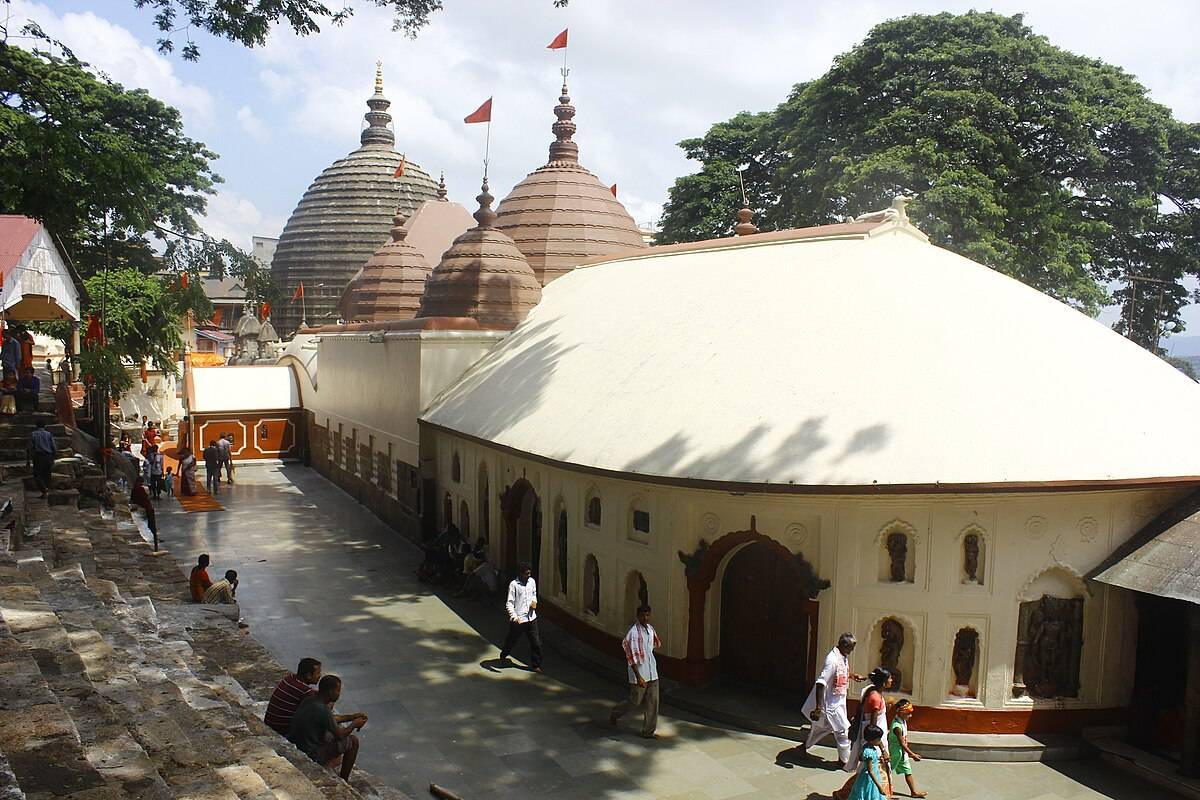
Kāmākhyā Temple (কামাখ্যা মন্দির / कामाख्या मंदिर) stands atop Nīlācala Hill (the “Blue Mountain”) in Guwahati, Assam, as the most revered of all Shakti Pīṭhas — sacred sites where the dismembered body of Goddess Satī fell to earth. Unlike most Hindu temples, Kāmākhyā enshrines no anthropomorphic idol; its sanctum sanctorum contains a natural rock cleft in the shape of a yoni (the feminine creative principle), perpetually moistened by an underground spring. This remarkable feature makes Kāmākhyā a living symbol of the goddess’s generative power and a unique pilgrimage destination that has drawn Tāntric practitioners, Śākta devotees, and spiritual seekers for over a millennium.
The Legend of Satī’s Yoni
The origin of Kāmākhyā is inseparable from the cosmic myth of Satī and Śiva. According to the Kālikā Purāṇa (chapters 15–18) and the Devī Bhāgavata Purāṇa (7.30), Satī immolated herself in the sacrificial fire of her father Dakṣa after he insulted Lord Śiva. Grief-stricken, Śiva lifted her lifeless body and began his devastating Tāṇḍava dance across the universe, threatening cosmic dissolution. To halt the destruction, Lord Viṣṇu released his Sudarśana Cakra, which severed Satī’s body into fragments that fell across the Indian subcontinent.
The Kālikā Purāṇa (18.41–43) explicitly states that Satī’s yoni (the organ of generation) fell upon Nīlācala Hill, making this site the most intimate and powerful of all Shakti Pīṭhas. The Purāṇa declares: “Where the yoni of Satī fell, there arose the great Pīṭha of Kāmākhyā, foremost among all sacred seats of the Goddess.” Different textual traditions enumerate either 51 or 108 Shakti Pīṭhas, but virtually all place Kāmākhyā at the pinnacle of the hierarchy.
The name Kāmākhyā itself derives from the Sanskrit kāma (“desire”) and ākhyā (“renowned, known for”), meaning “the one renowned for desire” — reflecting the goddess’s association with creative desire, fertility, and the power of procreation. An alternative etymology connects the name to the legend that Kāmadeva (the god of love) recovered his body here after being reduced to ashes by Śiva’s third eye, earning the hill the epithet “the place where Kāma was fulfilled.”
Nīlācala Hill and the Sacred Geography
Nīlācala Hill rises approximately 200 meters above the Brahmaputra River’s southern bank in western Guwahati. The Kālikā Purāṇa (chapters 62–63) describes the hill as a self-manifested sacred landscape (svayambhū kṣetra) that existed long before human habitation. The blue hue of its granite rocks, which gives the hill its name (“nīla” meaning blue, “acala” meaning mountain), was traditionally interpreted as the visible form of the goddess’s divine energy permeating the earth.
The Yoginī Tantra (1.7–9) declares Kāmaroopa (the ancient name for this region of Assam) to be the supreme Tāntric landscape: “Among all the Pīṭhas, Kāmarūpa is the highest; among all mantras, the Kāmākhyā mantra is supreme.” The text further describes Nīlācala as a place where the boundary between the physical and spiritual worlds grows thin — where ordinary human consciousness can most readily access the transcendent power of the Goddess.
The hill complex encompasses not merely the main Kāmākhyā shrine but an entire sacred ecosystem of temples, caves, and ritual spaces spread across its slopes.
Architecture: The Temple Without an Idol
The present temple structure dates primarily to the Koch dynasty reconstruction of 1565 CE, undertaken by King Naranārāyaṇa (also known as Malladev) after the earlier temple was destroyed during the invasion of Kālapāhāḍ, a Bengali Muslim general, in 1553. The temple’s architecture represents the distinctive Nīlācala style, a regional variant that blends indigenous Assamese building traditions with elements of the pan-Indian nāgara style.
The temple consists of four principal chambers:
-
Garbhagṛha (sanctum sanctorum): A cave-like chamber below ground level, accessible by narrow stone steps. Here lies the yoni-shaped rock cleft — a natural fissure in the bedrock — which serves as the primary object of worship. No sculpted image of the goddess exists; the rock itself is the goddess. A natural underground spring keeps the cleft perpetually moist, reinforcing its identification with the creative, life-giving power of the feminine divine.
-
Calantā: The middle chamber housing images of other deities.
-
Paṅcharatna: A chamber with five small turrets.
-
Naṭamaṇḍira: The large frontal hall used for congregational worship, dance, and ritual performances.
The most striking external feature is the temple’s distinctive hemispherical dome (śikhara), shaped like a beehive and crowned by a gilded finial. Unlike the soaring towers of north Indian temples, this rounded dome reflects the Kāmarūpa architectural tradition and symbolically echoes the curved form of the yoni it enshrines. The outer walls bear exquisite sculptural panels depicting deities, celestial musicians (gandharvas), and erotic motifs (mithuna figures) that celebrate the creative power of desire.
The Ten Mahāvidyās
One of Kāmākhyā’s most distinctive features is its role as the primary seat of the Daśa Mahāvidyā tradition — the worship of ten forms of the Great Goddess, each representing a different aspect of transcendent wisdom (mahā = great, vidyā = knowledge/wisdom). The Nīlācala Hill complex houses individual temples dedicated to each of the ten Mahāvidyās:
- Kālī (काली) — The power of time and transformation
- Tārā (तारा) — The compassionate guide who ferries souls across the ocean of existence
- Ṣoḍaśī / Tripurasundarī (षोडशी) — The beauty of the three worlds, the sixteen-year-old goddess
- Bhuvaneśvarī (भुवनेश्वरी) — The sovereign of the cosmos
- Bhairavī (भैरवी) — The fierce aspect of Śakti
- Chinnamastā (छिन्नमस्ता) — The self-decapitated goddess symbolizing self-sacrifice and the kuṇḍalinī
- Dhūmāvatī (धूमावती) — The widow goddess, representing the void and dissolution
- Bagalāmukhī (बगलामुखी) — The paralyzer of enemies, the power of stambhana (immobilization)
- Mātaṅgī (मातंगी) — The outcaste goddess of inner wisdom and creative arts
- Kamalā (कमला) — The lotus goddess of prosperity and beauty
The Yoginī Tantra (2.1–10) describes the Nīlācala complex as the “living maṇḍala of the Mahāvidyās,” where each temple occupies a ritually precise position corresponding to a specific direction and cosmic function. The tradition holds that worshipping all ten Mahāvidyās at Kāmākhyā in the prescribed sequence grants the practitioner complete spiritual wisdom.
Tāntric Traditions and Ritual Life
Kāmākhyā is universally regarded as the foremost Tāntric pīṭha in India. The temple’s ritual practices draw from the Kaulācāra (left-hand) Tāntric tradition, which embraces aspects of existence that orthodox Brahmanical Hinduism traditionally avoided — including practices involving the pañcamakāra (five “M”s): madya (wine), māṃsa (meat), matsya (fish), mudrā (parched grain), and maithuna (ritual union). These are understood not as indulgence but as a disciplined path of integrating all aspects of existence into spiritual realization.
The temple’s principal priests belong to a hereditary lineage of Baropujārīs (chief priests), traditionally drawn from the Assamese Brahmin community. They maintain an unbroken tradition of Tāntric ritual knowledge passed through initiation (dīkṣā) from guru to disciple. Daily worship (nitya pūjā) includes offerings of red hibiscus flowers (jābā), red silk cloth, and animal sacrifice — practices that underscore the goddess’s association with blood, vitality, and the raw power of creation.
The Kālikā Purāṇa (chapters 67–74) provides detailed instructions for Tāntric sādhanā at Kāmākhyā, including mantra recitation, yantra worship, and meditation on the goddess’s fierce and benevolent forms. The text emphasizes that Kāmākhyā is the supreme site for attaining siddhis (supernatural accomplishments) and ultimately mokṣa (liberation).
Ambubācī Melā: Celebrating the Goddess’s Menstrual Cycle
The most extraordinary festival at Kāmākhyā is the annual Ambubācī Melā (also spelled Ambubashi), held in late June during the āṣāḍha month of the Hindu calendar. This three-day festival celebrates the annual menstruation of the goddess — a belief that the earth becomes fertile during the monsoon season because Goddess Kāmākhyā undergoes her menstrual cycle at this time.
During Ambubācī, the temple closes for three days. The Brahmaputra River near the temple is said to turn red — a phenomenon attributed to the goddess’s menstrual blood, though geologists note the presence of iron-rich soil and minerals in the area. On the fourth day, the temple reopens with great celebration, and devotees receive pieces of the Aṅgabastra (अंगवस्त्र) — a red cloth that covered the yoni stone during the three sacred days — as supremely auspicious prasāda.
Ambubācī attracts hundreds of thousands of pilgrims, Tāntric practitioners (sādhakas and sādhvīs), Aghori ascetics, and Nāga sādhus from across India and beyond. The melā transforms the Nīlācala Hill area into a vast temporary city of tents, religious discourses, and ritual gatherings. It is one of the largest congregations of Tāntric practitioners anywhere in the world and serves as an annual reaffirmation of the goddess’s living, embodied presence at the sacred site.
The celebration of menstruation as divine and auspicious stands in powerful contrast to widespread cultural taboos surrounding menstruation in South Asia, making Ambubācī a uniquely progressive religious tradition.
The Koch Dynasty and Historical Patronage
While archaeological evidence suggests that Kāmākhyā has been a site of goddess worship since at least the 7th–8th centuries CE (a period associated with the Kāmarūpa kingdom under the Varman, Mlechchha, and Pāla dynasties), the temple’s golden age came under the patronage of the Koch dynasty (16th–17th centuries).
After the original temple was destroyed by Kālapāhāḍ in 1553, Koch king Naranārāyaṇa (r. 1540–1587) undertook a comprehensive reconstruction that resulted in the temple’s current architectural form. The Yoginī Tantra — one of the most important Tāntric texts associated with Kāmākhyā — is believed to have been composed or compiled during this period of Koch patronage, between the 15th and 17th centuries.
The Koch rulers positioned themselves as protectors and chief patrons of the goddess, deriving political legitimacy from their devotion. The later Ahom dynasty continued this patronage, with several Ahom kings making substantial grants of land and resources to the temple. King Śiva Siṃha (r. 1714–1744) and his queen Phuleśvarī (later known as Prabhāvatī) were particularly notable for their devotion, with Phuleśvarī herself becoming an initiated Tāntric practitioner and using the temple as a center for religious reforms.
Scriptural Authority
Two texts hold paramount authority for the theology and ritual practices of Kāmākhyā:
The Kālikā Purāṇa (c. 10th century CE) is the primary scriptural source, containing detailed accounts of the goddess’s mythology, the creation of the Shakti Pīṭha, prescriptions for worship and ritual, descriptions of sacred geography, and philosophical teachings on the nature of Śakti. Chapters 62–63 are devoted specifically to the māhātmya (glorification) of Kāmākhyā and Nīlācala.
The Yoginī Tantra (c. 15th–17th century CE) provides the Tāntric ritual framework for worship at Kāmākhyā, including elaborate instructions for mantra initiation, descriptions of the Mahāvidyā temples, prescriptions for the Ambubācī observances, and a theological vision of Kāmarūpa as the supreme Tāntric landscape.
Together, these texts establish Kāmākhyā not merely as one among many pilgrimage sites but as a place of unique cosmic significance — the point where the goddess’s most intimate creative power resides permanently in the earth.
Living Traditions and Contemporary Significance
Today, Kāmākhyā Temple remains a vibrant, active center of worship. It draws an estimated two to three million pilgrims annually, with numbers swelling dramatically during Ambubācī and Durgā Pūjā. The temple is administered by the Kāmākhyā Debuttar Board (established under the Kamakhya Debuttar Act, 1959), which oversees the temple’s operations, festivals, and extensive landholdings.
In contemporary Hinduism, Kāmākhyā has become a powerful symbol of Śākta feminism — a tradition that locates the supreme divine principle in the feminine. The temple’s unabashed celebration of female reproductive power, its veneration of a yoni rather than an anthropomorphic image, and its annual Ambubācī festival have resonated with modern movements seeking to reclaim and honor the sacred feminine.
For Tāntric practitioners, Kāmākhyā remains the ultimate site of spiritual accomplishment — a place where the veil between the mundane and the transcendent is thinnest, and where the goddess’s power is most directly accessible to those who approach with sincerity, discipline, and devotion.