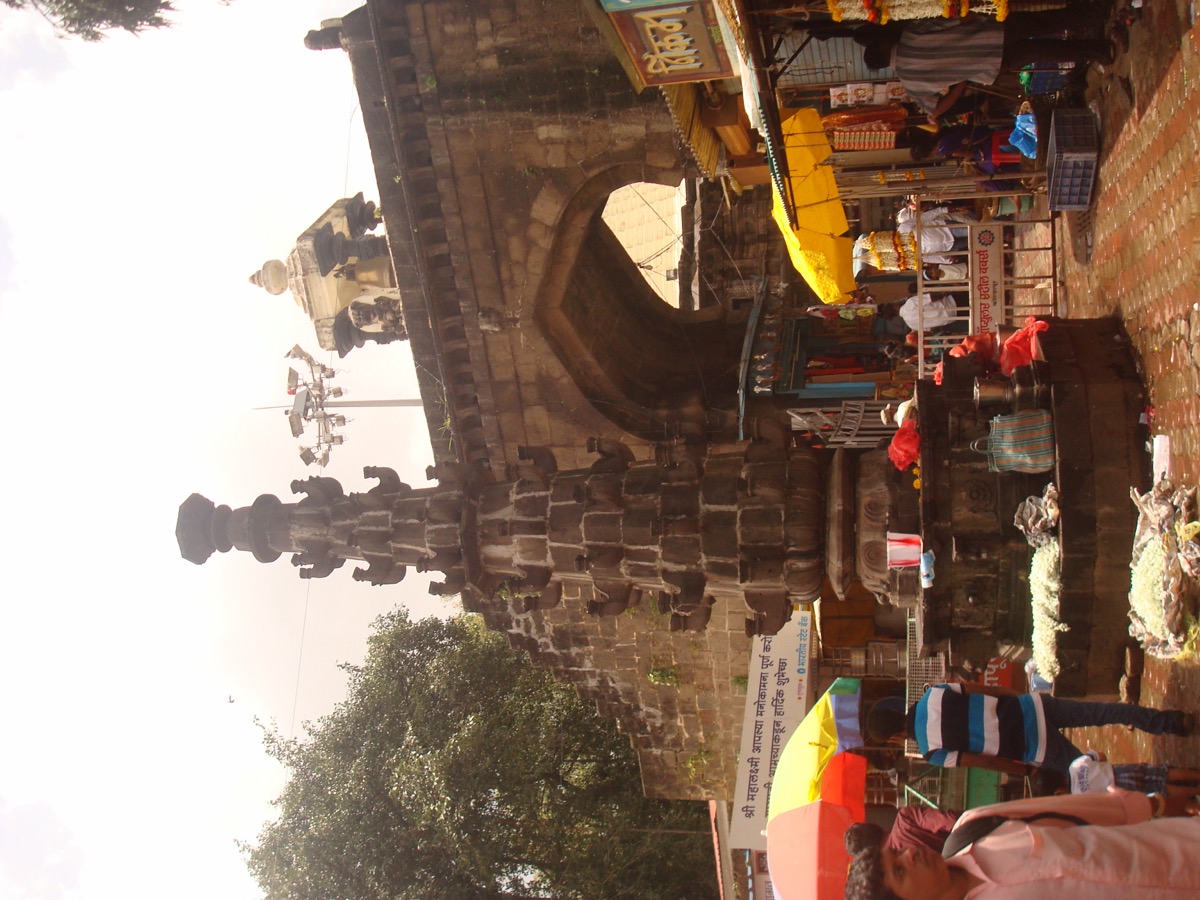
Mahālakṣmī Temple (श्री महालक्ष्मी मंदिर), nestled in the heart of the ancient city of Kolhāpur in Maharashtra, is one of the most sacred Śākta shrines in all of Hinduism. Known locally as the Ambābāī Mandir, this temple enshrines a remarkable swayambhū (self-manifested) idol of Goddess Mahālakṣmī carved in black stone — a four-armed, west-facing deity who has presided over the spiritual life of the Deccan for well over a millennium. Revered as one of the Sāḍe Tīn Śakti Pīṭhas (three and a half Śakti Pīṭhas) of Maharashtra, included among the 51 Śakti Pīṭhas of the pan-Indian tradition, and listed among the 18 Mahā Śakti Pīṭhas referenced in the Skanda Purāṇa, this temple occupies a position of extraordinary eminence in the sacred geography of the subcontinent. The city of Kolhāpur itself bears the epithet Dakṣiṇa Kāśī (“Kāśī of the South”), affirming that a pilgrimage here carries the same spiritual merit as visiting Vārāṇasī.
The Legend of Kolhāsura and the Birth of Karavīrapura
The mythological origins of Kolhāpur and its presiding deity are recorded in the Karavīra Māhātmya, a section of the Padma Purāṇa devoted entirely to the glorification of this sacred land. According to this narrative, a fearsome demon named Kolhāsura once terrorized the gods and all living beings. The devas, desperate for liberation from his tyranny, appealed to the Divine Mother. Goddess Mahālakṣmī descended to earth and engaged Kolhāsura in a terrible battle. After a prolonged cosmic struggle, She slew the demon at the very spot where the temple now stands.
The Karavīra Māhātmya declares that the spot of Kolhāsura’s death became a tīrtha (sacred ford) of the highest order. The Goddess, pleased with the devotion of the local inhabitants, chose to take permanent abode in a shrine at this location. The city that grew around this sacred site came to be called Kolhāpur after the slain demon, while its ancient Purāṇic name Karavīrapura derives from the abundance of karavīra (Nerium oleander) shrubs that once blanketed the region. The Lakṣmī Sahasranāma of the Skanda Purāṇa praises the Goddess as “Oṃ Karavīra Nivāsinyai Namaḥ” — “Glory to the Goddess who dwells in Karavīra.”
The Swayambhū Idol: A Unique Manifestation
The presiding deity of the Kolhāpur temple is one of the most distinctive and theologically significant mūrtis in all of Hindu worship. The idol of Mahālakṣmī is carved from a single block of black gemstone (some authorities describe it as black sandstone), stands approximately three feet in height, and weighs about 40 kilograms. What makes this image extraordinary from both an iconographic and devotional standpoint is a constellation of unusual features.
The Goddess is depicted with four arms: the lower right hand holds a mātuliṅga (a citron fruit, symbolizing fertility and auspiciousness), the upper right grasps a large gadā (mace, identified as the Kaumodakī of Viṣṇu, symbolizing divine power), the upper left bears a kheṭaka (shield, representing protection), and the lower left carries a pānapātra (bowl or vessel, symbolizing nourishment). A stone lion — the traditional vāhana (mount) of Durgā — stands behind the idol, while a Śivaliṅga is carved upon her crown, signifying the inseparable unity of Śiva and Śakti. The head of the serpent Śeṣanāga also adorns the crown, connecting the image to Vaiṣṇava iconography.
Perhaps most strikingly, the idol faces west — a highly unusual orientation in Hindu temple architecture, where deities almost universally face east or north. This westward orientation is integral to the temple’s most celebrated phenomenon: the Kirṇotsava. The tradition holds that the idol is swayambhū — it manifested on its own without any human installation ritual (prāṇa-pratiṣṭhā), lending it an aura of supreme sanctity.
Kirṇotsava: The Festival of Sun Rays
The Kirṇotsava (“Festival of Rays”) is the Mahālakṣmī Temple’s most awe-inspiring spectacle, a testament to the astronomical knowledge and architectural genius of the ancient builders. Twice each year, the rays of the setting sun pass through a small window on the western wall of the temple and fall directly upon the idol of the Goddess. This phenomenon is not accidental — the entire temple is oriented and constructed so that sunlight enters through this specific aperture only during these precise calendrical windows.
The Kirṇotsava occurs during two periods:
- January 31 to February 3: On the first day, the sun’s rays illuminate the feet of the Goddess; on the second day, they rise to her torso; and on the third day, the entire idol is bathed in golden sunlight.
- November 9 to 12: The phenomenon repeats in reverse order, with the rays progressively illuminating the idol over three days.
This alignment corresponds to the sun’s transit through specific zodiacal positions (the signs of Makara/Capricorn and Siṃha/Leo), demonstrating that the temple architects possessed sophisticated knowledge of solar astronomy and carefully calibrated the temple’s orientation to create this annual spectacle. Thousands of devotees gather to witness the Kirṇotsava, viewing it as a moment when Sūrya (the Sun God) himself offers abhiṣeka (ritual bathing) to the Divine Mother with his rays — a celestial worship that transcends human ritual.
The Sāḍe Tīn Śakti Pīṭhas: Maharashtra’s Sacred Quadrilateral
The Mahālakṣmī Temple holds pride of place as the foremost among Maharashtra’s Sāḍe Tīn Śakti Pīṭhas — the “three and a half” Śakti Pīṭhas that form the state’s most revered pilgrimage circuit for devotees of the Divine Mother. This concept, rooted in the Devī Bhāgavata Purāṇa, identifies four temples as the most favoured abodes of Śakti in the Deccan:
- Kolhāpur — Śrī Mahālakṣmī (Ambābāī), counted as a full Pīṭha
- Tuḷjāpur — Tuḷjā Bhavānī, counted as a full Pīṭha
- Māhur — Śrī Reṇukā Devī (Yellammā), counted as a full Pīṭha
- Vāṇī (Saptaśṛṅgī) — Saptaśṛṅgī Devī, counted as the “half” (ādhā) Pīṭha
The designation “three and a half” reflects a traditional hierarchy in which the first three temples are considered complete manifestations of the Goddess’s power, while Saptaśṛṅgī — perched at 4,800 feet on the Saptaśṛṅgī hill near Nāśik — is revered as a partial but potent seat. Together, these four Pīṭhas form a sacred quadrilateral across Maharashtra that millions of devotees traverse during Navarātri.
Beyond this regional framework, the Kolhāpur Mahālakṣmī temple is also recognized as one of the 51 Śakti Pīṭhas in the pan-Indian tradition (where Satī’s body parts fell after Viṣṇu’s Sudarśana Cakra dismembered her) and as one of the 18 Mahā Śakti Pīṭhas referenced in the Aṣṭādaśa Śakti Pīṭha Stotram attributed to Ādi Śaṅkarācārya. The Devī Bhāgavata Purāṇa (7.30) records that Satī’s three eyes fell at the location of the present Kolhāpur temple, making it a site of supreme divine vision — the Goddess literally “sees” the world from Karavīrapura.
Connection to the Devī Māhātmya
The theological identity of the Kolhāpur Mahālakṣmī is deeply intertwined with the Devī Māhātmya (also known as the Durgā Saptaśatī or Caṇḍī Pāṭha), the foundational text of Śākta philosophy embedded in the Mārkaṇḍeya Purāṇa. The Devī Māhātmya is accompanied by three esoteric commentaries known as the Rahasya Traya (“Three Secrets”), of which the Prādhānika Rahasya describes a supreme cosmic form of Mahālakṣmī who is not merely the goddess of wealth and consort of Viṣṇu, but the primordial Śakti from whom the entire universe emanates.
In the Prādhānika Rahasya, Mahālakṣmī is described as the transcendent source who gives birth to the three primary forms of the Goddess: Mahākālī (the power of dissolution), Mahālakṣmī (the power of sustenance), and Mahāsarasvatī (the power of creation). This cosmic triad corresponds perfectly to the temple’s arrangement: the sanctum of Mahālakṣmī is flanked by shrines to Mahākālī on the right and Mahāsarasvatī on the left — a physical embodiment of the Devī Māhātmya’s theological framework.
The description of the Goddess in the Prādhānika Rahasya — four-armed, bearing symbols of power and nourishment — closely matches the iconography of the Kolhāpur mūrti, leading many scholars and devotees to regard this temple as the earthly seat of the Prādhānika Mahālakṣmī herself.
A Theological Question: Lakṣmī or Pārvatī?
One of the most fascinating scholarly and devotional debates surrounding the Kolhāpur deity concerns her precise identity. While the temple is named “Mahālakṣmī,” the iconographic evidence presents an intriguing ambiguity:
- The stone lion at her feet is the vāhana of Durgā/Pārvatī, not of Lakṣmī (whose mount is the owl or elephant)
- The Śivaliṅga on her crown signifies a consort relationship with Śiva, pointing to a Śaiva affiliation
- Yet the Śeṣanāga serpent on the crown and the Kaumodakī mace are distinctly Vaiṣṇava emblems
This iconographic synthesis reflects the profound Śākta theology in which the Supreme Goddess transcends sectarian divisions. She is simultaneously Lakṣmī, Pārvatī, and Durgā — the undifferentiated Mahāśakti who manifests in all forms. As the Lakṣmī Sahasranāma of the Skanda Purāṇa declares: “Oṃ Śeṣavāsuki Saṃsevyā Namaḥ” — “Glory to the Goddess served by Ādi Śeṣa and Vāsuki” — integrating both Vaiṣṇava and Śaiva serpent symbolism into a unified devotional vision.
Architectural Heritage: From Chālukya to Marāṭhā
The Mahālakṣmī Temple is an architectural palimpsest, bearing the marks of multiple dynasties that patronized, expanded, and renovated the structure across more than thirteen centuries.
Chālukya Origins (7th Century CE)
The temple’s earliest construction is attributed to Chālukya king Karṇadeva around 634 CE, though some scholars date the initial foundation to the broader 7th–8th century period. The mortarless stone construction, horizontal mouldings, and vertical offsets of the original structure echo the distinctive style of early Deccan Chālukya temples, creating a rich interplay of light and shadow across the carved surfaces. The temple belongs architecturally to the Kannada Chālukya tradition, with affinities to the great Chālukya shrines of Bādāmī, Aihoḷe, and Paṭṭadakal.
Rāṣṭrakūṭa and Śilāhāra Patronage (8th–12th Century)
After the Chālukyas, the temple received royal patronage from the Rāṣṭrakūṭa dynasty. It was during the Śilāhāra period, however, that the temple underwent its most significant expansion. King Gaṇḍarāditya of the Śilāhāra dynasty, in the 11th century CE, completed the construction of the pradakṣiṇā patha (circumambulation path) around the main shrine and added two new sancta sanctorum consecrated to Goddess Mahākālī and Goddess Mahāsarasvatī — creating the theological triad described in the Devī Māhātmya. This was a seminal moment in the temple’s history, transforming it from a single shrine into a complete manifestation of the triple Goddess.
Yādava Dynasty Additions (12th–13th Century)
The Yādava (Seuna) dynasty further enriched the temple complex. Tailana (Tailan) constructed an ornamental archway in 1140 CE. During the Yādava period, the Mātuliṅga — a ceremonial citron fruit — was installed as a devotional object, since the actual Śivaliṅga carved on the crown of the Goddess remained invisible to ordinary worship as it stays covered. King Siṅghana of the Yādava dynasty built the Kūrma Maṇḍapa and the Gaṇapati Chowk, adding further ritual and architectural dimensions to the complex.
Between 1178 and 1209, under the rule of Rājā Jayasiṃha and Sindhava, the South Gate and the Atibaleśvara Temple were erected, expanding the sacred precinct.
Marāṭhā Era Restoration
The temple’s modern history includes a period of crisis during the Ādilshāhī (Bijapur Sultanate) rule, when the idol of the Goddess was hidden in the home of a local priest to protect it from destruction. On September 26, 1715, during the auspicious occasion of Vijayādaśamī, the idol was ceremonially re-installed in the temple — an event that marked the restoration of the temple’s sacred life under Marāṭhā sovereignty.
In the 18th century, Mahārāṇī Ahilyābāī Holkar — the legendary queen of Indore renowned for her temple restoration work across India — made significant contributions to the temple’s renovation. The Garuḍa Maṇḍapa, with its square pillars and foliated wooden arches characteristic of Marāṭhā temple architecture, was constructed under political agent Dājī Paṇḍit between 1838 and 1843. In 1954, the Kolhāpur Mahārāja Śāhajī Rāje oversaw a further restoration of the idol, and additional temple expansion took place in 1960.
The Temple Complex: Sacred Spaces
The Mahālakṣmī Temple complex is a vast sacred precinct featuring five massive towers (śikharas), with the tallest rising above the main sanctum of the Goddess. The complex encompasses numerous shrines and ritual spaces:
- Garbhagṛha (Sanctum Sanctorum): Houses the swayambhū idol of Mahālakṣmī, adorned with diamonds and precious stones. The sanctum is designed so the Kirṇotsava rays can enter through the western window.
- Mahākālī and Mahāsarasvatī Shrines: Flanking the main sanctum, completing the Devī Māhātmya triad.
- Garuḍa Maṇḍapa: The pillared hall built in the Marāṭhā period, serving as the main assembly area for devotees.
- Kūrma Maṇḍapa: The Yādava-period pavilion used for special rituals.
- Maṇikarṇikā Kuṇḍa: The sacred temple tank, on whose banks stands a shrine to Viśveśvara Mahādeva, echoing the Kāśī connection (Maṇikarṇikā being the most sacred ghāṭ in Vārāṇasī).
- Dīpastambha: The grand lamp pillar standing in the temple courtyard, a characteristic feature of Maharashtra’s great temples.
- Navagraha Shrine: A shrine dedicated to the nine planetary deities.
- Sūrya Shrine: A shrine to the Sun God, fitting given the temple’s solar alignments.
The presence of a Maṇikarṇikā Kuṇḍa and a Viśveśvara shrine within the complex directly mirrors the sacred geography of Vārāṇasī, reinforcing the designation of Kolhāpur as Dakṣiṇa Kāśī. Just as Vārāṇasī offers mokṣa through the grace of Śiva, Kolhāpur offers liberation through the grace of the Supreme Goddess.
Navarātri: The Grand Festival
Navarātri is the most magnificent and widely celebrated festival at the Mahālakṣmī Temple, drawing millions of devotees from across Maharashtra and beyond. Celebrated over ten days in the Hindu month of Āśvina (typically falling in September–October), the festival transforms the entire temple precinct and the city of Kolhāpur into a vibrant celebration of the Divine Feminine.
During Navarātri, the Goddess is elaborately decorated with different ornaments, garments, and floral arrangements each day, representing various aspects and moods of the Divine Mother. Special abhiṣeka ceremonies and mahā-naivedya (grand food offerings) are performed at 8:30 AM and 11:30 AM daily. The highlight of each evening is the Ratha Yātrā (chariot procession) at 9:30 PM, when the Goddess’s utsava mūrti (processional image) is placed in a magnificently decorated chariot illuminated with thousands of lamps and paraded through the streets of Kolhāpur to the accompaniment of traditional music and military bands.
The festival culminates on Vijayādaśamī (Dasarā), which holds special historical significance for this temple — it was on this very day in 1715 that the idol was restored to the temple after the period of concealment. The Sāḍe Tīn Śakti Pīṭha pilgrimage circuit sees its heaviest traffic during the Navarātri period, as devotees attempt to visit all four seats of the Goddess within the auspicious nine-night window.
Other major festivals include the Rathotsava (chariot festival) in April, Lalitā Pañcamī, and special celebrations on Mārgaśīrṣa Pūrṇimā — the full moon of the Mārgaśīrṣa month — when, according to one Vaiṣṇava tradition, Mahālakṣmī reunites with Lord Veṅkaṭeśvara (Viṣṇu at Tirupati) from whom She had departed after a divine disagreement.
Dakṣiṇa Kāśī: Spiritual Equivalence with Vārāṇasī
The designation of Kolhāpur as Dakṣiṇa Kāśī (“the Kāśī of the South”) is not merely honorific — it reflects a deep theological conviction, articulated in the Karavīra Māhātmya and supported by the temple’s own sacred infrastructure, that Kolhāpur offers the same spiritual merit and liberation as the holy city of Vārāṇasī. The parallels are striking:
- Both cities possess a Maṇikarṇikā — the most sacred spot for ritual bathing and cremation
- Both house a Viśveśvara (Śiva as Lord of the Universe) shrine
- Both are described in Purāṇic literature as mokṣa-dāyaka — bestowers of liberation
- Both are ancient tīrthas where the accumulated merit of worship is said to be multiplied manifold
The Karavīra Māhātmya (within the Padma Purāṇa) devotes extensive passages to establishing Kolhāpur’s equivalence with Kāśī, declaring that the Goddess herself chose this location as her permanent earthly abode — making Kolhāpur not merely a place of pilgrimage but a living, eternal seat of divine presence.
The Living Temple: Daily Worship and Modern Devotion
The Mahālakṣmī Temple maintains an elaborate daily ritual schedule that has continued, with brief interruptions, for over a millennium. The temple opens at 4:00 AM with the Kākaḍ Āratī (dawn worship with lamps), followed by Abhiṣeka (ritual bathing of the idol), Pūjā, and Mahānaivedya at scheduled intervals throughout the day. The evening Dhūp Āratī and the closing Śej Āratī (bedtime ceremony) complete the daily cycle.
The temple is administered by the Kolhāpur Devasthan Committee and attracts an estimated 10,000 to 15,000 devotees on ordinary days, with numbers swelling to hundreds of thousands during Navarātri and other festivals. The Goddess is affectionately called Ambābāī (“Mother”) by local Marāṭhī-speaking devotees, and her formal liturgical title — Śrī Karvīr Nivāsinī Ambābāī Mahālakṣmī — encapsulates her identity: the Great Lakṣmī, the Mother, who dwells in Karvīra (Kolhāpur).
Pilgrimage and Practical Significance
For the modern pilgrim, the Mahālakṣmī Temple serves as the anchor of multiple pilgrimage circuits. The Sāḍe Tīn Śakti Pīṭha Yātrā — covering Kolhāpur, Tuḷjāpur, Māhur, and Saptaśṛṅgī — is one of Maharashtra’s most popular devotional journeys, particularly during Navarātri. The Maharashtra State Road Transport Corporation (MSRTC) runs special bus services for this circuit during the festival season, making the pilgrimage accessible to devotees of all economic backgrounds.
Kolhāpur is also a significant stop on the broader Jyotirliṅga and Śakti Pīṭha pilgrimage routes of western India, connecting naturally with Bhīmāśaṅkara, Tryambakeśvara, and Gṛhṇeśvara (all Jyotirliṅgas in Maharashtra), as well as the great temple cities of Paṇḍharpura (Viṭṭhala) and Tuḷjāpur (Bhavānī).
The Mahālakṣmī Temple of Kolhāpur thus stands as a living testament to the enduring power of Śākta devotion in the Deccan — a place where Chālukya stone meets Marāṭhā devotion, where solar astronomy intersects with sacred geometry, and where the Supreme Goddess continues to manifest her grace to all who seek her in the ancient city of Karavīra.