Introduction: The Island of Shiva
An hour’s ferry ride from the Gateway of India in Mumbai, across the shimmering waters of the Arabian Sea, lies a small basalt island that harbours one of India’s supreme artistic and spiritual achievements. Known in antiquity as Ghārapurī — the “city of caves” in Marathi — Elephanta Island is home to a complex of rock-cut cave temples dedicated to Lord Śiva that rank among the greatest works of Indian sculpture. The centrepiece of this subterranean shrine is the monumental Trimūrti Sadāśiva, a 5.5-metre-high three-faced bust of Śiva that has been called “the most perfect expression of the Hindu godhead in stone.”
Carved into the volcanic basalt of the island’s twin hills, the Elephanta Caves were excavated between the mid-5th and mid-6th centuries CE, a period of extraordinary artistic flowering that also produced the painted caves of Ajanta and the rock-cut temples of Ellora. Inscribed as a UNESCO World Heritage Site in 1987, the caves represent, in the words of the UNESCO citation, “a masterpiece of human creative genius” and “an exceptional testimony to the Shaiva cult.” Despite centuries of neglect and colonial vandalism, the surviving sculptures retain a power that has moved travellers, scholars, and pilgrims for over a millennium.
The Island: Ghārapurī to Elephanta
Ancient Name and Sacred Geography
The island’s original name, Ghārapurī (also spelled Gharapuri), derives from the Marathi words “ghār” (cave) and “purī” (city or settlement). Ancient texts and copper-plate inscriptions refer to it as Puri or Purī, suggesting that it was once a prosperous settlement with its own administrative and religious significance. Situated roughly 10 kilometres east of Mumbai in the harbour, the island covers about 10-16 square kilometres and rises to two hills — the western hill containing the Hindu cave temples and the eastern hill housing a smaller group of Buddhist caves (the Stūpa Hill).
The Stone Elephant and the Portuguese Name
When Portuguese explorers first landed on the island in the early 16th century, they encountered a colossal monolithic elephant sculpted from basalt near the landing site. They christened the island “Ilha Elephanta” (Elephant Island), and the name endured in European cartography and eventually in common usage. The stone elephant itself had a troubled fate: it collapsed in 1814, was transported to the mainland by the British, and after several attempts at reassembly, was finally reconstructed in 1914 by Cadell and Hewett. Today it stands in the Jijamata Udyaan (formerly Victoria Gardens) in Mumbai, far from the island it once adorned.
Cave 1: The Great Cave of Śiva
The main temple, universally known as Cave 1 or the Great Cave, is the crown of the Elephanta complex. It is an enormous rock-cut hall carved entirely from the living basalt of the hillside, measuring approximately 39 metres from front to back, with a total area of nearly 5,000 square metres. The cave is oriented along an east-west axis and is entered through three doorways — one on the north, one on the east (the principal entrance), and one on the west.
The Pillared Hall (Maṇḍapa)
The main hall is a grand hypostyle chamber supported by rows of massive basalt columns arranged in a grid pattern. Each pillar, roughly 5 metres tall, features a fluted shaft rising from a square base, topped by a cushion capital (āmalaka) and a broad abacus. The rhythmic repetition of these pillars creates a cathedral-like atmosphere of solemn grandeur, drawing the visitor inward toward the sacred images on the walls.
The hall is divided into several functional zones. The central area serves as a circumambulatory space around the Śiva-liṅga shrine. On the north, south, and west walls, enormous sculptural panels depict various forms and legends of Śiva. Subsidiary shrines and open courtyards flank the main chamber on the east and west.
The Śiva-Liṅga Shrine (Garbhagṛha)
At the centre of the cave, slightly south of the geometric midpoint, stands a square free-standing shrine housing a Śiva-liṅga — the aniconic symbol of the Lord. This garbhagṛha is built on the sarvatobhadra plan, meaning it has doorways on all four sides, each guarded by a pair of colossal dvārapāla (door-guardian) figures. The four-sided openness is both architecturally innovative and symbolically profound: it allows the devotee to circumambulate the liṅga while remaining visually connected to the narrative panels on the surrounding walls. The sarvatobhadra plan at Elephanta represents an important development in rock-cut temple architecture that would influence later cave temples across the Deccan.
The Trimūrti Sadāśiva: Crown of Indian Sculpture
Description and Iconography
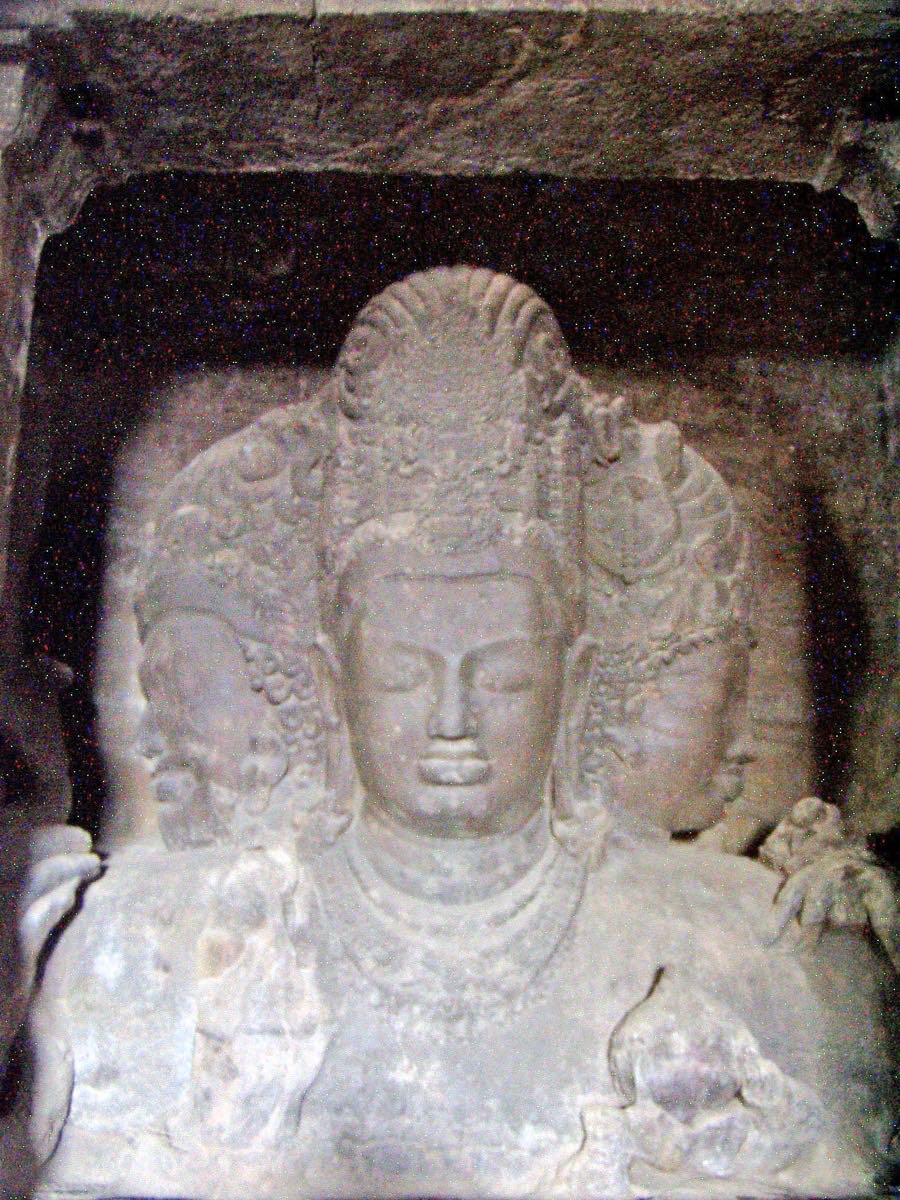
Dominating the south wall of the cave, directly opposite the north entrance, rises the most celebrated sculpture of the Elephanta complex — and arguably of all Indian art. The Trimūrti, also known as Sadāśiva or Maheshmurti (the “Great Lord” form), is a colossal three-faced bust of Śiva carved in high relief from the living rock. The sculpture measures approximately 5.45 metres (about 18 feet) in height and 6.55 metres in width, with a depth of about 3.2 metres.
The three faces represent three fundamental aspects of the divine:
-
The Central Face (Tatpuruṣa or Mahadeva): The front-facing visage gazes forward with serene composure, eyes half-closed in meditative calm. This is Śiva as the Preserver, the benevolent sustainer of the cosmos. The expression embodies the quality of sattva — pure equilibrium and transcendence. Art historians have noted that the face seems to float between wakefulness and meditation, between the world and the absolute.
-
The Left Face (Aghora or Bhairava): Turned to the viewer’s left, this face is fierce and wrathful, with thick moustache, furrowed brow, and a serpent coiled in the matted locks. This is Śiva as the Destroyer, embodying tamas — the force of dissolution and transformation. In one hand this aspect holds a cobra, symbolising the power over death and fear.
-
The Right Face (Vāmadeva or Umā): Turned to the viewer’s right, this face is strikingly feminine and gentle, with delicate features, a lotus held gracefully in one hand, and an expression of tender beauty. This is the creative, nurturing aspect of Śiva, associated with rajas and identified with the feminine principle. Some scholars identify this face with Umā (Pārvatī), the goddess consort, highlighting the inseparability of Śiva and Śakti.
Theological Significance
The Trimūrti embodies a profound theological statement. It is not merely a portrait of a god but a visual hymn to the nature of the Absolute (Brahman) as understood in Śaiva philosophy. The three faces correspond to the three guṇas (sattva, rajas, tamas), the three cosmic functions (creation, preservation, dissolution), and the three temporal modes (past, present, future). Yet they emerge from a single bust, a single rock, a single divine reality — illustrating the Shaiva Siddhānta teaching that the multiplicity of the phenomenal world arises from and returns to the one undivided Sadāśiva.
The Śvetāśvatara Upaniṣad (4.3) provides the theological foundation: “Thou art woman, thou art man; thou art the youth and the maiden too; thou as an old man totterest along on thy staff; being born, thou becomest facing in every direction.” The Elephanta sculptor has given this verse visible, tangible form.
The Great Panels: Narrative Sculptures of Śiva
Surrounding the liṅga shrine and flanking the Trimūrti, the walls of Cave 1 bear a series of monumental relief panels, each approximately 3 to 5 metres in height, depicting major episodes from Śaiva mythology. These reliefs are among the finest narrative sculptures in all of Indian art.
Ardhanārīśvara (The Androgynous Lord)
On the west face of the south wall, to the right of the Trimūrti, stands the magnificent Ardhanārīśvara panel, approximately 5 metres tall. It depicts Śiva as half-male, half-female — the right side showing the masculine form of Śiva with broad shoulders, matted hair, and a trident, and the left side showing the feminine form of Pārvatī with a rounded breast, a mirror in her hand, and an elegant hip sway. Nandī the bull stands below the Śiva half. The sculpture embodies the philosophical teaching of the Liṅga Purāṇa (1.3.2-3) that the supreme reality transcends gender, containing within itself both the masculine principle (puruṣa) and the feminine principle (prakṛti). This panel suffered significant damage during the Portuguese period, particularly in its lower portions.
Naṭarāja (The Cosmic Dancer)
On the north wall, Śiva appears as Naṭarāja, the Lord of Dance. Though damaged, the panel retains its extraordinary dynamism. The eight-armed figure is shown in a vigorous dance pose, one leg planted and the other raised, with arms fanning outward holding various attributes. Celestial musicians and attendants surround the dancing lord. Unlike the later bronze Naṭarāja of Chola art, the Elephanta Naṭarāja is carved in stone relief, but it achieves a comparable sense of cosmic motion — the Ānanda Tāṇḍava, or Dance of Bliss, through which Śiva creates, sustains, and dissolves the universe.
Gaṅgādhara (The Bearer of Gaṅgā)
Facing the Ardhanārīśvara on the east face of the south wall, the Gaṅgādhara panel narrates the descent of the sacred river Gaṅgā from heaven to earth. Śiva stands in the elegant tribhaṅga (triple-flexed) posture, roughly 5 metres tall, receiving the celestial river in his matted locks to break her fall and prevent the earth from being shattered by the force of the heavenly waters. Pārvatī stands beside him, and the three river goddesses — Gaṅgā, Yamunā, and Sarasvatī — are depicted in smaller scale. A crescent moon adorns Śiva’s coiffure, and a water vessel above symbolises the life-giving stream. The panel illustrates the myth as narrated in the Rāmāyaṇa (Bāla Kāṇḍa, chapters 42-44) and the Bhāgavata Purāṇa (9.9).
Andhakāsuravadha (The Slaying of Andhaka)
One of the most dramatically animated panels in the cave depicts Śiva’s destruction of the demon Andhaka. Śiva appears with eight arms in a fierce posture, impaling the blind demon on his trident. The demon Andhaka (“the blind one”), born from the sweat of Śiva’s forehead according to the Matsya Purāṇa (179), had attempted to abduct Pārvatī. The panel captures the terrible beauty of divine wrath — swirling draperies, dynamic limbs, and the cup into which Śiva collects the demon’s blood to prevent it from spawning new demons. Despite Portuguese damage, the sculptural energy remains palpable.
Kalyāṇasundara (The Divine Marriage)
This exquisite panel depicts the marriage of Śiva and Pārvatī. Śiva stands regally on the left, while Pārvatī — rendered with extraordinary delicacy — tilts her head slightly toward him with a subtle expression of bridal coyness. Brahmā presides over the ceremony as the officiating priest. The Viṣṇu Purāṇa and the Śiva Purāṇa both narrate the elaborate wedding, but the Elephanta sculptor distils the story into a single frozen moment of tenderness and grace.
Rāvaṇānugrahamūrti (Rāvaṇa Shaking Mount Kailāsa)
The panel dramatises the episode from the Rāmāyaṇa in which the demon-king Rāvaṇa, in his arrogance, attempts to uproot Mount Kailāsa, the abode of Śiva. Śiva sits calmly atop the mountain with Pārvatī beside him, while Rāvaṇa strains from below with his multiple arms. Śiva merely presses his toe down, and the mountain crushes Rāvaṇa beneath its weight. The contrast between Śiva’s effortless composure and Rāvaṇa’s futile exertion conveys a powerful spiritual message about the futility of ego before the divine.
Mahāyogī (The Great Ascetic)
A quieter panel shows Śiva seated in deep meditation on a lotus, limbs gathered in padmāsana. This is Śiva as Yogeśvara, the first guru of yoga, the silent axis around which all cosmic activity revolves. The meditative stillness of this panel forms a deliberate counterpoint to the kinetic energy of the Naṭarāja and Andhakāsuravadha panels.
Dating and Patronage: The Scholarly Debate
The Kalachuri Theory
The question of who commissioned the Elephanta Caves has generated considerable scholarly debate. The most widely accepted theory, championed by the art historian Walter Spink, attributes the main cave to King Kṛṣṇarāja of the Kalachuri dynasty, dating the excavation to the mid-6th century CE (approximately 535-550 CE). Spink’s argument rests on several pillars of evidence: thousands of copper coins bearing Kṛṣṇarāja’s name have been found on the island; the sculptural style shows strong affinities with other Kalachuri-period works; and the iconographic programme is consistent with the sophisticated Shaiva theology patronised by the Kalachuri court.
Alternative Attributions
Other scholars have proposed alternative patrons. Some attribute the caves to the Chalukya dynasty, particularly the powerful king Pulakeshin II (r. 610-642 CE), whose dominion extended over the Konkan coast. The Rāṣṭrakūṭa dynasty, which succeeded the Chalukyas and was responsible for the Kailāsa temple at Ellora, has also been suggested. Still others link the caves to the Konkan Mauryas, a minor dynasty that controlled the region in the 5th-6th centuries. The Śilāhāra kings (9th-13th centuries) are associated with later additions and renovations rather than the original excavation.
Stylistic Context
Regardless of the specific patron, the Elephanta sculptures belong to the artistic tradition that flowered across western India during the post-Gupta period (5th-8th centuries CE). They share stylistic features with the caves at Jogeśvarī (near Mumbai), the Daśāvatāra temple at Deogarh, and the early caves at Ellora. The monumental scale, the sophisticated interplay of high and low relief, the mastery of anatomical form, and the ability to convey complex theological ideas through visual narrative all place Elephanta at the pinnacle of this tradition.
Portuguese Destruction and Colonial History
The Devastation
The arrival of the Portuguese in the early 16th century marked a catastrophic turning point in the history of the Elephanta Caves. The island was ceded to Portugal by the sultans of Gujarat in 1534, and under Portuguese rule, the caves ceased to function as active places of worship. Portuguese soldiers, motivated by religious iconoclasm and simple vandalism, used the sculptures for target practice. Arms and legs were shot off, faces disfigured, and entire lower sections of panels destroyed. The Ardhanārīśvara, Naṭarāja, and Andhakāsuravadha panels all bear the scars of this systematic destruction.
An inscribed stone at the island’s entrance, which might have provided crucial evidence about the caves’ patrons and date, was removed by the Portuguese Viceroy João de Castro in 1540 and subsequently lost. This act of colonial plunder robbed historians of what might have been definitive proof of the caves’ origins.
Transfer to the British
In 1661, the island passed to the British Crown as part of the dowry of Catherine of Braganza upon her marriage to King Charles II. The British showed somewhat greater respect for the monuments, though damage continued through neglect. Conservation efforts began tentatively in 1890 under the Bombay Public Works Department, and the Archaeological Survey of India (ASI) assumed custodianship in 1909.
UNESCO Inscription and Conservation
World Heritage Status (1987)
The Elephanta Caves were inscribed on the UNESCO World Heritage List in 1987 under cultural criteria (i) and (iii). The UNESCO citation recognised the caves as “a masterpiece of human creative genius” and noted that they “bear a unique or at least exceptional testimony to a cultural tradition or to a civilisation which is living or which has disappeared.” The inscription brought international attention and resources to the conservation of the site.
Conservation Efforts
Major conservation and consolidation work was undertaken in the 1970s, stabilising the fragile rock surfaces and preventing further deterioration. Post-inscription efforts have focused on stabilising rock faces, consolidating fallen pillars, repairing collapsed facades, constructing protective pathways, and managing visitor impact. The ASI continues to maintain the site, balancing the needs of conservation with public access. Challenges remain, including water seepage, biological growth on the rock surfaces, and the cumulative impact of over a million visitors annually.
Visiting the Caves: The Journey from Mumbai
The Boat Ride
The journey to Elephanta begins at the Gateway of India jetty in Colaba, South Mumbai. Ferries operated by the Maharashtra Tourism Development Corporation (MTDC) and private operators depart between 9:00 AM and 2:00 PM daily (except Mondays, when the caves are closed). The one-hour voyage across the harbour offers views of the Mumbai skyline, the Colaba coastline, and Marine Drive. Tickets cost approximately 120-200 rupees for a round trip.
The Climb
Upon landing at the island jetty, visitors face a 1-kilometre walk and a climb of approximately 120 steps up the hillside to reach the cave entrances. The path is lined with souvenir stalls and refreshment vendors. A small toy train operates between the jetty and the foot of the hill. The caves are open from 9:30 AM to 5:30 PM, and an entry fee is charged by the ASI.
The Elephanta Festival
Since 1989, the Maharashtra Tourism Development Corporation has organised the annual Elephanta Festival, typically held in February over two days. The festival transforms the island into an open-air stage for classical Indian performing arts. Kathak, Bharatanatyam, Odissi, and other classical dance forms are performed against the dramatic backdrop of the illuminated caves. Hindustani classical vocal and instrumental music fill the night air. The festival traditionally opens with a folk dance by the local Koli fishing community, honouring the island’s maritime heritage. Craft exhibitions, local cuisine, and cultural activities complement the performances, making the Elephanta Festival one of Mumbai’s most distinctive cultural events.
Spiritual Significance: The Living Theology of Stone
The Elephanta Caves are not merely an art-historical monument. They are a stone scripture — a three-dimensional exposition of Shaiva theology as profound as any textual commentary. The arrangement of the panels is itself a theological statement: the devotee who enters the cave and circumambulates the liṅga shrine encounters Śiva in all his aspects — as the tranquil meditator, the cosmic dancer, the wrathful destroyer of demons, the androgynous union of male and female, the bearer of the sacred river, and the bridegroom of Pārvatī. At the culmination of this journey stands the Trimūrti, revealing the ultimate truth: all these forms are faces of the one Sadāśiva, the Eternal Śiva, who is beyond form yet contains all forms.
The Māṇḍūkya Upaniṣad teaches that Brahman has four states: waking, dreaming, deep sleep, and the transcendent “fourth” (turīya) that underlies them all. The Elephanta Trimūrti may be read as a sculptural meditation on this teaching: the three visible faces represent the three manifest states, while the implied fourth face — invisible, turned toward the rock itself — points to the turīya, the formless absolute that is the ground of all being.
In this way, the caves of Ghārapurī remain, after fifteen centuries, what they were always meant to be: not a museum but a mandira, not a gallery but a garbhagṛha — a womb-house of the divine, where stone speaks the silence of the Absolute.