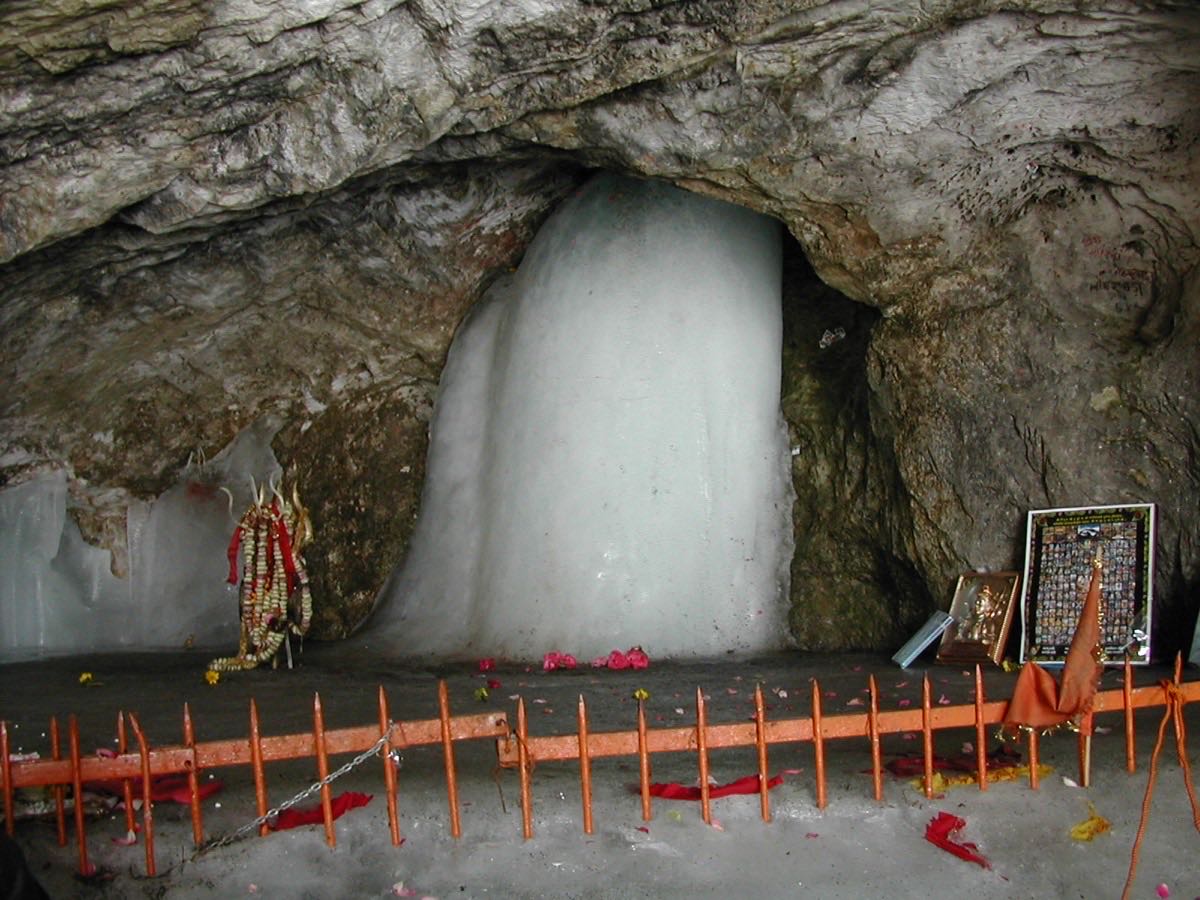
High in the Kashmir Himalayas, at an altitude of 3,888 metres (12,756 feet) in the Anantnag district of Jammu and Kashmir, lies one of Hinduism’s most awe-inspiring sanctuaries — the cave shrine of Amarnāth (अमरनाथ). Each year, as summer melts the surrounding snowfields, water seeping through the limestone ceiling of this ancient cave freezes into a towering ice stalagmite revered by millions as a naturally manifested Śivaliṅga — a physical symbol of Lord Śiva’s formless, infinite nature. The name “Amarnāth” itself means “Lord of Immortality” (from Sanskrit amara, immortal, and nātha, lord), pointing directly to the cave’s most celebrated legend: that it was here Śiva disclosed the secret of eternal life to his consort, Goddess Pārvatī.
The Legend of the Amar Kathā
The most revered mythological tradition associated with Amarnāth is the narration of the Amar Kathā — the “Story of Immortality.” According to this account, Goddess Pārvatī once asked Lord Śiva why he was immortal while all other beings perished. Śiva, moved by her persistent devotion, agreed to reveal the closely guarded secret, but insisted on a location so remote that no living creature could overhear the discourse, for knowledge of immortality in the wrong hands would upset the cosmic order.
Śiva chose the cave now known as Amarnāth. To ensure absolute privacy during the journey, he undertook a series of symbolic renunciations along the way:
- At Pahalgam (from Bailgāṁv, “village of the bull”), he left his mount Nandī, the sacred bull.
- At Chandanvāḍī, he released the Moon (Candra) from his matted locks.
- At the shores of Śeṣanāga lake, he shed his serpent ornaments, the Nāgas.
- At Mahāguṇas mountain, he left behind his son Gaṇeśa.
- At Pañcatarṇī (“five streams”), he abandoned the five elements — earth, water, fire, air, and ether — that constitute all material existence.
Thus stripped of every worldly attachment, Śiva entered the cave with Pārvatī and assumed samādhi (deep meditative absorption). He then created Kālāgni (the fire of destruction) to scorch the surroundings and ensure no creature survived to eavesdrop. In this sanctified space, he narrated the Amar Kathā.
The Two Immortal Pigeons
However, tradition holds that a pair of pigeons (or doves) had nested inside the cave and inadvertently heard the entire discourse. Having absorbed the secret of immortality, they became eternal. Pilgrims to this day report sighting pairs of pigeons deep inside the cave, far from any natural food source, and regard such a sighting as an extraordinarily auspicious blessing — living proof of the Amar Kathā’s power.
The Amarnāth Māhātmya (a devotional text glorifying the shrine) describes the pigeons as divine witnesses, perpetually circling the cave as testimony to Śiva’s grace.
The Ice Śivaliṅga: Nature’s Sacred Formation
The centrepiece of the Amarnāth shrine is the ice stalagmite that forms naturally within the cave. Water droplets seeping through the limestone ceiling freeze as they hit the cold cave floor, gradually building an upward-growing dome of ice that can reach a height of over two metres. Devotees call this formation “Bābā Barfānī” (“Lord of Ice”).
The ice liṅga traditionally waxes and wanes with the lunar cycle, reaching its maximum height around the full moon of the Hindu month of Śrāvaṇa (July-August) — precisely the period when the annual yātrā takes place. Two smaller ice formations flanking the main stalagmite are venerated as representations of Goddess Pārvatī and Lord Gaṇeśa.
The limestone cave itself is approximately 40 metres (130 feet) wide and 11 metres (36 feet) high at the entrance, sloping inward to a depth of about 24 metres (80 feet). The cave’s interior maintains temperatures well below freezing even during peak summer, creating the conditions necessary for the liṅga’s formation.
Historical and Textual References
The antiquity of Amarnāth as a pilgrimage site is attested by multiple classical texts:
Nīlamata Purāṇa
The Nīlamata Purāṇa, one of the earliest texts describing the religious and cultural life of Kashmir (dated as early as the 6th-7th century CE, though some scholars place its core material in the 3rd century), contains references to the worship of Śiva at sacred sites in the Kashmir valley, including high-altitude cave shrines.
Rājataraṅgiṇī
The 12th-century historical chronicle Rājataraṅgiṇī (“River of Kings”) by the Kashmiri historian Kalhaṇa records that Sāndimati, a ruler of Kashmir (traditionally dated to 34-17 BCE), made a pilgrimage to the ice liṅga. This reference places devotional activity at the cave at least two millennia ago.
Bṛhat Saṃhitā and Amarnāth Māhātmya
The site is also referenced in the Bṛhat Saṃhitā of Varāhamihira (6th century CE) and in the Amarnāth Māhātmya, a dedicated devotional text extolling the cave’s glory and prescribing rituals for pilgrims.
The Būṭā Malik Legend
A popular Kashmiri folk tradition attributes the cave’s modern rediscovery to a Muslim shepherd named Būṭā Malik. According to this account, Būṭā Malik encountered a sage who gave him a sack of coal. Upon reaching home, the coal had transformed into gold. Rushing back to thank the sage, Malik instead found the cave with the ice liṅga. This legend — though its historicity is debated (the earliest written accounts date to the 20th century) — is significant for reflecting the shrine’s deep interfaith roots in Kashmiri culture. The Malik family traditionally received a share of the shrine’s offerings in recognition of this discovery.
The Annual Yātrā: Pilgrimage Routes
The Amarnāth Yātrā is one of India’s most demanding and spiritually charged pilgrimages. Conducted annually during the 45-60 day window around the Śrāvaṇī Melā (July-August), it draws over half a million pilgrims in a typical year. Two primary routes lead to the cave:
The Pahalgam Route (Traditional Route)
The longer, more traditional path begins at Pahalgam in Anantnag district and covers approximately 36-48 kilometres over 3-5 days. The route passes through:
- Chandanvāḍī (2,895 m) — the first major camp, where Śiva is said to have released the Moon
- Piṣṣū Top (3,600 m) — a steep ascent named after a legendary battle between demons
- Śeṣanāga (3,657 m) — a stunning glacial lake where Śiva shed his serpents
- Pañcatarṇī (3,657 m) — the confluence of five streams, where Śiva released the five elements
- Amarnāth Cave (3,888 m) — the final destination
The Baltal Route (Shorter Route)
Beginning at Baltal in the Sonamarg area of Ganderbal district, this route covers approximately 14-15 kilometres and can be completed in a single day, though the terrain is steeper and more strenuous. It passes through Domail, Barārī, and Saṅgam before reaching the cave.
Pilgrims travel on foot, on ponies, in palanquins (palkhī), or by helicopter (from designated helipads). All participants must register with the Shri Amarnath Shrine Board (SASB) and carry mandatory RFID tags for safety tracking.
The Chharī Mubārak Procession
A distinctive tradition of the Amarnāth Yātrā is the ceremonial procession of the Chharī Mubārak — a sacred silver mace representing Lord Śiva’s divine authority. According to tradition, when pilgrims in ancient times faced threats from demons (rākṣasas) on the treacherous mountain paths, the sage Bṛṅgeśa prayed to Śiva for protection. Śiva gifted him a silver mace imbued with divine power.
The Chharī Mubārak departs from the Dashanāmī Akhāṛā in Srinagar and travels in a grand procession to the cave, led by the head priest (Mahant). Its arrival at the cave on Śrāvaṇa Pūrṇimā (the full moon of Śrāvaṇa, coinciding with Rakṣā Bandhana) marks the spiritual climax of the yātrā. The procession symbolically re-enacts the divine journey of Śiva and Pārvatī to the cave.
The Shri Amarnath Shrine Board
The Shri Amarnath Shrine Board (SASB), established by the Government of Jammu and Kashmir, is the statutory body responsible for managing the shrine and organising the annual yātrā. Its responsibilities include:
- Registration and health certification of pilgrims
- Maintenance of trek routes, camps, and medical facilities
- Coordination with the Indian Army, Central Reserve Police Force (CRPF), and state police for security
- Environmental conservation measures, including waste management and single-use plastic bans
- Helicopter services and emergency evacuation
The Board works in close coordination with multiple agencies to ensure the safety of pilgrims in what remains one of the most logistically challenging religious events in the world.
Challenges and the Test of Devotion
The Amarnāth Yātrā has faced numerous challenges throughout its history:
- Security concerns: The pilgrimage was suspended from 1991 to 1995 due to militancy in Kashmir. Terrorist attacks have targeted the yātrā on several occasions, including incidents in 2000, 2001, 2002, and 2017.
- Natural disasters: A devastating snowstorm in 1996 killed over 250 pilgrims. Flash floods caused by cloudbursts have struck multiple times, including a deadly cloudburst in July 2022 that killed at least 13 people near the cave.
- Altitude sickness and health risks: The high altitude, unpredictable weather, and strenuous terrain make the pilgrimage physically demanding. Medical camps with oxygen support and 24/7 ambulance services operate along both routes.
Despite these dangers, the unbroken faith of devotees has ensured that the yātrā continues year after year. For many pilgrims, the physical hardship is itself a form of tapas (austerity) — a purification of body and spirit that makes the final darśana of the ice liṅga all the more transcendent.
Spiritual Significance
Amarnāth occupies a unique position in Hindu sacred geography. It is simultaneously a Śiva kṣetra (field of Śiva), a site of profound ascetic power, and — according to some traditions — a Śaktipīṭha (seat of divine feminine energy, associated with Pārvatī’s presence during the Amar Kathā narration).
The theological message of Amarnāth is inseparable from its landscape. Śiva, the great ascetic, chose the most remote, inhospitable, and breathtakingly beautiful corner of the Himalayas to reveal the ultimate truth. The pilgrim who undertakes the yātrā mirrors Śiva’s own journey of renunciation — leaving behind comfort, security, and worldly attachment, ascending through progressively more austere terrain until, in the cold silence of the cave, they stand before the ice liṅga: impermanent in form yet eternal in significance.
As the Amarnāth Māhātmya declares, the merit of worshipping Śiva at Amarnāth surpasses that of a thousand pilgrimages to other sacred sites, for here the devotee encounters not a sculpted image or an ancient stone, but a liṅga fashioned anew each year by nature itself — a perpetual reminder that the divine is not fixed in the past but forever manifesting in the present.