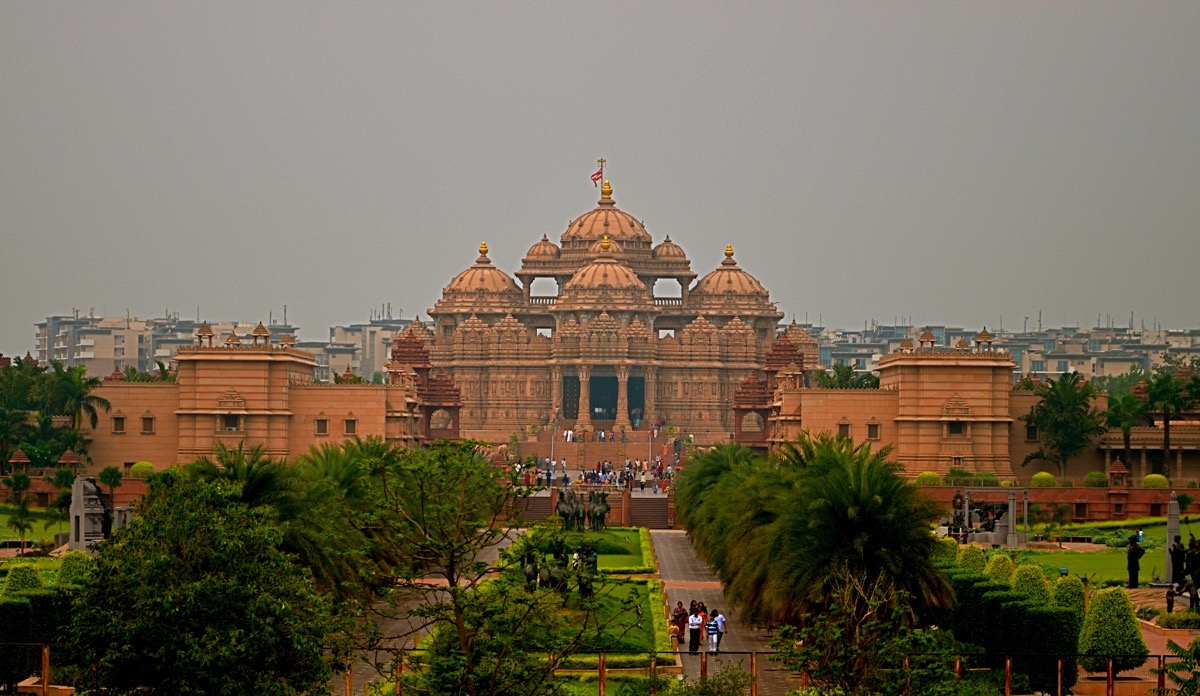
Swaminarayan Akshardham (Sanskrit: अक्षरधाम, Akṣaradhām, “the eternal divine abode”) in New Delhi stands as one of the most ambitious religious and cultural monuments built in the modern era. Inaugurated on 6 November 2005, this sprawling 100-acre complex on the banks of the Yamunā river marries ancient Indian architectural principles with contemporary engineering, creating a structure that has been called both a temple and a living cultural exposition of 10,000 years of Indian civilization.
Unlike the ancient tīrthas that dot India’s sacred geography — Varanasi, Dwarka, Rameshwaram — Akshardham is a decidedly modern creation. Yet it draws deeply from the Vāstu Śāstra and Śilpa Śāstra traditions that governed temple construction for millennia, seeking to demonstrate that the principles encoded in texts like the Mānasāra and Mayamata remain vibrant and architecturally viable in the twenty-first century.
The Vision of Pramukh Swami Maharaj
The temple is the brainchild of Pramukh Swami Maharaj (1921–2016), the fifth spiritual successor of Bhagavān Swāminārāyaṇa (1781–1830) and the head of the Bochasanwasi Akshar Purushottam Sanstha (BAPS), one of the largest Hindu organizations in the world. Pramukh Swami envisioned Akshardham not merely as a place of worship but as a comprehensive cultural complex that would inspire visitors — Hindu and non-Hindu alike — with the depth, continuity, and contemporary relevance of Indian spiritual civilization.
The seed of this vision was planted in 1968 when Pramukh Swami Maharaj first expressed the desire to build a grand cultural complex in Delhi that would serve as a gateway to Indian values for generations to come. The project took formal shape in the late 1990s, and construction began in earnest in 2000. Over the next five years, approximately 11,000 artisans and volunteers worked on the site, many of them traditional śilpīs (temple sculptors) from Rajasthan who brought centuries-old stone-carving lineages to the project.
Pramukh Swami Maharaj personally oversaw the project’s artistic and spiritual direction, reviewing thousands of design sketches and carved panels. His guiding principle was that every element of the complex should teach something — every carved figure should tell a story, every exhibition should transform the visitor’s understanding of Indian heritage.
Architecture: A Symphony in Stone
The central monument of Akshardham is an architectural tour de force that deliberately eschews modern construction shortcuts. Rising 141 feet (43 metres) in height, spanning 356 feet (109 metres) in width, and extending 316 feet (96 metres) in length, the main temple (mandir) was built using approximately 6,000 tons of pink Rajasthani sandstone and 100,000 tons of Italian Carrara marble — and notably, no structural steel was employed in the superstructure.
This last detail is extraordinary in the context of modern construction. The absence of steel means the temple relies entirely on traditional load-bearing stone construction methods — the same principles documented in the Śilpa Śāstra texts that governed the building of Khajurāho, Konārak, and the great Chola temples. Iron clamps and dowels join stone blocks in a technique continuous with ancient practice, while the overall structural engineering was validated through modern computer-aided analysis.
Key Architectural Features
- 234 ornately carved pillars support the interior, each unique in its decorative programme
- 9 ornate domes (śikhara) crown the structure, representing the navagraha (nine celestial bodies)
- 20,000 carved figures of deities, sages, musicians, dancers, and devotees adorn the walls and pillars
- 148 life-size elephant sculptures form the Gajendra Pīṭha (elephant plinth) at the base — each elephant carved from a single stone block and depicting episodes from Hindu scripture and Indian history
- The Garbhagṛha (sanctum sanctorum) houses the central mūrti of Bhagavān Swāminārāyaṇa, an 11-foot-tall gold-leafed idol in abhaya mudrā (the gesture of fearlessness)
The architectural programme draws from multiple regional temple traditions: the Nāgara style of north India (visible in the curvilinear śikharas), the ornate sculptural density of Hoysala art (reflected in the intricately carved panels), and the grand scale of Chola architecture. The result is a deliberate synthesis — a pan-Indian temple that does not belong to any single regional tradition but synthesizes them all.
Vāstu and Śilpa Śāstra Principles
The entire complex adheres to Vāstu Śāstra, the ancient Indian science of architecture and spatial arrangement. The main temple faces east — the auspicious direction associated with the rising sun and spiritual awakening. The proportional systems governing the relationship between the adhiṣṭhāna (base), bhitti (walls), prastara (entablature), and śikhara (tower) follow ratios prescribed in the Mānasāra Śilpa Śāstra, a foundational text of Indian temple architecture.
The Śilpa Śāstra texts specify that a temple is not merely a building but a microcosmic representation of the universe — the Vāstu Puruṣa Maṇḍala. Akshardham’s floor plan conforms to this sacred geometry, with the garbhagṛha positioned at the brahmasthāna (cosmic centre) and the concentric zones radiating outward following prescribed spatial hierarchies.
The Central Mūrti and Worship
At the spiritual heart of Akshardham stands the 11-foot idol of Bhagavān Swāminārāyaṇa (1781–1830), the founder of the Swaminarayan Sampradāya. Born as Ghanshyām Pande in Chhapaiya, Uttar Pradesh, Swāminārāyaṇa is regarded by his followers as the supreme manifestation of Parabrahman (the Supreme Being). The Vacanāmṛta, the primary scripture of the Swaminarayan tradition, records his philosophical discourses in which he synthesizes Viśiṣṭādvaita (qualified non-dualism) with devotional theism.
Surrounding the central sanctum are mūrtis of Sītā-Rāma, Rādhā-Kṛṣṇa, Śiva-Pārvatī, Lakṣmī-Nārāyaṇa, and the Guru Paramparā (lineage of spiritual masters) of the BAPS tradition. This arrangement underscores BAPS’s position that Swāminārāyaṇa is not a sectarian deity but the supreme reality who encompasses all divine manifestations.
Daily worship (nitya pūjā) follows the Swaminarayan liturgical tradition, including the mahā āratī ceremony performed each evening. The temple observes major Hindu festivals — Diwālī, Janmāṣṭamī, Rāma Navamī — alongside events specific to the Swaminarayan calendar, such as Swāminārāyaṇa Jayantī.
Cultural Exhibitions
What distinguishes Akshardham from traditional temples is its suite of immersive cultural exhibitions, designed to make Indian heritage accessible through modern presentation technologies.
Sahajanand Darshan (Hall of Values)
This exhibition uses lifelike robotics, fibre optic lighting, and dioramic displays across 15 halls to present episodes from Swāminārāyaṇa’s life and the values he taught — ahiṃsā (non-violence), sevā (selfless service), family harmony, and devotion to God. The animatronic figures were crafted by international specialists and are among the most sophisticated in any Indian cultural venue.
Neelkanth Darshan (Large-Format Film)
A 40-minute large-format film chronicles the youthful pilgrimage of Nīlkaṇṭha Varnī — the name under which Swāminārāyaṇa undertook a seven-year barefoot journey across India as a child-ascetic. Shot on location across the subcontinent, the film deploys a giant screen to immerse viewers in India’s natural and spiritual geography.
Sanskruti Vihar (Cultural Boat Ride)
Perhaps the most distinctive exhibition, Sanskṛti Vihār is an indoor boat ride that carries visitors along a waterway past life-size tableaux depicting 10,000 years of Indian civilization. From the Vedic period and the Indus Valley settlements to the mathematical achievements of Āryabhaṭa, the surgical techniques of Suśruta, the grammatical genius of Pāṇini, and the spiritual luminaries of medieval and modern India — the exhibition presents a panoramic sweep of Indian contributions to world civilization.
Sahaj Anand Water Show
The evening culmination of a visit to Akshardham is the Sahaj Ānand water show, performed in an outdoor amphitheatre featuring the Yajñapuruṣa Kuṇḍa — described as the world’s largest yajña kuṇḍa (ceremonial fire pit), built in the traditional stepped design. The show uses water fountains, fire projections, laser effects, and music to narrate a scene from the Kena Upaniṣad (approximately 3rd century BCE) in which the gods learn that their powers derive from Brahman alone. The narrative weaves Upaniṣadic philosophy with spectacular visual effects, making abstract Vedāntic ideas accessible to a general audience.
Guinness World Records
In December 2007, Swaminarayan Akshardham was officially recognized by the Guinness World Records as the “World’s Largest Comprehensive Hindu Temple.” The record acknowledges not merely the physical dimensions of the temple but the comprehensiveness of the complex — encompassing the main monument, the cultural exhibitions, the musical fountain, landscaped gardens (Bhārat Upavan, a garden themed on India’s flora), and the educational facilities.
The complex also features the Narayan Sarovar — a lake containing sanctified water from 151 rivers, lakes, and sacred water bodies across India. Devotees perform parikramā (circumambulation) around this lake as an act of devotion.
Construction: A Monumental Volunteer Effort
The construction of Akshardham represents one of the most remarkable volunteer-driven building projects in modern history. While professional engineers and architects provided technical oversight, a significant portion of the labour was contributed by BAPS volunteers (kāryakartās) who donated their time and skills.
The stone-carving work was executed by approximately 7,000 śilpīs (traditional artisans) stationed at dedicated workshops in Rajasthan. These craftsmen used both traditional hand tools — chisels, mallets, and abrasives — and modern power tools to shape the sandstone and marble. The carved components were then transported to Delhi and assembled on-site using a combination of traditional joinery techniques and modern cranes.
The entire project was completed in approximately five years — a remarkably short timeline for a structure of this complexity built substantially in stone without steel framing. By comparison, the great medieval temples of India — Konārak, Khajurāho, Thanjavur — took decades or even centuries to complete, though at scales generally smaller than Akshardham.
Controversy and Debate
Akshardham has not been without its critics. Some architectural purists argue that the temple, despite its adherence to Śilpa Śāstra proportions, is essentially a modern theme park dressed in traditional stonework — that it lacks the organic, centuries-layered sacredness of ancient tīrthas like Varanasi or Rameshwaram. Others have noted the temple’s close association with the BAPS organization, questioning whether a sectarian institution’s cultural complex should be presented as representative of pan-Indian heritage.
Security concerns have also shaped the complex. A terrorist attack in September 2002 — before the temple’s completion — killed two people and injured several others. As a result, Akshardham enforces stringent security measures, including a ban on cameras, mobile phones, and electronic devices inside the complex. While these measures are understandable, they have drawn criticism for creating an atmosphere more akin to an airport than a place of worship.
Supporters counter that Akshardham has succeeded in its primary mission: introducing millions of visitors — including large numbers of international tourists and school groups — to Indian spiritual heritage in an accessible, engaging format. The temple receives approximately 70 percent non-Hindu visitors, a remarkable statistic that underscores its effectiveness as a cultural bridge.
Comparison with Traditional Tīrthas
Akshardham occupies a unique position in the landscape of Hindu sacred sites. Unlike ancient tīrthas whose sanctity derives from scriptural reference, legendary association, or natural geography (a river confluence, a mountain cave, a self-manifested liṅga), Akshardham’s significance is primarily cultural and devotional rather than mythological.
The Skanda Purāṇa defines a tīrtha as any place where the divine is especially accessible — where the barrier between the mundane and the sacred thins. By this expansive definition, Akshardham qualifies: it is a place where the arts, sciences, and spiritual wisdom of Indian civilization are concentrated and made available to all seekers, regardless of caste, creed, or nationality.
In the tradition of modern Hindu temple-building movements — from the Birla Mandirs of the twentieth century to the reconstructed Somnath temple championed by Sardar Patel — Akshardham represents the latest and most ambitious attempt to create a sacred space that speaks to contemporary sensibilities while honouring traditional forms.
Visitor Experience and Practical Information
Akshardham welcomes visitors six days a week (closed on Mondays) and charges no entry fee for the main temple. The exhibitions require separate tickets. The complex includes vegetarian dining facilities, a gift shop offering books and artefacts related to Indian heritage, and extensive landscaped gardens suitable for contemplative walks.
The recommended visiting sequence begins with the main temple for darśana (sacred viewing) of the central mūrti, proceeds through the exhibition halls, continues with the boat ride, and culminates with the evening water show. A thorough visit requires approximately four to five hours.
The temple’s location on National Highway 24, near the Akshardham Metro Station on the Delhi Metro’s Blue Line, makes it easily accessible. It has become one of Delhi’s most visited cultural attractions, drawing an estimated 12,000 visitors daily and over 100 million total visitors since its inauguration.
Legacy and Continuing Influence
Swaminarayan Akshardham Delhi has inspired similar BAPS temple projects worldwide, including the Swaminarayan Akshardham in Robbinsville, New Jersey (inaugurated in 2023), which is the largest Hindu temple in the Western Hemisphere. The architectural and organizational model pioneered in Delhi — combining traditional stone construction with modern cultural exhibitions — has become a template for a new generation of Hindu temples that aspire to be both sacred spaces and cultural institutions.
Pramukh Swami Maharaj, who did not live to see the completion of the New Jersey temple (he passed away in 2016), left behind a legacy that redefined what a Hindu temple could be in the modern world. Akshardham Delhi remains the most visible expression of that legacy — a place where the ancient and the modern coexist, where 10,000 years of civilizational memory are encoded in stone, and where the doors remain open to anyone seeking to understand the spiritual traditions of India.