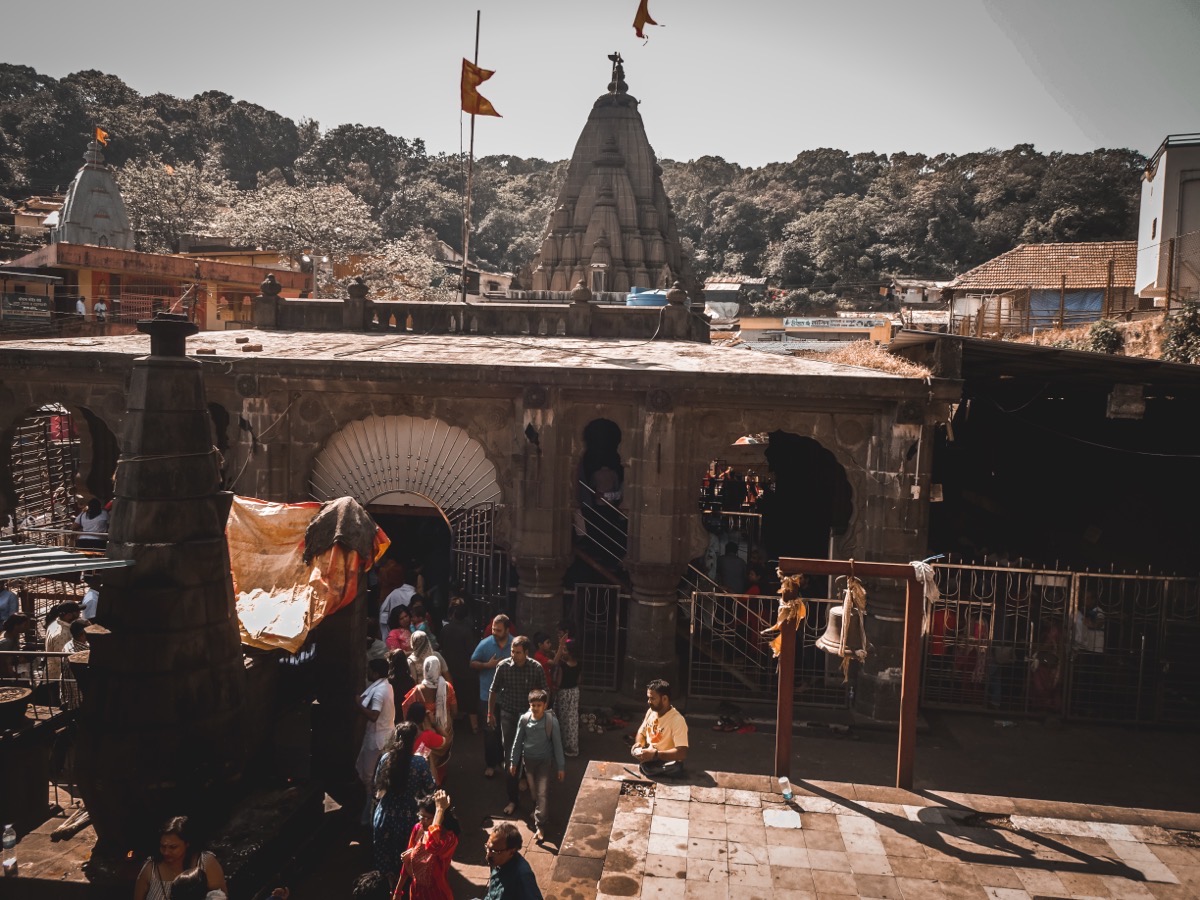
The Bhīmāśaṅkara Temple, nestled deep in the ancient Sahyādri mountain range of western Maharashtra, is one of the twelve sacred Jyotirliṅgas of Lord Śiva. Situated at an altitude of approximately 1,034 metres above sea level in the Khed taluka of Pune district, this temple stands at the confluence of the divine and the wild — a timeless shrine surrounded by dense semi-evergreen forests that harbour some of the Western Ghats’ most remarkable biodiversity. The story of its origin, recorded in the Śiva Purāṇa (Koṭirudra Saṃhitā, Chapters 20-21), tells of the cosmic battle between Lord Śiva and the demon Bhīma, a tale of arrogance undone by divine grace.
The Legend of the Demon Bhīma
Birth and Penance
The mythology of Bhīmāśaṅkara is rooted in the events following the great war of the Rāmāyaṇa. According to the Śiva Purāṇa, after Lord Rāma slew the demon king Rāvaṇa and his mighty brother Kumbhakarṇa in the battle of Laṅkā, Kumbhakarṇa’s wife — grief-stricken and displaced — retreated into the forests of the Sahyādri mountains. There, in exile, she gave birth to a son whom she named Bhīma.
Growing up in the wilderness, Bhīma eventually learned the truth of his parentage — that his father was the fearsome Kumbhakarṇa, and that his uncle Rāvaṇa had been vanquished by Lord Rāma with the aid of the gods. Consumed by rage and a desire for vengeance, Bhīma resolved to acquire power that would make him invincible. He undertook severe penance (tapas) for a thousand years, directing his austerities toward Lord Brahmā.
The Boon and the Tyranny
Pleased by the ferocity of Bhīma’s penance, Lord Brahmā appeared before him and granted him immense power. Armed with this divine boon, Bhīma grew arrogant and tyrannical. He conquered the three worlds — heaven, earth, and the netherworld — dethroning Indra and the other Devas. His reign of terror extended to the suppression of all dharmic worship, as he forbade the performance of yajñas and the veneration of the gods.
Bhīma’s wrath particularly targeted devotees of Lord Śiva. He marched upon the kingdom of Kāmarūpa (identified by some scholars with the Dakiṇī region of the Sahyādris, though others associate it with Assam) and seized its righteous king, Kāmarūpeśvara, a devout Śiva-bhakta. Bhīma imprisoned the king and commanded him to abandon his worship of Śiva, but the steadfast Kāmarūpeśvara refused. Even in captivity, the king fashioned a small earthen Śivaliṅga and continued his daily worship with unwavering devotion.
The Divine Manifestation
Enraged by the king’s defiance, Bhīma stormed into the prison and raised his sword to destroy the Śivaliṅga. At that instant, Lord Śiva himself manifested from the liṅga in his terrifying form. A fierce battle ensued between the Lord and the demon. The Śiva Purāṇa describes how Śiva, uttering the sacred syllable “Hūṃ,” reduced Bhīma to ashes with the blazing fire of his third eye.
Witnessing this cosmic event, the Devas, Ṛṣis, and celestial beings gathered at the site and entreated Lord Śiva to remain there permanently in the form of a Jyotirliṅga — a self-manifested pillar of light. Lord Śiva graciously acceded to their request, and the liṅga became known as Bhīmāśaṅkara — “Śaṅkara (Śiva) who vanquished Bhīma.”
The Birth of the Bhīmā River
One of the most evocative elements of the Bhīmāśaṅkara legend concerns the origin of the Bhīmā River (also called Bhīmarathī). According to tradition, after the ferocious battle with the demon, Lord Śiva rested at this spot. The perspiration that flowed from his divine body is said to have coursed down the mountain slopes and become the Bhīmā River, one of the major tributaries of the Kṛṣṇā.
The Bhīmā rises near the Bhīmāśaṅkara temple in the Sahyādri hills and flows southeastward for approximately 861 kilometres through Maharashtra, Karnataka, and Telangana before merging with the Kṛṣṇā River. According to the Encyclopaedia Britannica, the river’s drainage basin is bounded by the Western Ghats to the west, the Bālāghāṭ Range to the north, and the Mahādeo Hills to the south. Its waters sustain agriculture across vast tracts of the Deccan Plateau, irrigating crops of sorghum, millet, oilseeds, and sugarcane.
The sacred origin of the Bhīmā at Śiva’s abode lends the river a sanctity comparable to the Gaṅgā in the eyes of local devotees. Pilgrims visiting Bhīmāśaṅkara often bathe in the river’s nascent waters near the temple, believing that such a bath washes away sins accumulated over many lifetimes.
The Dvādaśa Jyotirliṅga and Bhīmāśaṅkara’s Place
Bhīmāśaṅkara is enumerated as the sixth among the twelve Jyotirliṅgas in the celebrated Sanskrit verse:
Saurāṣṭre Somanāthaṃ ca Śrīśaile Mallikārjunam | Ujjayinyāṃ Mahākālaṃ Oṃkāram amalēśvaram || Paraly Vaidyanāthaṃ ca Ḍākinīyāṃ Bhīmaśaṅkaram | Setu-bandhe tu Rāmeśaṃ Nāgeśaṃ Dārukāvane || Vārāṇasyāṃ tu Viśveśaṃ Tryambakaṃ Gautamī-taṭe | Himālaye tu Kedāraṃ Ghuśmeśaṃ ca Śivālaye ||
The verse places Bhīmāśaṅkara at “Ḍākinīyām” — the land of the Ḍākinīs. This geographical reference has generated scholarly debate. Maharashtrian tradition identifies the Ḍākinī hills with the Sahyādri range where the temple stands today, while an alternative tradition in Assam holds that the original Bhīmāśaṅkara is the Bhimeśvara Dhāma near Guwahati, as Kāmarūpa is historically associated with that region. Despite this debate, the Maharashtra shrine is the most widely venerated and visited of the claimant sites, and it is this temple that most Hindu pilgrims recognize as the sixth Jyotirliṅga.
Temple Architecture
Nāgara Style and Hemāḍpanthī Elements
The Bhīmāśaṅkara temple is a striking example of Nāgara-style architecture blended with Hemāḍpanthī construction techniques characteristic of medieval Maharashtra. The Hemāḍpanthī style, attributed to the 13th-century minister Hemādri (Hemāḍpaṇḍit) of the Yādava dynasty, employs black basalt stone fitted together without mortar, relying instead on precise interlocking joints.
The temple’s śikhara (spire) rises in the characteristic curvilinear form of the Nāgara tradition, tapering upward to a crowning āmalaka and kalaśa. The walls are adorned with intricate carvings depicting mythological scenes, celestial beings, and divine figures. The garbhagṛha (sanctum sanctorum) houses the svayambhū (self-manifested) Śivaliṅga at floor level, and notably, the liṅga features a distinctive groove dividing it into two halves — a feature interpreted as symbolizing the Ardhanārīśvara form, the union of Śiva and Śakti.
Maratha-Era Additions
While the core shrine dates to approximately the 13th century (roughly 800 years old), significant additions were made during the Maratha period. Chhatrapati Śivājī Mahārāj (1630-1680) endowed the temple with land grants and funds for the maintenance of daily rituals (nityapūjā). In the 18th century, Nānā Phaḍṇavīs (1742-1800), the influential minister of the Peshwa court, undertook a major renovation. He constructed the sabhāmaṇḍapa (assembly hall) and rebuilt the śikhara, reflecting the architectural sensibilities of the late Maratha era. The pillars and door frames of the sabhāmaṇḍapa are covered with carvings of deities and human figures, and the interior walls bear Amba-Ambikā carvings showing Buddhist-influenced artistic elements — a testament to the region’s layered cultural history.
In 1437 CE, the merchant Chimājī Antājī Nāyik Bhiṇḍe is recorded to have constructed a court hall (maṇḍapa), suggesting that the temple attracted significant patronage well before the Maratha era.
The Temple Complex
The wider complex includes several smaller shrines and sacred water bodies:
- Śanī (Saturn) shrine adjacent to the main temple
- Nandī statue facing the sanctum, carved in black stone
- Mokṣakuṇḍa Tīrtha, Sarasvatī Tīrtha, Kuśāraṇya Tīrtha, and Jñānakuṇḍa — sacred ponds used for ritual bathing
- Sākṣī Vināyaka — a stone Gaṇeśa shrine in the surrounding forest
Worship and Rituals
Daily Schedule
The temple follows a structured daily ritual cycle:
- Akāḍā Āratī (4:30 AM): The first and most auspicious āratī of the day. During this early morning ceremony, devotees are permitted to touch and worship the main Śivaliṅga directly — a rare privilege not available at other times
- Madhyāhna Āratī (3:00 PM): The midday āratī, accompanied by the chanting of Vedic hymns
- Śṛṅgāra Darśana (4:00-9:30 PM): The evening viewing, during which the liṅga is elaborately decorated with flowers, ornaments, and sacred cloth
A distinctive feature of the Bhīmāśaṅkara worship is that the Śivaliṅga remains visible in its unadorned form only during the morning pūjā. For the remainder of the day, it is covered with a silver cloth, and devotees view the decorated form.
Mahāśivarātri
The most significant annual festival at Bhīmāśaṅkara is Mahāśivarātri, which falls on the fourteenth day of the dark fortnight in the month of Phālguna (February-March). This night is believed to mark the anniversary of Lord Śiva’s manifestation as the Jyotirliṅga at this site. Thousands of devotees journey to the temple for an all-night vigil (jāgaraṇa), observing fasts, performing abhiṣeka (ritual bathing of the liṅga with milk, honey, water, and bilva leaves), chanting the Śrī Rudram and Mahāmṛtyuñjaya Mantra, and participating in cultural programmes that continue until dawn.
Śrāvaṇa Month
The holy month of Śrāvaṇa (July-August) sees a surge of pilgrims. Every Monday (Somavāra) during Śrāvaṇa is considered especially sacred for Śiva worship, and devotees undertake the arduous trek through the forested hills to offer prayers. The temple also celebrates Kārtik Pūrṇimā and Dīpāvalī with special rituals.
The Bhīmāśaṅkara Wildlife Sanctuary
A Biodiversity Hotspot
The temple is uniquely situated within the Bhīmāśaṅkara Wildlife Sanctuary, a protected area of 130.78 square kilometres established in 1985 under the Wildlife Protection Act of 1972. The sanctuary lies within the Western Ghats, recognized as one of the world’s twelve biodiversity hotspots, and preserves some of the finest remnants of tropical and subtropical forests in peninsular India.
The Indian Giant Squirrel
The sanctuary was created primarily to protect the habitat of the Indian Giant Squirrel (Ratufa indica elphinstonii), the state animal of Maharashtra. This striking creature, with its multi-coloured fur of maroon, cream, and black, can grow up to one metre in length including its tail. The subspecies found at Bhīmāśaṅkara is endemic to this region — it is found nowhere else on earth. Watching these magnificent animals leap between the canopy trees of the ancient forest is a memorable experience for visitors.
Flora
The vegetation is classified predominantly as Southern Tropical Semi-Evergreen Forest, with patches of deciduous and fully evergreen forest types. The canopy includes species such as jāmbūl (Syzygium cumini), mango (Mangifera indica), bamboo, hirḍā (Terminalia chebula), and behḍā (Terminalia bellirica). The sanctuary harbours 14 sacred groves (devrai or devraī), some believed to be thousands of years old, which have served as natural seed banks and refugia for rare plant species. These groves hold deep cultural significance — local communities have traditionally protected them as abodes of forest deities.
Fauna
Beyond the Indian Giant Squirrel, the sanctuary supports a rich assemblage of wildlife:
- Mammals: Leopard, sambar deer, barking deer (muntjac), wild boar, Indian pangolin, striped hyena, golden jackal, common langur, and mouse deer (chevrotain)
- Birds: Over 172 species have been recorded, including the Malabar Grey Hornbill, Malabar Whistling Thrush, Black Eagle, Grey Junglefowl, Green Pigeon, and Quaker Babbler
- Reptiles and Amphibians: Several species of snakes, lizards, and endemic frogs inhabit the moist forest floor
The BirdLife International designation of this area as an Important Bird Area underscores its global conservation value.
Guptakāśī and Hidden Shrines
The forests surrounding Bhīmāśaṅkara conceal several sacred sites that add to the pilgrimage’s mystical character:
- Gupta Bhīmāśaṅkara (“Hidden Bhīmāśaṅkara”): Located approximately 4-5 kilometres from the main temple, deep within the forest, this site features a natural Śivaliṅga beneath a waterfall. Tradition holds that this is the actual spot where Śiva battled and destroyed the demon Bhīma, and that the main temple was later built at a more accessible location
- Pañcagaḍī Temple: A remarkable shrine housing five deities together — Brahmā, Viṣṇu, Śiva, Sūrya, and Candra
- Hanumān Tāl: A hidden lake within the forest, near which ascetics and sādhus are known to reside
The great Marathi saint-philosopher Jñāneśvara (1275-1296), author of the celebrated Jñāneśvarī commentary on the Bhagavad Gītā, is also traditionally associated with this region, said to have visited and meditated at Bhīmāśaṅkara.
Connection to Other Jyotirliṅgas
Bhīmāśaṅkara’s place within the Dvādaśa Jyotirliṅga network gives it a special relationship with the other eleven shrines. Maharashtra alone hosts five of the twelve Jyotirliṅgas — Bhīmāśaṅkara, Tryambakeśvara (Nashik), Ghuṣmeśvara (Ellora), Vaidyanātha (Parli), and Nāganātha (Aundha) — making the state the heartland of Jyotirliṅga pilgrimage. Many devotees undertake a Dvādaśa Jyotirliṅga Yātrā, visiting all twelve shrines across India, and Bhīmāśaṅkara’s proximity to Pune (approximately 110 kilometres) makes it one of the more accessible stops on this sacred circuit.
The temple at Bhīmāśaṅkara also shares thematic connections with Somanātha (the first Jyotirliṅga, where Śiva appeared to redeem the Moon god), Mallikārjuna at Śrīśailam, and Mahākāleśvara at Ujjain. All twelve shrines embody the same fundamental truth expressed in the Śiva Purāṇa: that wherever dharma is threatened and devotion is sincere, Lord Śiva manifests to protect and sanctify.
Pilgrimage Information
How to Reach
Bhīmāśaṅkara is located approximately 110 kilometres northwest of Pune and about 220 kilometres from Mumbai:
- By Road: State transport buses and private vehicles ply regularly from Pune via Manchar and Ghodegaon. The final approach involves a winding mountain road through the sanctuary forest
- By Rail: Pune Junction is the nearest major railway station
- By Air: Pune International Airport is the closest airport
- Trekking Routes: For the adventurous pilgrim, several trekking routes lead through the forested Sahyādri hills to the temple. The most popular trek starts from the village of Khandas at the base of the hills and ascends through the sanctuary, covering approximately 6-7 kilometres of forested trail
Best Time to Visit
The temple is open year-round, but the most popular periods are:
- Mahāśivarātri (February-March): The peak pilgrimage period
- Śrāvaṇa month (July-August): Sacred to Śiva, though the monsoon makes trails muddy and challenging
- October to February: Pleasant weather, clear skies, and the forest at its greenest after the monsoon
Temple Timings
The temple generally opens at 4:30 AM for the Akāḍā Āratī and closes at 9:30 PM after the evening darśana. Specific ritual timings may vary on festival days.
A Living Confluence of Faith and Nature
Bhīmāśaṅkara occupies a unique position among India’s great temple sites. It is not merely a place of worship but a living ecosystem where the sacred and the natural are inextricably intertwined. The ancient legend of Śiva’s triumph over Bhīma resonates with the environment itself — the dense, primordial forests, the mist-shrouded peaks, the clear mountain streams that become the mighty Bhīmā River. The Indian Giant Squirrel leaping through the canopy, the call of the Malabar Whistling Thrush echoing through the valleys, and the fragrance of wild flowers carried on the mountain breeze all contribute to an atmosphere of profound sanctity.
For the devotee, Bhīmāśaṅkara affirms a core teaching of the Śaiva tradition: that Lord Śiva is both the destroyer of evil and the sustainer of life, both the transcendent absolute and the immanent presence pervading every leaf, stone, and flowing stream. As the Śiva Purāṇa declares, the Jyotirliṅga is not merely a stone idol but a manifestation of the infinite light of consciousness — and at Bhīmāśaṅkara, set amid the timeless forests of the Sahyādris, that light shines with a special luminance.