Introduction: The Jewel Box of the Chola Trinity
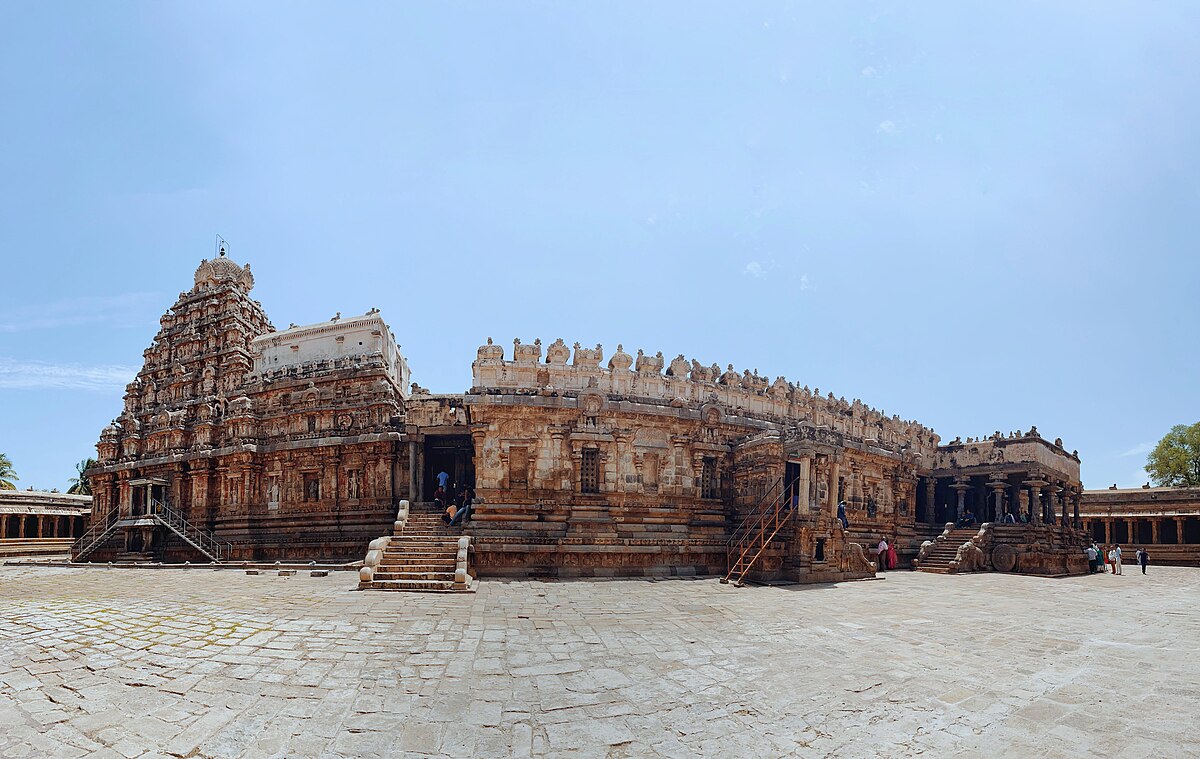
If the Bṛhadīśvara Temple at Thanjavur is a fortress of faith built to stagger the beholder with its colossal scale, and the Bṛhadīśvara Temple at Gangaikonda Cholapuram is an imperial statement of conquest, then the Airāvateśvara Temple at Darasuram is a jeweller’s casket carved in stone — smaller than its two sisters yet surpassing them both in the sheer delicacy and intricacy of its sculptural programme. Standing in the quiet suburb of Darasuram, barely three kilometres south-west of the temple town of Kumbakonam in Tamil Nadu’s Thanjavur district, this 12th-century masterpiece was built by the Chola emperor Rājarāja II (r. 1146—1173 CE) and completed around 1166 CE.
UNESCO inscribed the temple as an extension to the “Great Living Chola Temples” World Heritage Site in 2004, joining the Thanjavur and Gangaikonda Cholapuram temples that had received recognition in 1987. The citation praises the three temples collectively for testifying “to the brilliant achievements of the Chola in architecture, sculpture, painting, and bronze casting.” Yet among connoisseurs of Dravidian art, it is the Airāvateśvara Temple that commands the deepest admiration, for nowhere else in the Chola realm was stone coaxed into such breathtaking refinement — from one-inch miniature deities to a staircase that literally sings.
The Builder: Rājarāja Chola II
A Patron of Art in a Shifting Empire
Rājarāja Chola II, also known as Rājarāja II, ruled the Chola Empire from approximately 1146 to 1173 CE. He was the grandson of Vikrama Chola and the great-grandson of Kulottuṅga Chola I. By his time, the Chola Empire no longer possessed the expansive military reach of Rājarāja I or Rājendra I, but it remained a culturally vibrant realm, and Rājarāja II channelled the empire’s resources into the arts, literature, and temple-building rather than military campaigns.
Unlike his forebears who expanded and embellished existing temples, Rājarāja II was a sponsor of entirely new sacred complexes. He was also a patron of Tamil literature and the arts, and the temple at Darasuram reflects this refined aesthetic sensibility. The inscriptions in the temple record his titles, including “Rājakesarivarman” and “Rājagambhīra” — the latter meaning “the Royal Majestic One,” a title that was also given to the temple’s great front hall, the Rājagambhīra-tiru-maṇḍapam.
The Name “Airāvateśvara”
The temple takes its name not from its builder but from the mythological elephant Airāvata, the celestial mount of Indra, king of the Devas. According to the Sthala Purāṇa (local temple legend), Airāvata was cursed by the sage Durvāsa to lose his resplendent white complexion. Tormented by the curse, the great elephant wandered the earth until he arrived at Darasuram, where he worshipped Lord Śiva with intense devotion and bathed in the temple’s sacred tank. Through the grace of Śiva, Airāvata’s original lustrous form was restored, and the grateful elephant is said to have worshipped the liṅga here daily. The deity thus came to be known as Airāvateśvara — “the Lord worshipped by Airāvata.”
A second legend narrates that Yama, the god of death, was also suffering from a curse that caused a burning sensation throughout his body. Yama too sought relief at this sacred spot, bathing in the temple tank and finding immediate cure through Śiva’s compassion. The tank thereafter became known as Yama-tīrtham, and a shrine to Yama stands in the south-west corner of the temple courtyard — one of the very rare temples in India where the god of death receives formal worship.
Architecture: Where Engineering Meets Embroidery
Overall Layout
The Airāvateśvara Temple complex sits on a plinth measuring approximately 23 metres by 63 metres and is enclosed by a compound wall of roughly 107 metres (east-west) by 70 metres (north-south). Outside the compound wall stand a Nandī maṇḍapa housing a monolithic bull and a dhvajastambha (flagstaff pillar). The temple is classified as a “Karak Kōvil” — a chariot temple — because its front hall was designed to resemble a divine processional chariot.
Unlike many South Indian temple complexes that grew organically over centuries with additions by successive rulers, the Airāvateśvara Temple was built as a unified composition in a single building campaign, with no later structural additions. This architectural integrity gives the complex an unusual harmony of design and proportion.
The Vimāna: A Crown of Stone
The temple’s vimāna (sanctuary tower) rises to a height of approximately 24 metres (79 feet) above the garbhagṛha (inner sanctum). The sanctum itself is a 12-metre-sided square with thick granite walls. While considerably shorter than the 66-metre vimāna of the Thanjavur Bṛhadīśvara or the 53-metre tower of Gangaikonda Cholapuram, the Airāvateśvara vimāna compensates with the extraordinary refinement of its carved surfaces.
The vimāna features multiple receding tiers adorned with pilastered niches housing images of various forms of Śiva, including Bhikṣāṭanamūrti (Śiva as the wandering mendicant), Ardhanārīśvara (the half-male, half-female form), and Naṭarāja (the cosmic dancer). The kūṭam (capstone) at the summit is a single granite block, echoing the engineering tradition established at Thanjavur, though on a more intimate scale.
The Mahāmaṇḍapa: The Great Hall
Extending eastward from the garbhagṛha is the mahāmaṇḍapa, a rectangular hall measuring approximately 24 metres by 18 metres. It contains six rows of pillars — forty-eight in total — each carved with miniature sculptures of extraordinary precision. Among these pillars one can find depictions of Śiva’s marriage attended by Viṣṇu and Brahmā, the wedding of Murugan, Sarasvatī in a yoga posture, Annapūrṇā with astonishingly realistic fingernails, and breathtaking one-inch miniature sculptures of Gaṇeśa, Śiva, Pārvatī, and Murugan that demonstrate the Chola sculptors’ near-superhuman command of the chisel.
The Agra-Maṇḍapa: The Chariot That Never Moves
The temple’s most iconic architectural feature is the agra-maṇḍapa, also known by its inscriptional name, the Rājagambhīra-tiru-maṇḍapam (“the Royal Majestic Sacred Hall”). This front hall is designed as a colossal stone chariot — the Tripurāntaka Ratha — complete with carved wheels, spokes, hubs, and a team of leaping stone horses harnessed to its front.
The south side of the maṇḍapa displays large stone chariot wheels that also function as sundials: one on the east side serves as a morning sundial, and one on the west side as an evening sundial. The horses are depicted in dynamic motion, their legs extended mid-gallop, their manes flowing, their harness-work carved with meticulous detail. The entire composition conveys a sense of frozen movement — a divine chariot perpetually on the verge of thundering forward yet held eternally in stone.
This chariot motif is not merely decorative. In Śaiva theology, Śiva as Tripurāntaka rides a celestial chariot to destroy the three demonic flying cities (Tripura). The chariot-shaped maṇḍapa thus transforms the entire temple into a symbolic re-enactment of this cosmic victory, with the devotee entering the chariot of God as they approach the sanctum.
The Musical Staircase: Steps That Sing
Perhaps the most celebrated feature of the Airāvateśvara Temple is its musical staircase, located near the balipīṭham (sacrificial altar) outside the main podium. This balustraded staircase of seven steps is engineered so that each step produces a distinct musical note when tapped or walked upon, corresponding to the seven svaras (sa, ri, ga, ma, pa, dha, ni) of the Indian musical scale.
The mechanism behind this acoustic marvel remains a subject of debate. Some scholars believe that the steps were carved from specially selected stones with particular resonant properties, while others suggest that hollow chambers beneath the steps amplify the vibrations. Whatever the engineering secret, the effect is unmistakable: walking up the staircase produces a cascade of melodious tones, earning these steps the name “singing steps” or “musical steps” (isai paḍikkaḷ in Tamil).
This feature testifies to the Chola court’s deep engagement with music and the performing arts. The Chola rulers were renowned patrons of music, dance, and theatre, and the musical staircase transforms the act of approaching the deity into a performative, almost liturgical experience — the devotee literally making music with every step toward the divine.
Sculptural Programme: A Stone Encyclopaedia
The Sixty-Three Nāyaṉmār Saints
Running along the base of the main temple walls are continuous narrative relief panels depicting the life stories of the sixty-three Nāyaṉmār — the great Bhakti movement saints of Tamil Śaivism whose legends are recorded in Cēkkiḻār’s 12th-century hagiographic masterpiece, the Periya Purāṇam. Each panel is accompanied by an inscriptional label identifying the saint and the key episode from his or her life.
The north wall of the verandah contains 108 sections of inscriptions, each recording the name, description, and an image of a Śaivācārya, listing the principal events in their life. These relief-and-inscription panels effectively transform the temple’s outer walls into a visual edition of the Periya Purāṇam — a stone book that illiterate devotees could “read” by walking around the temple in ritual circumambulation (pradakṣiṇa).
Among the saints depicted are Appar, Campantar, Cuntarar, and Māṇikkavācakar — the four great Śaiva hymnists whose compositions form the Tēvāram and Tiruvācakam, foundational texts of Tamil Śaiva devotional literature. The sculptors captured each saint in characteristic posture: Appar with his hoe (as a reminder of his years of forced labour in a Jain monastery before his reconversion to Śaivism), Campantar as the child-prodigy fed with divine milk by Pārvatī, and Cuntarar with his trademark expression of wayward devotion.
Dance Poses and the 108 Karaṇas
The Airāvateśvara Temple is a veritable gallery of classical dance. Its pillars and wall panels feature 108 dance postures corresponding to the karaṇas described in Bharata Muni’s Nāṭya Śāstra, the foundational treatise on Indian performing arts. These karaṇas are the basic units of movement in classical Indian dance, and their depiction here — carved with anatomical precision showing the exact positioning of arms, legs, torso, and head — makes the temple an invaluable primary source for dance historians and practitioners of Bharatanāṭyam.
The dance panels are not confined to divine figures. Many depict human dancers, both male and female, in courtly settings, suggesting the rich tradition of temple dance that flourished under Chola patronage. Alongside these are carved representations of musical instruments — the vīṇā, mṛdaṅgam, flute, and cymbals — creating a comprehensive visual record of the Chola performing arts tradition.
Scenes of Daily Life
One of the most remarkable aspects of the Airāvateśvara Temple’s sculptural programme is its extensive depiction of secular daily life. Unlike many temples whose carvings are exclusively mythological or theological, the walls of the Darasuram temple include vivid scenes of farmers at work, artisans plying their crafts, musicians performing, merchants conducting trade, royal processions, wrestling matches, and domestic activities. These carvings provide an invaluable ethnographic record of 12th-century Chola society — the clothes people wore, the tools they used, the games they played, and the social interactions that defined their world.
Celestial figures also abound: yakṣīs (nature spirits) and apsarās (celestial maidens) are carved in graceful tribhaṅga poses, their jewellery, hairstyles, and garments rendered with a delicacy that rivals the finest Chola bronze work. These female figures are among the most aesthetically accomplished in all of South Indian sculpture.
The Periya Nāyakī Amman Shrine
To the north of the main Airāvateśvara temple stands a separate shrine dedicated to Periya Nāyakī Amman — the Goddess, consort of Śiva. This shrine was constructed slightly later than the main temple and represents the emergence of the Amman shrine as an essential component of the South Indian temple complex. By the 12th century, the cult of the Goddess had become so prominent in Tamil Śaivism that no major Śiva temple was considered complete without a separate shrine for his consort.
The Periya Nāyakī Amman shrine features its own maṇḍapa and garbhagṛha, with the Goddess depicted in her benevolent, auspicious form as the divine mother. The shrine’s sculptural programme, while more modest than the main temple’s, includes elegant depictions of the Goddess’s various aspects and attendant deities.
Comparison with the Other Great Living Chola Temples
The three Great Living Chola Temples form a remarkable trilogy that traces the evolution of Chola architectural ambition across approximately 150 years:
Bṛhadīśvara Temple, Thanjavur (1003—1010 CE): Built by Rājarāja I at the height of Chola imperial power. Its 66-metre vimāna is a declaration of raw architectural might — the tallest temple tower in South India at the time of its construction, crowned by an 80-ton capstone. The sculptures are powerful and monumental in scale.
Bṛhadīśvara Temple, Gangaikonda Cholapuram (~1025 CE): Built by Rājendra I to celebrate his conquest of the Ganges. Its 53-metre curvilinear vimāna introduces a more graceful, feminine silhouette. The bronzes and stone sculptures are among the finest in the Chola corpus.
Airāvateśvara Temple, Darasuram (~1166 CE): Built by Rājarāja II in a period of cultural refinement. Its 24-metre vimāna is the smallest of the three, but the sculptural detailing reaches an unmatched level of delicacy. The chariot maṇḍapa, musical staircase, and miniature carvings represent the culmination of Chola artistic achievement.
Together, the three temples demonstrate a fascinating trajectory: from the overwhelming scale of Thanjavur, through the balanced grandeur of Gangaikonda Cholapuram, to the consummate artistry of Darasuram. If the first temple shouts the Chola dynasty’s power to the heavens, the last whispers its sophistication.
Inscriptions and Historical Record
The Airāvateśvara Temple contains numerous inscriptions that constitute an important historical archive. These inscriptions, carved into the temple walls in Tamil and Grantha scripts, record:
- The titles and achievements of Rājarāja II, including his epithet “Rājagambhīra”
- Donations of land, gold, and other resources to the temple
- Details of temple administration, including the roles of priests, musicians, dancers, and maintenance staff
- A later inscription recording the renovation of shrines by Kulottuṅga Chola III (r. 1178—1218 CE), indicating that the temple continued to receive royal patronage after its builder’s death
These inscriptions complement the epigraphic records at Thanjavur and Gangaikonda Cholapuram, providing scholars with a rich documentary record of Chola-era religion, administration, and social organization.
Conservation and UNESCO Recognition
The Archaeological Survey of India (ASI) maintains the Airāvateśvara Temple as a protected monument. While the main temple and its sculptures are well preserved, the compound wall’s gopura (gateway tower) has lost its upper portion, and some peripheral structures have suffered the ravages of time. Conservation efforts have focused on stabilizing the existing fabric, cleaning accumulated deposits from the sculptural surfaces, and ensuring proper drainage to prevent water damage to the foundations.
The UNESCO inscription in 2004 was a significant moment for the temple’s international recognition. The World Heritage Committee noted that the three Great Living Chola Temples together represent “an outstanding creative achievement in the architectural conception of the pure form of the Dravida type of temple.” The Committee further observed that the temples illustrate “the brilliant achievements of the Chola in architecture, sculpture, painting, and bronze casting” and that they continue to function as active places of worship, justifying the designation “living” in their title.
Spiritual Significance and Living Worship
The Airāvateśvara Temple remains an active Śaiva shrine where daily pūjā is performed according to the Śaiva Āgamic traditions that have been maintained for nearly nine centuries. The temple follows the traditional six-time worship schedule (āṟukāla pūjā) prescribed in the Āgamas.
The Yama-tīrtham tank continues to be a site of ritual bathing, and devotees believe its waters possess curative properties — a belief rooted in the founding legends of both Airāvata and Yama finding healing here. The Māśi Makam festival, celebrated in the Tamil month of Māśi (February—March), draws large congregations of pilgrims who participate in ritual processions and temple tank bathing.
The temple’s association with the Nāyaṉmār saints makes it an important stop on the pilgrimage circuit of Tamil Śaiva Bhakti, and devotees who visit the temple often perform a meditative circumambulation while contemplating the carved narratives of the saints’ lives — a practice that transforms the architectural space into a devotional journey through the history of Tamil Śaivism itself.
Visiting Information and Practical Details
The Airāvateśvara Temple is open daily from 8:00 AM to 12:00 PM and from 4:00 PM to 8:00 PM. It is located in Darasuram, approximately 3 kilometres south-west of Kumbakonam town centre and about 35 kilometres from Thanjavur city. The nearest railway station is Kumbakonam, well connected to Chennai, Thanjavur, and Tiruchirappalli. The temple is easily accessible by road from Kumbakonam, Thanjavur, and other towns in the Kaveri Delta region.
Visitors are advised to allocate at least two hours to fully appreciate the temple’s sculptural wealth. The morning hours offer the best light for photography, particularly for the chariot maṇḍapa and the vimāna’s western face. The musical staircase, while partially restricted to prevent damage from foot traffic, can still be experienced during guided visits.
Conclusion: The Chola Dynasty’s Final Masterpiece
The Airāvateśvara Temple at Darasuram stands as the Chola dynasty’s final architectural testament — not its largest or tallest, but arguably its most beautiful. In its chariot-shaped hall, its singing staircase, its one-inch deities, and its stone narratives of saints and dancers, the temple embodies a civilization at the height of its artistic refinement. Where Rājarāja I built to overwhelm and Rājendra I built to commemorate conquest, Rājarāja II built to enchant. Nine centuries later, the enchantment holds.
Every stone of the Airāvateśvara Temple carries a message: that devotion to the divine need not always thunder — sometimes it sings, sometimes it dances, and sometimes it whispers in miniatures so small that one must kneel close to the stone to hear what the Chola sculptors had to say. That whisper, patient and eternal, is the temple’s greatest offering.