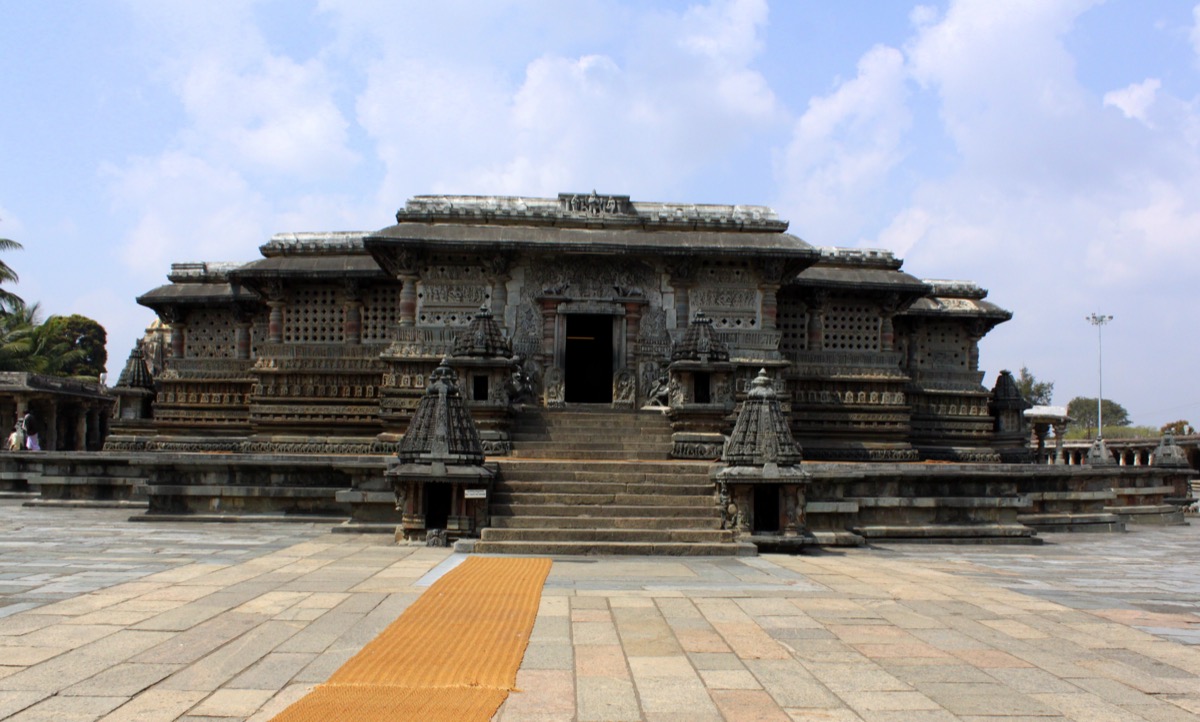
Introduction: Frozen Poetry in Stone
In the lush, coconut-palm-fringed Hassan district of Karnataka, two small towns preserve what many art historians consider the greatest achievements of Indian temple sculpture. Belur and Halebidu (ancient Vēlapura and Dvārasamudra), separated by just 16 kilometres, house temple complexes that took generations of master craftsmen to complete — and that still leave modern viewers astonished by the sheer density, refinement, and narrative richness of their carved stone surfaces.
The Chennakēśava Temple at Belur, commissioned by the Hoysala king Viṣṇuvardhana in 1117 CE to celebrate his victory over the Cholas at Talakkāḍu, and the Hoysalēśvara Temple at Halebidu, begun in 1121 CE during the reign of the same dynasty, together represent the flowering of a unique architectural tradition that synthesized Dravidian and Nāgara styles into something entirely new. In 2023, UNESCO inscribed these temples (along with the Kēśava Temple at Somnāthpur) as a World Heritage Site under the title “Sacred Ensembles of the Hoysalas,” recognizing their “outstanding universal value.”
The Hoysala Dynasty: Patrons of Sacred Art
Origins and Rise
The Hoysala dynasty ruled much of present-day Karnataka from the 10th to the 14th century CE. According to their origin legend, the dynasty’s founder, Sala, rescued his Jain guru from a lion by striking the beast with a mace. The guru’s command — “Hoy, Sala!” (“Strike, Sala!”) — became the dynasty’s name and its royal emblem: a warrior striking a lion, known as the Śāla or Hoysala emblem, which appears prominently in both Belur and Halebidu temples (Foekema, A Complete Guide to Hoysala Temples, p. 12).
Viṣṇuvardhana and Śāntala Devī
King Viṣṇuvardhana (r. 1108-1152 CE) was the most celebrated patron of Hoysala temple building. Originally a Jain, he converted to Vaishnavism under the influence of the great philosopher Rāmānujācārya, who visited the Hoysala court. This conversion inspired the construction of the Chennakēśava Temple at Belur, dedicated to Viṣṇu in his form as Keśava (“the beautiful-haired one”). Viṣṇuvardhana’s queen, Śāntala Devī, herself a legendary dancer, is believed to have inspired the exquisite dancing-maiden brackets (madanikā or śilābālikā) that adorn the temple exterior.
A Civilization of Temple Builders
The Hoysalas built over 1,500 temples across their territory, of which approximately 100 survive. Their architectural style evolved from relatively simple early structures to the breathtaking complexity of Belur, Halebidu, and Somnāthpur. The dynasty’s patronage was ecumenical: they built temples for Viṣṇu, Śiva, and Jain tīrthaṅkaras with equal magnificence, reflecting a sophisticated religious pluralism.
Chennakēśava Temple, Belur: The Crown Jewel
Architecture: The Star-Shaped Wonder
The Chennakēśava Temple stands on a jagati (raised platform) in the distinctive Hoysala star-shaped (stellate) plan. The star shape is not merely decorative — it multiplies the wall surface area, providing vastly more space for sculptural programs than a conventional rectangular plan. The temple consists of:
- Garbhagṛha (Sanctum): Houses the main deity, Chennakēśava (Viṣṇu), a striking 6-foot black stone image holding the conch, discus, mace, and lotus.
- Sukhanāsī (Vestibule): A transitional space connecting the sanctum to the hall.
- Navaranga (Main Hall): A large pillared hall with lathe-turned columns of such precision that they appear machine-made, though they were hand-carved from chloritic schist (soapstone). The most famous of these is the Narasimha pillar, which once rotated on its base.
- Jagati (Platform): The raised platform serves as a processional path (pradakṣiṇā patha) and provides the base from which the temple’s sculptural program rises.
The Sculptural Program
The exterior walls of the Chennakēśava Temple present one of the most ambitious sculptural programs in world art. Reading from bottom to top, the wall surfaces are organized in horizontal friezes (bands):
- Elephants (Gaja Frīze): The lowest band depicts rows of elephants, symbolizing stability and royal power. Over 650 elephants march around the temple base, no two identical.
- Lions (Siṃha Frīze): Above the elephants, lions represent courage and the Hoysala royal emblem.
- Equestrian Scrolls: Horsemen in various poses of battle and procession.
- Mythological Narrative Panels: The broadest and most elaborate band, depicting scenes from the Rāmāyaṇa, Mahābhārata, Bhāgavata Purāṇa, and other Hindu texts. Individual panels show Kṛṣṇa lifting Mount Govardhana, Rāvaṇa shaking Mount Kailāsa, Arjuna’s penance, and dozens of other episodes, each rendered with extraordinary detail and emotional expressiveness.
- Makara (Sea-Creature) Scrolls: Intricate foliage emerging from the mouths of makaras (mythical aquatic beings).
- Haṃsa (Swan) Frīze: Rows of sacred geese, symbolizing spiritual discernment.
The Madanikā Bracket Figures
Perhaps the most celebrated sculptures at Belur are the 42 madanikā (bracket figures) — larger-than-life female figures positioned under the eaves, each in a distinct pose of dance, grooming, or devotion. These figures display astonishing anatomical precision, fluid drapery, elaborate jewellery, and individualized facial expressions. Among the most famous are:
- Darpaṇa Sundarī (“Mirror Beauty”): A woman gazing into a mirror, adjusting her hair
- Bhairavī: A huntress drawing a bow, with a dog at her feet
- Naṭyā Sundarī (“Dancing Beauty”): A dancer in a complex pose, believed to be modeled on Queen Śāntala Devī herself
Art historian Adam Hardy describes these figures as representing “the high-water mark of Indian figurative sculpture, combining sensuality with spiritual refinement in a manner unmatched anywhere in the subcontinent” (Indian Temple Architecture, p. 283).
Inscriptions
The Chennakēśava Temple bears over 100 inscriptions in Old Kannada and Sanskrit, recording details of the temple’s construction, the artists who created it, and the grants made by various Hoysala rulers. These inscriptions reveal that the temple took 103 years to complete — three generations of continuous artistic labour.
Hoysalēśvara Temple, Halebidu: The Śaiva Masterpiece
Dvārasamudra: The Hoysala Capital
Halebidu, known in the Hoysala period as Dvārasamudra (“Gateway of the Sea,” named for the large artificial lake nearby), served as the Hoysala capital. The Hoysalēśvara Temple, built here beginning in 1121 CE, is dedicated to Lord Śiva. The temple’s name combines the dynasty’s name with Īśvara (Lord Śiva), reflecting the close identification between ruler and deity.
Twin Shrines: A Dvikūṭa Temple
The Hoysalēśvara Temple is a dvikūṭa (twin-shrined) structure, housing two liṅgas: the Hoysalēśvara Liṅga and the Śāntalēśvara Liṅga (named after Queen Śāntala Devī). This paired arrangement reflected Hoysala royal practice, where king and queen each had their own dedicated shrine within a single temple complex. The two shrines are connected by a common hall.
Unlike the Chennakēśava Temple at Belur, the Hoysalēśvara Temple was never completed — it lacks its superstructure (śikhara/vimāna) entirely. Yet even in its unfinished state, the temple’s sculptural decoration is considered by many scholars to surpass Belur in sheer density and virtuosity.
Sculptural Richness
The exterior walls of the Hoysalēśvara Temple carry the same system of horizontal friezes as Belur, but on a grander scale. Key features include:
- Over 340 large narrative panels depicting scenes from the epics and Purāṇas
- Depictions of the Daśāvatāra (ten incarnations of Viṣṇu) alongside Śaiva mythology, demonstrating Hoysala religious inclusivity
- Scenes of courtly life: Dancers, musicians, acrobats, and royal processions, providing an invaluable visual record of 12th-century South Indian society
- Battle scenes from the Mahābhārata: The Bhīṣma Parva and Droṇa Parva episodes are depicted with cinematic dynamism
- Rāvaṇa lifting Mount Kailāsa: One of the most celebrated panels, showing the ten-headed demon king straining to uproot Śiva’s mountain abode, while Pārvatī clings to Śiva in alarm
The Nandī Shrine
A large Nandī (sacred bull of Śiva) pavilion faces the temple, housing a beautifully polished monolithic Nandī. The Nandī figure, with its finely carved ornaments and smooth, almost lustrous surface, exemplifies the Hoysala sculptors’ mastery of stone finishing.
Hoysala Architectural Style: Innovation in Stone
The Soapstone Advantage
The Hoysala architects made a pivotal material choice: chloritic schist (locally called “soapstone” or “potstone”), a metamorphic rock that is relatively soft when freshly quarried but hardens upon exposure to air. This property allowed sculptors to carve details of extraordinary fineness — jewellery, hair ornaments, fabric textures, and even fingernails — that would be impossible in harder stones like granite. The medium green-grey colour of the stone also gives Hoysala temples their characteristic hue.
The Star-Shaped Plan
The stellate (star-shaped) ground plan, a Hoysala innovation, was achieved by projecting and receding the temple walls in a pattern of points, creating a complex polygon. This design:
- Maximized exterior wall surface for sculptural decoration
- Created dramatic plays of light and shadow across the facade throughout the day
- Symbolized the cosmic lotus or the petals of a divine flower
- Distinguished Hoysala temples from both the rectilinear Nāgara temples of North India and the pyramidal Dravidian temples of Tamil Nadu
Lathe-Turned Pillars
The pillars inside Hoysala temples are turned on a lathe (or carved to simulate lathe-turning), producing bell-shaped, disc-shaped, and cylindrical profiles of remarkable symmetry. The famous pillars of the Chennakēśava Temple’s navaranga (hall) are so precisely circular that they appear industrially produced, though they were entirely handcrafted.
The Śāla Emblem
The Hoysala royal emblem — a warrior (Sala) fighting a lion — appears repeatedly throughout both temple complexes, carved into walls, pillar bases, and ceiling panels. This emblem served both as a dynastic signature and as an apotropaic (evil-averting) symbol.
UNESCO World Heritage Status
In September 2023, UNESCO inscribed the “Sacred Ensembles of the Hoysalas” (comprising Belur’s Chennakēśava Temple, Halebidu’s Hoysalēśvara Temple, and Somnāthpur’s Kēśava Temple) as a World Heritage Site. The inscription citation praised the temples for their “outstanding artistic achievement,” noting that they represent “the highest point of development of Hoysala temple architecture” and constitute “an exceptional testimony to the Hoysala civilization’s creative genius in temple building, sculpture, and stone craftsmanship.”
India had nominated these temples repeatedly since 2014, and their inscription was celebrated as a recognition of one of the world’s great but underappreciated architectural traditions.
Festivals and Living Worship
Despite being over 900 years old, the Chennakēśava Temple at Belur remains an active Hindu temple where daily pūjā is performed. Major festivals include:
- Vaikunṭha Ekādaśī: The most important annual festival, celebrating Viṣṇu’s heavenly abode, with elaborate decorations and processions
- Chennakēśava Jayantī: Commemorating the temple’s consecration
- Navarātri and Dīpāvalī: Observed with special pūjās and cultural programs
- Ratha Yātrā: A chariot procession through the temple streets
The Hoysalēśvara Temple at Halebidu, while administered by the Archaeological Survey of India, also hosts seasonal observances and cultural events, particularly during Mahāśivarātri.
Cultural Impact and Legacy
The Hoysala temple tradition influenced subsequent South Indian temple architecture and sculpture, particularly the Vijayanagara style of the 14th-16th centuries. The narrative relief tradition of Belur and Halebidu — telling epic stories through continuous sculptural panels — represents a uniquely Indian contribution to world art, comparable in ambition and execution to the relief programs of Angkor Wat in Cambodia or the Parthenon frieze in ancient Greece.
The temples also serve as an invaluable historical record, documenting through their inscriptions and sculptural scenes the social life, religious practices, courtly customs, and artistic ideals of 12th-century Karnataka.
Conclusion: The Imperishable Chisel
Belur and Halebidu stand as monuments not merely to royal piety but to the anonymous generations of sculptors, architects, and craftsmen — the Hoysala śilpīs — who transformed blocks of green soapstone into what the poet and scholar A.K. Ramanujan called “the body language of the gods.” Nine centuries after their creation, the dancers still dance, the elephants still march, and the gods still enact their eternal dramas on walls that were conceived as nothing less than the cosmos rendered in stone. In the words of the UNESCO citation, these temples represent “creative genius” — and to stand before them is to understand why.