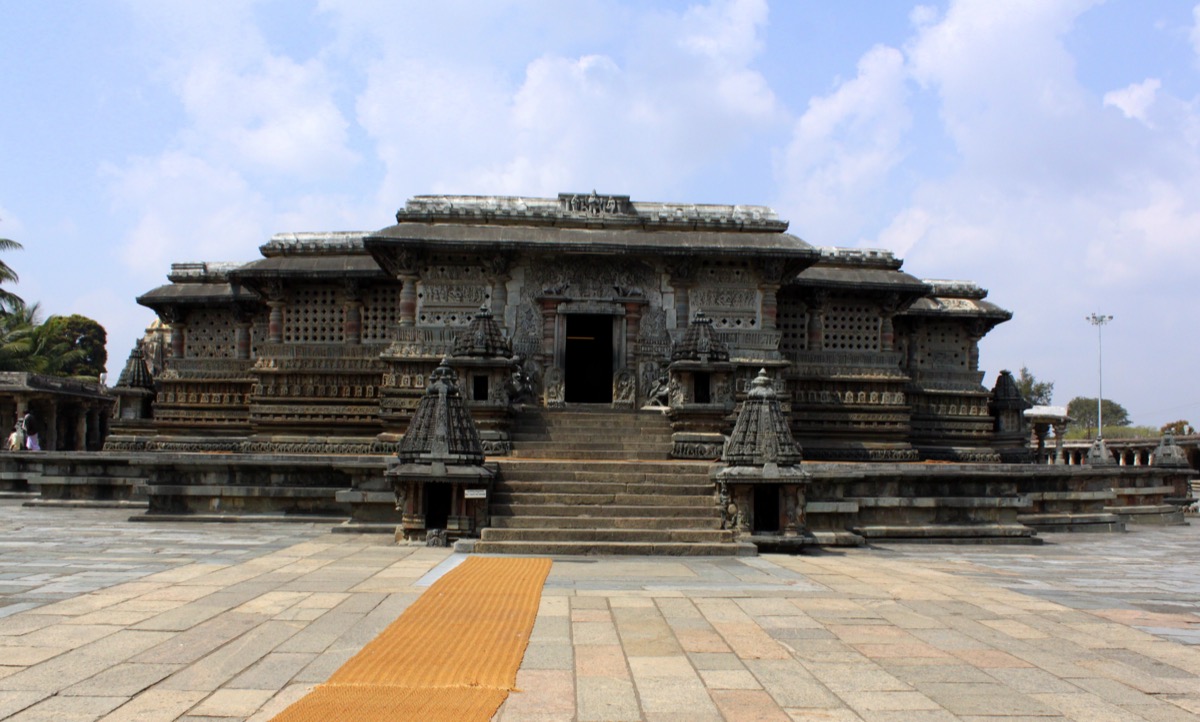
Introduction: An Ocean of Artistry
On the verdant banks of the Yagachi River in the Hassan district of Karnataka stands a temple that the people of the region have called Kalasāgara — “an ocean of artistry.” The Chennakēśava Temple at Belur, commissioned by the Hoysala king Viṣṇuvardhana in 1117 CE, is not simply a place of worship but a sculptural cosmos, a stone encyclopedia of Hindu mythology, and one of the most elaborately decorated sacred structures ever raised by human hands. With approximately 4,000 individual carvings adorning its walls, pillars, and ceilings, the temple stands as irrefutable testimony to a civilization that regarded the sculptor’s chisel as an instrument of devotion equal to the priest’s mantra.
Unlike many celebrated Indian temples that impress primarily through scale — towering gopurams, sprawling courtyards — the Chennakēśava Temple achieves its effect through an almost inconceivable density and refinement of sculptural detail. Every surface, from the massive exterior wall panels to the tiniest bracket ornament, is carved with a precision and expressiveness that has prompted art historians to describe it as “frozen poetry” and “the Sistine Chapel of India.” In September 2023, UNESCO inscribed the temple, along with the Hoysalēśvara Temple at Halebidu and the Kēśava Temple at Somnāthpur, as a World Heritage Site under the title “Sacred Ensembles of the Hoysalas,” recognizing their “outstanding universal value” as expressions of human creative genius.
Historical Context: A Victory Set in Stone
The Battle of Talakāḍu (1116 CE)
The genesis of the Chennakēśava Temple lies in one of the most decisive military campaigns in South Indian history. In 1116 CE, the Hoysala king Viṣṇuvardhana (r. 1108—1152 CE) led his forces against the Chola viceroys who controlled the ancient city of Talakāḍu (Talakkāḍu) on the banks of the river Kāvēri. The Chola dynasty, which had dominated the Deccan and Tamil country for centuries, maintained its suzerainty over Gaṅgavāḍi (modern southern Karnataka) through appointed governors. Viṣṇuvardhana’s victory at Talakāḍu shattered Chola dominance over the region and established the Hoysalas as the paramount power in the southern Deccan.
To commemorate this triumph, Viṣṇuvardhana commissioned the construction of a magnificent Vaiṣṇava temple at Belur (ancient Vēlapura), which then served as the early capital of the Hoysala kingdom. The city was so revered by the dynasty that inscriptions refer to it as bhūloka Vaikuṇṭha — “Vaikuṇṭha (Viṣṇu’s heavenly abode) on earth.” The original name of the temple was Vijaya-Nārāyaṇa (“Victorious Nārāyaṇa”), directly referencing the military triumph that inspired it. The name Chennakēśava — “Handsome Keśava,” a form of Viṣṇu — became prevalent later.
Viṣṇuvardhana and Rāmānujācārya
Viṣṇuvardhana’s patronage of Vaiṣṇava temple building was intimately connected to his personal religious transformation. According to traditional accounts, the king was originally a Jain, but came under the spiritual influence of the great Śrī Vaiṣṇava philosopher Rāmānujācārya (1017—1137 CE), who visited the Hoysala court. Under Rāmānuja’s guidance, Viṣṇuvardhana embraced Śrī Vaiṣṇavism, adopting the epithet “Viṣṇuvardhana” (“increaser of Viṣṇu’s glory”) to mark his conversion. While modern historians debate the precise nature and extent of this conversion — noting that Viṣṇuvardhana continued to patronize Jain and Śaiva institutions as well — the Chennakēśava Temple’s overwhelmingly Vaiṣṇava iconographic program reflects the king’s deep personal devotion to Viṣṇu.
Queen Śāntala Devī
The role of Viṣṇuvardhana’s queen, Śāntala Devī, in the temple’s creation deserves special mention. Śāntala Devī was herself a renowned dancer, and tradition holds that she served as the model for one of the temple’s most celebrated sculptures — the Darpaṇa Sundarī (“Lady with the Mirror”). She also commissioned the smaller Kappe Chennīgarāya Temple within the same complex. The exquisite dancing-maiden bracket figures (madanikās) that are the temple’s most iconic feature are widely believed to reflect Śāntala Devī’s patronage and influence, bringing the art of dance into permanent dialogue with the art of sculpture.
Architecture: The Star-Shaped Marvel
The Stellate Plan
The Chennakēśava Temple is built on a distinctive star-shaped (stellate) platform called a jagati, which rises approximately three feet above the surrounding paved courtyard. This jagati is not merely a foundation but serves as a pradakṣiṇā patha (circumambulatory path), allowing devotees to walk around the temple while contemplating the sculptural program at close range. The star shape is formed by a 32-pointed polygon, with alternating projections and recessions that create a rhythmic undulation across the temple walls.
This stellate plan is a hallmark of Hoysala architecture and represents one of its most original contributions to Indian temple design. By multiplying the number of wall surfaces through projections and recesses, the architects dramatically increased the available area for sculpture. The zigzag walls of the garbhagṛha (sanctum) also produce shifting patterns of light and shadow throughout the day, causing the carved figures of the 24 forms of Viṣṇu to appear subtly different at different hours — an effect that Hoysala architects clearly intended.
The Soapstone Medium
The material that made the temple’s extraordinary sculptural detail possible is chloritic schist, locally known as “soapstone” or baḷḷa kallu in Kannada. This metamorphic rock possesses a remarkable property: it is relatively soft and pliable when freshly quarried, allowing sculptors to carve details of astonishing fineness — individual strands of hair, the texture of silk fabric, the links of chain jewellery, even fingernails and eyelids. Upon prolonged exposure to air, however, the stone gradually hardens, ensuring the permanence of even the most delicate carving. The characteristic greenish-grey hue of the stone gives the temple its distinctive appearance.
The choice of soapstone was a deliberate and consequential decision. It liberated Hoysala sculptors from the constraints imposed by harder materials like granite, enabling a degree of sculptural refinement that has no parallel in Indian temple art. As the art historian Gerard Foekema observes in A Complete Guide to Hoysala Temples, the softness of soapstone “permitted the Hoysala sculptors to treat stone as if it were sandalwood or ivory.”
Structural Layout
The temple complex consists of several interconnected structures:
- Garbhagṛha (Sanctum Sanctorum): The innermost chamber houses the presiding deity — a striking six-foot-tall black stone image of Chennakēśava (Viṣṇu), holding his four traditional attributes: the śaṅkha (conch), cakra (discus), gadā (mace), and padma (lotus).
- Sukhanāsī (Vestibule): A transitional space connecting the sanctum to the main hall, adorned with elaborately carved doorframes and ceiling panels.
- Navaranga (Main Hall): The largest navaranga of any Hoysala temple, laid out in a triratha (diamond-shaped) plan. This hall is supported by 48 intricately carved pillars, no two of which are identical. The central four pillars surrounding the dance floor are the only exception to this rule of uniqueness.
- Jagati (Raised Platform): The circumambulatory platform that encircles the entire structure.
The Sculptural Program: A Stone Encyclopedia
The Horizontal Friezes
The exterior walls of the Chennakēśava Temple are organized into a system of horizontal decorative bands (friezes) that encircle the entire structure, reading from bottom to top:
- Gaja Frīze (Elephants): The lowest band features rows of elephants symbolizing stability, strength, and royal power. Over 650 individual elephants march around the temple base, and according to tradition, no two are depicted in exactly the same posture.
- Siṃha Frīze (Lions): Above the elephants, rows of lions represent courage and the Hoysala royal identity.
- Aśva Frīze (Horsemen): Equestrian scrolls depicting mounted warriors in various attitudes of battle and procession.
- Purāṇic Narrative Panels: The broadest and most elaborate frieze, depicting scenes from the Rāmāyaṇa, Mahābhārata, Bhāgavata Purāṇa, and other sacred texts. Individual panels portray Kṛṣṇa lifting Mount Govardhana, Rāvaṇa shaking Mount Kailāsa, Arjuna’s penance, the churning of the ocean (Samudra Manthana), and dozens of other episodes rendered with cinematic narrative power.
- Makara Scrolls: Elaborate foliate designs emerging from the mouths of makaras (mythical aquatic creatures), symbolizing the fertile abundance of creation.
- Haṃsa Frīze (Swans): Rows of sacred geese representing spiritual discernment (viveka) and the capacity to separate truth from illusion.
The 42 Madanikā Bracket Figures
The most celebrated sculptures at the Chennakēśava Temple are the 42 madanikā (bracket figures) — larger-than-life female figures positioned under the eaves as structural brackets supporting the roof overhang. These celestial maidens, also known as śilābālikās (stone damsels) or salabhañjikās, are each depicted in a distinct pose of dance, grooming, play, or devotion. Of these, 38 are positioned on the temple exterior and 4 are inside.
The madanikās display an astonishing level of anatomical precision, fluid drapery, elaborate jewellery, and individualized facial expressions. They are carved in such high relief that they appear almost three-dimensional, detaching themselves from the wall behind them. Among the most famous are:
- Darpaṇa Sundarī (“Lady with the Mirror”): The most iconic sculpture at Belur, depicting a woman gazing at her reflection in a hand mirror while adjusting her hair. According to local tradition, this figure is modelled on Queen Śāntala Devī herself. The carving captures not merely the physical beauty of the subject but a moment of intimate self-contemplation — the human act of seeing oneself, rendered as a meditation on consciousness and self-awareness.
- Bhairavī (“The Huntress”): A woman drawing a bow while a dog stands alert at her feet, capturing the dynamism and tension of the hunt in stone.
- Naṭya Sundarī (“Dancing Beauty”): A dancer frozen in a complex dance pose, her body describing an elegant tribhaṅga (three-bend) curve, believed by some scholars to represent Śāntala Devī in her role as a court dancer.
- Bhasma Mohinī (“The Enchantress with Ash”): A woman applying sacred ash or cosmetics, depicted with extraordinary delicacy.
Inscriptions at the temple record the names of the master sculptors who created these figures. Dasoja and his son Chavana, who hailed from Balligāvi in the Shimoga district, were responsible for the majority of the madanikās — Dasoja is credited with four and Chavana with five. Other named sculptors include Malliyanna, Nagoja, and Malloja, each identified by elaborate professional titles. In all, 118 inscriptions have been recovered from the temple complex, covering the period from 1117 CE to the 18th century.
Engineering Marvels: Pillars of Genius
The Narasimha Pillar
Among the 48 pillars of the navaranga hall, the Narasimha Pillar stands out as one of the most remarkable feats of ancient Indian engineering. This pillar is carved with miniature figures spiralling from top to bottom, depicting virtually every sculpture and motif found elsewhere in the temple. For this reason, it is also called the “Index Pillar” — a carved catalogue of the entire temple’s iconographic program compressed onto a single column.
What makes the Narasimha Pillar truly extraordinary is its legendary rotating mechanism. According to tradition and local accounts, this pillar was originally designed to rotate on its own axis, supported by a system analogous to ball bearings at its base and top. While the pillar can no longer be rotated today, the engineering principle it embodies — a massive carved stone column capable of axial rotation — testifies to the Hoysala architects’ command of mechanical principles. Though the pillar appears circular at first glance, careful examination reveals that it is actually polygonal, with exquisite carvings positioned on each face.
The Gravity Pillar (Mahāstambha)
Outside the main temple stands the Gravity Pillar, also known as the Mahāstambha or Kārtika Dīpotsava Stambha (the lamp pillar for the festival of Kārtika). This 42-foot-tall freestanding pillar is an engineering marvel: it stands without any foundation below it, balancing on its own weight through precise calculations of the centre of gravity. The pillar is set on a star-shaped platform characteristic of Hoysala design. It served a practical liturgical function as a lamp post during the Kārtika Dīpotsava festival, when rows of oil lamps were lit along its height.
Lathe-Turned Pillars
The pillars of the navaranga exhibit a technique that continues to astonish modern engineers and art historians. They are turned on a lathe — or, more precisely, carved to simulate the effect of lathe-turning — producing bell-shaped, disc-shaped, and cylindrical profiles of such perfect symmetry and smoothness that they appear to have been produced by industrial machinery. These pillars, polished to a mirror-like finish, demonstrate the Hoysala sculptors’ mastery of both geometry and stone-working technique.
103 Years of Continuous Creation
The Chennakēśava Temple was not the work of a single generation. While the main temple was consecrated in 1117 CE during Viṣṇuvardhana’s reign, the complex continued to grow and receive sculptural additions for 103 years, spanning three generations of Hoysala rulers. Successive kings and queens added subsidiary shrines, pillared halls, entrance gopurams, and sculptural panels. The Kappe Chennīgarāya Temple, attributed to Queen Śāntala Devī, and the Vīra-Nārāyaṇa shrine are among the notable later additions.
This prolonged period of construction produced a remarkable archaeological record. The 118 inscriptions found within the complex document not merely royal grants and dedications but also the names, titles, guilds, and places of origin of individual sculptors and architects. This epigraphic wealth is one of the distinctive features of Hoysala temple art — the craftsmen were not anonymous labourers but named and honoured artists whose professional identity was literally carved into the stones they shaped.
Hoysala Style: A Synthesis of Traditions
The Chennakēśava Temple exemplifies the mature Hoysala architectural style, which art historian Adam Hardy has termed the “Karṇāṭa Drāviḍa tradition.” This style represents a creative synthesis of two major streams of Indian temple architecture:
- Drāviḍa (South Indian): The pyramidal superstructure (vimāna), the emphasis on horizontal articulation, and the integration of sculpture into the wall surface.
- Nāgara (North Indian): The curvilinear tower profiles, the use of projecting niches for major deity images, and certain ornamental motifs.
The Hoysala architects did not merely combine these traditions — they transformed them into something entirely new. The stellate plan, the circumambulatory jagati, the multi-tiered frieze system, and above all the unprecedented density of figurative sculpture across every available surface distinguish Hoysala temples from all other Indian architectural traditions.
Comparison with Halebidu and Somnāthpur
The Chennakēśava Temple at Belur is one of three Hoysala temples that together form the UNESCO World Heritage Site “Sacred Ensembles of the Hoysalas.” Each represents a distinct phase and aspect of Hoysala artistic achievement:
- Belur (1117 CE): The earliest of the three, distinguished by its completed superstructure (vimāna), its 42 madanikā bracket figures, and the refinement of its individual sculptures. The temple remains an active place of worship.
- Halebidu (1121 CE): The Hoysalēśvara Temple, dedicated to Śiva, surpasses Belur in the sheer density and scale of its narrative relief panels (over 340 large panels) but was never completed — it lacks its vimāna entirely.
- Somnāthpur (1268 CE): The Kēśava Temple, the latest and most geometrically refined of the three, represents the fully mature Hoysala style with its perfectly symmetrical triple-shrine plan.
UNESCO World Heritage Status (2023)
On 18 September 2023, the 45th session of the UNESCO World Heritage Committee inscribed the “Sacred Ensembles of the Hoysalas” on the World Heritage List, making it India’s 42nd World Heritage Site. The inscription was based on three criteria:
- Criterion (i) — Human Creative Genius: The creation of the Hoysala style and the artistic achievement of the sculptural art are “exceptional testimonies to the outstanding creativity and inventive genius of the Hoysala people.”
- Criterion (ii) — Interchange of Human Values: The Hoysala temple form “was the successful outcome of the interchange of human values” through creative modifications of architectural plans and elements from elsewhere in the Indian subcontinent.
- Criterion (iv) — Architectural Significance: The ensembles constitute “an exceptional testimony to the Hoysala-style temples, which illustrate a significant stage in the historical development of Hindu temple architecture.”
India had nominated these temples repeatedly since 2014, and the inscription was celebrated as long-overdue recognition of one of the world’s great but historically underappreciated architectural traditions.
Living Temple: Nine Centuries of Unbroken Worship
What sets the Chennakēśava Temple apart from many comparable historical monuments is that it remains a fully functioning Hindu temple where daily pūjā has been performed without interruption for over 900 years. The temple is administered by the Śrī Vaiṣṇava Viśiṣṭādvaita tradition, following rituals established in the Pāñcarātra Āgama texts.
Major festivals celebrated at the temple include:
- Vaikuṇṭha Ekādaśī: The most significant annual festival, honouring the opening of the gates of Vaikuṇṭha (Viṣṇu’s celestial abode), observed with elaborate decorations, processions, and special rituals.
- Ratha Yātrā: A grand chariot procession through the streets of Belur, when the temple deity is taken out on a decorated wooden chariot.
- Kārtika Dīpotsava: The festival of lights in the month of Kārtika (October-November), when the Gravity Pillar is illuminated with rows of oil lamps.
- Chennakēśava Jayantī: The anniversary celebration of the temple’s original consecration.
The temple’s unbroken liturgical tradition means that the sculptures and architecture are experienced not as museum exhibits but as integral elements of an ongoing relationship between devotees and the divine — exactly as their creators intended nine centuries ago.
Conclusion: The Imperishable Chisel
The Chennakēśava Temple at Belur stands as one of humanity’s supreme achievements in the art of stone carving. Born from the intersection of military triumph, royal devotion, philosophical transformation, and generations of master craftsmanship, it transcends the categories of “architecture” or “sculpture” to become something more: a total artistic environment in which every surface speaks, every stone tells a story, and the boundary between the human and the divine is dissolved in an ocean of artistry.
Nine centuries after Dasoja, Chavana, and their fellow sculptors laid down their chisels, the celestial maidens still dance on the walls, the elephants still march around the base, and the gods still enact their eternal dramas on the star-shaped walls of this incomparable temple. In the words of the Kannada poet and scholar D.R. Nagaraj, the Chennakēśava Temple is “not a building with sculpture — it is sculpture that has become a building.” To walk its circumambulatory path is to traverse an entire civilization’s understanding of beauty, devotion, and the sacred — rendered imperishable in stone.