Introduction: The Abode of Viṣṇu Among the Peaks
At the confluence of the rivers Alaknandā and Ṛṣigaṅgā, cradled between the towering Nara and Nārāyaṇa mountain ranges at an altitude of 3,133 metres, stands Badrīnāth — the most sacred of Lord Viṣṇu’s earthly abodes. Situated in the Chamoli district of Uttarakhand in the Garhwal Himālayas, this ancient temple town is the northernmost of the four Char Dhām pilgrimage sites that define the sacred geography of the Indian subcontinent.
The Bhāgavata Purāṇa declares: “There in Badrikāśrama, the Personality of Godhead, in His incarnation as the sages Nara and Nārāyaṇa, had been undergoing great penance since time immemorial for the welfare of all living entities” (Bhāgavata Purāṇa 3.4.22). This statement encapsulates the fundamental belief that Badrīnāth is not merely a pilgrimage site but the place where the Supreme Being eternally resides in meditative austerity.
The Viṣṇu Purāṇa (2.8.97-109) and the Skanda Purāṇa extensively praise Badrīnāth as the foremost among all tīrthas dedicated to Viṣṇu. The temple is recognized as one of the 108 Divya Desams — the most sacred Vaiṣṇava shrines celebrated in the hymns of the Āḻvār saints — and is regarded by many Hindus as one of eight svayam vyakta kṣetras, sites where Viṣṇu manifested of His own accord.
Mythology: Viṣṇu Beneath the Badrī Tree
The Legend of Nara-Nārāyaṇa
The most foundational myth of Badrīnāth concerns the twin sages Nara and Nārāyaṇa, who are considered partial incarnations (aṃśa-avatāras) of Lord Viṣṇu. According to the Bhāgavata Purāṇa and the Mahābhārata (Vana Parva), these divine twins — born as sons of Dharma and his wife Mūrti (the daughter of Dakṣa) — chose Badrīkāśrama as the site of their eternal tapas (austerity) for the welfare of humanity.
The Mahābhārata identifies Arjuna as the incarnation of Nara and Kṛṣṇa as Nārāyaṇa, establishing a direct theological link between the epic’s central narrative and Badrīnāth’s cosmic significance. The two mountain ranges flanking the temple — the Nara range to the east and the Nārāyaṇa range to the west — are named after these divine sages.
Viṣṇu and the Badrī Tree
A beloved legend explains the temple’s name. When Lord Viṣṇu chose this Himalayan valley for His meditation, the region was covered with wild badri trees (Indian jujube, Ziziphus jujuba). As Viṣṇu sat in deep penance exposed to the harsh mountain elements, His consort Lakṣmī, moved by compassion, transformed herself into a badrī tree (badri vṛkṣa) and spread her branches over Him to shield Him from the scorching sun and the biting cold. For millennia she stood as His shelter, until Viṣṇu, upon emerging from His meditation, beheld Lakṣmī’s sacrifice and declared: “O Devī, you have endured austerity equal to mine in this place of badrī. Henceforth this kṣetra shall be known as Badrīkāśrama, and I shall be worshipped here as Badrīnārāyaṇa.”
The Departure of Śiva and the Coming of Viṣṇu
Another significant legend recounts that Badrīnāth was originally a site sacred to Lord Śiva and Pārvatī. When Viṣṇu desired this region for His meditation, He appeared at Śiva’s doorstep in the form of a crying infant. Pārvatī, overcome by maternal instinct, took the child inside and nursed Him. When Śiva returned, the infant Viṣṇu had expanded into His cosmic form and occupied the entire valley. Recognizing the divine play, Śiva graciously withdrew to Kedāranāth, approximately 233 kilometres to the southwest, where He established His own dhām. This is why pilgrims traditionally visit both Kedāranāth and Badrīnāth — the twin hearts of Uttarakhand’s sacred landscape.
Ādi Śaṅkarācārya’s Restoration
The temple’s modern history is inseparable from Ādi Śaṅkarācārya, the 8th-century philosopher-saint who revitalized Hindu temple worship across India. According to tradition, Śaṅkarācārya discovered the sacred Śāligrāma (black stone) image of Lord Badrīnārāyaṇa submerged in the Alaknandā River near the Tapt Kuṇḍ hot springs. He retrieved the mūrti and enshrined it in a cave near the springs, establishing the formal worship of Badrīnārāyaṇa.
Śaṅkarācārya also established Badrīnāth as the northern seat of his four maṭhas (monastic centres) — the Jyotir Maṭha, located in the nearby town of Joshimaṭh, which oversees the temple’s spiritual administration. In a remarkable tradition that endures to this day, the head priest (Rawal) of Badrīnāth Temple is always a Nambūdiri Brahmin from Kerala in south India, a custom instituted by Śaṅkarācārya himself, who was a Nambūdiri from Kāladī in Kerala. The Rawal is assisted by Dimrī Brahmins from the Garhwal region and a retinue of priests, administrators, and temple servants who maintain the elaborate daily rituals.
In the 16th century, the King of Garhwal moved the sacred image from its original cave to the present temple structure, which has undergone multiple renovations due to avalanches and earthquakes in this seismically active Himalayan region.
Temple Architecture
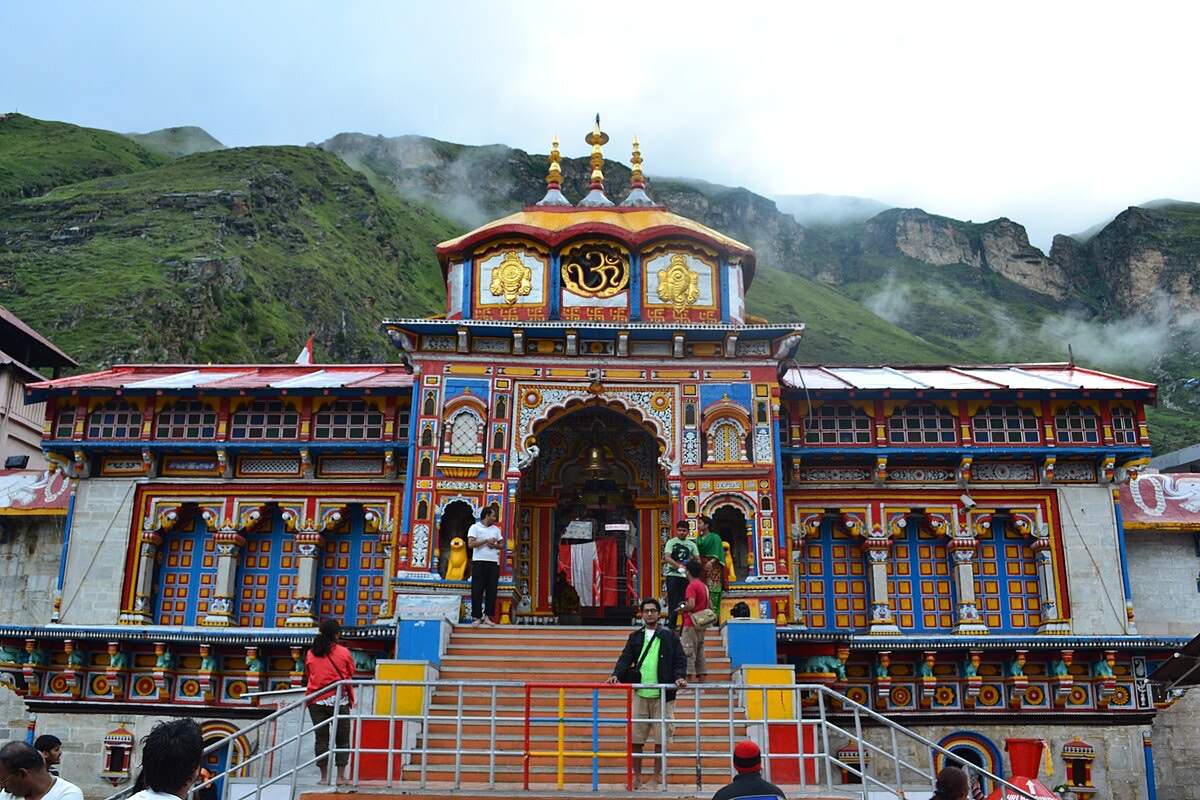
Badrīnāth Temple, though not monumental in scale, is architecturally distinctive and vividly colourful. The structure comprises three main sections: the Garbhagṛha (sanctum sanctorum), the Darśana Maṇḍapa (worship hall), and the Sabhā Maṇḍapa (assembly hall).
The Sanctum and the Sacred Image
The Garbhagṛha houses the primary deity: a one-foot-tall Śāligrāma stone image of Lord Badrīnārāyaṇa seated in padmāsana (lotus posture) in deep meditation, placed beneath a golden canopy under a badrī tree. Unlike most Vaiṣṇava temples where Viṣṇu is depicted standing or reclining, the meditating form at Badrīnāth is unique and reflects the site’s association with eternal tapas.
The Brightly Painted Facade
The temple’s facade is one of its most striking features — a tall, arched gateway known as the Siṃhadwāra (“Lion Gate”) painted in vivid colours that stand out dramatically against the grey Himalayan landscape. Scholars have noted that the architectural style, particularly the colourful facade and the arched windows, bears a resemblance to Buddhist vihāra design, suggesting possible Buddhist influence during the centuries before Śaṅkarācārya’s revitalization. The conical śikhara (tower) rises approximately 15 metres and is topped with a small cupola covered in gilded gold.
The Maṇḍapas
The Darśana Maṇḍapa is a spacious, pillared hall whose walls and columns are adorned with intricate carvings depicting scenes from Vaiṣṇava mythology. The Sabhā Maṇḍapa serves as the assembly area where devotees gather for kīrtana (devotional singing) and religious discourses. Both halls feature traditional stone masonry characteristic of Garhwal Himalayan temple architecture.
Tapt Kuṇḍ: The Sacred Hot Springs
Immediately below the temple lies Tapt Kuṇḍ, a natural hot sulphur spring considered among the most sacred bathing sites in Hinduism. The spring maintains a year-round temperature of approximately 55 degrees Celsius, remarkable given that the ambient temperature at this altitude rarely exceeds 17 degrees Celsius. The name “Tapt Kuṇḍ” literally means “heated pool,” and Hindu tradition attributes its warmth to Agni, the fire god, who heats the waters from beneath the earth as a service to Lord Viṣṇu’s devotees.
Pilgrims consider bathing in Tapt Kuṇḍ an essential purificatory rite before entering the temple. The waters are believed to possess both spiritual and medicinal properties — curing skin ailments and rheumatic conditions. The Skanda Purāṇa describes the spring as having arisen from the earth at Viṣṇu’s command so that pilgrims braving the harsh mountain journey would find warmth and healing.
Adjacent to Tapt Kuṇḍ is Nārad Kuṇḍ, a cooler pool where the sacred Śāligrāma image was said to have been discovered by Śaṅkarācārya.
The Char Dhām Yātrā
Badrīnāth holds the supreme position among the four Char Dhām pilgrimage sites of Uttarakhand — Yamunōtrī, Gaṅgōtrī, Kedāranāth, and Badrīnāth — which together constitute one of the most important pilgrimage circuits in Hinduism. The Char Dhām Yātrā traditionally proceeds from west to east, with Badrīnāth as the final and climactic destination.
Badrīnāth is also the northernmost of the all-India Char Dhām established by Ādi Śaṅkarācārya, alongside Rāmeśvaram in the south, Dvārakā in the west, and Purī Jagannāth in the east. This pan-Indian Char Dhām circuit symbolizes the spiritual unity of the subcontinent, with Badrīnāth representing the celestial north, the direction of the Himālayas and the abode of the gods.
Hindu tradition teaches that a pilgrimage to all four dhāms washes away accumulated sins and brings the devotee closer to mokṣa (liberation). The Skanda Purāṇa declares: “There are many sacred places in heaven, on earth, and in the nether regions, but there has been none equal to Badrī, nor shall there be” (Skanda Purāṇa, Vaiṣṇava Khaṇḍa).
The Seasonal Temple: Opening and Closing Ceremonies
Due to extreme winter conditions at its Himalayan altitude, Badrīnāth Temple is open to pilgrims for only six months each year, roughly from late April to early November. The opening and closing ceremonies are among the most significant religious events in the Hindu calendar.
The Opening (Kapāṭ Utsava)
The temple doors (kapāṭ) are ceremonially opened on or near the auspicious day of Akṣaya Tṛtīyā, a date determined by the priests at Jyotir Maṭha. Before the doors are opened, the Rawal and his priestly retinue perform elaborate Vedic rituals. Remarkably, the akhaṇḍa jyoti (eternal flame) lit before the temple was closed the previous autumn is often found still burning when the doors reopen after six months — a phenomenon devotees regard as proof of Viṣṇu’s living presence.
The Closing (Viṣṇu Saṅkrānti)
The temple closes on or near the festival of Bhāī Dūj (Yama Dvitīyā), two days after Dīvālī, usually in late October or November. In the closing ceremony, the sacred mūrti is symbolically offered a final meal, dressed in warm woollen garments, and the perpetual lamp is lit before the heavy temple doors are sealed. For the next six months, the valley is buried under metres of snow, and the administration shifts to the winter headquarters at Joshimaṭh, where worship of a portable image continues.
Sacred Sites Around Badrīnāth
Mānā Village: India’s Last Inhabited Settlement
Just 3 kilometres north of Badrīnāth lies Mānā, the last Indian village before the Tibet (China) border. This tiny settlement of the Bhoṭiyā community is steeped in mythology. A natural stone bridge over the Sarasvatī River, known as Bhīma Pul, is said to have been created by Bhīma, the mighty Pāṇḍava, to help Draupadī cross the torrent during the Pāṇḍavas’ final journey (mahāprasthāna) toward heaven, as described in the Mahābhārata.
Vyāsa Guhā: Where the Mahābhārata Was Written
In Mānā village stands a cave known as Vyāsa Guhā (“Vyāsa’s Cave”), where the sage Vyāsa is believed to have dictated the Mahābhārata to Lord Gaṇeśa. According to the Ādi Parva, Vyāsa approached Gaṇeśa to serve as his scribe, and Gaṇeśa agreed on the condition that Vyāsa would not pause in his recitation. The cave, accessible to visitors, is a modest rock formation where devotees offer prayers, contemplating the birthplace of one of humanity’s greatest epics.
Nearby is Gaṇeśa Guhā, the cave where Gaṇeśa is said to have sat writing as Vyāsa dictated.
Nīlakaṇṭha Peak
Towering above the temple at 6,597 metres, Nīlakaṇṭha Peak — known as the “Queen of Garhwal” — forms a dramatic backdrop to the sacred precinct. Its snow-covered summit is visible from the temple courtyard on clear days, and pilgrims regard it as the frozen crest of Viṣṇu’s celestial abode. The peak’s name (“Blue-Throated”) is an epithet shared with Śiva, another instance of the theological interweaving of Vaiṣṇava and Śaiva traditions at this sacred site.
Sarasvatī River and Vasudhārā Falls
The Sarasvatī River, emerging from between the Nara and Nārāyaṇa mountains, is one of the few places where this mythical river is visible above ground before it disappears underground — a phenomenon that resonates with the Vedic hymns describing the Sarasvatī as both visible and hidden. Approximately 9 kilometres from Badrīnāth, Vasudhārā Falls cascades from a height of 122 metres, and tradition holds that the waters fall directly onto the hands of only the truly virtuous.
Scriptural Authority
Badrīnāth’s sanctity is attested across a vast range of Hindu scriptures:
- Viṣṇu Purāṇa (2.8.97-109): Describes Badrīkāśrama as the foremost of all Viṣṇu tīrthas
- Bhāgavata Purāṇa (3.4.22): Establishes Nara-Nārāyaṇa’s eternal penance at Badrīkāśrama
- Mahābhārata (Vana Parva 88-89): The Pāṇḍavas’ visit to Badrīkāśrama during their forest exile
- Skanda Purāṇa (Vaiṣṇava Khaṇḍa): Declares Badrīnāth supreme among all tīrthas
- Padma Purāṇa: Lists Badrīnāth among the foremost pilgrimage destinations
- Divya Prabandham: The Āḻvār saints’ Tamil hymns celebrating Badrīnāth as a Divya Desam
The Mahābhārata’s Vana Parva records that during their twelve years of forest exile, the Pāṇḍavas journeyed to Badrīkāśrama and performed austerities here. The final book of the Mahābhārata, the Mahāprasthānika Parva, describes the Pāṇḍavas’ ultimate journey through this very region — ascending the Himalayan peaks toward Svarga (heaven), with only Yudhiṣṭhira surviving to reach the summit.
Festivals and Rituals
Māta Mūrti Kā Melā
The most important local festival, Māta Mūrti Kā Melā, is celebrated in September and honours Mūrti, the mother of the sages Nara and Nārāyaṇa. The festival commemorates her joy upon learning that Lord Viṣṇu had incarnated as her twin sons. It features vibrant processions, devotional music, and rituals invoking maternal blessings.
Badrī-Kedār Festival
This cultural and spiritual festival celebrates the twin dhāms of Badrīnāth and Kedāranāth through classical music, dance, and religious discourses, drawing artists and scholars from across India.
Daily Rituals
The daily worship schedule at Badrīnāth follows an elaborate pattern: Mahābhiṣeka Pūjā (grand bathing) at dawn, Gītā Pāṭha (recitation of the Bhagavad Gītā), Bhagavat Pūjā (main worship), and Āratī in the evening. The temple closes briefly each afternoon, and during this interval, the deity is believed to receive worship from the gods themselves.
Conclusion: The Eternal Meditator
Badrīnāth endures as one of Hinduism’s most powerful sacred landscapes — a place where the boundary between the earthly and the divine dissolves in the thin Himalayan air. Here, where the Alaknandā rushes through a valley flanked by peaks named for divine sages, where hot springs defy the glacial cold, and where the snow-shrouded summit of Nīlakaṇṭha pierces the sky, the devout Hindu encounters the living presence of Viṣṇu in His most contemplative form. As the Skanda Purāṇa promises, among all the sacred places across the three worlds, none has been nor ever shall be the equal of Badrīnāth — the place where God Himself sits in eternal meditation, waiting beneath the sheltering branches of the badrī tree for all who undertake the arduous journey to His Himalayan door.