Introduction: The City That Never Falls
Ayodhyā — literally “the unconquerable” (from the Sanskrit a-yudhyā, “not to be fought against”) — stands as one of the most sacred cities in Hinduism and one of the oldest continuously significant sacred geographies in the Indian subcontinent. Situated on the right bank of the Sarayū (Ghaghara) river in present-day Uttar Pradesh, Ayodhyā is revered above all as the birthplace and capital of Lord Rāma, the seventh avatāra of Viṣṇu, whose life as narrated in the Rāmāyaṇa has shaped the moral, spiritual, and political imagination of Hindu civilization for over three millennia.
The Garuḍa Purāṇa lists Ayodhyā first among the seven sacred cities that grant liberation: “Ayodhyā, Mathurā, Māyā, Kāśī, Kāñcī, Avantikā, and Dvārakā — these seven cities are the givers of mokṣa” (Garuḍa Purāṇa XVI.14). This primacy of position is not accidental: Ayodhyā is the city of the Sūrya Vaṃśa (Solar Dynasty), the most ancient and illustrious royal lineage in Hindu tradition, the dynasty that produced Rāma and, through him, the very concept of the righteous ruler.
Rāma’s Birth and the Rāmāyaṇa Connection
The City of the Solar Dynasty
According to the Rāmāyaṇa (Bāla Kāṇḍa, Cantos 5-6), Ayodhyā was founded by Manu Vaivasvata, the progenitor of humanity, and served as the capital of the Ikṣvāku dynasty — the Solar Dynasty (Sūrya Vaṃśa) — for countless generations. Vālmīki describes Ayodhyā as a city of magnificent palaces, wide avenues, flourishing gardens, and prosperous citizens, rivalling the city of Indra in heaven: “Ayodhyā was a great and prosperous city, twelve yojanas long and three yojanas wide, with well-ordered streets and joyous people” (Rāmāyaṇa, Bāla Kāṇḍa 5.7-8).
The greatest of the Solar Dynasty kings before Rāma included Harishchandra (the embodiment of truth), Sagara (whose quest for the lost sacrificial horse led to the descent of the Gaṅgā), Bhagīratha (who brought the Gaṅgā to earth), and Dilīpa (the ideal patron of the sacred cow). Each contributed to the dynasty’s reputation for dharma, culminating in the reign of Rāma himself.
The Birth of Rāma
The Rāmāyaṇa (Bāla Kāṇḍa, Cantos 15-18) describes how King Daśaratha, childless and anxious for an heir, performed the Putreṣṭi Yajña (the sacrifice for obtaining sons) under the guidance of the sage Ṛṣyaśṛṅga. From the sacrificial fire emerged a divine being bearing a vessel of celestial payasam (rice pudding), which was distributed among Daśaratha’s three queens: Kausalyā, Sumitrā, and Kaikeyī.
On the ninth day of the bright half of the month of Caitra (March-April), under the asterism of Punarvasu and with five planets in exaltation, Lord Viṣṇu manifested as the eldest son of Kausalyā. This child was named Rāma — “the one who delights” — and with him were born Bharata (from Kaikeyī), and the twins Lakṣmaṇa and Śatrughna (from Sumitrā). The Rāmāyaṇa states that the city of Ayodhyā celebrated for eleven days, with music, dance, feasting, and the distribution of gifts to all citizens (Bāla Kāṇḍa 18.10-15).
The Exile and the Return
The great drama of the Rāmāyaṇa — Rāma’s fourteen-year exile to the forest, Sītā’s abduction by Rāvaṇa, the alliance with the Vānara (monkey) army, the construction of the bridge to Laṅkā, the war, the rescue of Sītā, and the triumphant return to Ayodhyā — begins and ends in this city. The return of Rāma to Ayodhyā after his exile, celebrated as the festival of Dīvālī, is described in the Rāmāyaṇa (Yuddha Kāṇḍa 127-128) as a moment of cosmic joy: the citizens illuminated the city with rows of lamps, the streets were decorated with garlands and festoons, and the earth itself seemed to rejoice at the restoration of dharma.
Rāma’s subsequent reign — the famous Rāma Rājya — became the Hindu ideal of perfect governance: a kingdom where no one suffered, where truth prevailed, where the rains came on time, and where the king’s sole concern was the welfare of his people. This ideal has informed Hindu political philosophy for millennia and continues to resonate in contemporary Indian public discourse.
Rāma Janmabhūmi: The Birthplace Temple
Historical Significance
The Rāma Janmabhūmi (“birthplace of Rāma”) in Ayodhyā marks the spot traditionally identified as the exact location where Lord Rāma was born. This site has been one of the most venerated locations in Hindu sacred geography for many centuries. The Skanda Purāṇa (Ayodhyā Māhātmya) describes the Janmasthāna as a place where merely touching the earth grants spiritual merit equivalent to donating a thousand cows.
The New Ram Mandir
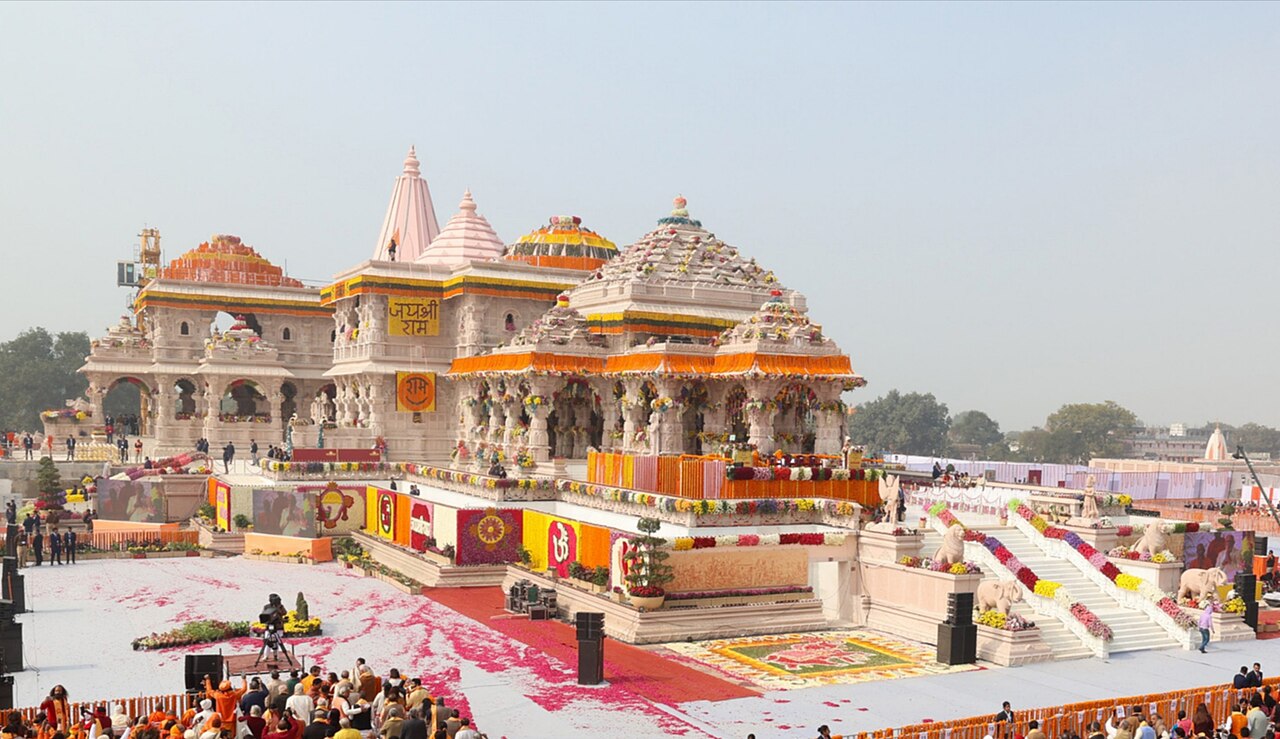
The Śrī Rāma Janmabhūmi Mandir, inaugurated on 22 January 2024 with the prāṇa pratiṣṭhā (consecration ceremony) of the Rāma Lallā (infant Rāma) deity, is one of the largest Hindu temples in the world. Designed in the Nāgara style of North Indian temple architecture and built entirely of stone without the use of steel or iron, the temple rises to a height of 161 feet with three stories. The ground floor houses the sanctum with the deity of Rāma Lallā, carved from a single block of black stone (Kṛṣṇa Śilā) from the Sarayū river region.
The temple complex, spread over 70 acres, includes a prayer hall accommodating 5,000 devotees, a museum, a library, and gardens. The temple’s śikhara (tower) is crowned with a gold kalaśa (finial), and the walls are adorned with carvings depicting scenes from the Rāmāyaṇa. The inauguration drew global attention, with millions watching the ceremony, and the temple has since become one of the most visited pilgrimage destinations in India, drawing over 135 million visitors in its first year.
The Ghats of the Sarayū
The Sarayū river, on whose banks Ayodhyā stands, is one of the holiest rivers in Hinduism. The Rāmāyaṇa frequently references the Sarayū as the life-giving artery of Ayodhyā, and several Purāṇas attribute great sanctity to bathing in its waters.
Rāma Ghāṭ
Rāma Ghāṭ is the principal bathing ghat of Ayodhyā and the site of the grand Sarayū Āratī ceremony performed every evening. This ghat is believed to be the spot where Rāma performed his ritual ablutions. During festivals, particularly on Rāma Navamī and Kārtika Pūrṇimā, hundreds of thousands of devotees gather here for sacred bathing.
Svargadvāra Ghāṭ
Svargadvāra Ghāṭ (“the gateway to heaven”) marks the site where, according to the Uttara Kāṇḍa of the Rāmāyaṇa and the Padma Purāṇa, Lord Rāma entered the waters of the Sarayū for his final departure from the earthly realm (mahāprasthāna). Accompanied by the entire population of Ayodhyā, Rāma walked into the river and returned to his divine abode as Viṣṇu. This ghat is therefore associated with mokṣa, and many devout Hindus consider it auspicious to perform ancestral rites (śrāddha) here.
Lakṣmaṇa Ghāṭ
Named after Rāma’s devoted brother Lakṣmaṇa, this ghat is believed to be the spot where Lakṣmaṇa performed his daily worship. The Lakṣmaṇa Ghāṭ complex includes a Lakṣmaṇa temple and is a popular site for morning prayers and ritual bathing.
Scriptural Authority
The Vālmīki Rāmāyaṇa
The Rāmāyaṇa of Vālmīki, composed in approximately the 5th century BCE, is the foundational text for the sacredness of Ayodhyā. The epic’s opening cantos (Bāla Kāṇḍa 5-6) contain the most detailed description of the ancient city, establishing its dimensions, its prosperity, its governance structure, and its role as the seat of dharmic kingship.
The Rāmacaritamānasa of Tulasīdāsa
Gosvāmī Tulasīdāsa’s Rāmacaritamānasa (composed in Vārāṇasī in the 16th century) is the most widely read and recited telling of the Rāma narrative in North India. While not composed in Ayodhyā itself, the Mānasa opens with an elaborate hymn to Ayodhyā and Rāma’s birth that has shaped popular Hindu devotion more than any other text. The Ayodhyā Kāṇḍa of the Mānasa — describing Rāma’s exile and the grief of the city — contains some of the most emotionally powerful verses in Hindi devotional literature.
Purāṇic References
The Skanda Purāṇa contains a dedicated Ayodhyā Māhātmya establishing the city’s sacred geography, listing its temples, tīrthas, and the spiritual benefits of pilgrimage. The Padma Purāṇa, Viṣṇu Purāṇa, and Agni Purāṇa all contain references to Ayodhyā’s sanctity and its connection to the Solar Dynasty.
Other Sacred Sites in Ayodhyā
Hanumānagarhi
Hanumānagarhi (“the fort of Hanumān”) is a temple perched atop a hill in the centre of Ayodhyā, accessed by climbing 76 steps. According to local tradition, Hanumān stationed himself here as a vigilant guardian of the Rāma Janmabhūmi, protecting it from any threat. The temple houses a striking image of Hanumān with the infant Rāma on his lap and is one of the most visited shrines in Ayodhyā. Pilgrims traditionally visit Hanumānagarhi before proceeding to the Janmabhūmi.
Kanak Bhavan
Kanak Bhavan (“the golden palace”) is a temple dedicated to Rāma and Sītā, believed to have been the personal palace given by Queen Kaikeyī to Sītā as a wedding gift. The temple houses beautifully adorned golden images of Rāma and Sītā and is one of Ayodhyā’s most beloved sites of devotion, particularly for couples and families.
Nāgeśvaranātha Temple
One of the oldest temples in Ayodhyā, the Nāgeśvaranātha Temple is dedicated to Lord Śiva and is believed to have been established by Kuśa, the son of Rāma. The temple is one of the few Śaiva shrines in the predominantly Vaiṣṇava city, reflecting the theological principle that Rāma himself was a devotee of Śiva.
Daśaratha Mahala and Rāṇī Mahal
These sites mark the locations of King Daśaratha’s royal palace and the queens’ quarters, respectively. Though the ancient structures no longer survive, the sites are maintained as places of devotion where pilgrims can contemplate the domestic setting of the Rāmāyaṇa narrative.
Ayodhyā in the Jain Tradition
Ayodhyā holds deep significance for Jainism as well. It is revered as the birthplace of five Jain Tīrthaṅkaras: Ṛṣabhadeva (the first), Ajitanātha (the second), Abhinandananātha (the fourth), Sumatinātha (the fifth), and Anantnātha (the fourteenth). The presence of ancient Jain temples in Ayodhyā attests to the city’s pan-Indian sacred character, transcending sectarian boundaries.
Festivals and Living Traditions
Rāma Navamī
Rāma Navamī (the ninth day of the bright half of Caitra) celebrates the birth of Lord Rāma and is the most important festival of Ayodhyā. The entire city is transformed with decorations, processions, and continuous recitation of the Rāmacaritamānasa. The Janmabhūmi temple conducts elaborate abhiṣeka ceremonies at the precise muhūrta (auspicious moment) of Rāma’s birth, and devotees observe fasts and offer prayers throughout the day.
Dīpāvalī (Dīvālī)
Ayodhyā claims a special relationship with Dīvālī, as the festival celebrates Rāma’s triumphant return to the city after fourteen years of exile and his victory over Rāvaṇa. In recent years, Ayodhyā has organized spectacular Dīvālī celebrations, including the lighting of hundreds of thousands of earthen lamps along the Sarayū ghats, earning Guinness World Records for the largest display of oil lamps.
Parikarma (Circumambulation)
The Ayodhyā Parikarma is a 14-kilometre circumambulation of the sacred city, passing through all its major temples, ghats, and sacred sites. This pilgrimage route, prescribed in the Skanda Purāṇa, is performed by thousands of devotees daily and by millions during festivals.
Conclusion: The Abode of Dharma
Ayodhyā stands as more than a city of temples and ghats; it is the living embodiment of the Hindu ideal that the divine can enter history, that God can be born in a palace, walk among ordinary people, endure exile and hardship, and through his example establish the principles by which human society should be governed. The concept of Rāma Rājya — the reign of Rāma — remains the most enduring political metaphor in Indian civilization: a society governed by truth, compassion, duty, and selfless service. As the Rāmāyaṇa declares: “As long as the mountains stand and the rivers flow, so long shall the story of Rāma be told in this world” (Rāmāyaṇa, Bāla Kāṇḍa 2.36). And as long as Rāma’s story endures, Ayodhyā — the unconquerable city, the birthplace of dharma incarnate — shall endure with it.