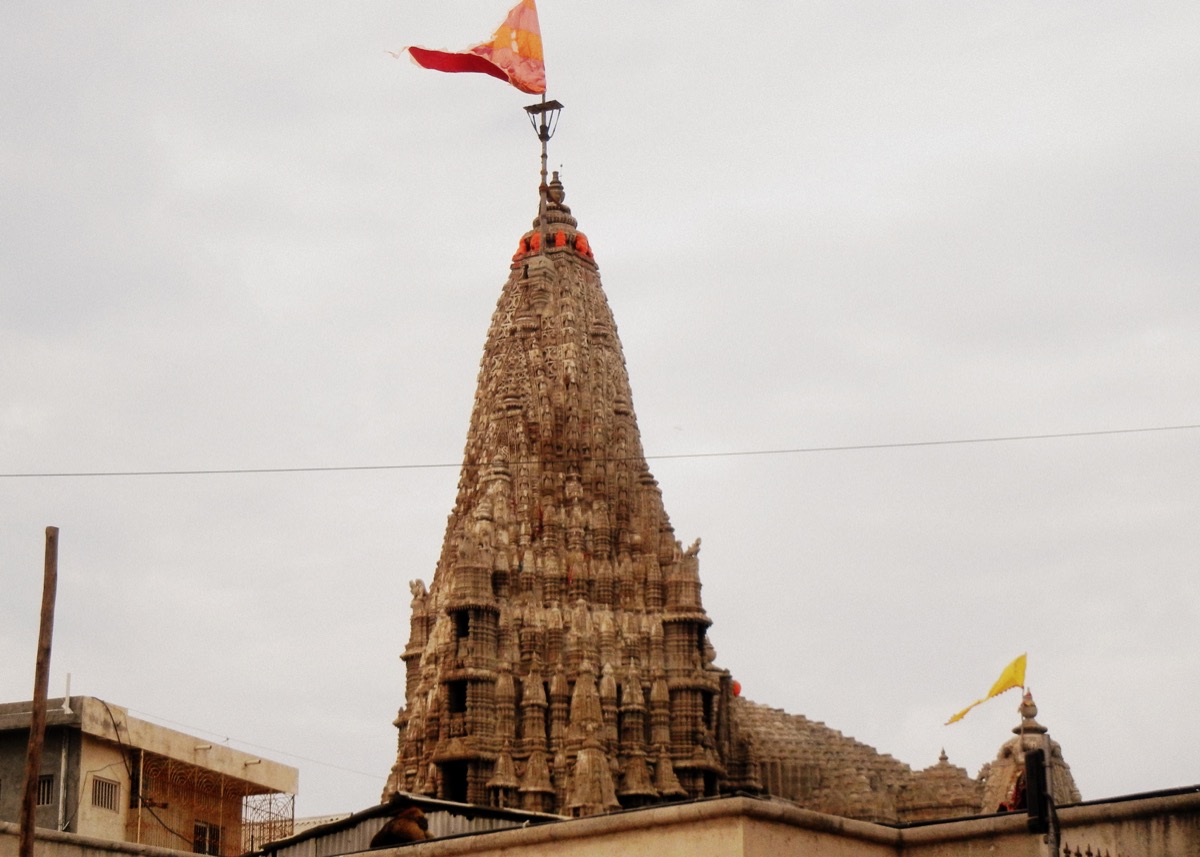
Introduction: The City That Rose from the Sea
Dvārakā — known also as Dvāravatī (“the city of many gates”), Kuśasthalī, and Svarna Dvārakā (“Golden Dvārakā”) — stands among the most sacred sites in Hinduism. Located on the western tip of the Saurashtra peninsula in present-day Gujarat, where the Gomtī river meets the Arabian Sea, this ancient pilgrimage city holds the extraordinary distinction of being simultaneously one of the four Char Dhām (sacred abodes established by Ādi Śaṅkarācārya) and one of the seven Sapta Purī (cities that grant mokṣa).
The name Dvārakā derives from the Sanskrit word “dvāra” meaning “gate” or “door,” reflecting the mythological description of a city with magnificent gateways. The Bhāgavata Purāṇa (10.50.50-53) describes Dvārakā as a city of gold and jewels, designed by the divine architect Viśvakarman at the command of Lord Kṛṣṇa, rising from the waters of the western ocean as a paradise on earth.
For the devout Hindu, Dvārakā is not merely a historical or archaeological site — it is the living abode of Kṛṣṇa as Dvārakādhīśa, the “King of Dvārakā,” where the Lord’s presence is felt as powerfully today as it was in the age of the Mahābhārata.
Mythological Origins: Kṛṣṇa’s Golden Kingdom
The Flight from Mathurā
The story of Dvārakā begins with a crisis. According to the Bhāgavata Purāṇa (10.50) and the Harivaṃśa, after Kṛṣṇa killed his tyrannical uncle Kaṃsa in Mathurā, Kaṃsa’s father-in-law Jarāsandha, the mighty king of Magadha, launched seventeen successive attacks on Mathurā to avenge his son-in-law’s death. To protect the Yādava people from this relentless onslaught, Kṛṣṇa made the strategic decision to relocate his entire kingdom.
Kṛṣṇa requested twelve yojanas of land from the ocean (Samudra), and the sea withdrew to create a magnificent island. He then summoned Viśvakarman, the celestial architect, to construct a city of unprecedented splendour. The Harivaṃśa (Viṣṇu Parva 55-58) describes the resulting city in extraordinary detail: streets paved with precious gems, palaces of crystal and gold, gardens perpetually in bloom, and sixteen thousand palatial residences — one for each of Kṛṣṇa’s queens.
The Splendour of Dvārakā
The Bhāgavata Purāṇa (10.69.1-12) provides the most vivid description of Dvārakā’s magnificence. When the sage Nārada visited the city, he found it surrounded by moats and walls of gold, with 900,000 royal palaces. The city was adorned with parks, orchards, and lakes filled with lotuses. Crystal-clear roads were lined with assembly halls, temples, and marketplaces. The entire city radiated such splendour that it appeared to be a second Vaikuṇṭha (Viṣṇu’s celestial abode) descended to earth.
The Viṣṇu Purāṇa (5.23.7-15) adds that Dvārakā was protected by the Sudarśana Cakra (Viṣṇu’s divine discus), which orbited the city constantly, ensuring no enemy could breach its defences.
The Submersion of Dvārakā
The most poignant chapter in Dvārakā’s mythology is its submersion beneath the sea. According to the Mausala Parva of the Mahābhārata (16.7) and the Bhāgavata Purāṇa (11.30-31), after Kṛṣṇa’s departure from the mortal world (the event known as Kṛṣṇa’s niryāṇa), the golden city was gradually consumed by the ocean. As the Yādava clan destroyed itself through an internecine conflict precipitated by the curse of the sage Viśvāmitra’s descendants, and as Kṛṣṇa departed to his eternal abode, the sea rose to reclaim the land. Arjuna, who had come to rescue the remaining residents, watched helplessly as the waves swallowed the city — all except the Dvārakādhīśa temple, which was spared by the Lord’s grace.
The Bhāgavata Purāṇa (11.31.24) records: “The sea immediately inundated Dvārakā after Lord Kṛṣṇa departed for His supreme abode. But the Lord’s own temple and its immediate surroundings were spared.”
The Dvārakādhīśa Temple: Heart of Devotion
Architecture and Antiquity
The Dvārakādhīśa Temple, also known as the Jagat Mandir (“Universal Shrine”) or Triloka Sundara (“the most beautiful in all three worlds”), is the principal temple of Dvārakā. Tradition ascribes its original construction to Vajranābha, the great-grandson of Lord Kṛṣṇa, over 2,500 years ago, though the present structure dates primarily to the 15th-16th centuries with subsequent restorations.
The temple stands majestically on the banks of the Gomtī river, its five-storey structure rising 43 metres (140 feet) into the sky. The temple’s elaborately carved śikhara (spire) is topped by a massive flag — the Dhvaja — sewn from 52 yards of cloth, which is changed five times daily and can be seen from as far as 10 kilometres out at sea. This flag has served as a beacon for sailors and pilgrims alike for centuries.
The temple is built of soft limestone and consists of a sanctum (garbhagṛha), a vestibule (antarāla), and a rectangular pillared hall (sabhā-maṇḍapa) with porches on three sides. It has two principal gateways: the Svarga Dvāra (“Gate to Heaven”), through which pilgrims enter from the marketplace side, and the Mokṣa Dvāra (“Gate of Liberation”), through which they exit on the riverside, descending 56 steps to the Gomtī Ghāṭ.
The Deity and Worship
The presiding deity is Lord Kṛṣṇa in his form as Dvārakādhīśa — the sovereign king of Dvārakā, depicted as a four-armed Viṣṇu holding the conch (śaṅkha), discus (cakra), mace (gadā), and lotus (padma). This royal iconography distinguishes the Dvārakā Kṛṣṇa from the pastoral flute-playing Kṛṣṇa of Vṛndāvana, emphasizing his role as divine ruler and protector.
The temple follows the Vallabhācārya tradition of worship (Puṣṭi Mārga), with an elaborate daily ritual schedule that includes the maṅgalā āratī at dawn, the śṛṅgāra darśana when the deity is adorned, the rājbhoga offering at noon, and the śayana āratī at night when the Lord is ceremonially put to rest.
Bet Dvārakā: The Island Sanctuary
Approximately 30 kilometres from the mainland temple, in the Gulf of Kutch, lies Bet Dvārakā (also called Śaṅkhodhāra), an island believed to be the original residential palace of Lord Kṛṣṇa. The Bhāgavata Purāṇa indicates that while Kṛṣṇa held court in the main city, his personal quarters and intimate divine play (līlā) occurred on this island.
The island houses the ancient Kṛṣṇa temple where the deity is adorned with a distinctive gold crown. According to local tradition, this is the very spot where Kṛṣṇa lived with his chief queen Rukmiṇī. The island also contains temples dedicated to Hanumān, Dattātreya, and Viṣṇu. Archaeological excavations on Bet Dvārakā have revealed pottery, anchors, and structural remains dating to the late Harappan period (circa 1500 BCE), lending historical weight to the traditions.
Pilgrims consider a visit to Dvārakā incomplete without crossing the sea to Bet Dvārakā. The boat journey itself is considered a sacred act, recalling the sea journeys of Kṛṣṇa’s companions.
Nāgeśvara Jyotirliṅga
Located between Dvārakā and Bet Dvārakā stands the Nāgeśvara Jyotirliṅga temple, one of the twelve sacred Jyotirliṅgas of Lord Śiva. The Śiva Purāṇa (Koṭirudra Saṃhitā 1.17-18) lists Nāgeśvara (also called Dārukāvana Nāgeśvara) among the twelve self-manifested liṅgas of light. The temple houses a massive 25-foot tall statue of Lord Śiva in the outer compound, one of the largest Śiva images in India.
The legend of Nāgeśvara involves a devout Śiva-bhakta named Supriya who was captured by the demon Dāruka and imprisoned in Dārukāvana (the Forest of Dāruka). Even in captivity, Supriya continued chanting “Om Namaḥ Śivāya.” Moved by his devotion, Śiva manifested as Nāgeśvara and destroyed the demon, establishing his Jyotirliṅga at this site.
The presence of a Jyotirliṅga near Dvārakā underscores the site’s pan-sectarian importance — it is sacred to Vaiṣṇavas (devotees of Viṣṇu/Kṛṣṇa) and Śaivas (devotees of Śiva) alike.
Marine Archaeology: The Submerged City
One of the most remarkable aspects of Dvārakā’s significance is the discovery of submerged ruins off its coast, lending archaeological support to the ancient accounts of a city swallowed by the sea. Beginning in 1963, and continuing through extensive expeditions by the Marine Archaeology Centre of the National Institute of Oceanography under Dr. S.R. Rao in the 1980s-2000s, underwater explorations have revealed:
- Stone structures: Fortification walls, bastions, and building foundations submerged in approximately 6-7 metres of water in the intertidal zone of modern Dvārakā.
- Anchors: Triangular stone anchors of a type used in Mediterranean and West Asian maritime trade, suggesting Dvārakā was a major port city with international connections.
- Pottery: Ceramics dating from the late Harappan period (circa 1500 BCE) through the Historical period (circa 1st century BCE - 1st century CE).
- Seals: A seal inscribed with a three-headed animal motif, reminiscent of Harappan seals.
While scholars debate whether these ruins correspond to the mythological Dvārakā of Kṛṣṇa or to later historical settlements, the discoveries confirm that a significant urban settlement existed at this site in antiquity and was indeed submerged by the sea — a striking parallel to the Purāṇic accounts.
Gomtī Ghāṭ and the Sacred River
The Gomtī river at Dvārakā (distinct from the Gomtī of Lucknow) is considered sacred in its own right. The river’s confluence with the Arabian Sea at Dvārakā is a tīrtha of great merit. Gomtī Ghāṭ, the broad stone steps descending from the Mokṣa Dvāra of the Dvārakādhīśa temple to the river, is the primary bathing and ritual site.
Pilgrims perform the saṅkalpa (ritual resolve) and take a sacred bath in the Gomtī before entering the temple. The Skanda Purāṇa (Prabhāsa Khaṇḍa) declares that bathing at the Gomtī-Sāgara saṅgama (the confluence of the Gomtī and the ocean) destroys the sins of seven lifetimes and grants the merit of performing the Aśvamedha Yajña.
The five sacred bathing sites (Pañca Tīrtha) of Dvārakā are: Gomtī Saṅgama, Cakra Tīrtha, Siddheśvara Tīrtha, Ratnākara Tīrtha, and Madhuvana. Pilgrims who bathe at all five in a single day are believed to gain the full fruit of the Dvārakā pilgrimage.
Char Dhām and Sapta Purī: Dvārakā’s Dual Status
Among the Char Dhām
Dvārakā holds the western position in the Char Dhām circuit established by Ādi Śaṅkarācārya in the 8th century CE. The four sacred abodes — Badrīnātha (north), Purī (east), Rāmeśvaram (south), and Dvārakā (west) — span the four cardinal directions of the Indian subcontinent, representing the spiritual unity of the land. Ādi Śaṅkarācārya established the Śāradā Pīṭha (also called Kālikā Pīṭha) at Dvārakā as one of the four principal maṭhas (monastic centres) of the Advaita Vedānta tradition.
Pilgrims who complete the Char Dhām Yātrā — visiting all four sites — are believed to accumulate immeasurable spiritual merit and advance significantly toward mokṣa.
Among the Sapta Purī
The seven cities that grant liberation (Sapta Purī or Sapta Mokṣapurī) are enumerated in a famous verse from the Garuḍa Purāṇa (16.14): “Ayodhyā, Mathurā, Māyā (Haridvār), Kāśī (Vārāṇasī), Kāñcī, Avantikā (Ujjain), and Dvārakā — these seven cities are the givers of mokṣa.” Dvārakā’s inclusion in this list affirms that simply dwelling in or dying within the sacred zone of Dvārakā is sufficient for liberation from the cycle of birth and death.
Festivals and Living Traditions
Janmāṣṭamī
The birth festival of Lord Kṛṣṇa, celebrated on the eighth day (aṣṭamī) of the dark fortnight of the month of Bhādrapada (August-September), is the grandest festival in Dvārakā. The Dvārakādhīśa temple is elaborately decorated, and thousands of devotees gather for the midnight celebration marking the exact moment of Kṛṣṇa’s birth. The city resonates with devotional songs (bhajans), dramatic enactments of Kṛṣṇa’s childhood exploits (rāslīlā), and a festive procession carrying the deity through the streets.
Śarad Pūrṇimā and Rāsa Līlā
The full moon night of the month of Āśvina (October) commemorates the divine Rāsa Līlā — Kṛṣṇa’s cosmic dance with the gopīs. In Dvārakā, this night is celebrated with all-night singing of Kṛṣṇa bhajans and special worship at the temple.
Dvārakā Parikramā
The circumambulation (parikramā) of the sacred zone of Dvārakā is an essential pilgrimage ritual. The route encompasses the Dvārakādhīśa temple, the Rukmiṇī temple (located about 2 km from the main shrine, where the goddess is worshipped separately according to a legend that she arrived at the temple late and was cursed to remain apart), the Gomtī Ghāṭ, and several subsidiary shrines.
The Rukmiṇī Temple
Located approximately two kilometres from the main Dvārakādhīśa temple stands the Rukmiṇī Devī temple, dedicated to Kṛṣṇa’s principal queen. According to local legend, the sage Durvāsā was once invited to dine with Kṛṣṇa and Rukmiṇī. During the walk to the feast, Rukmiṇī became thirsty, and Kṛṣṇa summoned the Gaṅgā by pressing his toe into the ground. But Rukmiṇī drank without offering water first to Durvāsā, who cursed her to remain forever separated from Kṛṣṇa in her temple. This legend explains the unusual circumstance of the divine consort’s temple standing apart from the Lord’s.
The temple itself is a fine example of Chalukya architecture, richly adorned with carved panels depicting scenes from Kṛṣṇa’s life.
Conclusion: The Eternal Gate
Dvārakā endures as one of Hinduism’s most potent sacred landscapes — a place where mythology, history, and living devotion converge at the edge of the western ocean. For the pilgrim who ascends the 56 steps of Gomtī Ghāṭ and passes through the Svarga Dvāra into the presence of Dvārakādhīśa, the golden city of Kṛṣṇa is not submerged in the past but vibrantly alive. As the Bhāgavata Purāṇa (10.69.40-42) declares: “Wherever Kṛṣṇa is, there is Dvārakā; wherever Dvārakā is, there is liberation.” The city’s very name — “the Gateway” — promises that those who enter with devotion will find, beyond its many doors, the ultimate door to the divine.