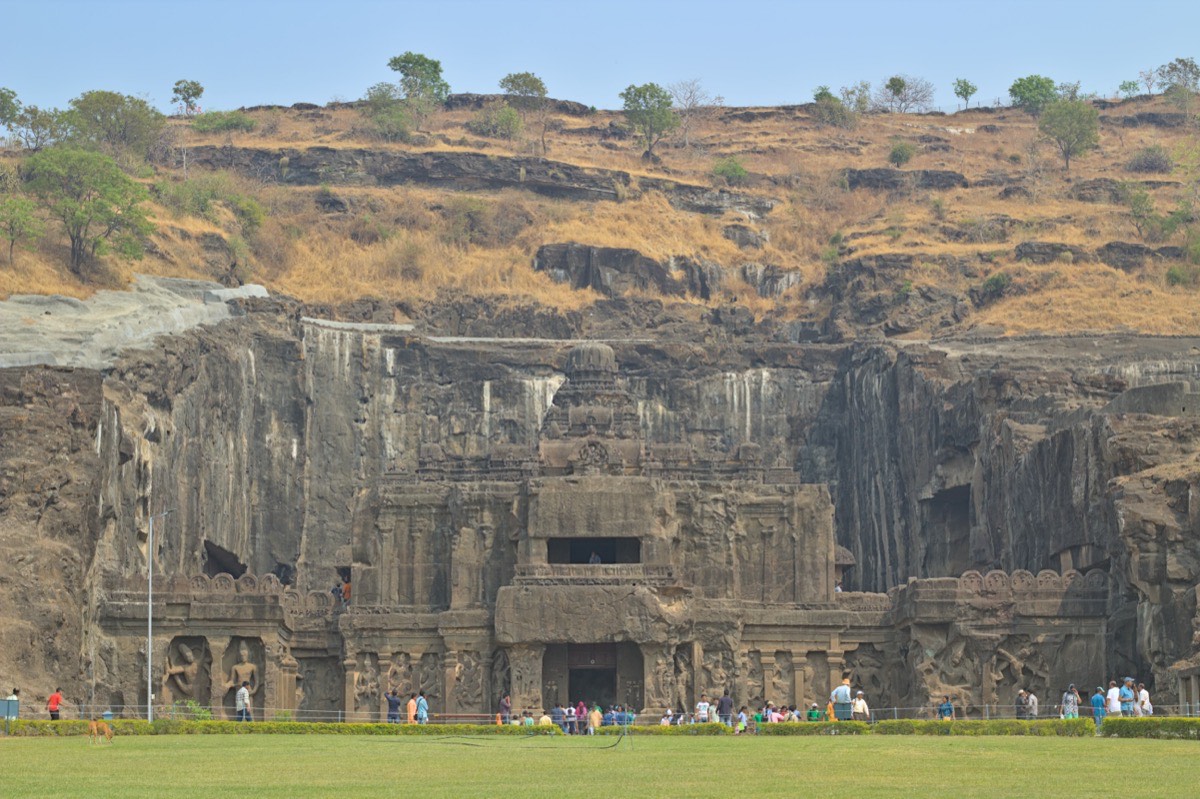
Stretching for more than two kilometres along the face of a high basalt cliff in the Charanandri Hills of Maharashtra, the Ellora Caves (एलोरा गुफाएँ) constitute one of the most extraordinary achievements of human creativity in the ancient world. Located approximately 30 kilometres from the city of Aurangabad (now officially Chhatrapati Sambhajinagar), this complex of 34 rock-cut caves — excavated between the 6th and 11th centuries CE — encompasses monasteries, prayer halls, and temples dedicated to three of India’s great religious traditions: Buddhism, Hinduism, and Jainism.
In 1983, UNESCO inscribed Ellora on its World Heritage List, recognising the site as “a unique artistic creation and a technological exploit” that “illustrates the spirit of tolerance that was characteristic of ancient India.” The unbroken sequence of monuments across five centuries brings the civilisation of classical and early medieval India vividly to life.
Geography and Setting
Ellora sits on the ancient trade route linking the port cities of India’s western coast with the Deccan interior — a fact that partly explains why it attracted the patronage and artistic investment of successive ruling dynasties. The caves were carved from the volcanic Deccan Trap basalt, a dense, fine-grained rock well suited to detailed sculptural work. The cliff face runs roughly north-south, with the caves opening to the west, so that the afternoon sun illuminates many of the interiors — an orientation that was almost certainly deliberate.
The site lies at an elevation of roughly 600 metres above sea level, and the surrounding landscape of scrubby hills and seasonal streams would have provided the monastic communities with the solitude and natural beauty conducive to contemplation.
The Three Groups of Caves
Although over 100 caves exist in the Charanandri escarpment, 34 are open to the public and formally numbered. These fall into three groups arranged sequentially along the cliff.
Buddhist Caves (Caves 1-12): 5th-8th Century CE
The earliest phase of excavation at Ellora produced twelve Buddhist caves, dating approximately from the 5th to the 8th century CE. These caves reflect the Mahāyāna school of Buddhism that was prevalent in the Deccan during this period.
Most of the Buddhist caves are vihāras (monasteries) — multi-storeyed complexes with residential cells for monks arranged around central halls. Some of the notable Buddhist excavations include:
- Cave 5 (“Mahārwāḍā”): One of the largest vihāras at Ellora, measuring approximately 36 by 17 metres, with two rows of ten columns and long stone benches that may have served as communal dining or study tables — an unusual feature not seen at other Indian rock-cut sites.
- Cave 10 (“Viśvakarmā” or “Carpenter’s Cave”): The only chaitya (prayer hall) among the Buddhist group, this remarkable cave features a vaulted ceiling with carved ribs imitating wooden beams — hence the popular name. A large seated Buddha figure, over 3 metres tall, occupies the apse at the rear.
- Cave 12 (“Tīn Tāl”): A massive three-storeyed monastery, the most elaborate Buddhist structure at Ellora. The uppermost floor contains rows of seated Buddha figures in various mudrās (gestures), along with images of Bodhisattvas such as Padmapāṇi and Vajrapāṇi, and early depictions of the goddess Tārā.
The Buddhist caves at Ellora display an interesting fusion with Hindu artistic conventions, particularly in Cave 8, where four-armed figures appear — the earliest known example of such Hindu iconographic influence on Buddhist art at this site.
Hindu Caves (Caves 13-29): 6th-10th Century CE
The Hindu group constitutes the largest and most artistically ambitious section of Ellora, comprising seventeen caves carved over approximately four centuries. These range from small, simple shrines to the colossal Kailāsa Temple (Cave 16) — the undisputed centrepiece of the entire complex.
The earliest Hindu cave, Cave 21 (“Rāmeśvara”), dates to the late 6th century CE and is attributed to the Kalacuri dynasty. Its entrance is flanked by exquisite carvings of the river goddesses Gaṅgā and Yamunā, while the interior contains superb panels of Śiva dancing among musicians and Durgā slaying the buffalo demon Mahiṣāsura.
Cave 29 (“Dhūmar Leṇā”) is among the largest early excavations and is architecturally reminiscent of the famous Elephanta caves near Mumbai. It is built around a natural waterfall that flows over the cave during the monsoon — described poetically as “falling over great Śiva’s brow.” The cave contains powerful sculptures of Śiva slaying the demon Andhaka and the wedding of Śiva and Pārvatī.
Cave 15 (“Daśāvatāra”) is a two-storeyed temple with spectacular large-scale sculptural panels illustrating the ten avatāras of Viṣṇu, including a celebrated depiction of the Varāha (boar) avatāra lifting the earth goddess Bhūdevī from the primordial ocean. This cave also contains the only significant ancient inscription at Ellora — a record documenting the visit of the Rāṣṭrakūṭa ruler Dantidurga (c. 730-755 CE).
Other Hindu caves feature an extraordinary range of Purāṇic narratives: scenes from the Rāmāyaṇa and Mahābhārata, manifestations of Śiva as Lakulīśa, Ardhanārīśvara (the androgynous form), and Gaṅgādhara (receiving the Gaṅgā in his matted locks), as well as images of Viṣṇu, Brahmā, Sūrya, and various dikpālas (directional guardians).
Jain Caves (Caves 30-34): 9th-12th Century CE
The five Jain caves at the northern end of the escarpment represent the final phase of construction at Ellora. Though smaller in scale than the Hindu group, these caves are remarkable for their precise, intricate carving and austere elegance — qualities that reflect the Jain aesthetic of disciplined restraint.
- Cave 32 (“Indra Sabhā”): The finest and largest Jain cave at Ellora, this two-storeyed complex is dedicated to the Jain Tīrthaṅkaras. At its centre stands a sarvātobhadra shrine with four Tīrthaṅkaras facing the four cardinal directions — Ṛṣabhanātha (1st), Neminātha (22nd), Pārśvanātha (23rd), and Mahāvīra (24th). The ceiling is carved with exquisite lotus medallions, and the upper storey features a monolithic elephant and a free-standing column.
- Cave 33 (“Jagannātha Sabhā”): The second-largest Jain cave, dating to the 9th century CE, with pillars bearing inscriptions and sculptural panels showing Pārśvanātha with his characteristic seven-hooded serpent canopy, and Bāhubali (Gomateśvara) standing in kāyotsarga (rigid meditation posture).
The pairing of Pārśvanātha and Bāhubali appears nineteen times across the Jain caves — a distinctive iconographic programme reflecting the Digambara Jain theology prevalent in the Deccan.
The Kailāsa Temple (Cave 16): A Mountain Carved from a Mountain
The Kailāsa Temple (Kailāsanātha) is the supreme achievement of Ellora and arguably the single most extraordinary work of architecture in India. Dedicated to Lord Śiva, it is conceived as a physical replica of Mount Kailāsa — the mythical Himalayan abode of the god. What makes it unique in the history of world architecture is that it is entirely monolithic: carved downward from the top of the basalt cliff, not built upward from a foundation.
Dimensions and Scale
The temple complex measures approximately 50 metres long, 33 metres wide, and 30 metres high (164 x 108 x 100 feet) and occupies a footprint roughly twice the size of the Parthenon in Athens. Scholars estimate that between 150,000 and 200,000 tonnes of rock were excavated to create it — equivalent to removing approximately 1.5 to 2 million cubic feet of solid basalt.
The Top-Down Excavation Technique
The architects of the Kailāsa Temple employed a revolutionary construction method. They began by cutting three massive trenches into the cliff top — two parallel trenches approximately 90 metres long and a connecting trench 53 metres in length — to isolate an enormous rectangular “island” of rock, over 60 metres long, 30 metres wide, and 30 metres high at its apex. The sculptors then carved the temple from the top down, removing rock layer by painstaking layer.
This approach demanded extraordinary advance planning, since every cut was irreversible: there is no scope for correction when carving a monolith. The architect and sculptors had to visualise the entire finished temple — every pillar, every sculpture, every stairway — before making the first chisel mark. The historian M.K. Dhavalikar estimated that, at a rate of approximately 4 cubic feet per worker per day, some 250 labourers could have completed the excavation in roughly five and a half years.
Architectural Layout
The Kailāsa Temple complex includes the following elements, all carved from a single mass of rock:
- Gopura (entrance gateway): A two-storeyed gateway leading into the courtyard
- Nandī Maṇḍapa: A free-standing pavilion housing a monolithic sculpture of Nandī, Śiva’s sacred bull
- Main Temple: A three-storeyed structure crowned by an octagonal śikhara (tower) in the Drāviḍa style
- Maṇḍapa (assembly hall): A sixteen-pillared hall with carved ceiling panels
- Garbhagṛha (sanctum sanctorum): Housing the Śiva liṅga
- Two dhvajastambhas (flagstaff pillars): Monolithic free-standing columns flanking the Nandī pavilion
- Side galleries and subsidiary shrines: Including shrines to Gaṅgā, Yamunā, and Sarasvatī
- Life-size elephants and lions: Carved along the base, appearing to support the entire structure
Key Sculptural Masterpieces
The Kailāsa Temple contains some of the finest sculptural compositions in Indian art:
-
Rāvaṇa Shaking Mount Kailāsa: Perhaps the most celebrated panel at Ellora, this monumental relief on the southern base of the temple depicts the ten-headed demon king Rāvaṇa trapped beneath Mount Kailāsa, attempting to shake the mountain loose from its foundations. Above, Śiva calmly presses his foot down to quell the trembling, while Pārvatī clings to him in alarm. The sculpture vibrates with kinetic energy — one can almost feel the mountain shudder. This panel is positioned directly beneath the temple itself, so that the worshipper standing before it gazes up at the very “Mount Kailāsa” that Rāvaṇa seeks to uproot.
-
Naṭarāja — Śiva as Cosmic Dancer: A magnificent panel on the interior walls shows Śiva performing the tāṇḍava dance of cosmic creation and destruction, surrounded by musicians and celestial attendants. The fluidity and grace of the carving make this one of the finest Naṭarāja compositions in early medieval Indian art.
-
Rāmāyaṇa and Mahābhārata Panels: Continuous sculptural friezes along the plinth depict episodes from both great epics — the abduction of Sītā, Rāma’s battle with Rāvaṇa, the Pāṇḍavas at dice, and scenes from the Bhagavad Gītā.
-
Daśāvatāra Panels: The upper floors display the ten incarnations of Viṣṇu in large-scale relief.
-
Gajalakṣmī: The goddess Lakṣmī lustrated by elephants, carved at a prominent position near the entrance.
Patron Dynasties
The creation of Ellora was the work of multiple dynasties over five centuries:
Kalacuri Dynasty (6th-7th Century)
The earliest Hindu caves, including Cave 21 (Rāmeśvara) and Cave 29 (Dhūmar Leṇā), are attributed to the Kalacuri rulers who dominated the region before the Rāṣṭrakūṭas. Their artistic style shows connections to the Elephanta caves and the Gupta sculptural tradition.
Rāṣṭrakūṭa Dynasty (8th-10th Century)
The Rāṣṭrakūṭas were the most prolific patrons of Ellora. After the ruler Dantidurga defeated the Cālukyas around 753 CE and established Rāṣṭrakūṭa supremacy in the Deccan, Ellora became the dynasty’s prestige project. Dantidurga’s successor and uncle, Kṛṣṇa I (r. c. 756-773 CE), commissioned the Kailāsa Temple — a monument intended to rival any temple in the known world and to demonstrate the Rāṣṭrakūṭa claim to cakravartitva (universal sovereignty).
Later Rāṣṭrakūṭa rulers continued to embellish the site, and the early Jain caves are also attributed to Rāṣṭrakūṭa patronage.
Yādava Dynasty (12th-13th Century)
The final phase of work at the Jain caves is associated with the Yādava (Seuna) dynasty, particularly under Singhana (r. c. 1200-1247 CE). Jain visitors and worshippers continued to use the caves until the late 13th century, when the region came under the Delhi Sultanate.
Religious Harmony: Three Faiths, One Cliff
Perhaps the most remarkable aspect of Ellora is what it reveals about the character of Indian civilisation during the 6th-12th centuries. Here, Buddhist monks, Śaiva and Vaiṣṇava priests, and Jain ascetics lived, worshipped, and created art side by side, sometimes literally sharing the same stretch of cliff face. There is no evidence of defacement or hostility between the three communities; rather, the artistic styles show mutual influence and borrowing.
The Buddhist caves incorporate Hindu iconographic elements; the Hindu caves draw on Buddhist spatial planning; and the Jain caves adapt both Hindu and Buddhist architectural conventions to their own austere theology. This peaceful coexistence was no accident — it reflected the broader Indian philosophical tradition of anekāntavāda (the Jain doctrine of “many-sidedness”) and the Hindu concept of iṣṭa-devatā (the personal chosen deity), which allowed for theological pluralism within a shared cultural framework.
As the UNESCO citation notes, Ellora “illustrates the spirit of tolerance that was characteristic of ancient India” — a message that resonates powerfully in the modern world.
Conservation and Tourism
The Ellora Caves are protected as a Centrally Protected Monument under the Archaeological Survey of India (ASI). Major conservation challenges include water seepage through the basalt (which causes efflorescence and biological growth on sculptures), vibration damage from nearby quarrying and vehicular traffic, and the pressure of mass tourism.
The ASI has undertaken several conservation campaigns, including chemical cleaning of sculptures, installation of drainage systems to divert rainwater away from cave interiors, and the construction of protective walls to prevent rock falls. The site receives approximately three million visitors per year, making it one of the most visited heritage sites in India.
The best time to visit Ellora is between October and March, when the weather is cool and dry. The caves are open from sunrise to sunset, and the Kailāsa Temple is especially dramatic in the late afternoon, when the western sun illuminates its sculpted facades in warm golden light.
Spiritual Legacy
Ellora is far more than an archaeological site. For millions of Hindus, it remains a living place of worship — particularly the Kailāsa Temple, where Śiva is still venerated in the garbhagṛha. For Buddhists, the vihāras recall the centuries when Mahāyāna monasticism flourished in the heart of India. For Jains, the Indra Sabhā and Jagannātha Sabhā are reminders of the Digambara tradition’s deep roots in the Deccan.
For all visitors, regardless of faith, Ellora poses a question that transcends religion: what kind of civilisation produces a work of art on this scale — not out of imperial compulsion, but out of spiritual aspiration? The answer lies in the rock itself, where the chisel marks of anonymous sculptors, working stroke by stroke over centuries, transformed a basalt cliff into a hymn in stone.