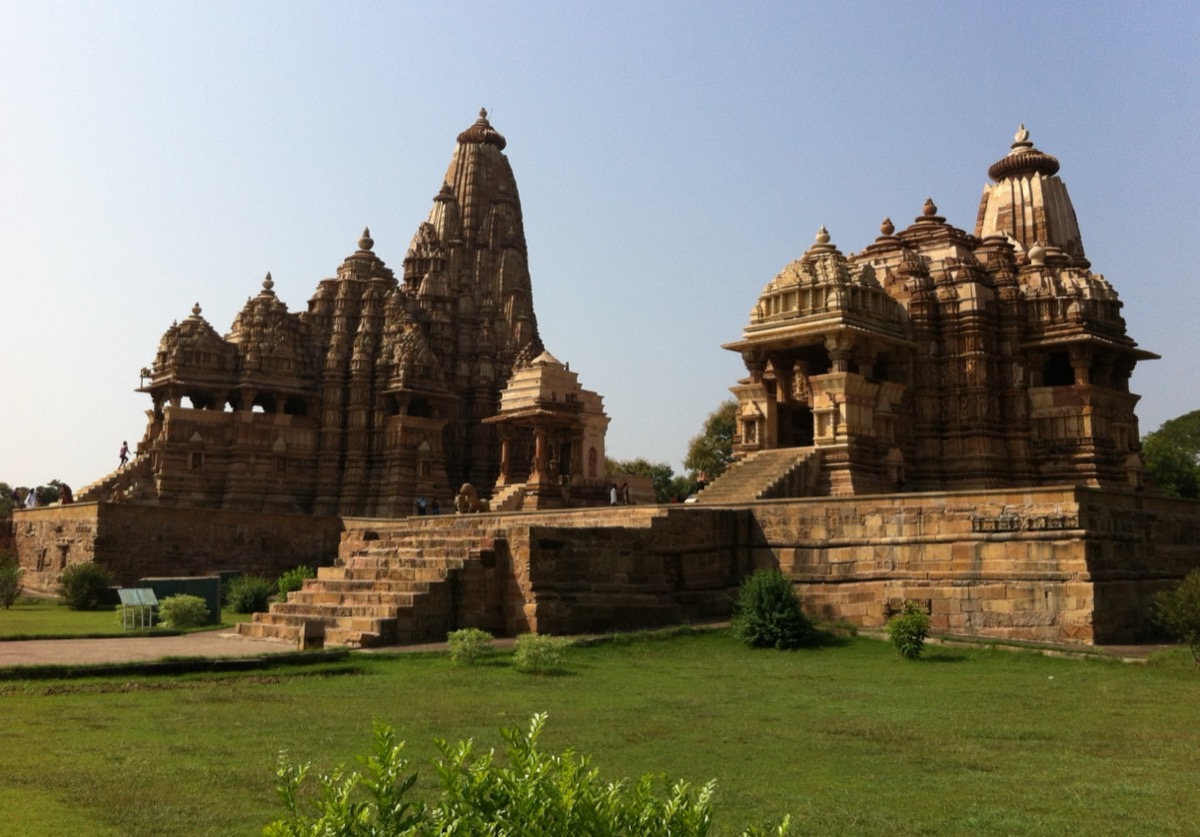
Introduction: Where Stone Transcends Into Spirit
On the plains of Bundelkhand in central India, roughly fifty kilometres from the town of Chhatarpur in Madhya Pradesh, stands one of humanity’s most extraordinary achievements in stone — the Khajurāho Group of Monuments. Built between approximately 885 CE and 1050 CE under the patronage of the Chandela Rājpūt dynasty, these temples represent the absolute zenith of Nāgara-style Hindu temple architecture. In 1986, UNESCO inscribed the site on the World Heritage List, recognizing the temples for their “outstanding architecture, diversity of temple forms, and testimony to the Chandela civilization.”
Of the original 85 temples that once spread across some twenty square kilometres, only about 25 survive today, dispersed across six square kilometres in three distinct groups — Western, Eastern, and Southern. Yet what remains is nothing less than miraculous: soaring sandstone towers that simulate the peaks of the Himālaya, walls alive with nearly a thousand sculptures of gods, celestial beings, warriors, musicians, and lovers, and an architectural programme that charts the entire spectrum of human and divine experience. The erotic sculptures for which Khajurāho is most famous constitute less than ten percent of the total imagery, but they have come to symbolize a civilization that saw no contradiction between the sensual and the sacred — a civilization that understood kāma (desire) as one of the four legitimate aims of life (puruṣārthas), alongside dharma (righteousness), artha (prosperity), and mokṣa (liberation).
The Chandela Dynasty: Builders of the Divine
Origins and Legend
The Chandela dynasty (c. 831-1315 CE) traced its lineage to the moon (Chandra-vaṃśa) through a romantic legend. According to the tradition preserved in Chandela inscriptions and the Mahobā-khaṇḍa section of the Prithvīrāja-rāso, a Brāhmaṇa maiden named Hemāvatī was seduced by the Moon God (Chandra) while bathing in a lotus pond. Her son, Chandravarman, became the founder of the dynasty. This lunar descent was a source of great pride for the Chandelas, who emblazoned the crescent moon on their royal insignia and named their capital Kharjūravāhaka — “the bearer of date palms” — from which the modern name Khajurāho derives.
The Great Temple Builders
The Chandelas rose to prominence as feudatories of the Pratihāra Empire before declaring independence in the early 10th century. The golden age of Chandela temple-building spans approximately a century and a half, under a succession of powerful and culturally sophisticated rulers:
-
Yaśovarman (r. c. 925-950 CE): Built the magnificent Lakṣmaṇa Temple, dedicated to Viṣṇu in his Vaikuṇṭha form. An inscription dated 954 CE records its consecration. The Lakṣmaṇa Temple is the earliest surviving temple at Khajurāho that displays the fully developed pañcāyatana plan.
-
Dhanga (r. c. 950-1002 CE): The longest-reigning and most powerful Chandela king, Dhanga commissioned the Viśvanātha Temple dedicated to Śiva, and the Pārśvanātha Temple in the Jain group. According to inscriptions, Dhanga abdicated the throne at the age of one hundred to end his life at the sacred confluence of the Gaṅgā and Yamunā at Prayāga.
-
Vidyādhara (r. c. 1003-1035 CE): The last great builder among the Chandelas, Vidyādhara commissioned the Kandariyā Mahādeva Temple — the largest, tallest, and most richly sculpted temple at Khajurāho. He is also celebrated for repelling the invasions of Sultan Maḥmūd of Ghazni.
The Three Temple Groups
The Western Group
The Western Group, enclosed within a landscaped garden maintained by the Archaeological Survey of India (ASI), contains the most celebrated temples. This is the group that most visitors experience and where the architectural and sculptural achievement of the Chandelas is most grandly displayed.
Kandariyā Mahādeva Temple (c. 1025-1050 CE): The crown jewel of Khajurāho, this temple dedicated to Lord Śiva rises to a height of 31 metres (102 feet) — the tallest of all the Khajurāho temples. Its name, meaning “the Great God of the Cave,” refers to the garbhagṛha (sanctum sanctorum) that evokes a cave within the cosmic mountain. The temple bears over 870 large sculptures on its exterior and interior walls, each approximately one metre in height. Its śikhara (tower) is composed of 84 miniature subsidiary towers (urusṛṅgas) that cluster around the main spire in an ascending cascade, creating the effect of a mountain range culminating in a single cosmic peak — a stone translation of Mount Meru, the axis of the universe.
Lakṣmaṇa Temple (c. 930-950 CE): Dedicated to Viṣṇu in his three-headed Vaikuṇṭha form, this is the earliest surviving temple that exhibits the complete pañcāyatana layout — a central shrine flanked by four subsidiary shrines at the corners of the platform. The massive adhisthāna (platform) is richly carved with a frieze of elephants, horses, warriors, and scenes of daily life. The lintel of the sanctum doorway bears a striking image of Viṣṇu’s Vaikuṇṭha form with human, lion, and boar heads.
Viśvanātha Temple (c. 1002 CE): Dedicated to Śiva as “Lord of the Universe,” this temple built by King Dhanga also follows the pañcāyatana plan. Its walls feature some of the finest sculptural compositions at Khajurāho, including exquisite images of surasundarīs (celestial maidens), writing letters, applying cosmetics, and playing with children — scenes of intimate femininity rendered with extraordinary grace.
Citraguptā Temple (c. 1000-1025 CE): The only temple at Khajurāho dedicated to Sūrya, the Sun God. The sanctum houses a 2.1-metre tall image of Sūrya standing in his characteristic armoured coat and boots, driving a chariot drawn by seven horses. The temple faces east to receive the first rays of the rising sun. Its octagonal ceiling in the mahāmaṇḍapa is one of the most striking architectural features in the complex.
Devī Jagadambī Temple (c. 1000-1025 CE): Sharing a platform with the Kandariyā Mahādeva, this temple was originally dedicated to Viṣṇu but is now named for a black stone image of Pārvatī as Jagadambī (“Mother of the World”) installed in the sanctum. The temple’s exterior bears some of the most celebrated erotic sculptures at Khajurāho.
The Eastern Group
The Eastern Group contains a mix of Hindu and Jain temples, reflecting the religious pluralism of Chandela society. The Hindu and Jain communities worshipped side by side, and the Chandela rulers patronized both faiths.
Pārśvanātha Temple (c. 950-970 CE): The largest of the Jain temples at Khajurāho, this temple was originally dedicated to Ādinātha but is now named for a Pārśvanātha image installed in the 19th century. Despite its Jain affiliation, the temple’s exterior is adorned with Hindu Vaiṣṇava imagery, including graceful surasundarīs, flying celestial couples, dancers, and musicians. A remarkable inscription dated 954 CE records endowments of gardens by a Jain patron named Pāhila. The temple also bears one of the oldest known 4x4 magic squares, called the “Jaina square,” in which every horizontal row, vertical column, and diagonal sums to 34.
Ghantāī Temple: A ruined Jain temple named for the chain-and-bell (ghaṇṭā) motifs carved on its pillars. Though only the pillared hall survives, the quality of its carved columns hints at a once-magnificent structure.
Jāvarī Temple and Vāmana Temple: Smaller Hindu temples dedicated to Viṣṇu. The Vāmana Temple houses an image of Viṣṇu’s dwarf incarnation and features a striking makara-arch (ornamental gateway with mythical crocodile-like creatures).
The Southern Group
The Southern Group, slightly apart from the main complex, contains two notable temples:
Duladeo Temple (c. 1100-1150 CE): Dedicated to Śiva, this is the latest of the major temples at Khajurāho and shows a more formalized, somewhat repetitive style compared to the exuberant creativity of the earlier temples. Nevertheless, its apsarā (celestial dancer) sculptures are among the finest individual figures in the complex.
Chaturbhuja Temple (c. 1100 CE): Named for the four-armed (chaturbhuja) image of Viṣṇu in the sanctum, this temple is notable for its remarkably well-preserved, 2.7-metre tall standing Viṣṇu image. Unusually, the temple exterior bears no erotic sculptures.
The Sculpture: A Universe in Stone
Beyond the Erotic: The Full Programme
The sculptural programme of the Khajurāho temples is encyclopaedic in scope. While the erotic carvings attract the most attention, they form only a small fraction — approximately 10 percent — of the total sculptural output. The vast majority of carvings depict:
- Deities and their Avatāras: Śiva as Naṭarāja, Viṣṇu with Lakṣmī, the Daśāvatāra (ten incarnations), Brahmā, Gaṇeśa, Kārtikeya, Sūrya, and numerous forms of the Devī
- Surasundarīs (celestial maidens): The most celebrated non-erotic sculptures, these depictions of idealized feminine beauty show women in graceful poses — removing a thorn from the foot, wringing water from their hair, applying kohl to their eyes, playing with a ball, or looking into a mirror
- Apsarāsas and Nāginīs: Celestial dancers and serpent-women of extraordinary sensuality and elegance
- Vyālas and Sardūlas: Mythical composite creatures — part lion, part horse, part elephant — shown in combat with warriors, representing the conquest of untamed natural forces
- Dikpālas (directional guardians): The eight guardians of the cardinal and intercardinal directions
- Scenes of daily life: Musicians, dancers, teachers with students, potters, farmers, soldiers in procession, and royal courts
The Erotic Sculptures: Philosophy in Stone
The erotic sculptures — known as mithuna (amorous couple) imagery — are concentrated on the junction walls (the angles where two temple walls meet) on the exterior of the temples. Their placement is architecturally significant: they appear on the outer walls, never inside the sanctum, suggesting a deliberate symbolic programme.
Multiple interpretive traditions exist for these celebrated carvings:
The Tantric Interpretation: Many scholars associate the erotic imagery with the Tantric traditions that flourished in the Chandela court. In Tantric philosophy, the union of Śiva and Śakti — male and female cosmic principles — is the fundamental creative act of the universe. The mithuna sculptures externalize this metaphysical truth: sexual union becomes a sādhana (spiritual practice) through which the practitioner experiences the dissolution of duality and the bliss (ānanda) of cosmic unity.
The Puruṣārtha Interpretation: In the classical Hindu framework of the four aims of life, kāma is a legitimate and necessary pursuit. The temples, in depicting all four puruṣārthas across their sculptural programme, present a complete vision of the ideal human life — one that embraces desire, fulfils worldly duties, pursues material well-being, and ultimately attains liberation. The devotee, walking around the temple in pradakṣiṇā (circumambulation), symbolically journeys through all stages of worldly experience before entering the sanctum to encounter the divine.
The Protective Interpretation: A folk tradition holds that the erotic figures serve an apotropaic function — protecting the temple from lightning strikes, as the thunder god Indra, known for his amorous nature, would be so captivated by the imagery that he would spare the temple from his wrath.
Architectural Mastery: The Nāgara Idiom Perfected
The Nāgara Style
The Khajurāho temples are supreme examples of the Nāgara (northern Indian) style of temple architecture. The defining characteristic of the Nāgara style is the curvilinear śikhara (tower) that rises above the sanctum, tapering to a point crowned by an āmalaka (fluted disc representing the cosmic lotus) and a kalaśa (finial pot). At Khajurāho, the śikhara is composed of cascading miniature towers that create a mountain-like silhouette, symbolizing Mount Meru — the cosmic axis where gods dwell.
The Pañcāyatana Plan
The major temples at Khajurāho follow the pañcāyatana (“five-shrine”) layout: a central main temple surrounded by four subsidiary shrines at the corners of a shared platform (jagati). This quincunx arrangement represents the five elemental forces or the principal deity attended by four aspects of divinity. The elevated jagati, sometimes rising several metres above ground level, separates the sacred precinct from the mundane world and creates a processional ambulatory.
Spatial Progression
The interior of each temple follows a carefully orchestrated axial progression from the profane to the sacred:
- Ardhamaṇḍapa (entrance porch): The threshold between the outer world and the sacred interior
- Maṇḍapa (pillared hall): A congregational space with elaborately carved pillars and ceilings
- Mahāmaṇḍapa (great hall): In larger temples, a second, more spacious hall with lateral balconies and transepts
- Antarāla (vestibule): The transitional passage between the congregational space and the sanctum
- Garbhagṛha (sanctum sanctorum): The innermost chamber housing the deity, directly beneath the tallest tower, dark and womb-like — the cave within the cosmic mountain
The light diminishes progressively as one moves inward, creating a dramatic experiential transition from the sun-drenched, sculpture-rich exterior to the dark, intimate encounter with the deity in the garbhagṛha. This architectural programme mirrors the spiritual journey from the sensory world to the formless absolute.
Materials and Construction
The temples are constructed from fine-grained sandstone quarried from the Panna district, approximately 35 kilometres away. The blocks were joined with a sophisticated system of mortise-and-tenon joints and iron dowels — no binding mortar was used. The sandstone’s warm honey-gold colour gives the temples a luminous quality, especially at sunrise and sunset when the stone seems to glow from within.
Decline, Abandonment, and Rediscovery
The Fall of the Chandelas
After the reign of Vidyādhara, the Chandela dynasty entered a period of decline. Incursions by the Delhi Sultanate in the 13th century weakened the dynasty further. By the 14th century, Chandela power had effectively ended, and Khajurāho lost its royal patronage. Yet the temples did not fall into immediate ruin — worship continued at many shrines, most notably at the Mataṅgeśvara Temple, which remains an active Śiva temple to this day.
Over the centuries, however, the surrounding jungle gradually reclaimed the site. By the early 19th century, most of the temples were hidden beneath dense tropical vegetation, known only to local villagers who continued to worship at a handful of shrines.
Captain T.S. Burt and the “Rediscovery” (1838)
In February 1838, Captain T.S. Burt of the Bengal Engineers, while surveying the region for the East India Company, was guided to the site by a local palanquin-bearer. What he found astonished him. In a report published in the Journal of the Asiatic Society of Bengal (1838), Burt described “seven distinct Hindu temples, most beautifully and exquisitely carved” in a state of remarkable preservation despite centuries of neglect. His account brought Khajurāho to the attention of the scholarly world.
In the following decades, Alexander Cunningham, the first Director-General of the Archaeological Survey of India, conducted systematic surveys of the site (1852, 1864-65), documenting and cataloguing the temples and their inscriptions. Cunningham’s meticulous work laid the foundation for the conservation efforts that followed.
The Mataṅgeśvara Temple: A Living Link
The Mataṅgeśvara Temple (c. 900-925 CE) is the only temple at Khajurāho where active worship has continued without interruption. It houses a massive 2.5-metre tall Śiva liṅga, 1.1 metres in diameter. Local tradition holds that this liṅga is svayambhū (self-manifested) and continues to grow incrementally each year — temple priests measure it annually on Kārtika Pūrṇimā. During Mahāśivarātri, a three-day ceremony attended by approximately 25,000 devotees celebrates the divine marriage of Śiva. The liṅga is bathed, dressed, and decorated like a bridegroom — a living testament to the enduring sacred power of a site that has been worshipped for over eleven centuries.
Religious Pluralism: Hindu and Jain Temples Together
One of the most remarkable aspects of Khajurāho is the coexistence of Hindu and Jain temples within the same complex. The Chandela rulers patronized both faiths, and the temples were built in close proximity — sometimes sharing architectural motifs and sculptural styles. The Pārśvanātha Temple, though Jain in affiliation, bears Hindu Vaiṣṇava imagery on its exterior, suggesting not confusion of traditions but a deep interfaith harmony.
This religious pluralism reflects a broader pattern in medieval Indian culture, where sectarian boundaries were far more fluid than modern categories suggest. The Chandela inscriptions record grants to both Hindu temples and Jain institutions, and the sculptural programmes of the temples celebrate a shared aesthetic vision that transcended doctrinal differences.
The Khajurāho Dance Festival
Every February, the temples of Khajurāho come alive with music and dance during the Khajurāho Dance Festival, initiated in 1975 by the Madhya Pradesh government to celebrate India’s classical performing arts against the backdrop of the medieval temples. Now in its 52nd year, the week-long festival (typically 20-26 February) showcases India’s foremost exponents of Bharatanāṭyam, Kathak, Odissi, Kuchipudi, Maṇipurī, Gaudiya Nṛtya, and Kathakali.
Performances are held in the open air at the Citraguptā and Viśvanātha Temples, with the floodlit sandstone walls providing a setting of extraordinary beauty. The festival draws audiences from across India and the world, creating a living continuum between the ancient sculptural art of the temples — which itself depicts dancers and musicians in profusion — and the living tradition of Indian classical dance. Admission is free, making it one of the most accessible cultural events in India.
Conservation and Tourism
The Archaeological Survey of India (ASI) maintains the Western Group within a well-tended garden with pathways, signage, and a museum displaying sculptures and architectural fragments. The ASI has undertaken extensive conservation work over the decades, including structural stabilization, removal of invasive vegetation, and careful restoration of damaged elements using traditional materials and techniques.
The Khajurāho Archaeological Museum, located near the Western Group, houses a superb collection of sculptures recovered from the site, including pieces that cannot be displayed in situ. A separate Jain Museum near the Eastern Group preserves Jain sculptures and artefacts.
Khajurāho is well-connected by air (the Khajurāho Airport receives domestic flights from Delhi, Varanasi, and other cities), by rail (Khajurāho railway station), and by road. The best time to visit is from October to March, when the weather is pleasant. A sound-and-light show at the Western Group, narrated in English and Hindi, brings the history of the Chandelas to life after sunset.
A Meditation on the Wholeness of Life
The Khajurāho temples stand as a monumental assertion that the sacred and the sensual, the divine and the human, the spiritual and the material are not opposites to be reconciled but aspects of a single, indivisible reality. In the theology of the Chandelas — drawing on Śaiva, Vaiṣṇava, and Tantric traditions — the cosmos itself is the play (līlā) of divine consciousness. Every human experience, from the ecstasy of love to the stillness of meditation, is a face of the divine.
To walk around these temples is to journey through the fullness of existence: the noise and beauty of the outer world, rendered in stone on the exterior walls; the gradual quieting of the senses in the pillared halls; and the final encounter with the formless deity in the dark sanctum. It is an architectural programme of liberation — a path from māyā to mokṣa, from the multiplicity of form to the unity of the absolute.
As the Bṛhadāraṇyaka Upaniṣad declares: “Pūrṇam adaḥ, pūrṇam idam” — “That is whole, this is whole.” At Khajurāho, this ancient truth is carved in every stone.