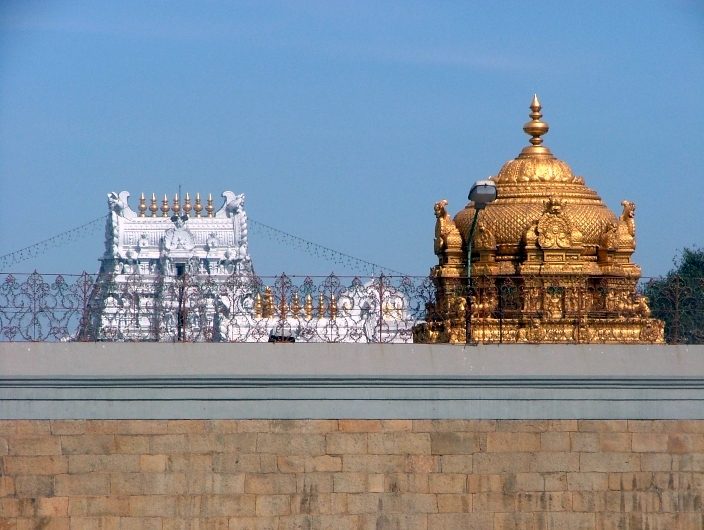
Tirumala Vēṅkaṭēśvara Temple (తిరుమల వేంకటేశ్వర దేవస్థానం), perched atop the seven sacred hills of the Eastern Ghats in Andhra Pradesh, stands as the most visited and wealthiest Hindu temple on Earth. Known reverently as the Temple of Seven Hills (Saptagiri), this magnificent shrine draws over 50,000 pilgrims daily — and up to 100,000 on festival days — making it the most frequented place of worship in the world. The presiding deity, Lord Vēṅkaṭēśvara, is a form of Lord Viṣṇu and is also called Bālājī, Śrīnivāsa, and Govinda.
The Seven Sacred Hills (Saptagiri)
The Tirumala Hills comprise seven peaks of the Śeṣācala range, each named after a sacred association:
- Śeṣādri — named after Ādiśeṣa, the divine serpent on whom Lord Viṣṇu reclines
- Nīlādri — the blue mountain, referring to the dark complexion of the Lord
- Garuḍādri — named after Garuḍa, the divine eagle and vehicle of Viṣṇu
- Añjanādri — associated with Añjanā, mother of Lord Hanumān
- Vṛṣabhādri — named after Vṛṣabha, the sacred bull of Lord Śiva
- Nārāyaṇādri — named after Nārāyaṇa, another name for Viṣṇu
- Vēṅkaṭādri — the hill on which the main temple stands, where Lord Vēṅkaṭēśvara resides
The Varāha Purāṇa identifies these hills as a manifestation of Ādiśeṣa himself, who took the form of a mountain range to provide a dwelling place for Lord Viṣṇu on Earth. According to the Brahmāṇḍa Purāṇa, these hills were transported from Vaikuṇṭha (the celestial abode of Viṣṇu) by Ādiśeṣa and Garuḍa during the early ages of creation.
The Legend of Lord Vēṅkaṭēśvara
The origin legend of the Tirumala temple is among the most beloved narratives in Vaiṣṇava tradition, drawing from the Varāha Purāṇa and the Vēṅkaṭācala Māhātmya section of the Brahmāṇḍa Purāṇa.
The Quarrel in Vaikuṇṭha
According to the sacred narrative, the sage Bhṛgu once visited Vaikuṇṭha to test the Trimūrti. When he arrived before Lord Viṣṇu, the Lord was reclining with Goddess Lakṣmī and did not immediately acknowledge the sage. Feeling insulted, Bhṛgu kicked Viṣṇu on the chest — the very place where Lakṣmī resides (Śrīvatsa). Though Viṣṇu humbly pressed the sage’s foot and apologised for any hurt, Lakṣmī was furious at the insult to her abode. She left Vaikuṇṭha in anger and descended to Earth, taking residence in Kolhāpur (modern Maharashtra) and later at Tiruchanur near Tirumala.
The Descent to Earth
Heartbroken by Lakṣmī’s departure, Lord Viṣṇu also left Vaikuṇṭha and descended to the Tirumala Hills, where he took residence inside an anthill under a tamarind tree near the Svāmī Puṣkariṇī tank. During this period, he meditated in a state of deep sorrow, sustained only by the forest deity Vakulāmālikā (identified as Yaśodā, Kṛṣṇa’s foster mother, reborn).
The Marriage to Padmāvatī
While residing on Earth, Lord Viṣṇu — now known as Śrīnivāsa — fell in love with Padmāvatī, the daughter of the local king Ākāśarāja. To arrange the grand wedding, Śrīnivāsa borrowed an enormous sum from Kubera, the god of wealth. This divine debt, according to tradition, is the reason devotees offer wealth and donations at Tirupati — they are helping the Lord repay his cosmic loan. The interest on this loan is believed to accumulate until the end of the Kali Yuga.
Temple History and Architecture
Ancient Origins
The temple’s antiquity is attested by references in Saṅgam literature (300 BCE – 300 CE), where the hill is called “Tiruvēṅkaṭam” and praised by the Āḻvārs, the twelve Vaiṣṇava poet-saints of Tamil Nadu. All twelve Āḻvārs have sung about Tirumala, making it one of the 108 Divya Desams — the most sacred Vaiṣṇava shrines. The earliest epigraphic reference dates to the Pallava dynasty (9th century CE), though the temple’s origins are believed to be far older.
The Garbhagṛha and Vimāna
The sanctum sanctorum (Garbhagṛha) houses the magnificent mūla vigraha (primary idol) of Lord Vēṅkaṭēśvara, carved from a single block of black granite (śālagrāma stone). The idol stands approximately six feet tall, adorned with gold ornaments, diamond-studded crowns, and sacred marks. The most distinctive feature is that the Lord’s eyes are partially covered — traditionally explained as protecting devotees from the overwhelming power of His direct gaze.
The golden vimāna (tower above the sanctum) is called Ānanda Nīlaya (“Abode of Bliss”). Gilded with pure gold donated by successive dynasties — including the Pallavas, Cholas, Vijayanagara rulers, and later kings — it gleams brilliantly in sunlight and serves as a beacon visible from the plains below.
The Gopurams
Three ornate gopurams (towered gateways) guard the temple approaches:
- The Outer Gopuram — the main entrance, elaborately carved with mythological scenes
- The Inner Gopuram — housing the famous silver doors (Vendi Vākili) that devotees pass through
- The Gold Gopuram (Ānanda Nīlaya Vimāna) — rising directly above the sanctum
Sacred Traditions and Rituals
Tonsuring (Munḍana)
One of the most distinctive practices at Tirumala is the offering of hair, known as munḍana or śikhā-dāna. Each year, approximately 20 million pilgrims have their heads tonsured at the temple as an act of surrender and devotion. This practice symbolises the surrender of ego and vanity before God. The hair is collected and auctioned internationally, generating significant revenue for the temple’s charitable activities.
The practice finds its scriptural basis in the concept of tyāga (sacrifice) described in the Bhagavad Gītā (18.5-6), where all acts of sacrifice, charity, and austerity should not be abandoned but performed as duty.
The Sacred Laddu Prasādam
The Tirumala Laddu (also called Śrī Vāri Laddu) is perhaps the most famous temple prasādam (sacred food offering) in India. Made from Bengal gram flour (besan), sugar, cashews, raisins, cardamom, and ghee, this sweet has received a Geographical Indication (GI) tag — the first prasādam in India to earn this recognition. The Potu (temple kitchen) prepares approximately 300,000 laddus daily using traditional recipes passed down over centuries.
The Suprabhātam
Each day at the temple begins before dawn with the singing of Śrī Vēṅkaṭēśvara Suprabhātam — a morning hymn composed by the 15th-century saint Prativādi Bhayaṅkara Aṇṇaṅgarāchārya. This beautiful devotional poem awakens the Lord and describes the glory of Tirumala. The recitation begins at 2:30 AM and remains one of the most beloved Vaiṣṇava hymns.
Darśan
The temple offers multiple types of darśan (sacred viewing of the deity):
- Sarva Darśan — free darśan available to all pilgrims (waiting times can extend to 10-20 hours)
- Divya Darśan — for pilgrims who walk up the hill on foot
- Śīghra Darśan — a faster paid option through the Tirumala Tirupati Devasthanams (TTD)
- Special Entry Darśan — through advance booking via the TTD website
Tirumala Tirupati Devasthanams (TTD)
The Tirumala Tirupati Devasthanams (TTD) is the governing body that administers the temple and its vast network of charitable operations. Established by the government of Andhra Pradesh, the TTD manages:
- Anna Dāna — free meals for all pilgrims (serving over 100,000 meals daily through the Anna Prasādam programme)
- Hospitals and medical services — including the SVIMS super-specialty hospital
- Educational institutions — from primary schools to Sri Venkateswara University
- Dharmic propagation — through the SVBC (Sri Venkateswara Bhakti Channel) television network
- Gō-Samrakṣaṇa — cow protection programmes across multiple gōśālās
The TTD manages an annual budget exceeding billions of rupees, funded primarily by the Huṇḍi (donation box) offerings, making it one of the wealthiest religious institutions in the world.
The Brahmotsavam Festival
The annual Brahmotsavam is the most important festival at Tirumala, celebrated for nine days in the month of Āśvina (September-October). According to tradition, this festival was first conducted by Lord Brahmā himself — hence the name “Brahmotsavam” (Brahmā’s festival).
During the Brahmotsavam, the processional deity (utsava mūrti) of Lord Vēṅkaṭēśvara is taken through the four streets (mādā vīdhis) of Tirumala atop various sacred vāhanas (divine vehicles):
- Pedda Śeṣa Vāhana — the great serpent carrier (Day 1)
- Chinna Śeṣa Vāhana — the small serpent carrier (Day 2)
- Garuḍa Vāhana — the divine eagle (Day 5, the most significant)
- Sūrya Prabha and Candra Prabha — Sun and Moon chariots
- Rathotsavam — the grand chariot procession (Day 8)
The Garuḍa Vāhana Sēva on the fifth day draws the largest crowds, with over 200,000 devotees gathering to witness the Lord riding upon His divine eagle.
Scriptural Significance
The sacred importance of Tirumala is established across multiple Hindu scriptures:
- Varāha Purāṇa — contains the most detailed account of the Vēṅkaṭēśvara legend and describes the temple’s establishment. The Varāha (boar) form of Viṣṇu himself narrates the glory of Tirumala to Bhūmi Devī (Earth Goddess).
- Brahmāṇḍa Purāṇa — includes the “Vēṅkaṭācala Māhātmya,” which details the topography of the sacred hills and their celestial origins.
- Skanda Purāṇa — mentions Tirumala in the Veṅkaṭācala Khaṇḍa as one of the foremost pilgrimage sites.
- Padma Purāṇa — references the Svāmī Puṣkariṇī tank and its power to cleanse devotees of sins.
The Āḻvārs — especially Tirumaṅgai Āḻvār and Namāḻvār — composed passionate hymns about Tirumala in the Nālāyira Divya Prabandham, the Tamil Vaiṣṇava canon. These verses describe the breathtaking beauty of the hills, the forests teeming with elephants and peacocks, and the overwhelming grace of Lord Vēṅkaṭēśvara.
Pilgrimage Pathways
Traditionally, devotees ascend the seven hills on foot as an act of devotion. Two main footpaths exist:
- Alipiri Steps — approximately 3,550 steps climbing 12 km from the base of the hills, the most ancient and popular route
- Srivari Mettu — a shorter, steeper path of about 2,800 steps beginning from Chandragiri
Walking up the hills barefoot while chanting “Govinda, Govinda!” is considered a deeply meritorious act. The TTD has constructed shelters, drinking water stations, and rest stops along both routes.
The Temple Today
Tirumala Vēṅkaṭēśvara Temple receives annual donations exceeding USD 300 million, collected primarily through the Huṇḍi. These funds support one of the largest charitable networks in Asia, including free housing for pilgrims (through choultries and cottages), free meals, free education, and free healthcare.
The temple’s enduring popularity across millennia — from the Saṅgam-era Tamil poets to modern-day pilgrims arriving by air, rail, and road — testifies to the unbroken continuity of devotion at this sacred site. Whether one approaches as a scholar of history, a seeker of divine grace, or simply a traveller marvelling at India’s living traditions, Tirumala offers an experience that transcends the ordinary and touches the eternal.
As the devotees say: “Govinda! Govinda!” — the very hills echo with the name of the Lord.