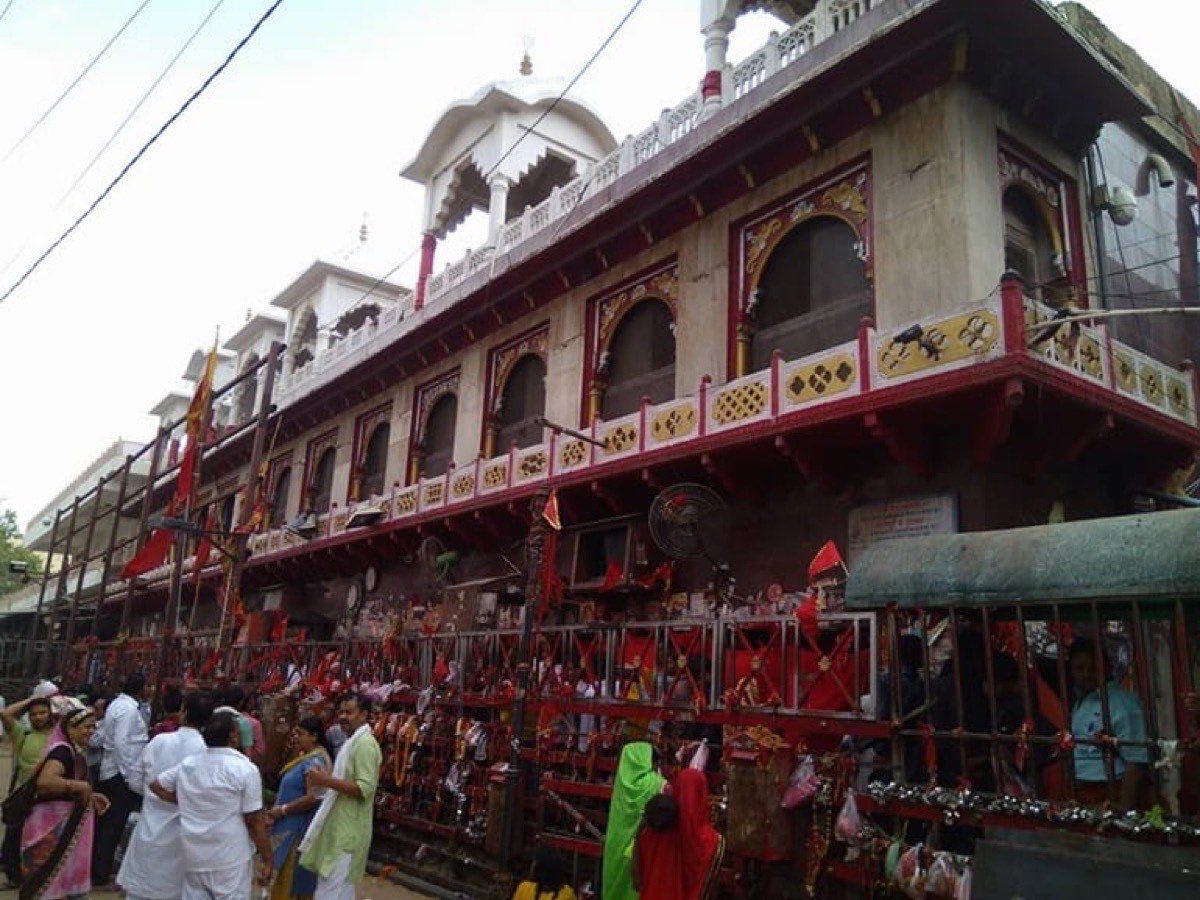
Introduction: The Exorcism Temple of India
In the rocky folds of the Āravallī hills, roughly 103 kilometres from Jaipur on the Jaipur-Āgrā highway, stands a temple unlike any other in India. The Mehandīpur Bālājī Temple — dedicated to Lord Hanumān in his child form (Bālājī) — is not a place of quiet contemplation or serene devotion. It is, instead, a site of intense spiritual confrontation, where the boundary between the seen and unseen worlds is believed to dissolve daily. Here, possessed individuals writhe and scream, chains rattle against ancient stone, and the air throbs with the ceaseless chanting of mantras. For centuries, pilgrims afflicted by what they believe to be evil spirits (bhūt-pret), black magic (jādū-ṭonā), and supernatural curses have journeyed to this remote Rajasthani village seeking deliverance through the divine power of Lord Hanumān.
What makes Mehandīpur Bālājī unique among India’s thousands of Hanumān temples is its singular focus on bhūt-pret nivāraṇa — the removal of ghostly and demonic afflictions. While other temples celebrate Hanumān as the devoted servant of Lord Rāma or the mighty warrior of the Rāmāyaṇa, Mehandīpur Bālājī draws specifically upon his scriptural role as the supreme protector against dark forces. The Hanumān Chālīsā of Gosvāmī Tulasīdāsa declares: “Bhūta pisācha nikaṭa nahiṃ āvai, Mahāvīra jaba nāma sunāvai” — “No ghost or demon dares approach when the name of the Great Hero (Hanumān) is uttered” (Hanumān Chālīsā, verse 24). This verse is the theological cornerstone of the entire Mehandīpur tradition.
The Legend of the Self-Manifested Deities
Discovery of the Swayambhū Mūrtis
The origin of Mehandīpur Bālājī is shrouded in the mists of sacred legend. According to temple tradition, the idols enshrined here are svayambhū (self-manifested) — they were not carved by human hands but emerged spontaneously from the Āravallī hillside through divine will. The area where the temple now stands was once a dense, uninhabited forest teeming with leopards, snakes, and wild creatures, making it an unlikely site for a shrine.
The most widely narrated account credits the temple’s discovery to Shrī Ganesh Purī Jī Mahārāj, a devout saint who received a divine vision in his dreams. In this vision, Lord Hanumān, accompanied by Pret Rāj Sarkār (the King of Spirits) and Bhairav Jī, appeared before the saint and commanded him to uncover their divine presence hidden within the forested hills. Following the precise instructions received in his dream, Ganesh Purī Jī excavated the site and discovered three miraculous stone forms — Bālājī, Pret Rāj, and Bhairav — exactly where the vision had indicated.
Growth from Forest Shrine to Pilgrimage Centre
A small shrine was constructed at the discovery site, believed to date to approximately the eleventh century. Over subsequent centuries, the shrine grew in reputation as word of miraculous healings spread through the villages of Rajputana. Local rulers of the Karaulī kingdom expanded the temple complex during the seventeenth century, adding stone walls and covered halls. During periods of Mughal incursion, the temple suffered damage, but the devotion of local communities ensured its reconstruction in the eighteenth and nineteenth centuries with marble and dressed sandstone. Today, the temple complex spans approximately three acres, its red sandstone and white marble structures nestled dramatically between towering Āravallī ridges.
The Sacred Trinity: Bālājī, Bhairav, and Pret Rāj
Understanding the Divine Hierarchy
What distinguishes Mehandīpur Bālājī from virtually every other Hindu temple is the worship of a unique trinity of deities, each with a specific role in the spiritual adjudication of supernatural afflictions. This three-deity system operates as a kind of divine court (darbār), where cases of possession and spiritual distress are heard and resolved through cosmic justice.
Bālājī (Lord Hanumān)
The primary deity is Bālājī, a four-foot self-manifested stone idol of Lord Hanumān depicted in his child (bāla) form, covered with layers of vermilion (sindūra) and clarified butter (ghī). The name “Bālājī” itself derives from bāla (child), reflecting the playful yet immensely powerful young Hanumān who, according to the Rāmāyaṇa, once leapt toward the sun mistaking it for a ripe fruit.
In the Mehandīpur tradition, Bālājī functions as the supreme judge and deliverer. He is Saṅkaṭa Mocana — the “Remover of Difficulties” — and his divine authority over all ghostly and demonic entities is absolute. The Sundara Kāṇḍa of the Rāmāyaṇa repeatedly demonstrates Hanumān’s power to overcome rākṣasas (demons), and Hindu theology holds that no malevolent spirit can withstand his presence. At Mehandīpur, this theological principle is enacted daily as afflicted individuals are brought before Bālājī’s sanctum for healing.
Bhairav Bābā (Koṭvāl Bhairav)
The second deity in the trinity is Bhairav Bābā, enshrined as a three-foot black stone idol in a secondary chamber. Bhairav is a fierce manifestation of Lord Śiva, and in the Mehandīpur system, he serves as the koṭvāl (chief of police or guardian). His role is that of cosmic enforcement: no malevolent spirit that enters the temple precincts can leave without Bhairav’s permission. He is the divine sentinel who ensures that once an evil entity has been summoned before the court of Bālājī, it cannot escape justice.
The worship of Bhairav at Mehandīpur draws upon the broader Hindu tradition of Bhairava as the guardian of sacred spaces. The Śiva Purāṇa describes Bhairava as the protector appointed by Śiva himself, capable of destroying the most fearsome adversaries. At Mehandīpur, devotees offer mustard oil, liquor, and special foods to Bhairav, recognizing his fierce nature and his role as the enforcer of the divine court’s verdicts.
Pret Rāj Sarkār (King of Spirits)
The third and perhaps most unusual member of the trinity is Pret Rāj Sarkār — literally, “the Government of the King of Ghosts.” Pret Rāj presides over his own court within the temple complex, where the cases of spirit possession are investigated and adjudicated before being brought to Bālājī for final resolution. His chamber is known as Pret Rāj kī Kachahrī (the Court of the Spirit King).
In Hindu cosmology, the preta realm is a liminal state between death and rebirth, inhabited by restless spirits who have not received proper funerary rites or who died with unfulfilled desires. Pret Rāj Sarkār is understood as the sovereign ruler of this realm, holding authority over all such wandering spirits. His presence at Mehandīpur creates a complete judicial system: Pret Rāj examines the nature and cause of the possession, Bhairav enforces the proceedings and prevents escape, and Bālājī delivers the final verdict and healing.
Rituals and the Arjī System
The Arjī: Petition Before the Divine Court
The central ritual practice at Mehandīpur Bālājī is the arjī — a formal petition or application submitted by devotees to the divine court seeking intervention in their spiritual afflictions. The arjī system mirrors the structure of a legal proceeding, reflecting the temple’s understanding of itself as a court of divine justice.
An arjī offering typically consists of specific prescribed items: 1.25 kilograms of ladḍūs (sweet wheat balls), 2.25 kilograms of urad dāl (black gram), and 4.25 kilograms of boiled rice. These quantities are fixed by temple tradition and are not arbitrary — each element carries symbolic significance. The ladḍūs represent the sweetness of devotion offered to Bālājī, the black urad dāl is associated with Śani (Saturn) and is offered to propitiate planetary and astral forces, and the rice symbolizes sustenance and the restoration of normalcy to the afflicted person’s life.
When submitting an arjī, the devotee (or a family member acting on behalf of the afflicted person) presents the offering before each of the three deities in sequence, formally stating their grievance and requesting divine intervention. The process is understood not as a simple prayer but as the filing of a case in the celestial court — hence the juridical terminology that pervades the entire Mehandīpur tradition.
Darkhāst: The Initial Request
For devotees seeking general blessings or relief from milder afflictions, a simpler offering called darkhāst is available. This involves two plates of four to five wheat ladḍūs each: one plate is offered for general blessings and the other for specific wishes. The offering is made first to Shrī Bālājī Mahārāj, then to Bhairav Bābā and Pret Rāj Sarkār. After the offering, the devotee circles the plate seven times around their own body and then offers the food to birds and animals outside the temple, ensuring that no prasāda from the Mehandīpur shrine is taken home.
Sāvāmanī: The Gratitude Offering
When a devotee’s petition has been fulfilled and the affliction resolved, they return to Mehandīpur to offer sāvāmanī — a large-scale thanksgiving offering. This typically involves the preparation and distribution of fifty kilograms of halwā-pūrī (sweet semolina and fried bread) to the poor and to fellow pilgrims. The sāvāmanī is performed on Tuesdays and Saturdays, considered the most auspicious days for Hanumān worship.
Cholā Chaḍhāī: The Sacred Cloth Offering
Another significant ritual is cholā chaḍhāī, in which devotees offer a saffron or red cloth to drape over Bālājī’s idol. The cholā symbolizes devotion, surrender, and the covering of the deity in new garments as an act of service and love. This offering is often made alongside the arjī or sāvāmanī.
The Exorcism Tradition
Daily Healing Sessions
The most distinctive — and to outsiders, most startling — aspect of Mehandīpur Bālājī is its daily practice of exorcism. Every afternoon at approximately 2:00 PM, a kīrtana (devotional chanting session) is held in the court of Pret Rāj, during which the spirits inhabiting afflicted individuals are believed to manifest and be confronted by the combined power of the three deities.
During these sessions, individuals believed to be possessed may exhibit dramatic physical symptoms: they scream, convulse, speak in altered voices, thrash against restraints, and engage in behaviour that devotees interpret as the spirit resisting the divine power that seeks to expel it. Some individuals are restrained with chains or have heavy stones placed upon their bodies — practices that the temple tradition holds are necessary to subdue the possessing entity while the divine forces work to dislodge it.
The chanting of specific mantras, particularly the Hanumān Chālīsā and verses from the Sundara Kāṇḍa, forms the sonic backbone of these sessions. The collective recitation is believed to create an intensely charged spiritual atmosphere in which evil spirits cannot maintain their hold on their human hosts. Temple priests (pujārīs) also administer sacred ash (vibhūti), sanctified water, and blessed food to the afflicted.
The Course of Treatment
Unlike a single dramatic exorcism, the healing process at Mehandīpur often extends over weeks or even months. Devotees suffering from severe afflictions may take up residence in the village of Mehandīpur, attending daily sessions and following a strict regimen prescribed by the temple. This regimen typically includes complete vegetarianism (excluding even onion and garlic), abstinence from alcohol and non-vegetarian food, observance of brahmacarya (celibacy), and regular recitation of the Hanumān Chālīsā.
The temple tradition holds that the severity of the affliction determines the duration of treatment: minor cases may be resolved in a single visit, while deeply entrenched possessions may require repeated sessions over several months. Throughout the process, the afflicted person is expected to submit completely to the authority of the divine court, trusting that Bālājī’s justice will ultimately prevail.
Academic Perspectives
The healing practices at Mehandīpur Bālājī have attracted significant scholarly attention. A systematic review published in the African Journal of Biomedical Research examined exorcism at Mehandīpur as a “culturally embedded healing practice,” noting that the rituals function through multiple therapeutic mechanisms including “community-based support, symbolic meaning-making, emotional catharsis, stigma reduction, and embodied expression of distress.” A landmark clinical study of 100 randomly selected patients at the shrine found that the majority were between 15 and 39 years of age, 80% were educated, 82% had urban domicile, and 54% were female. Among clinical presentations, 48% were classified as neurotic and 28% as psychotic, with patients who developed trance states being predominantly neurotic. Approximately one quarter of the patients — mainly psychoneurotics — showed measurable improvement.
These findings suggest that the Mehandīpur tradition, whatever one’s theological views, operates as a complex psychosocial intervention that provides genuine relief for a significant subset of those who seek its aid — though scholars have also raised ethical concerns about delayed psychiatric treatment and physical practices associated with certain rituals.
Temple Rules and Protocols
Strict Visitor Guidelines
Mehandīpur Bālājī enforces an unusually stringent set of rules for visitors, reflecting the temple’s understanding that the spiritual forces at work within its precincts require extraordinary precautions.
Dietary restrictions: All visitors are expected to maintain a strict vegetarian diet excluding onion, garlic, meat, eggs, and alcohol for a period before and after their visit. This dietary discipline is considered essential for maintaining the spiritual purity necessary to benefit from the temple’s healing energies.
Dress code: Men are expected to wear shirts and trousers or traditional dhotīs; women wear sārīs or salwār-kamīz with the shoulders covered. Leather items must be removed before entering the temple complex.
No prasāda to be taken home: Unlike virtually every other Hindu temple, Mehandīpur Bālājī strictly prohibits devotees from carrying prasāda (blessed food offerings) away from the temple. All food offerings must be consumed within the temple grounds or given to animals and birds outside. The rationale is that the food, having been offered in a space charged with the presence of spirits, may carry residual spiritual contamination if removed from the sanctified environment.
No looking back: Perhaps the most distinctive rule is the prohibition against looking back at the temple when departing. Devotees are instructed to walk away without turning their gaze backward. This rule is rooted in the belief that the spirits expelled during the healing process linger near the temple exit, and looking back may invite them to reattach to the departing visitor.
No photography: Photography and videography are strictly prohibited within the temple complex, out of respect for the deeply personal and often distressing nature of the healing rituals.
No physical contact: Visitors are advised to avoid touching other pilgrims, as those around them may be possessed by spirits that could potentially transfer through physical contact.
Tuesdays and Saturdays: The Auspicious Days
While the temple operates daily, Tuesdays and Saturdays hold special significance. Tuesday is the traditional day of Lord Hanumān worship throughout India, rooted in the association of Hanumān with the planet Mars (Maṅgala), which governs Tuesday. Saturday is associated with Śani (Saturn), whose malefic influences are believed to be countered by Hanumān’s protective power — a belief supported by the popular narrative in which Hanumān rescued Śani from the clutches of Rāvaṇa, earning Śani’s gratitude and a promise never to trouble Hanumān’s devotees.
On these auspicious days, the temple witnesses its largest crowds, with estimates suggesting that 50,000 or more devotees may visit during major festivals. The āratī (lamp-worship ceremony) performed on these days is particularly elaborate, with the entire temple complex resonating with the collective chanting of the Hanumān Chālīsā.
Architecture and Sacred Geography
The Temple Complex
The Mehandīpur Bālājī temple complex occupies approximately three acres, dramatically situated in a narrow valley between towering Āravallī ridges. The architectural style blends traditional Rajput elements with later additions, featuring red sandstone and white marble construction. The main temple structure rises to approximately fifty feet, crowned with a gold-tipped dome (śikhara) that gleams against the rocky hillside.
The complex includes a spacious marble courtyard (approximately 300 metres in length), a sacred water tank (kuṇḍa) of about five metres, and an ornately carved main gate approximately eight metres high, decorated with traditional Rajasthani motifs of peacocks and floral patterns. The interior chambers are dimly lit, creating an atmosphere of profound intensity that is central to the temple’s spiritual function.
The Sacred Circuit
Mehandīpur Bālājī is part of a sacred triangle of Hanumān temples in Rajasthan, the other two being the Sālāsar Bālājī temple in Chūru district and the Khaṭūshyām Jī temple (dedicated to Barbarīka, an incarnation associated with Kṛṣṇa) in Sīkar district. Many Rajasthani pilgrims undertake a circuit of all three temples as a complete pilgrimage, believing that the combined blessings of these three sacred sites provide comprehensive spiritual protection.
Festivals and Special Occasions
Hanumān Jayantī
The most important festival at Mehandīpur Bālājī is Hanumān Jayantī, celebrated in the month of Chaitra (March-April), marking the birth of Lord Hanumān. The temple is lavishly decorated, special rituals are performed throughout the day and night, and hundreds of thousands of devotees converge on the small village. The main idol of Bālājī is bathed in pañcāmṛta (a mixture of milk, curd, honey, ghee, and sugar), draped in a new cholā, and adorned with garlands of fresh flowers.
Dussehra
The Vijayādaśamī (Dussehra) festival in the month of Āśvina (September-October) is another peak occasion, celebrating the victory of Lord Rāma over Rāvaṇa — a triumph in which Hanumān played a pivotal role. The festival symbolically reinforces the temple’s core message: the ultimate victory of divine power over demonic forces.
Saturdays in Śrāvaṇa
The Saturdays falling in the holy month of Śrāvaṇa (July-August) are considered exceptionally auspicious at Mehandīpur, drawing large crowds of devotees who combine Hanumān worship with the broader Śaiva devotions that characterise this month.
Comparison with Other Hanumān Temples
India possesses thousands of temples dedicated to Lord Hanumān, yet Mehandīpur Bālājī occupies a unique niche. While temples like the Hanumān Gaṛhī in Ayodhyā celebrate Hanumān as the eternal guardian of Lord Rāma’s birthplace, and the Sālāsar Bālājī temple emphasises Hanumān’s role as a granter of wishes, Mehandīpur Bālājī is singular in its focus on Hanumān as the conqueror of malevolent spirits. The presence of the Pret Rāj court and the Bhairav guardian, forming a complete spiritual judiciary, is found at no other major Hanumān shrine in India.
The temple also differs from other exorcism-associated sites in India, such as the Dattatreya temples of Maharashtra or the Chottanikkara Bhagavathy Temple in Kerala. While these temples also address spirit possession, none has developed the elaborate juridical framework — the arjī system, the three-tiered divine court, the specific offering protocols — that characterises the Mehandīpur tradition.
The Pilgrimage Experience
A visit to Mehandīpur Bālājī is an experience of profound intensity that remains etched in the memory of every pilgrim. The journey itself, through the arid Rajasthani landscape dotted with thorny kīkar trees and rocky outcrops, builds a sense of approaching a threshold between worlds. As one nears the temple village, the atmosphere shifts palpably: the narrow lanes fill with vendors selling offering materials, the sound of bhajans grows louder, and the mingled scents of incense, camphor, and mustard oil thicken the air.
Inside the temple complex, the dimly lit chambers create a twilight world where the ordinary rules of daily life seem suspended. The intensity of devotion is visceral — pilgrims prostrate themselves fully on the stone floor, families gather anxiously around afflicted relatives, and the rhythmic chanting of the Hanumān Chālīsā provides a continuous sacred soundtrack. For the sceptical visitor, the experience is deeply unsettling; for the faithful, it is a direct encounter with the protective power of the divine.
The temple is accessible by air via Jaipur airport (approximately 62 kilometres away), by rail to Bandikui Junction (36 kilometres), and by road via National Highway 21. The optimal visiting period is October through March, when temperatures range from 10 to 25 degrees Celsius. Accommodation is available in the nearby town of Dausa and in dharamshālās (pilgrim rest houses) around the temple.
Conclusion: Faith, Healing, and the Unseen World
Mehandīpur Bālājī Temple stands at the intersection of ancient Hindu theology, folk tradition, and the enduring human need for protection against the unknown. Whether one approaches it as a devotee seeking divine healing, a scholar studying culturally embedded therapeutic practices, or a curious traveller exploring India’s spiritual landscape, the temple commands attention and respect. Its unbroken tradition of spiritual healing, centred on the protective power of Lord Hanumān and administered through a uniquely structured divine court, represents one of the most remarkable living expressions of Hindu faith in contemporary India.
As the Hanumān Chālīsā affirms: “Nāsai roga harai saba pīrā, japata nirantara Hanumata bīrā” — “All disease vanishes, all pain departs, when one ceaselessly chants the name of the brave Hanumān” (verse 26). At Mehandīpur Bālājī, this promise is tested and affirmed anew each day, in the dimly lit chambers where the ancient battle between light and darkness continues to be waged.