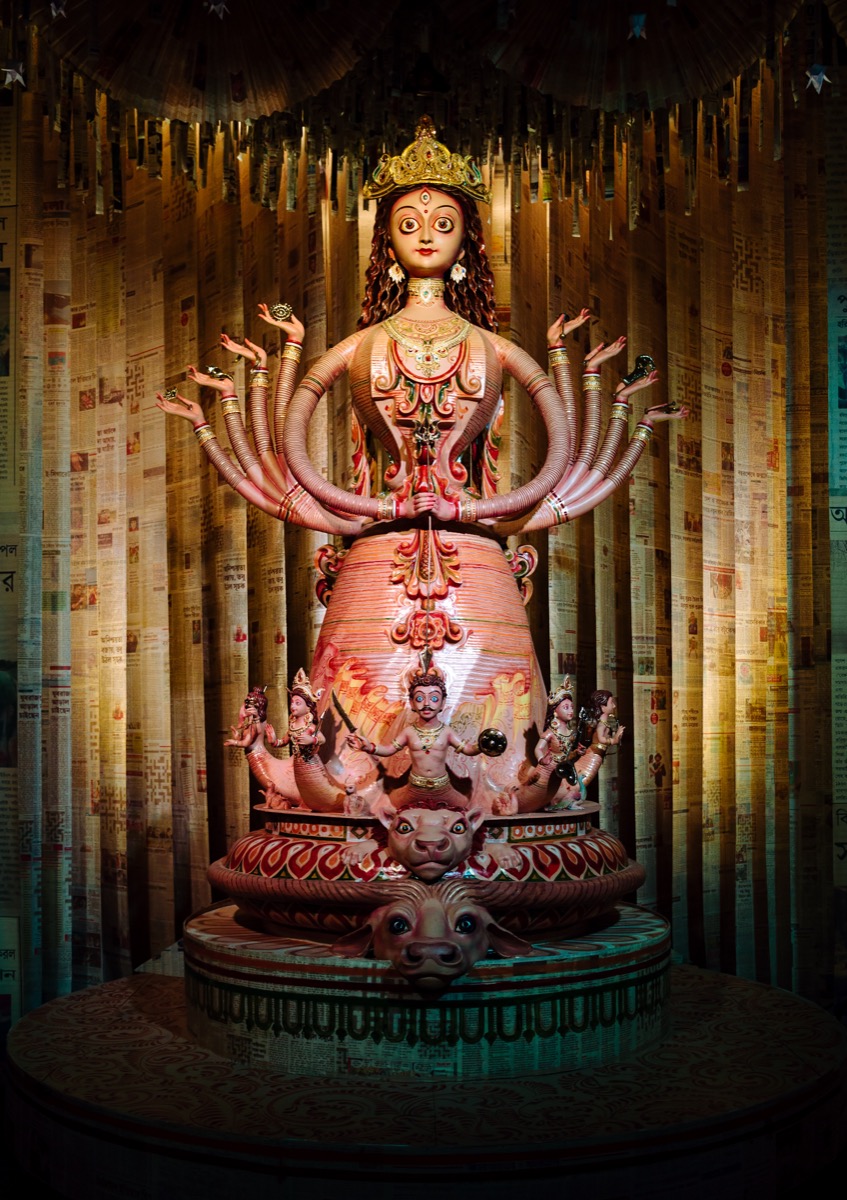
Durga Puja (দুর্গাপূজা, Durgā Pūjā), also known as Durgōtsava (দুর্গোৎসব, “the festival of Durgā”), is the greatest and most culturally defining festival of Bengal — an annual autumnal celebration that transforms the state of West Bengal, Bangladesh, and Bengali communities worldwide into a five-day carnival of worship, art, music, drama, cuisine, and communal ecstasy. In 2021, UNESCO inscribed “Durga Puja in Kolkata” on its Representative List of the Intangible Cultural Heritage of Humanity, recognizing it as a festival that “transcends the boundaries between social classes and brings together people from diverse backgrounds” (UNESCO, ICH/21/16.COM/10.b.1).
At its theological core, Durga Puja celebrates the triumph of Goddess Durgā — the supreme embodiment of śakti (divine feminine power) — over the buffalo demon Mahiṣāsura, as narrated in the Devī Māhātmya (also called Durgā Saptaśatī or Caṇḍī), the foundational text of Śākta theology embedded within the Mārkaṇḍeya Purāṇa. But Durga Puja is far more than a religious ceremony: it is Bengal’s cultural soul, an annual creative explosion that has produced some of the finest public art installations in the world and serves as the primary engine of community identity, artistic innovation, and social solidarity for over 300 million Bengalis.
The Mythology: Devī Māhātmya and the Slaying of Mahiṣāsura
The Rise of the Buffalo Demon
The mythological foundation of Durga Puja is the Devī Māhātmya (c. 5th–6th century CE), a 700-verse Sanskrit text composed by the sage Mārkaṇḍeya, forming chapters 81–93 of the Mārkaṇḍeya Purāṇa. The text narrates three cosmic battles between the Goddess and demonic forces, of which the central and most celebrated is the battle against Mahiṣāsura, the buffalo demon.
Mahiṣāsura had obtained a boon from Brahmā through severe austerities: he could not be killed by any god or demon (deva or asura). Armed with this near-invulnerability, Mahiṣāsura conquered the three worlds, drove the gods from heaven, and usurped Indra’s throne. The cosmos descended into chaos under his tyrannical rule (Devī Māhātmya 2.1–22).
The Birth of Durgā
In desperation, the defeated gods approached the trinity — Brahmā, Viṣṇu, and Śiva — and their collective fury manifested as an immense blaze of divine energy (tejas) that coalesced into the form of a magnificent goddess. Each god contributed his specific power and weapon: Śiva gave his trident, Viṣṇu his discus, Indra his thunderbolt, Varuṇa his conch, Agni his spear, Vāyu his bow, Sūrya his arrows, Viśvakarman his axe and armour, and Himālaya his lion as her mount. Thus was born Durgā — the “invincible one” — a deity who was not created by any single god but emerged from the combined potency of all divine forces (Devī Māhātmya 2.9–30).
The theological implication is profound: Durgā is not subordinate to any male deity but represents the śakti (primordial energy) that underlies all divine power. The Devī Māhātmya declares: “yā devī sarvabhūteṣu śakti-rūpeṇa saṃsthitā” — “She who is present in all beings in the form of power” (5.14–28).
The Battle and Victory
The battle between Durgā and Mahiṣāsura is described over several chapters of the Devī Māhātmya (chapters 2–4) with vivid martial imagery. Mahiṣāsura’s armies — led by generals Ciksura, Cāmara, Udagra, Mahāhanu, and Asilomā — were systematically destroyed by the Goddess. The demon himself fought in multiple forms — as a buffalo, lion, man, elephant, and finally returned to his buffalo form. In the climactic moment, as Mahiṣāsura emerged from the neck of the slain buffalo, Durgā pinned him with her foot and pierced him with her trident, beheading him with her sword (Devī Māhātmya 3.36–38).
This narrative — the annihilation of adharma by the divine feminine — is the theological heart of every Durga Puja.
Historical Origins: From Royal Patronage to Community Festival
Medieval Zamindari Puja
The historical origins of Durga Puja as a grand public festival trace back to the zamindars (landlords) of medieval Bengal. The earliest documented large-scale Durga Puja is attributed to the Dinajpur and Malda zamindars in the 16th century. The Rāja of Nadia, Krishnachandra Roy (1710–1783), is credited with popularizing elaborate Durga Puja celebrations as a tool for consolidating community allegiance and demonstrating social prestige.
According to one influential tradition, the shift to the akāla bodhan (untimely awakening) — performing Durga Puja in autumn rather than the traditional spring worship — originated with Rāma’s invocation of Durgā before the battle of Laṅkā, as described in the Kṛttivāsī Rāmāyaṇa, the 15th-century Bengali retelling by Kṛttivāsa Ojhā. Rāma needed Durgā’s blessing in the autumn (śarad) season, which was not the traditional time for her worship, hence the term “untimely awakening.”
The Plassey Connection
A pivotal moment in Durga Puja’s transformation came in 1757, when Rāja Nabakrishna Deb of the Śobhābāzār Rājbāṛī in Kolkata organized a grand Durga Puja and invited Robert Clive and other East India Company officials to attend, shortly after the Battle of Plassey. This event marked the beginning of Durga Puja’s evolution from a private zamindari affair into a public spectacle that could accommodate — and impress — visitors of all backgrounds. Throughout the 18th and 19th centuries, the great aristocratic houses of Kolkata — the Śobhābāzār, Jorasanko (Tagore), Pāthuriāghāṭā, and Hāṭkhola families — competed to stage the most magnificent pūjās, commissioning renowned artisans, musicians, and dancers.
The Sārvajanīn (Community) Puja Movement
The democratization of Durga Puja — its transformation from an aristocratic privilege to a mass community celebration — began in the early 20th century. The first sārvajanīn (public/community) Durga Puja is traditionally traced to the Baghbazar Sarvajanin Durgotsav in 1919 and the Simla Byayam Samiti pūjā, both inspired by the Swadeshi movement and the desire to create a forum for community solidarity that transcended caste and class barriers. The freedom movement catalysed this shift: community pūjās became sites of political consciousness, cultural assertion, and national identity.
After Indian independence (1947), the sārvajanīn puja model exploded across Kolkata. By the 1980s, the city hosted thousands of community pūjās, each competing for artistic originality and social relevance. Today, Kolkata is estimated to host over 3,000 community Durga Puja pandals annually, with the largest attracting millions of visitors.
The Ten-Day Structure
Mahālayā: The Invocation
Durga Puja effectively begins on Mahālayā (the new moon day of Āśvin), the day when the Goddess is ceremonially invited to descend from her celestial abode on Mount Kailāsa to her parental home on earth. Since 1931, Bengalis have woken before dawn on Mahālayā to listen to the legendary “Mahīṣāsura Mardinī” radio programme on All India Radio — a two-hour montage of Devī Māhātmya recitation by Bīrendra Krishna Bhadra, interspersed with devotional songs by some of Bengal’s greatest musicians. This broadcast has become an inseparable part of Bengali cultural identity, and its opening lines — “yā devī sarvabhūteṣu…” — are among the most recognized Sanskrit verses in Bengal.
Mahālayā is also the day of tarpaṇa — ritual offerings of water to deceased ancestors at the ghāṭs of the Gaṅgā, linking Devī worship with ancestral remembrance.
Ṣaṣṭhī to Navamī: The Five Core Days
-
Ṣaṣṭhī (Sixth Day): The Goddess is formally unveiled (bodhan), and the ritual of adhivāsa (consecration) establishes her presence in the idol. The ceremonial āmantrana (invitation) and face-unveiling (mukhā-darśana) take place, marking the beginning of the core pūjā days.
-
Saptamī (Seventh Day): The prāṇa pratiṣṭhā (infusion of life-breath) is performed, bringing the clay idol to life through mantric rituals. The nabapatrikā — nine sacred plants wrapped in a white sari with a red border, representing the nine forms of Durgā — is bathed in the Gaṅgā (or other river) and installed beside the Goddess. Saptamī pūjā is elaborate, with offerings of 108 lotuses and the recitation of 108 names of Durgā.
-
Aṣṭamī (Eighth Day): The most intense day of worship. The sandhi pūjā — performed at the precise juncture (sandhi) between aṣṭamī and navamī, lasting 48 minutes — is considered the most auspicious moment of the entire festival, the cosmic instant when Durgā slew Mahiṣāsura. During sandhi pūjā, 108 lamps are lit, 108 lotuses are offered, and in some traditional pūjās, a goat or buffalo is sacrificed (though this practice has declined in most urban settings). The dhunuchi nāch (dance with smoking incense pots) reaches its ecstatic peak during aṣṭamī evening ārati.
-
Navamī (Ninth Day): The final day of pūjā proper. The mahā-navamī homa (fire sacrifice) is performed. In many pūjās, the kumārī pūjā — worship of a young girl as the living embodiment of the Goddess — takes place, a practice famously conducted at the Belur Math by the Ramakrishna Order. Devotees perform añjali (offering of flowers with folded hands) and take prasāda (consecrated food, especially khichuri — a rice-and-lentil dish — and lābṛā — mixed vegetable stew).
Vijayādaśamī (Dashami): The Farewell
The tenth day is Vijayādaśamī — the day of victory and of heartbreaking farewell. The morning begins with sindoor khelā (সিঁদুর খেলা), in which married women smear vermilion powder on each other and on the face of the Goddess, a ritual of sisterly affection and marital auspiciousness. Women feed the Goddess sweets and whisper emotional farewells, treating her as a daughter returning to her husband’s home (Śiva’s abode on Kailāsa).
The bisarjana (immersion) processions then begin — the clay idols are hoisted onto trucks, lorries, and manual carriers, accompanied by thousands of devotees dancing to the rhythm of dhāk drums, and carried through the streets to the banks of the Gaṅgā (or Hooghly River in Kolkata) for immersion. The streets become rivers of colour, sound, and emotion. The cry of “āsche bochhor ābar hobe” (“it will happen again next year”) echoes through the crowds — a promise of cyclical renewal, of the Goddess’s eternal return.
Pandal Art Culture
The most distinctive feature of Kolkata’s Durga Puja is the pandal — a temporary structure housing the Durgā idol, designed and constructed by community organizations. What began as simple cloth canopies has evolved into one of the most extraordinary public art traditions in the world. Contemporary pandals are designed by professional artists and architects who transform entire city blocks into immersive installations exploring themes from mythology, social issues, environmental concerns, and global cultures.
Famous pandals draw from an astonishing range of inspirations: replicas of the Taj Mahal, Notre-Dame Cathedral, and the Parthenon; entire villages constructed from recycled materials; LED-illuminated fantasy worlds; politically provocative installations addressing climate change, refugee crises, or gender violence; and dazzling displays of traditional Bengali arts like terracotta, dokra metalwork, and kantha embroidery.
The competition between pandals — judged by newspapers, television channels, and cultural organizations — has become a creative engine driving innovation in temporary architecture, installation art, and community design. Major pandals like Bagbazar, College Square, Kumartuli Park, Deshapriya Park, Mohammad Ali Park, and Santosh Mitra Square attract audiences numbering in the millions over the five-day period.
Dhunuchi Dance and Ritual Arts
The dhunuchi nāch (ধুনুচি নাচ) is the most visually spectacular ritual of Durga Puja. Performed during the evening ārati, dancers hold burning clay pots (dhunuchi) filled with coconut husks, camphor, and frankincense (dhūpa), swinging them in rhythmic arcs while dancing to the pounding beat of the dhāk drum. Skilled practitioners balance multiple dhunuchi pots — on their hands, heads, and between their teeth — creating a hypnotic spectacle of smoke, fire, and devotion.
The dhāk — a large barrel drum played with wooden sticks — provides the rhythmic heartbeat of Durga Puja. The distinctive dhāk rhythms, particularly the dāśamī-r tāl (the rhythm of Dashami), are instantly recognizable to any Bengali and are capable of inducing powerful emotional states ranging from devotional ecstasy to the profound melancholy of the Goddess’s departure.
Sindoor Khelā and Women’s Traditions
Sindoor khelā (সিঁদুর খেলা, “vermilion play”) on Dashami morning is a uniquely Bengali women’s ritual that has gained national and international recognition for its joyful, uninhibited celebration of feminine energy. Married women, dressed in white saris with red borders (the traditional Bengali married woman’s attire), apply sindoor to each other’s foreheads and faces, play with red powder, feed each other sweets, and embrace — creating a spectacular visual tableau of crimson against white. The ritual concludes with women touching the Goddess’s feet and applying sindoor to her forehead, bidding her farewell as a beloved daughter.
Cuisine of Durga Puja
Durga Puja is inseparable from its distinctive cuisine. The community kitchens at pandals serve bhog (consecrated food) to thousands daily: the iconic khichuri (rice and lentil preparation), lābṛā (mixed vegetable curry), beguni (fried aubergine), ṭomāṭo chaṭnī, and pāyasa (sweet rice pudding). Street food stalls around pandals create a parallel festival of culinary exploration: phuchka, ghugni, kātī roll, and the Bengali sweet repertoire — rōśōgōllā, sāndesh, mishṭi doi, chōm chōm, and pantua.
UNESCO Recognition
On 15 December 2021, UNESCO inscribed “Durga Puja in Kolkata” on its Representative List of the Intangible Cultural Heritage of Humanity, recognizing the festival as a unique cultural practice that encompasses “food and craft traditions, performing arts, and the centrality of inclusive community participation.” The UNESCO citation specifically highlighted the role of Durga Puja in “bridging diverse communities” and its function as “a platform for art and cultural exchange.”
This recognition placed Durga Puja alongside other acclaimed traditions such as Turkish whirling dervishes, Chinese shadow puppetry, and Spanish flamenco, affirming its status as one of the world’s great living cultural traditions.
Theological Significance
Durga Puja embodies the core Śākta theological principle that the ultimate reality is the Divine Feminine — Mahādevī, the Great Goddess. The Devī Māhātmya’s declaration that the Goddess is simultaneously the creator, sustainer, and destroyer of the universe (sṛṣṭi-sthiti-vināśānāṃ śaktibhūte sanātanī) positions her not as a consort or subordinate deity but as the Supreme Being in feminine form.
For Bengalis, the emotional depth of Durga Puja lies in the metaphor of the Goddess as daughter — Umā, the daughter of the Himalaya, who comes to her parental home for a brief annual visit before returning to her husband Śiva on Mount Kailāsa. This domestic framing transforms cosmic theology into intimate family emotion: the joy of the daughter’s arrival, the intensity of shared days, and the devastating sorrow of her departure. The tears at Vijayādaśamī are real — they express the most universal of human experiences through the language of the divine.