Navratri (नवरात्रि, “nine nights”) is one of the most sacred and widely celebrated festivals in Hinduism, dedicated to the worship of the divine feminine principle — Śakti — manifested through the nine forms of Goddess Durgā (Navadurgā). Spanning nine nights and ten days, the festival celebrates the triumph of cosmic order (ṛta) over demonic chaos, of knowledge over ignorance, and of selfless devotion over ego. From the swirling Garba dances of Gujarat to the magnificent paṇḍāls of Bengal, Navratri unites hundreds of millions of Hindus across the subcontinent and the global diaspora in a shared act of devotion to the Goddess.
Etymology and Scriptural Foundations
The word Navratri is a compound of two Sanskrit terms: nava (nine) and rātri (night). The emphasis on night rather than day is theologically significant — in Hindu thought, the night represents the state of spiritual darkness or ignorance (avidyā) from which the devotee seeks liberation through the grace of the Goddess. The Devī Māhātmya (also called Durgā Saptaśatī or Caṇḍī Pāṭha), composed between 400–600 CE as chapters 81–93 of the Mārkaṇḍeya Purāṇa, is the foundational scripture of Navratri. This text of 700 verses, arranged in 13 chapters, presents the Goddess not as a consort or subordinate deity but as the supreme divine reality — the Ādi Paraśakti — who manifests to restore cosmic balance whenever the forces of adharma threaten to overwhelm the universe (Britannica - Devī Māhātmya).
The Devī Māhātmya is structured around three great battles (caritras), each featuring the Goddess in a different form:
-
Prathama Caritra (Chapters 1): Mahākālī destroys the demons Madhu and Kaiṭabha who arise from the ear-wax of Lord Viṣṇu as he sleeps upon the cosmic waters. This episode represents the triumph of awareness over the primordial torpor (tamas).
-
Madhyama Caritra (Chapters 2–4): Mahālakṣmī, created from the combined tejas (radiance) of all the gods, wages a fierce battle against Mahiṣāsura, the buffalo demon. This central narrative — the most celebrated portion of the text — culminates in Durgā slaying Mahiṣāsura on the tenth day, the event commemorated as Vijayādaśamī (Dussehra).
-
Uttama Caritra (Chapters 5–13): Mahāsarasvatī defeats the demons Śumbha and Niśumbha, who have usurped the thrones of Indra and the other devas. In this section, the Goddess manifests her most terrifying forms, including Kālī and the Saptamātṛkās (Seven Mothers).
These three battles are recited in sequence over the nine nights of Navratri, with the Devī Māhātmya considered by some Hindu traditions to be as spiritually potent as the Bhagavad Gītā (Devī Māhātmya - Wikipedia).
The Four Navratris
While most people know of two Navratris per year, the Hindu liturgical calendar actually prescribes four seasonal Navratri observances:
- Śārada Navratri (Ashwin, September–October): The most widely celebrated, also called Mahā Navratri. It falls at the onset of autumn (śarad ṛtu) and culminates in Dussehra/Vijayādaśamī.
- Vasanta / Chaitra Navratri (Chaitra, March–April): Celebrated in spring, it marks the beginning of the Hindu new year in many regional calendars. Rāma Navamī (Lord Rāma’s birthday) falls on the ninth day.
- Māgha Gupta Navratri (Māgha, January–February): Also called the “secret Navratri,” observed primarily by tāntric practitioners and Śākta devotees with intense sādhana and mantra recitation.
- Āṣāḍha Gupta Navratri (Āṣāḍha, June–July): Another “secret Navratri” at the onset of the monsoon, similarly observed by esoteric traditions.
Of these, the Śārada and Chaitra Navratris are the most publicly celebrated, while the two Gupta Navratris are observed more privately by dedicated practitioners of Śākta tantra (Drik Panchang - Navratri).
The Nine Forms of Durgā (Navadurgā)
Each night of Navratri is dedicated to a specific manifestation of the Goddess. The progression of the nine forms traces a spiritual journey from the awakening of the practitioner to the attainment of supernatural wisdom and liberation.
Days 1–3: Awakening and Purification
-
Day 1 — Śailaputrī (शैलपुत्री, “Daughter of the Mountain”): Born as the daughter of Himavān (the Himalayas), Śailaputrī represents the grounding energy of the earth and the beginning of the spiritual path. She rides the bull Nandī and carries a trident. Worshipping her invokes the Mūlādhāra Cakra, the root energy centre.
-
Day 2 — Brahmacāriṇī (ब्रह्मचारिणी, “The Celibate Seeker”): This form represents austere devotion and penance (tapas). In her previous birth as Satī, she performed severe austerities to win Lord Śiva as her husband. She embodies perseverance and the capacity for sustained spiritual effort. Her worship activates the Svādhiṣṭhāna Cakra.
-
Day 3 — Candraghaṇṭā (चन्द्रघण्टा, “She of the Crescent Bell”): Adorned with a half-moon (candra) shaped like a bell on her forehead, she represents preparedness for battle against evil. Her golden complexion radiates peace to devotees while striking terror into demons. She corresponds to the Maṇipūra Cakra.
Days 4–6: Empowerment and Creation
-
Day 4 — Kūṣmāṇḍā (कूष्माण्डा, “Creator of the Cosmic Egg”): The name derives from kū (a little), ūṣmā (warmth/energy), and aṇḍa (egg) — she who created the universe with her gentle smile. She resides in the solar realm and is considered the source of all light. She corresponds to the Anāhata Cakra.
-
Day 5 — Skandamātā (स्कन्दमाता, “Mother of Skanda”): The mother of Lord Kārtikeya (Skanda), she embodies the fierce protective love of a mother. She is depicted seated on a lion with her infant son on her lap. Her worship activates the Viśuddha Cakra.
-
Day 6 — Kātyāyanī (कात्यायनी, “Daughter of Sage Kātyāyana”): Born from the collective anger of the gods in the hermitage of sage Kātyāyana, she is the warrior form who slays Mahiṣāsura. The Devī Bhāgavata Purāṇa (7.28) describes her as the most fierce and combat-ready form. She corresponds to the Ājñā Cakra.
Days 7–9: Liberation and Transcendence
-
Day 7 — Kālarātrī (कालरात्री, “The Dark Night of Time”): The most fearsome of all the forms, Kālarātrī has a dark complexion, dishevelled hair, and a garland of lightning. She destroys ignorance and the fear of darkness. Despite her terrifying appearance, she is called Śubhaṅkarī — “she who does good.” She corresponds to the Sahasrāra Cakra.
-
Day 8 — Mahāgaurī (महागौरी, “The Supremely Radiant One”): After the fierce darkness of Kālarātrī, Mahāgaurī appears in brilliant white, symbolizing the purity attained through intense spiritual practice. She grants the devotee the power of forgiveness and detachment.
-
Day 9 — Siddhidātrī (सिद्धिदात्री, “The Bestower of Supernatural Powers”): The final form possesses and grants all eight siddhis (supernatural powers enumerated in Patañjali’s Yoga Sūtras: aṇimā, mahimā, garimā, laghimā, prāpti, prākāmya, īśitva, and vaśitva). She sits upon a lotus and is worshipped by gods, demons, and sages alike.
Theological Significance: The Primacy of Śakti
Navratri is the foremost festival of Śāktism, the tradition within Hinduism that worships the Goddess as the supreme being. The theological premise underlying the festival is articulated in the Devī Māhātmya (1.64–78), where the Goddess declares herself to be the power behind all the gods — it is she who wields Viṣṇu’s discus, Śiva’s trident, and Indra’s thunderbolt, not as borrowed weapons but as her own projections. The Devī Sūkta of the Ṛg Veda (10.125) provides an even more ancient testimony, where the Goddess declares: “I am the sovereign queen, the treasury of all treasures… I move with the Rudras, the Vasus, the Ādityas, and the Viśvedevas.”
This theological vision reaches its fullest philosophical expression in the Śrī Lalitā Sahasranāma, which describes the Goddess as both nirguṇa (without attributes, like Brahman in Advaita Vedānta) and saguṇa (with attributes, as the loving mother). Navratri celebrates both aspects — the transcendent cosmic power that slays demons and the immanent maternal love that nurtures all creation.
Regional Celebrations
Gujarat: Garba and Daṇḍiyā Rās
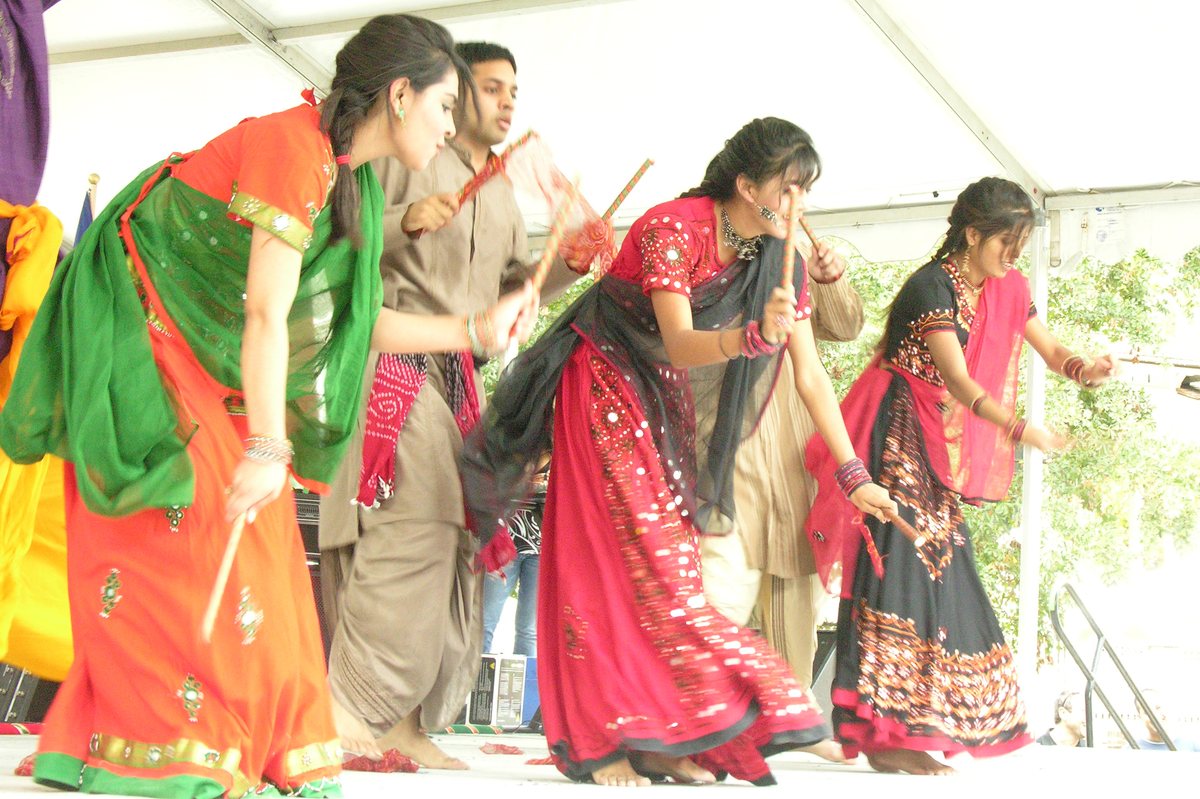
Gujarat’s Navratri celebrations are world-famous. Garba (from the Sanskrit garbha, “womb”) is a circular dance performed around a central lamp or image of the Goddess, symbolizing the cyclical nature of time and the eternal dance of creation, preservation, and dissolution. Daṇḍiyā Rās — a dance performed with decorated sticks — follows the Garba and represents the mock battle between Durgā and Mahiṣāsura. Modern Garba events in cities like Ahmedabad and Vadodara attract hundreds of thousands of participants over the nine nights, with professional choreography, live orchestras, and elaborate costumes.
Bengal: Durgā Pūjā
In West Bengal, Navratri is synonymous with Durgā Pūjā — the largest and most elaborate public festival in the region. The celebrations focus on the last five days (Ṣaṣṭhī through Vijayādaśamī). Artisan communities in Kumartuli (Kolkata) spend months crafting massive clay idols of Durgā slaying Mahiṣāsura, flanked by her children — Lakṣmī, Sarasvatī, Gaṇeśa, and Kārtikeya. These idols are installed in elaborately decorated temporary structures (paṇḍāls), some of which are architectural marvels themed on global landmarks, social issues, or mythological narratives. On Vijayādaśamī, the idols are carried in procession to the river and immersed (visarjana), symbolizing the Goddess’s return to her husband Śiva’s Himalayan abode. Durgā Pūjā was inscribed on UNESCO’s Representative List of the Intangible Cultural Heritage of Humanity in 2021.
North India: Kanyā Pūjā and Rāmlīlā
Across Uttar Pradesh, Bihar, Madhya Pradesh, and Rajasthan, devotees observe fasting, daily pūjā, and the recitation of the Devī Māhātmya. On Aṣṭamī (eighth day) or Navamī (ninth day), Kanyā Pūjā is performed — nine young girls, representing the nine forms of the Goddess, are invited into the home, their feet are washed, and they are offered food, clothing, and gifts. This ritual enacts the theology that the divine feminine resides in every female being.
The parallel Rāmlīlā tradition — dramatic re-enactments of the Rāmāyaṇa — runs concurrently with Navratri in many North Indian cities. The climactic burning of giant effigies of Rāvaṇa, Meghanāda, and Kumbhakarṇa on Dussehra draws enormous crowds, with the Rāmlīlā of Ramnagar (Varanasi) being one of the oldest and most faithful to the text of Tulsīdāsa’s Rāmacaritamānasa.
South India: Golu and Sarasvatī Pūjā
In Tamil Nadu, Karnataka, Andhra Pradesh, and Kerala, households arrange Golu (also called Bommai Kolu or Bommala Koluvu) — tiered displays of dolls and figurines depicting gods, mythological scenes, and daily life. Women visit each other’s homes to view the Golu and exchange gifts of turmeric, betel leaves, and coconuts. The ninth day, Sarasvatī Pūjā (also called Āyudha Pūjā), is dedicated to the worship of knowledge, books, musical instruments, and tools of one’s trade — all placed before the Goddess and ceremonially retrieved on Vijayādaśamī, the “day of victory,” considered the most auspicious day to begin new ventures and learning.
Maharashtra
Special Śāradīya Navratri celebrations feature daily pūjās in household shrines and community temples. The tradition of planting nine varieties of grain (navadhānya) in a clay pot on the first day and nurturing them through the nine nights — watching them sprout as a symbol of life and fertility — is particularly popular in rural Maharashtra.
The Nine Colours
Each day of Navratri is associated with a colour that devotees wear, linking the cosmic energy of each form to a chromatic vibration:
| Day | Goddess | Colour | Significance |
|---|---|---|---|
| 1 | Śailaputrī | Grey | Strength and stability |
| 2 | Brahmacāriṇī | Orange | Energy and devotion |
| 3 | Candraghaṇṭā | White | Purity and peace |
| 4 | Kūṣmāṇḍā | Red | Courage and power |
| 5 | Skandamātā | Royal Blue | Serenity and depth |
| 6 | Kātyāyanī | Yellow | Joy and warmth |
| 7 | Kālarātrī | Green | New growth and renewal |
| 8 | Mahāgaurī | Purple | Spiritual wisdom |
| 9 | Siddhidātrī | Saffron | Victory and renunciation |
Navratri Observances and Rituals
Fasting (Vrata)
Many devotees observe strict fasts during Navratri, abstaining from grains (anna), onions, garlic, meat, and alcohol. The permitted foods — fruits, milk, buckwheat (kuttu), water chestnut flour (singhāṛā), and rock salt (sendha namak) — are collectively called vrata ka khāna (fasting food). The fast is understood not merely as dietary restriction but as a form of tapas — austerity that purifies the body and focuses the mind on the divine.
Pūjā and Pāṭha
Daily worship during Navratri follows a structured liturgical sequence: invocation (āvāhana), ritual bathing of the image (abhiṣeka), offering of flowers, incense, and food (naivedya), recitation of the Devī Māhātmya or Lalitā Sahasranāma, singing of devotional hymns (bhajans), and the closing āratī with camphor and oil lamps. In many households, a jyoti (sacred flame) is lit on the first day and kept burning continuously through all nine nights — its unbroken flame symbolizing the uninterrupted presence of the Goddess.
Kanyā Pūjā
On Aṣṭamī or Navamī, nine pre-pubescent girls are worshipped as living embodiments of the nine forms. Their feet are washed, they are adorned with new clothes and alta (red dye), and they are offered a feast of pūrī, hālvā, chanā, and sweets. Each girl receives a gift — typically coins, jewellery, or clothing. This ritual powerfully affirms the sanctity of the feminine in Hindu culture.
Dussehra / Vijayādaśamī
The tenth day celebrates the Goddess’s ultimate victory over Mahiṣāsura and, in the Rāmāyaṇa tradition, Rāma’s victory over the ten-headed demon king Rāvaṇa. In North India, towering effigies of Rāvaṇa, Meghanāda, and Kumbhakarṇa — stuffed with firecrackers — are set ablaze at sunset. In South India, Vijayādaśamī is the day of vidyārambha — the initiation of young children into learning, when a guru guides the child’s finger to write the first letters of the alphabet in a tray of rice.
The Inner Meaning: From Tamas to Sattva
Beyond the pageantry, Navratri encodes a profound spiritual allegory. The three caritras of the Devī Māhātmya correspond to the three guṇas (fundamental qualities of nature) in Sāṅkhya philosophy:
- Madhu-Kaiṭabha (Days 1–3) represent tamas — inertia, sleep, and delusion. Their destruction symbolizes the seeker’s awakening from spiritual torpor.
- Mahiṣāsura (Days 4–6) represents rajas — restless desire, passion, and the ego’s constant activity. His defeat symbolizes the taming of the mind’s agitation.
- Śumbha-Niśumbha (Days 7–9) represent sattva distorted by pride — the subtlest obstacle, where even spiritual attainment becomes a source of ego. Their destruction represents the final transcendence beyond all three guṇas.
The tenth day, Vijayādaśamī, marks the state beyond the guṇas — triguṇātīta — where the devotee rests in pure consciousness, united with the Goddess who is herself the play of all three guṇas and simultaneously beyond them.
Navratri in the Modern World
In contemporary India and the global diaspora, Navratri has evolved while retaining its spiritual core. Garba nights in cities like London, New York, and Sydney draw thousands of participants. Social media campaigns promote eco-friendly celebrations, encouraging clay idols over plaster of Paris and natural dyes over synthetic colours. The festival has also become a platform for cultural diplomacy — India’s embassies worldwide host Navratri events that introduce the festival to international audiences.
At its heart, Navratri remains what it has always been: a nine-night vigil in which the devotee surrenders to the Goddess, trusting that her grace can vanquish even the most deeply rooted demons — not only the mythological asuras of the Purāṇas, but the inner demons of fear, anger, greed, and ignorance that obstruct the soul’s journey toward liberation. As the Devī Māhātmya (11.10) promises: “Wherever difficulties arise, whenever calamities descend upon the world, I shall manifest and destroy them” — a promise renewed each year through the nine sacred nights of Navratri.