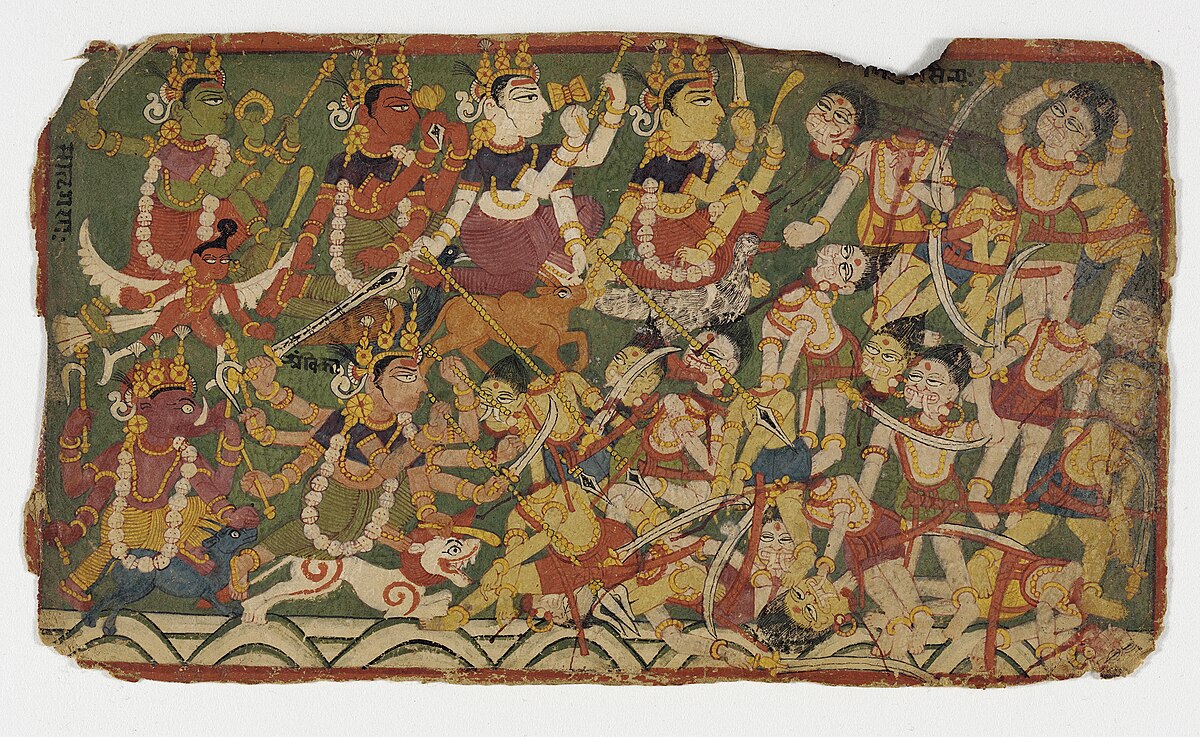
The Devī Māhātmya (देवीमाहात्म्यम्, “Glory of the Goddess”), also known as Durgā Saptaśatī (“Seven Hundred [Verses] of Durgā”) and Caṇḍī Pāṭh (“Recitation of Caṇḍī”), is the single most important scripture of Śākta Hinduism — the tradition that worships the Goddess (Devī) as the Supreme Reality. Comprising 700 Sanskrit verses arranged across 13 chapters, the text forms chapters 81–93 of the Mārkaṇḍeya Purāṇa and is generally dated to between the 5th and 6th centuries CE.
Scholar C. Mackenzie Brown has described it as the text in which “the various mythic, cultic and theological elements relating to diverse female divinities were brought together in what has been called the ‘crystallization of the Goddess tradition.’” It is, in the words of Thomas B. Coburn, “the oldest extant text in the world devoted entirely to a fiercely independent Goddess who is also the Supreme Being.” No other Hindu scripture of comparable length has generated such an immense ritual, commentarial, and devotional tradition — with at least sixty-five known commentaries, daily recitation by millions, and a ritual centrality in the Navarātri festival that has endured for over fifteen centuries.
The Frame Story: King Suratha and the Merchant Samādhi
The Devī Māhātmya is not presented as a direct divine revelation but unfolds within a carefully constructed frame narrative (kathā-mukha). A deposed king named Suratha and a merchant named Samādhi, both dispossessed of their worldly positions, meet in the forest hermitage of the sage Medhas. Puzzled by their continued attachment to the very people and possessions that have wronged them, they approach the sage for guidance.
Medhas explains that their attachment arises from Mahāmāyā — the Great Illusion — who is none other than the Supreme Goddess herself. She is the power that binds beings to the cycle of saṃsāra through delusion, and she is simultaneously the grace that liberates them. To illustrate her glory, Medhas narrates three cosmic episodes (carita) in which the Goddess manifests in terrifying forms to destroy demonic forces threatening the cosmic order.
This frame story is theologically significant: it establishes that the Devī’s power operates at every level of existence — from the cosmic battles of gods and demons down to the everyday psychological bondage of an ordinary king and merchant. The text thus addresses both the macrocosmic and microcosmic dimensions of māyā and liberation.
The Three Episodes (Carita)
First Episode: Mahākālī and the Slaying of Madhu-Kaiṭabha (Chapter 1)
The first carita contains 61 verses and is presided over by Mahākālī, the tāmasic form of the Goddess. At the dawn of creation, when Viṣṇu lies in cosmic sleep (yoga-nidrā) upon the serpent Śeṣa on the primordial waters, two terrible demons — Madhu and Kaiṭabha — emerge from the wax of Viṣṇu’s ears and prepare to attack Brahmā, who sits upon the lotus growing from Viṣṇu’s navel.
Brahmā hymns the Goddess as Yoga-nidrā (the very sleep enveloping Viṣṇu), beseeching her to withdraw so that Viṣṇu may awaken and fight. The Devī, praised as both the power of sleep and the power of awakening, withdraws from Viṣṇu’s body. In the ensuing battle, Viṣṇu wrestles with Madhu and Kaiṭabha for five thousand years. Only when the demons, intoxicated by Mahāmāyā’s delusion, foolishly offer Viṣṇu a boon does he seize the opportunity, requesting permission to slay them — which they grant. Viṣṇu destroys them upon his thighs, and from their bodily fat (medas), the earth (medinī) is said to have been formed.
Esoteric significance: According to Swami Krishnananda, this episode symbolizes the conquest of tamas — the fundamental ignorance, inertia, and dullness (mala) that obscures consciousness. Madhu (sweetness/desire) and Kaiṭabha (bitterness/anger) represent the most basic obstacles to spiritual life.
Second Episode: Mahālakṣmī and the Slaying of Mahiṣāsura (Chapters 2–4)
The central and most celebrated carita contains 252 verses and is presided over by Mahālakṣmī, the rājasic (or triguṇātmikā) form of the Goddess. The buffalo demon Mahiṣāsura, having obtained a boon from Brahmā that no god or demon could kill him, defeats the gods and usurps Indra’s throne.
The enraged gods direct their combined tejas (fiery energy) into a blazing mass from which the Goddess Durgā materialises. Each deity contributes a weapon: Śiva’s trident, Viṣṇu’s discus, Indra’s thunderbolt, Varuṇa’s conch, Agni’s spear, Vāyu’s bow, Sūrya’s arrows, and Himālaya’s lion as her mount. The Goddess is thus not created by any one god but emerges from the combined potency of all divine powers — a radical theological statement about the Feminine as the unified source of all masculine śakti.
A ferocious eighteen-day battle ensues. Mahiṣāsura shifts between forms — buffalo, lion, elephant, human warrior — but the Goddess pins him down with her foot, pierces him with her spear, and decapitates him as he emerges from the buffalo’s severed neck (Devī Māhātmya 3.37–39). The gods shower her with hymns of praise, and she promises to return whenever demonic forces threaten the cosmic order.
Esoteric significance: This episode represents the conquest of rajas — the restless, scattering power of the mind (vikṣepa-śakti). Mahiṣāsura’s shape-shifting represents the protean nature of desire, which constantly transforms but never truly disappears until the concentrated power of the Goddess destroys it at its root.
Third Episode: Mahāsarasvatī and the Slaying of Śumbha-Niśumbha (Chapters 5–13)
The longest carita contains 387 verses across nine chapters and is presided over by Mahāsarasvatī, the sāttvic form of the Goddess. Two demon brothers, Śumbha and Niśumbha, conquer the three worlds. The gods hymn the Devī at the Himālayan peak, and she manifests as the beautiful Ambikā (also called Kauśikī). Śumbha, smitten by her beauty, proposes marriage; she sets the condition that only one who defeats her in battle may claim her hand.
This carita introduces the most dramatic and theologically rich episodes of the text:
-
Caṇḍa and Muṇḍa: Two generals sent by Śumbha. The Goddess’s fury coalesces into the fearsome Kālī (also called Cāmuṇḍā after slaying them), who emerges from the Devī’s furrowed brow — dark-skinned, emaciated, garlanded with skulls, laughing terribly (5.24–33).
-
Raktabīja: A demon whose every drop of blood that touches the ground spawns a new demon. The Goddess emanates the Sapta Mātṛkās (Seven Mother Goddesses) — Brāhmī, Māheśvarī, Kaumārī, Vaiṣṇavī, Vārāhī, Nārasiṃhī, and Aindrī — who join the battle alongside Kālī. Kālī solves the Raktabīja problem by drinking his blood before it can touch the earth, then devouring the demon himself (8.49–62).
-
The Final Battle: Niśumbha falls first. Śumbha, the last surviving demon, challenges the Goddess, accusing her of relying on the strength of other goddesses. In the text’s supreme theological moment, the Devī declares: “I alone exist in this world; who else is there besides me? Behold, O wicked one, all these goddesses entering into me!” (10.5). The Mātṛkās, Kālī, and all other forms merge back into the single body of the Devī, and she defeats Śumbha in single combat.
Esoteric significance: This episode represents the conquest of the subtlest obstacle — āvaraṇa-śakti, the veiling power even of sattva, which creates a “transparent glass” between the soul and ultimate Truth. Śumbha (self-conceit) and Niśumbha (self-deprecation) represent the final ego-barriers that must be dissolved for liberation.
Key Hymns Within the Text
The Devī Māhātmya contains several hymns of extraordinary theological and devotional power:
Yā Devī Sarvabhūteṣu (Chapters 5.9–82)
The most widely recited hymn from the text, this series of verses follows the pattern: “Yā devī sarvabhūteṣu [quality]-rūpeṇa saṃsthitā / Namastasyai namastasyai namastasyai namo namaḥ” — “To the Goddess who abides in all beings in the form of [quality], salutations to her, salutations to her, salutations to her, salutations again and again.” The hymn identifies the Devī as present in all beings in the form of consciousness (citi), sleep (nidrā), hunger (kṣudhā), shadow (chāyā), power (śakti), thirst (tṛṣṇā), patience (kṣānti), modesty (lajjā), peace (śānti), faith (śraddhā), beauty (kānti), fortune (lakṣmī), memory (smṛti), compassion (dayā), contentment (tuṣṭi), mother (mātṛ), and error (bhrānti).
This hymn is theologically revolutionary: it asserts the Goddess’s immanence in every aspect of conscious experience — not only the noble qualities but also hunger, thirst, error, and delusion. She is the totality of existence itself.
Aparājitā Stuti (Chapter 4)
The hymn sung by the gods after the defeat of Mahiṣāsura, praising the Devī as the invincible one (aparājitā), the source and dissolution of the universe.
Nārāyaṇī Stuti (Chapter 11)
The hymn addressed to the Devī as Nārāyaṇī, identifying her with Viṣṇu’s supreme power and declaring her to be the refuge of the universe.
Devī’s Promise (Chapter 12)
In her final address before disappearing, the Goddess promises to return in future ages whenever demons threaten the world. She prophesies her future incarnations — as Śatākṣī (Hundred-Eyed), Śākambharī (Nourisher of Herbs), Bhīmā (The Terrible), and Bhrāmarī (She of the Bees) — establishing the theological basis for ongoing Goddess worship.
Theological Significance: The Goddess as Supreme Reality
The Devī Māhātmya’s theological innovation is its uncompromising assertion that the Goddess is the Supreme Reality (para-brahman) — not a consort, not a śakti subordinate to a male deity, but the independent, self-existent Absolute. The text achieves this through several strategies:
-
Synthesis of traditions: It draws together diverse goddess figures — Vedic (Vāk, Rātri), Epic (Durgā, Kālī), and local mother goddesses — into a single supreme Devī, creating a unified monotheistic Goddess theology.
-
Philosophical integration: It accepts the Sāṃkhya categories of puruṣa and prakṛti but identifies the Goddess with both — she is simultaneously the transcendent consciousness and the material nature, collapsing the Sāṃkhya dualism into Śākta non-dualism.
-
The Mahāmāyā doctrine: The Goddess is paradoxically both māyā (the binding power of illusion) and vidyā (the liberating power of knowledge). She is the cause of bondage and the means of liberation — a position that distinguishes Śākta theology from Advaita Vedānta’s treatment of māyā as merely negative.
-
The declaration of non-duality (Devī Māhātmya 10.5): The Goddess’s statement that she alone exists and all other forms are her own projections is the text’s supreme philosophical moment, establishing radical divine monism.
Ritual Use: Navarātri Recitation and Caṇḍī Homa
Navarātri Pārāyaṇa
The complete recitation (pārāyaṇa) of the Devī Māhātmya is the central liturgical act of the Śarad Navarātri (September–October), the most important of the four annual Navarātri observances. The thirteen chapters are traditionally distributed across the nine nights:
- Day 1: Chapter 1 (Mahākālī carita)
- Days 2–3: Chapters 2–4 (Mahālakṣmī carita)
- Days 4–9: Chapters 5–13 (Mahāsarasvatī carita)
Many traditions prescribe the recitation to be preceded by the Kavaca (armour), Argalā (bolt), and Kīlaka (pin) — three ancillary texts that “unlock” the power of the scripture — followed by the Navārṇa Mantra (aiṃ hrīṃ klīṃ cāmuṇḍāyai vicce), which is considered the bīja (seed) mantra of the entire text.
Caṇḍī Homa
The Caṇḍī Homa (fire ritual) is the most elaborate ritual form of Devī Māhātmya worship. Each of the 700 verses is recited while offering āhuti (oblations) into the sacred fire. The Śata-Caṇḍī Yajña involves 100 complete recitations by multiple priests over several days, while the Sahasra-Caṇḍī involves 1,000 recitations — undertaken only for the most momentous occasions. These fire rituals are considered among the most powerful in the entire Hindu liturgical tradition.
Daily Recitation
Beyond Navarātri, devout Śāktas recite the Devī Māhātmya daily, treating it as a nitya-karma (obligatory daily practice). Tuesdays and Fridays are considered especially auspicious for recitation.
The Bengali Durgā Pūjā Connection: Caṇḍīpāṭh and Mahālayā
In Bengal, the Devī Māhātmya occupies a position of unparalleled cultural centrality. The complete recitation of the text — known in Bengali as Caṇḍīpāṭh (চণ্ডীপাঠ) — forms the liturgical spine of Durgā Pūjā, the greatest festival of the Bengali people.
Mahālayā: The Radio Tradition
One of the most beloved cultural traditions in Bengal is the Mahālayā dawn broadcast. Since 1931, All India Radio’s Calcutta station has broadcast the programme Mahiṣāsuramarddinī on the morning of Mahālayā (the new moon day marking the start of Devīpakṣa). The programme — a 90-minute audio montage of Caṇḍīpāṭh recitation, Bengali devotional songs, and dramatic narration — was immortalised by the voice of Bīrendra Kṛṣṇa Bhadra (1905–1991), who narrated it from the 1930s until his death.
So deeply embedded is this broadcast in Bengali cultural identity that when All India Radio attempted to replace Bhadra’s version in 1976 with a new recording featuring the actor Uttam Kumār, public outcry forced an immediate reversion to the original. To this day, millions of Bengalis wake at 4:00 AM on Mahālayā morning to hear Bhadra’s recorded voice reciting the scripture, marking the emotional and spiritual beginning of the Durgā Pūjā season. The programme has been broadcast continuously — first live, then in its pre-recorded format since 1966 — for over ninety years, making it one of the longest-running radio programmes in the world.
Ritual Centrality in Durgā Pūjā
During the five days of Durgā Pūjā (Ṣaṣṭhī through Daśamī), the Caṇḍīpāṭh is recited by the officiating priest (purohita) at every pūjā paṇḍāl. The recitation accompanies the key rituals: bodhana (awakening), adhivāsa (consecration), ṣaṣṭhī pūjā, saptamī pūjā with nabapatrikā (nine plants), mahāṣṭamī with kumārī pūjā and sandhi pūjā, navamī homa, and the final vijayā daśamī with sindūr khelā and immersion. The text is not merely read but performatively enacted: the priest channels the cosmic drama into the ritual space, and the community participates in the Goddess’s victory over adharma.
Major Commentaries
The Devī Māhātmya’s importance is evidenced by the extraordinary number of commentaries it has inspired — at least 65 known commentaries, though not all survive. The most significant include:
-
Guptavatī by Bhāskararāya Makhin (c. 1690–1785): The most influential Śākta commentary, which interprets the text through the lens of Śrīvidyā tantra and Kaula tradition. Bhāskararāya demonstrates that the Goddess Caṇḍikā embodies the supreme non-dual Brahman and unveils the tantric rituals and mantric applications embedded in the text.
-
Śāntanavī (also called Caturdharī): One of the oldest commentaries, providing a straightforward grammatical and narrative explication.
-
Nagojī Bhaṭṭa’s commentary by Nāgeśa Bhaṭṭa (c. 1678–1755): An Advaita-inflected reading by the great Varanasi grammarian, differing from Bhāskararāya’s tantric approach while sharing the Advaita philosophical framework.
-
Durgāpradīpa: An important commentary offering both grammatical analysis and devotional interpretation.
-
Rāmaśramī, Puṣpāñjalī, Dāmoddharā: Among the traditionally cited “seven commentaries” (sapta-ṭīkā) that are studied together.
Several Tantric and Purāṇic texts also provide extended exegesis of the Devī Māhātmya, including the Kātyāyanī Tantra, Gāṭaka Tantra, Meru Tantra, Rudra Yāmala, and Cidambara Rahasya.
Influence on Śākta Theology
The Devī Māhātmya has been called the “Testament of Śākta philosophy” and forms the base and root of all subsequent Śākta doctrinal development. Its theological framework — the Goddess as simultaneously māyā and vidyā, as both immanent and transcendent, as the unified source of all divine power — became the foundation upon which later Śākta texts built their systems:
- The Devī Bhāgavata Purāṇa (c. 9th–14th century) expanded the Devī Māhātmya’s theology into a full Purāṇic framework.
- The Devī Upaniṣads (including the Devī Atharvashīrṣa) drew on its philosophical vision.
- The Śrīvidyā and Kaula tantric traditions adopted it as a key liturgical text and interpreted it through their own esoteric frameworks.
- The Devī Gītā (within the Devī Bhāgavata) modelled its structure on the Bhagavad Gītā but with the Goddess as the supreme teacher — a direct development of the Devī Māhātmya’s theology.
The text’s assertion of radical divine feminism — that the supreme power of the universe is inherently feminine and that male deities derive their power from her — remains the cornerstone of all Śākta thought.
Art and Iconographic Inspiration
The Devī Māhātmya has been one of the most prolific sources of Hindu religious art. Its vivid battle scenes — particularly the slaying of Mahiṣāsura, Kālī’s emergence, the Raktabīja episode, and the Mātṛkā warfare — have inspired an immense artistic tradition:
-
Sculpture: The iconic Mahiṣāsuramarddinī (Goddess slaying the buffalo demon) motif, found in temples from Mahabalipuram to Ellora to the Aihole cave temples, derives directly from chapters 2–4. Some of the finest examples date from the Pallava (7th century), Chola (11th century), and Hoysala (12th century) periods.
-
Manuscript painting: Illustrated Devīmāhātmya manuscripts, particularly from the Pahari schools (Kangra, Guler, Basohli) of the 18th–19th centuries, and from the Rajasthani and Mughal ateliers, constitute a major genre of Indian miniature painting. Superb folios survive in collections at LACMA, the Metropolitan Museum of Art, the Brooklyn Museum, the British Museum, and the National Museum, New Delhi.
-
Durgā Pūjā iconography: The standard idol (pratimā) of Durgā Pūjā — the ten-armed Goddess on her lion, spearing Mahiṣāsura while flanked by Lakṣmī, Sarasvatī, Gaṇeśa, and Kārttikeya — is a direct sculptural rendering of the Devī Māhātmya narrative. Every paṇḍāl idol in Bengal, from the simplest eka-cālā to the most elaborate contemporary installations, is a living artistic descendant of this text.
-
Performance arts: The text has inspired dramatic traditions such as the Bengali paṭa-citrā scroll painting narration, Odissi dance compositions on the Mahiṣāsuramarddinī theme, and Kathakali and Bharatanatyam pieces depicting the Goddess’s battles.
The Text’s Enduring Power
The Devī Māhātmya occupies a unique position in Hindu scripture. It is simultaneously a Purāṇic narrative, a philosophical treatise, a liturgical manual, a collection of hymns, and a living ritual text recited daily by millions. Its genius lies in making “abstruse philosophical ideas accessible and comprehensible to the common devotee” through gripping narrative — the triumph of good over evil, told with literary power and theological depth.
For the Śākta tradition, it is what the Bhagavad Gītā is to Vaiṣṇavism: the foundational text, the scripture of first resort, the lens through which all reality is understood. For Hindu culture more broadly, its images — the multi-armed Goddess astride her lion, Kālī drinking the demon’s blood, the Mātṛkās in cosmic warfare — have become among the most recognizable and emotionally resonant symbols in the entire Indian religious imagination. Fifteen centuries after its composition, the Devī Māhātmya remains what it has always been: the living voice of the Goddess, calling her devotees from bondage to liberation.