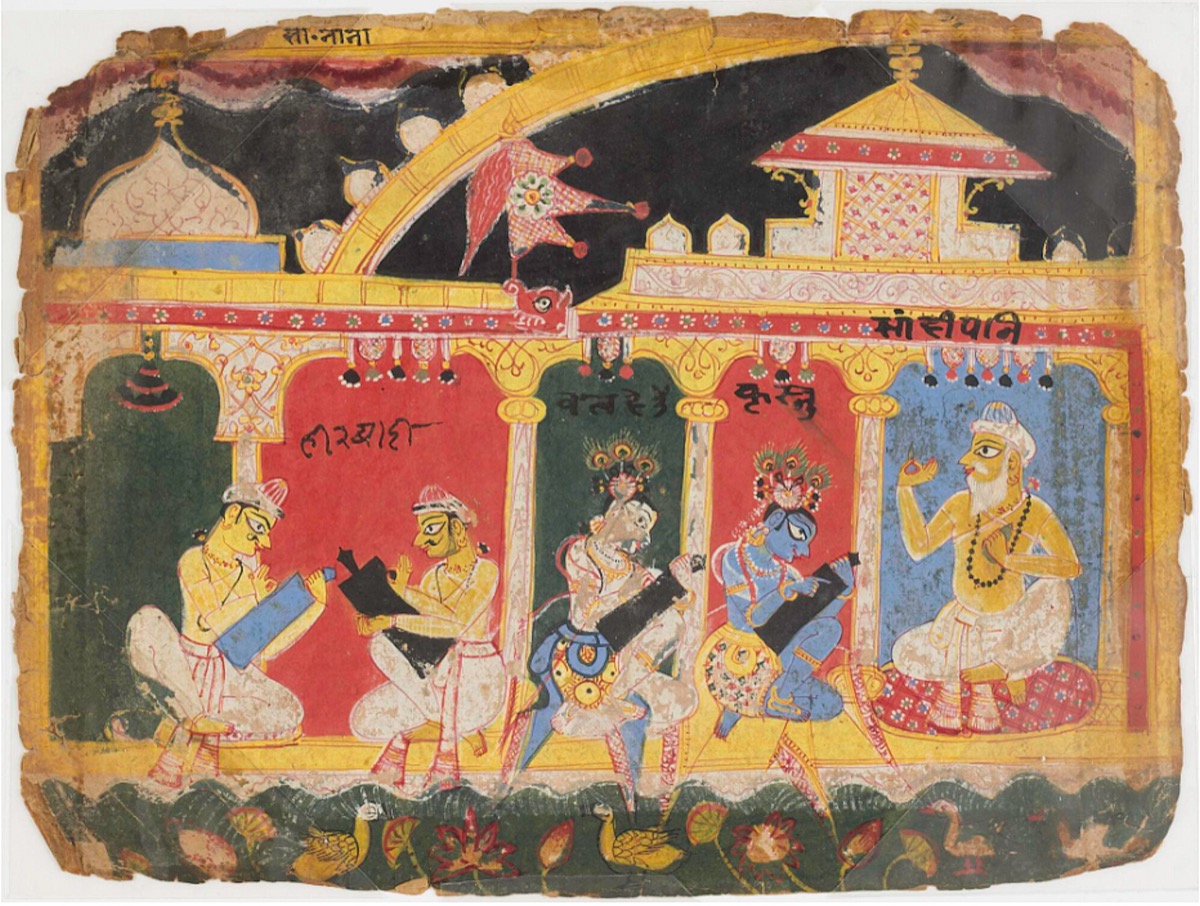
The Guru-Śiṣya Paramparā (गुरु-शिष्य परम्परा) — the unbroken chain of teacher and disciple — is perhaps the single most distinctive institution of Hindu civilization. While other cultures have known great teachers and devoted students, no other tradition has elevated the relationship between the two to such a central, sacrosanct, and philosophically elaborated position. From the forest hermitages of the Vedic ṛṣis to the concert stages of modern Hindustānī music, from the monastic maṭhas of Ādi Śaṅkarācārya to the Ramakrishna Mission of Svāmī Vivekānanda, the paramparā principle has ensured that knowledge — whether spiritual, intellectual, or artistic — is transmitted not through impersonal texts alone but through the living breath of a teacher who embodies what they teach.
The word paramparā (परम्परा) itself means “one after another” — an uninterrupted succession, a chain whose links extend backward to the origins of wisdom and forward into the uncharted future. In this understanding, no guru teaches alone: behind every teacher stands the entire lineage of teachers who came before, and within every student lies the potential to become a guru for those who will follow.
Etymology of “Guru”: Dispeller of Darkness
The Sanskrit word guru (गुरु) has a double significance. In its literal, grammatical sense it means “heavy, weighty, venerable” — cognate with the Latin gravis (from which English derives “gravity” and “grave”). The guru is thus one who carries the weight of wisdom, whose words possess gravitas.
But Hindu tradition offers a more evocative nirukta (etymological interpretation). The Advayatāraka Upaniṣad (verse 16) provides the classic derivation:
“gukāras tv andhakārasya, rukāras tan nivartakaḥ; andhakāra-nivārakatvāt, guru ity abhidhīyate”
“The syllable gu signifies darkness; the syllable ru signifies its remover. Because of the power to remove darkness, the teacher is called ‘guru.’”
This etymology, repeated in the Guru Gītā and countless other texts, transforms the guru from a mere instructor into a cosmic figure — one who performs the primordial act of bringing light where there was only the darkness of spiritual ignorance (avidyā). The Bṛhadāraṇyaka Upaniṣad (1.3.28) captures this aspiration in its famous prayer: “tamasō mā jyotirgamaya” — “Lead me from darkness to light” — and in Hindu understanding, it is the guru who answers this prayer.
Upaniṣadic Origins: The Birth of the Tradition
The guru-śiṣya relationship finds its earliest and most powerful articulation in the Upaniṣads — the philosophical texts that form the concluding portion of each Veda. The very word “Upaniṣad” is traditionally derived from upa (near), ni (down), and ṣad (to sit) — “sitting down near” the teacher. Knowledge in the Upaniṣadic vision is not something one reads in solitude; it is something one receives in proximity to a realized soul.
The Muṇḍaka Upaniṣad (1.2.12) prescribes the approach:
“tad-vijñānārthaṁ sa gurum evābhigacchet, samit-pāṇiḥ śrotriyaṁ brahma-niṣṭham”
“To know That (Brahman), one must approach a guru — carrying firewood in hand — a guru who is learned in the scriptures (śrotriya) and established in Brahman (brahma-niṣṭha).”
The firewood (samidh) symbolizes the student’s readiness to serve and the sacrificial fire of learning. The two qualifications of the guru — scriptural mastery and personal realization — establish a standard that reverberates through all subsequent Hindu teaching: the guru must not merely know the texts but must have lived the truth they proclaim.
The Kaṭha Upaniṣad dramatizes this relationship through the encounter of the boy Naciketas with Yama, the lord of death. Naciketas, having been cursed by his father to go to Death, arrives at Yama’s abode and, with extraordinary courage and discernment, refuses all material temptations offered by Yama — wealth, sons, kingship, heavenly pleasures — demanding instead the knowledge of what lies beyond death. Yama, impressed by the boy’s resolute inquiry, becomes his guru and reveals the secret of the Ātman (Self). This narrative establishes the archetypal qualities of the ideal student: fearlessness, single-pointed desire for truth, and willingness to renounce lesser goods.
The Chāndogya Upaniṣad records the famous instruction of Uddālaka Āruṇi to his son Śvetaketu: the nine-fold teaching on the nature of Being culminating in the mahāvākya “tat tvam asi” — “Thou art That.” Here the guru-śiṣya bond is simultaneously a father-son relationship, demonstrating that the paramparā could operate within family as well as in formal monastic structures.
The Gurukula System: Education as a Way of Life
The institutional expression of the guru-śiṣya paramparā was the gurukula (गुरुकुल, “the guru’s family/household”) — the residential school where students lived in the guru’s home, often for twelve years or more, immersed in an environment where learning was inseparable from daily life.
Structure and Practice
A boy’s gurukula education typically began with the upanayana (sacred thread ceremony), performed around the age of seven or eight. The Manusmṛti (2.36-37) specifies the appropriate ages: eight for a Brāhmaṇa, eleven for a Kṣatriya, and twelve for a Vaiśya. With the sacred thread ceremony, the boy became a brahmacārī — a celibate student bound by vows of simplicity, service, and dedicated study.
Life in the gurukula was austere. Students rose before dawn, performed sandhyāvandana (twilight prayers), tended the sacred fire, collected firewood and alms for the household, cooked, cleaned, and cared for the guru’s cattle. The Taittirīya Upaniṣad (1.11) preserves the guru’s parting address to the graduating student, revealing the breadth of what was taught: “satyaṁ vada, dharmaṁ cara” — “Speak truth, practise dharma” — alongside instructions on study, family life, charity, and hospitality.
The Curriculum
The gurukula curriculum encompassed the caturdaśa-vidyā (fourteen branches of knowledge): the four Vedas, six Vedāṅgas (phonetics, ritual, grammar, etymology, metrics, astronomy), Dharmaśāstra (law), Nyāya (logic), Mīmāṁsā (interpretation), and the Purāṇas. Beyond textual learning, students received training in practical arts — archery, horsemanship, medicine, agriculture, and statecraft — depending on their aptitude and social role.
The Arthaśāstra of Kauṭilya describes the relationship between the king and his ācārya (royal preceptor), indicating that even rulers were products of the gurukula system. The guru’s authority was considered higher than the king’s in matters of dharma — a principle that invested the paramparā with enormous social power.
Famous Guru-Śiṣya Pairs of Scripture and History
Droṇācārya and Arjuna
Perhaps the most celebrated martial guru-śiṣya relationship in Hindu lore is that of Droṇācārya and Arjuna. According to the Mahābhārata (Ādi Parva), Droṇa — a Brāhmaṇa master of the science of weapons — was appointed by Bhīṣma to instruct the princes of the Kuru dynasty. Among all his students, Arjuna stood supreme. The Mahābhārata recounts that Arjuna practiced archery even in darkness, having observed that his hand could find his mouth in the dark while eating — proving that accuracy did not require light. Droṇa, recognizing this extraordinary dedication, vowed to make Arjuna the greatest archer in the world.
The story of Ekalavya — the Niṣāda prince who taught himself archery by worshipping a clay image of Droṇa and was then asked for his thumb as guru-dakṣiṇā (teacher’s fee) — raises profound ethical questions about the obligations and limits of the guru-śiṣya bond that Hindu tradition has debated for millennia.
Sāndīpani and Kṛṣṇa-Balarāma
The Bhāgavata Purāṇa (10.45) narrates how Kṛṣṇa and Balarāma, despite being divine, submitted to the discipline of the gurukula by enrolling with the sage Sāndīpani at Avantipura (modern Ujjain). They mastered the sixty-four arts and sciences in just sixty-four days — one art per day — demonstrating both superhuman ability and the culturally non-negotiable requirement that even God incarnate must honour the institution of the guru. As guru-dakṣiṇā, Kṛṣṇa retrieved Sāndīpani’s dead son from the abode of Yama — a gift that transcended all worldly wealth.
Vasiṣṭha and Rāma
The Yoga Vāsiṣṭha (Vāsiṣṭha Rāmāyaṇa) presents the sage Vasiṣṭha as the guru of Prince Rāma, delivering an extended philosophical discourse on the nature of consciousness, the illusory character of the world, and the path to liberation. This text, spanning over 32,000 verses, is one of the largest philosophical dialogues in world literature — all framed as a guru’s instruction to a single student.
Kṛṣṇa and Arjuna on the Battlefield
The Bhagavad Gītā itself is a guru-śiṣya dialogue: Kṛṣṇa as the divine guru and Arjuna as the anguished disciple. Arjuna’s crisis on the battlefield of Kurukṣetra — his paralysis before the ethical complexities of war — mirrors the existential confusion that drives every seeker to a guru. Kṛṣṇa’s seven-hundred-verse teaching encompasses karma-yoga, jñāna-yoga, bhakti-yoga, and the revelation of his cosmic form — the most comprehensive spiritual instruction in Hindu scripture, delivered in the intimacy of the guru-śiṣya relationship.
The Guru as Brahmā, Viṣṇu, and Maheśvara
The most celebrated verse in the entire guru tradition comes from the Guru Gītā (a section of the Skanda Purāṇa):
“Gururbrahmā gururviṣṇuḥ gururdevo maheśvaraḥ, Guruḥ sākṣāt paraṁ brahma, tasmai śrī-gurave namaḥ”
“The guru is Brahmā, the guru is Viṣṇu, the guru is Deva Maheśvara (Śiva). The guru is verily the Supreme Brahman. To that glorious guru, I bow.”
This verse does not deify the human teacher in a crudely literal sense. Rather, it recognizes that the guru functions as the Trimūrti in the life of the student: like Brahmā, the guru creates by awakening new understanding; like Viṣṇu, the guru sustains by nurturing the student’s growth over years; and like Maheśvara (Śiva), the guru destroys the student’s ignorance, attachments, and false identifications. The guru is thus the entire cosmic process — creation, preservation, and transformation — concentrated in one human relationship.
The Guru Gītā further declares (verse 76): “dhyāna-mūlaṁ gurōr mūrtiḥ, pūjā-mūlaṁ gurōḥ padam; mantra-mūlaṁ gurōr vākyaṁ, mokṣa-mūlaṁ gurōḥ kṛpā” — “The root of meditation is the guru’s form; the root of worship is the guru’s feet; the root of mantra is the guru’s word; the root of liberation is the guru’s grace.”
Dīkṣā: The Sacrament of Initiation
The formal entry into a guru-śiṣya lineage is through dīkṣā (दीक्षा, “initiation”). The Āgama and Tantra traditions describe dīkṣā as the process by which the guru transmits spiritual power (śakti) to the disciple, often through the bestowal of a sacred mantra, a spiritual name, or a specific practice.
The Kulārṇava Tantra (14.3) defines dīkṣā etymologically: “dīyate jñānaṁ kṣīyate pāśa-bandhanam” — “That which gives (dī) knowledge and destroys (kṣi) the bondage of fetters.” Dīkṣā is thus simultaneously a gift and a liberation — the guru imparts the seed of wisdom while severing the chains of ignorance.
Hindu traditions recognize several forms of dīkṣā:
- Śāktī dīkṣā (śaktipāta) — initiation through the direct transmission of spiritual energy, often by touch, glance, or thought
- Śāmbhavī dīkṣā — initiation through the guru’s mere presence or will
- Mantradīkṣā — initiation through the bestowal of a sacred mantra
- Kriyā dīkṣā — initiation through a ritual action (such as a fire ceremony)
In the Śaiva Siddhānta tradition, dīkṣā is an elaborate ritual involving the purification of the disciple’s tattvas (cosmic principles) and the infusion of śivajñāna (knowledge of Śiva). In Vaiṣṇava traditions, dīkṣā involves receiving the dāśya (servant) or other sacred relationships with the Lord through the guru’s grace.
The Guru Gītā: Scripture of the Guru Principle
The Guru Gītā (गुरु गीता, “Song of the Guru”) is a text of approximately 352 verses embedded within the Skanda Purāṇa, cast as a dialogue between Lord Śiva and Pārvatī. When Pārvatī asks Śiva about the nature and glory of the guru, Śiva — himself the Ādi-Yogī (first yogi) and supreme guru — responds with a comprehensive teaching on guru-tattva (the guru principle).
The text covers the qualities of a true guru, the duties of the disciple, the glory of the guru’s grace, meditation techniques centred on the guru, and the ultimate identity of the guru with Brahman. It is recited daily in many Hindu monastic orders and forms the liturgical core of Guru Pūrṇimā celebrations.
Key teachings of the Guru Gītā include:
- The guru’s grace alone can bestow liberation — no amount of austerity, pilgrimage, or ritualism can substitute for it
- The disciple must serve the guru with body, mind, and speech — surrendering ego and personal will
- The guru is not merely a human being but a principle (tattva) that operates through the human form
- Meditation on the guru’s form, feet, and word is the highest form of spiritual practice
Modern Guru Traditions: Rāmakṛṣṇa and Vivekānanda
The 19th century saw one of the most powerful demonstrations of the guru-śiṣya paramparā in the encounter between Śrī Rāmakṛṣṇa Paramahaṁsa (1836-1886) and Svāmī Vivekānanda (1863-1902).
Rāmakṛṣṇa, the priest of the Kālī temple at Dakṣiṇeśvar, was an ecstatic mystic who had realized God through multiple paths — Śākta, Vaiṣṇava, Advaita, and even Islamic and Christian devotion. When the young Narendranāth Datta (later Vivekānanda), a rationalist and member of the Brāhmo Samāj, arrived at Dakṣiṇeśvar in 1881, Rāmakṛṣṇa recognized him as a spiritual giant and declared him a nityasiddha (eternally free soul). The meeting was electric: Narendranāth challenged Rāmakṛṣṇa’s mysticism with Western logic, and Rāmakṛṣṇa answered — not with arguments but with direct spiritual transmission. By a single touch, Rāmakṛṣṇa plunged Narendranāth into samādhi (superconsciousness), shattering his rationalist certainty.
Over the next five years, Rāmakṛṣṇa moulded Vivekānanda through a combination of mystical experience, philosophical instruction, and personal example. After Rāmakṛṣṇa’s death in 1886, Vivekānanda carried his guru’s teachings to the 1893 Parliament of Religions in Chicago, inaugurating the global spread of Hindu thought. The Ramakrishna Math and Mission, founded by Vivekānanda, remains one of the most influential monastic orders in the world — a living testament to the transformative power of one guru-śiṣya bond.
The Gharānā System: Paramparā in Music and Dance
The guru-śiṣya paramparā extends far beyond the strictly spiritual sphere into the classical arts. In Hindustānī (North Indian) classical music, the gharānā (घराना, “household, family”) system organizes musical knowledge into teacher-student lineages, each with distinctive stylistic characteristics.
Major vocal gharānās include the Gwalior, Agra, Jaipur-Atrauli, Kirana, Patiala, and Bhendibazaar gharānās. Instrumental gharānās include the Senia (descended from the legendary Tānsen, court musician of Akbar), Maihar (of the great Ustād Allāuddīn Khān, guru of Pt. Ravi Shankar and Ustād Ali Akbar Khan), and Imdadkhani gharānās.
In the gharānā system, a student typically lives with the guru for years, absorbing not just technical skill but the aesthetic sensibility, spiritual depth, and creative personality of the lineage. The relationship is exclusive: accepting instruction from another gharānā’s guru without permission is considered a betrayal. The transfer of knowledge occurs primarily through oral transmission — guru-mukha vidyā (knowledge from the guru’s mouth) — with the student learning rāgas, compositions, and improvisatory techniques by listening, imitating, and gradually developing independent mastery.
In Bharatanāṭyam, Kathak, Odissi, and other classical dance forms, the guru-śiṣya relationship is equally central. The naṭṭuvanār (dance master) lineages of Tamil Nadu, the Kathak gharānās of Lucknow and Jaipur, and the guru paramparā of Odissi (from Kelucharan Mohapatra onward) all demonstrate how the paramparā principle structures artistic knowledge across centuries.
Guru Pūrṇimā: The Festival of the Lineage
The annual celebration of Guru Pūrṇimā — the full moon of the Hindu month Āṣāḍha (June-July) — is the collective expression of gratitude toward the guru-śiṣya paramparā. Also called Vyāsa Pūrṇimā in honour of the sage Vyāsa (born on this day according to tradition), the festival is observed by Hindus, Buddhists, and Jains alike.
On Guru Pūrṇimā, disciples perform pādapūjā (worship of the guru’s feet), offer dakṣiṇā (teacher’s fee), recite the Guru Gītā and Gurvaṣṭakam, and recommit themselves to their studies and spiritual practice. In monastic traditions, an elaborate Vyāsa Pūjā is conducted, honouring the entire lineage from Vyāsa down to the present-day guru. In music and dance circles, students perform before their gurus as an act of devotion, and new students may receive formal acceptance into the lineage.
The festival affirms the Hindu conviction that the guru-śiṣya paramparā is not a relic of the past but a living, breathing institution — as necessary today as it was when Vyāsa divided the Vedas, when Droṇa strung his bow for Arjuna, when Sāndīpani taught the divine child Kṛṣṇa, and when Rāmakṛṣṇa touched the forehead of the young Narendranāth and changed the course of history.
The Eternal Chain
The guru-śiṣya paramparā endures because it addresses a need that no technology, no textbook, and no algorithm can satisfy: the human need for a living exemplar of wisdom. The Vivekacūḍāmaṇi of Ādi Śaṅkarācārya (verse 3) declares: “durlabhaṁ trayam evaitad devānugraha-hetukam: manuṣyatvaṁ mumukṣutvaṁ mahāpuruṣa-saṁśrayaḥ” — “Three things are exceedingly rare, and come only through divine grace: human birth, the desire for liberation, and the refuge of a great teacher.”
In this understanding, the meeting of guru and śiṣya is not accidental but providential — an event orchestrated by the deepest intelligence of the cosmos. And when it occurs, it becomes the most transformative relationship a human being can experience: the relationship that leads, in the words of the Bṛhadāraṇyaka Upaniṣad, “from the unreal to the Real, from darkness to Light, from death to Immortality.”