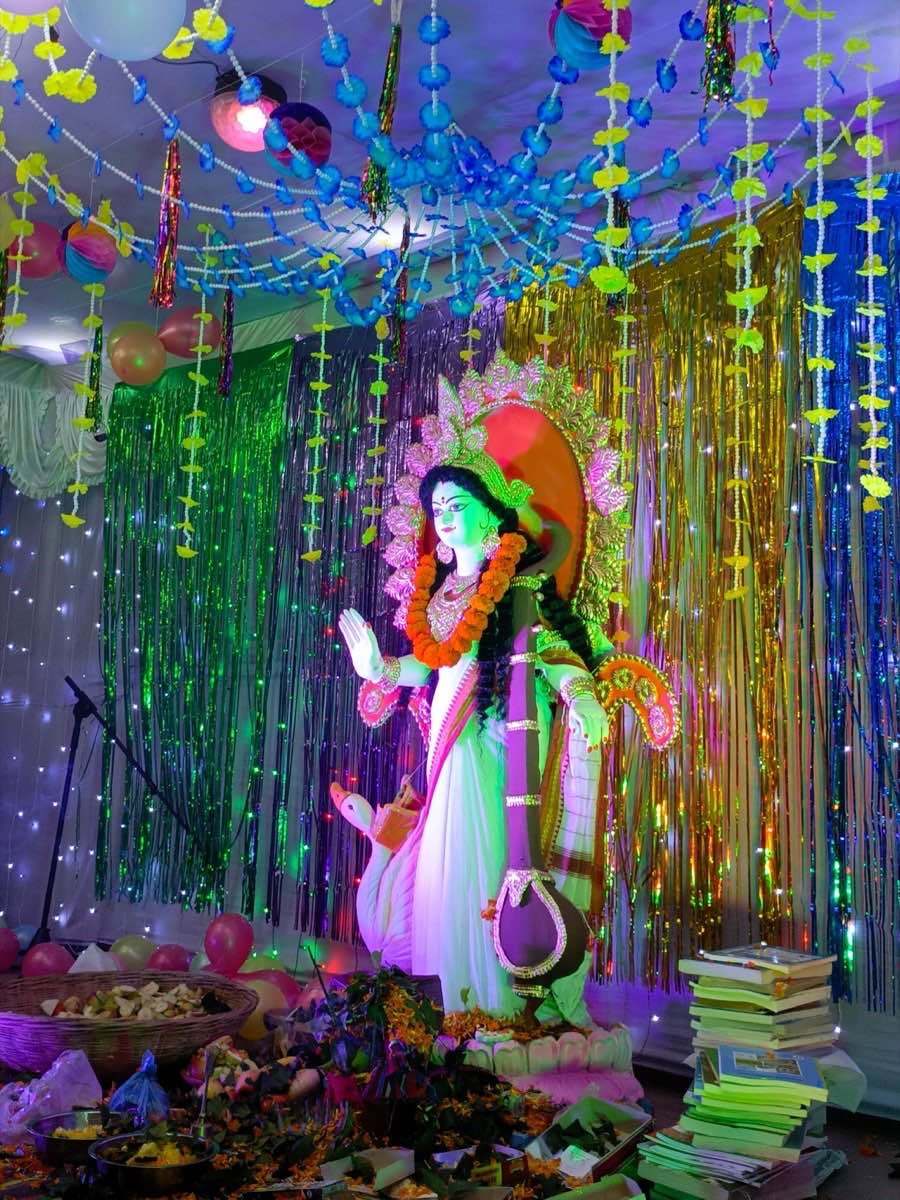
Vasant Pañchamī (वसन्त पञ्चमी, literally “the fifth day of spring”) is one of the most joyous festivals in the Hindu calendar — a celebration that marks the first stirring of spring, honours Goddess Sarasvatī as the divine source of knowledge and creativity, and initiates young children into the world of learning. Falling on the śukla-pakṣa pañchamī (fifth day of the bright fortnight) of the Hindu month of Māgha (typically late January or February), the festival transforms the landscape of India into a tapestry of yellow — the color of mustard flowers, of turmeric, of ripening grain, and of the goddess herself.
Known as Sarasvatī Pūjā in Bengal, Assam, and Odisha, as Basant in Punjab and Rajasthan, and as Śrī Pañchamī in parts of Nepal, this festival weaves together the themes of seasonal renewal, divine femininity, intellectual aspiration, and aesthetic beauty into a single, radiant celebration.
Etymology and Calendrical Significance
The name Vasant Pañchamī combines vasant (वसन्त, “spring”) with pañchamī (पञ्चमी, “fifth day”). In the Hindu six-season calendar, vasanta ṛtu (spring) begins from this very day — the fifth tithi of the waxing moon in Māgha — and continues through the month of Chaitra. The festival thus serves as the official inauguration of the spring season (vasanta-āgamana).
The Nirṇaya Sindhu, a medieval digest of Hindu religious law, prescribes Vasant Pañchamī as the day for Sarasvatī-pūjana (worship of Sarasvatī), stating that the goddess is especially accessible to devotees on this tithi. The Dharmasindhu similarly identifies this day as the foremost among tithis sacred to the goddess of learning.
In the agricultural calendar, Vasant Pañchamī coincides with the period when mustard (sarṣapa) fields across North India burst into brilliant yellow bloom — a visual signal that winter is receding and the earth is preparing for the abundance of the spring harvest. The festival is thus simultaneously a celebration of nature’s renewal and a supplication for the harvest of knowledge that Sarasvatī bestows.
Goddess Sarasvatī: The Divine Source of Knowledge
Sarasvatī (सरस्वती, “she who flows”) is the Hindu goddess of knowledge, music, arts, speech, wisdom, and learning. She is one of the Tridevi — the three supreme goddesses alongside Lakṣmī and Pārvatī — and the consort of Lord Brahmā, the creator. Her iconography typically depicts her seated upon a white lotus or riding a white swan (haṁsa), dressed in white or yellow garments, holding a vīṇā (stringed instrument), a pustaka (book), a mālā (rosary), and a kamaṇḍalu (water pot).
The Ṛg Veda (6.61, 7.95-96) contains some of the earliest hymns to Sarasvatī, celebrating her primarily as the great river goddess whose waters purify and nourish — “best of mothers, best of rivers, best of goddesses” (ambitame, nadītame, devitame sarasvatī, Ṛg Veda 2.41.16). Over the centuries, the river goddess evolved into the personification of speech (Vāc), learning (Vidyā), and creative power (Pratibhā).
The Brahmavaivarta Purāṇa narrates that Sarasvatī emerged from the cosmic waters during creation, bringing forth sound, speech, and knowledge to the universe. According to this text, Lord Brahmā, gazing upon the beauty of his creation but finding it mute and lifeless, performed a yajña (sacrifice) from which Sarasvatī arose — her vīṇā filling the universe with the first vibrations of nāda (sacred sound), her speech giving names to all created beings, and her wisdom illuminating the path of dharma.
The famous Sarasvatī Vandanā — “yā kuṇḍendu tuṣāra hāra dhavalā, yā śubhra vastrāvṛtā…” (“She who is fair as the jasmine flower, the moon, and a garland of snow, who is dressed in pure white garments…”) — is recited by millions of students across India before commencing their studies each day, invoking the goddess to illuminate their minds.
The Significance of Yellow
The color yellow (pīta or basantī) permeates every aspect of Vasant Pañchamī celebrations, carrying multiple layers of symbolism:
- Agricultural: The golden-yellow mustard flowers that carpet the fields of North India during this season
- Solar: Yellow represents the increasing power of the sun as winter gives way to spring
- Auspicious: Yellow and turmeric (haridrā) are considered supremely auspicious in Hindu tradition, associated with prosperity, fertility, and divine grace
- Sarasvatī: While the goddess is most commonly depicted in white, she is also worshipped in yellow during Vasant Pañchamī, symbolizing the warmth of knowledge that dispels the cold darkness of ignorance
On this day, devotees wear yellow garments, prepare yellow rice (kesar bhāt, saffron rice), distribute yellow sweets (besan ke laddoo, kesar peda), and offer yellow flowers — particularly marigolds and mustard blossoms — to the goddess. In some traditions, the goddess’s image itself is draped in yellow garments for this festival alone.
Vidyārambha: The Commencement of Learning
One of the most beautiful traditions associated with Vasant Pañchamī is Vidyārambha (विद्यारम्भ, “the beginning of learning”) — the ceremony in which young children write their first letters under the guidance of elders. This custom, practised across India but especially prominent in Bengal, Kerala, and Nepal, typically involves:
- The child is bathed and dressed in new (preferably yellow) clothes
- Seated before an image of Sarasvatī, the child’s hand is guided by a parent, teacher, or learned brāhmaṇa to trace the first letters of the alphabet — often Om (ॐ) or the first letter of the child’s name — on a plate of uncooked rice or with chalk on a slate
- Prayers are offered to Sarasvatī for the child’s intellectual growth
- The child is given a new slate, pen, or book as a blessing
The Arthaśāstra of Kauṭilya (c. 3rd century BCE) references the tradition of commencing education on an auspicious day, and the Manusmṛti (2.69-73) prescribes the upanayana (sacred thread ceremony) as the formal beginning of Vedic education, traditionally initiated during the vasanta ṛtu. The association of spring with the commencement of education is thus deeply rooted in Hindu cultural memory.
In Kerala, this ceremony is called Ezhuthiniruthu (എഴുത്തിനിരുത്ത്) and is traditionally performed at the temple of Thunchathu Ezhuthachan at Tirur or at the Sarasvatī temple at Panachikkad — among the few temples in India dedicated exclusively to the goddess of learning.
Sarasvatī Pūjā: The Bengal Tradition
In Bengal, Assam, Odisha, Bihar, and Jharkhand, Vasant Pañchamī is celebrated primarily as Sarasvatī Pūjā — and it is here that the festival reaches its most elaborate and passionate expression. The celebrations share structural similarities with the great Durgā Pūjā, though on a more intimate scale:
Preparation: In the days before the festival, households and educational institutions install clay images of Sarasvatī — typically depicting the goddess in white and yellow, seated on a lotus with her vīṇā and books. Artisans in the famous Kumartuli district of Kolkata begin fashioning these images weeks in advance.
Pūjā Day: On the morning of Vasant Pañchamī, the image is consecrated through prāṇa-pratiṣṭhā (invocation of divine presence). Students place their books, musical instruments, paintbrushes, pens, and tools of their craft before the goddess — refraining from using them for the entire day, as they are consecrated to Sarasvatī. The añjali (offering of flowers with folded hands) is performed communally, with students gathering to offer prayers together.
Attire: Bengali girls traditionally wear basantī sāṛī (yellow sarees), while boys don dhoti-kurta in white or yellow. The visual spectacle of thousands of students in yellow streaming toward community paṇḍāls and temples is one of the most iconic images of Bengali cultural life.
Visarjana: The following day, the clay images are taken in procession and immersed in rivers or lakes — the visarjana ceremony — returning the goddess to the cosmic waters from which she emerged.
Regional Variations Across India
Punjab and Rajasthan: The Basant Festival of Kites
In Punjab, Vasant Pañchamī is celebrated as Basant — with a distinctly exuberant, outdoor character. The Punjab skies fill with thousands of kites (patang or guḍḍī) as men, women, and children engage in spirited kite-flying contests. The kites are predominantly yellow, echoing the mustard fields below. Families wear yellow clothes, eat yellow rice, and prepare special dishes like meethe chawal (sweet yellow rice) and kesar halwa (saffron pudding). In the Sufi tradition, the shrine of Nizamuddin Auliya in Delhi has historically celebrated Basant with great fervor, a tradition established by the saint Amīr Khusrau in the 13th century.
Bihar: The Sun Temple Connection
In Bihar, Vasant Pañchamī holds special significance at the Deo Sun Temple in Aurangabad district — one of the oldest sun temples in India. Tradition holds that the temple was established on this day by King Aila of Allahabad. Devotees wash the temple’s images and replace old red cloths with new ones in a ritual renewal that mirrors the seasonal transition.
South India: Śrī Pañchamī
In South India, the festival is observed more quietly as Śrī Pañchamī or Sarasvatī Pūjā, often in conjunction with the broader Navarātrī celebrations. In Mysore, the Sarasvatī Pūjā during Navarātrī (known as Āyudha Pūjā on the ninth day) is a major celebration where books, tools, instruments, and even vehicles are worshipped and decorated.
Nepal: Śrī Pañchamī and Māghe Pañchamī
In Nepal, the festival is called Śrī Pañchamī and is one of the most widely celebrated days in the Nepalese calendar. Thousands of devotثees visit the Swayambhunath temple and the Hanuman Dhoka palace to worship Sarasvatī. The tradition of Vidyārambha is especially prominent in Nepal, with parents bringing even very young children to temples to begin their education.
Philosophical Dimensions: Knowledge as Liberation
The worship of Sarasvatī on Vasant Pañchamī embodies a profound Hindu philosophical conviction: that vidyā (knowledge) is the supreme liberating force. The Muṇḍaka Upaniṣad (1.1.4-5) distinguishes between parā vidyā (higher knowledge, the knowledge of Brahman) and aparā vidyā (lower knowledge, the knowledge of the world) — both of which fall under Sarasvatī’s domain.
The Viṣṇu Purāṇa (1.8.15) declares: “tāṁ vidyāṁ pratipadyeta yayā muktiṁ na vindati” — “One should seek that knowledge by which liberation is attained.” Sarasvatī, as the goddess of all knowledge — from the mundane sciences to the highest metaphysical realization — is thus the divine gateway to mokṣa (liberation).
The festival’s association with spring further deepens this symbolism. Just as the earth awakens from the dormancy of winter, the soul awakens from the sleep of ignorance through the grace of Sarasvatī. The yellow of the mustard flower — emerging from the cold, dark earth to face the returning sun — becomes a metaphor for the human intellect, reaching upward from the soil of avidyā (ignorance) toward the light of jñāna (knowledge).
Vasant Pañchamī and the Arts
The festival is also a day of special significance for musicians, artists, writers, and performers — all of whom worship Sarasvatī as their patron deity. Classical musicians perform special rāga Vasant and rāga Bahār — melodic modes associated with the spring season — in concerts dedicated to the goddess. Painters create new works, poets compose fresh verses, and dancers perform in honour of the deity who embodies creative inspiration.
The great Carnatic and Hindustani music traditions both recognize Sarasvatī as the source of all artistic accomplishment. The famous verse “yā śāstrasya vivartinī” (“she who turns the wheel of the śāstras”) honours the goddess as the animating force behind all systems of knowledge and artistic expression.
In medieval India, the courts of Hindu kings celebrated Vasant Pañchamī as a grand cultural occasion, featuring poetry recitations, music performances, and scholarly debates — all dedicated to Sarasvatī. The Bhojarāja dynasty of Mālwa (11th century) was especially renowned for its patronage of Vasant Pañchamī celebrations, with King Bhoja himself an accomplished scholar and devotee of the goddess.
The Festival in Contemporary Life
Today, Vasant Pañchamī remains one of the most universally observed Hindu festivals, celebrated with equal devotion in village schools and metropolitan universities, in ancient temples and modern homes. Schools and colleges across India conduct special Sarasvatī Pūjā programmes, with students organizing cultural events, debates, and artistic competitions in the goddess’s honour.
The festival serves as a powerful annual reminder of the Hindu civilizational commitment to the pursuit of knowledge — the conviction, expressed in the Taittirīya Upaniṣad (1.11.1), that “one should not neglect the study of the Vedas” (svādhyāyān mā pramadaḥ), and the broader understanding that learning, in all its forms, is a sacred act that connects the individual soul with the cosmic intelligence embodied in Goddess Sarasvatī.
As the yellow flowers of spring bloom across the Indian subcontinent each Māgha, millions of voices rise in the timeless invocation: “Sarasvatī Mahābhāge, Vidye Kamalalochane, Vidyārūpe Viśālākṣi, Vidyāṁ dehi namostute” — “O Sarasvatī, great and fortunate one, O lotus-eyed goddess of knowledge, O wide-eyed embodiment of learning, bestow upon us knowledge — we bow to you.”