Jyotiṣa (ज्योतिष, from the Sanskrit root jyot, meaning “light” or “heavenly body”) is the ancient Hindu system of astronomy and astrology, recognized as one of the six Vedāṅgas — the auxiliary disciplines essential for the proper understanding and practice of the Vedas. Far more than a system of fortune-telling, Jyotiṣa represents a sophisticated cosmological framework that integrates astronomical observation, mathematical calculation, mythology, and ritual science into a unified discipline that has shaped Hindu civilization for over three millennia.
The Vedāṅga Jyotiṣa text itself declares the discipline’s supreme importance: “vedā hi yajñārtham abhipravṛttāḥ, kālānupūrvyā vihitāśca yajñāḥ; tasmād idaṁ kālavidhāna-śāstraṁ, yo jyotiṣaṁ veda sa veda yajñān” — “The Vedas have been revealed for the purpose of performing yajña (sacrifice), and the sacrifices are prescribed in a time sequence; therefore, he who knows this science of time-reckoning (Jyotiṣa) knows the sacrifices” (Vedāṅga Jyotiṣa 1.3). This verse establishes Jyotiṣa not as a peripheral curiosity but as the eyes of the Vedas (vedānāṁ cakṣu), without which the entire Vedic ritual system cannot function.
Vedic Origins and Early Development
The roots of Jyotiṣa extend to the earliest stratum of Hindu scripture. The Ṛg Veda (c. 1500–1200 BCE) contains numerous hymns referencing celestial phenomena — the movement of the sun (Sūrya), the phases of the moon (Soma), and the role of the dawn (Uṣas). The Ṛg Vedic hymn to the Aśvins (Ṛg Veda 1.34.2) alludes to the three-fold division of the heavens, while hymns to Varuṇa (Ṛg Veda 7.86) describe his knowledge of the paths of celestial bodies.
The nakṣatras (lunar mansions) receive their earliest systematic treatment in the Atharva Veda (19.7.1–5), which lists the twenty-eight nakṣatras beginning with Kṛttikā (the Pleiades). The Taittirīya Brāhmaṇa (I.1.2) contains the famous Nakṣatra Sūkta (hymn to the lunar mansions), which assigns each nakṣatra a presiding deity and ritual significance — establishing the foundational framework that all later Jyotiṣa would build upon.
The Vedāṅga Jyotiṣa itself, attributed to the sage Lagadha (c. 1400–1200 BCE), exists in two recensions: the Ṛgveda Jyotiṣa (Ārcha-jyotiṣa, 36 verses) and the Yajurveda Jyotiṣa (Yājuṣa-jyotiṣa, 44 verses). This text focuses primarily on gaṇita (astronomical calculations) for determining the correct timing of Vedic rituals — calculating solstices, equinoxes, intercalary months, and the positions of the sun and moon. It describes a five-year cycle (yuga) of 1,830 days and provides rules for tracking the movement of the sun through the zodiac.
The Siddhānta Tradition: Hindu Astronomical Science
Around the early centuries of the Common Era, a new and more sophisticated astronomical literature emerged — the Siddhāntas (established theories). The Sūrya Siddhānta, the most celebrated of these texts, presents a comprehensive astronomical system including planetary orbits, eclipses, the precession of the equinoxes, and methods for calculating planetary positions with remarkable precision.
The great astronomer-mathematician Āryabhaṭa (476–550 CE) authored the Āryabhaṭīya, which advanced the understanding of planetary motion, proposed a heliocentric model for planetary movements, and calculated the Earth’s circumference and the length of the sidereal year with extraordinary accuracy. His work influenced the subsequent Siddhānta tradition profoundly.
Varāhamihira (c. 505–587 CE) compiled the Pañcasiddhāntikā (“Five Astronomical Canons”), synthesizing five earlier Siddhānta texts: the Paitāmaha, Romaka, Pauliśa, Vasiṣṭha, and Sūrya Siddhāntas. Varāhamihira also authored the Bṛhat Saṁhitā, an encyclopaedic work covering astronomy, astrology, geography, architecture, agriculture, gemology, and numerous other subjects — demonstrating the vast scope of the Jyotiṣa tradition.
Brahmagupta (598–668 CE) and Bhāskara II (1114–1185 CE) continued this mathematical-astronomical tradition with their own Siddhānta works, developing advanced algebraic methods for astronomical calculations that were among the most sophisticated in the pre-modern world.
The Zodiac System: Rāśi
The Hindu zodiac system comprises twelve rāśis (राशि, “portions” or “signs”), each spanning 30 degrees of the 360-degree ecliptic circle. The twelve rāśis — Meṣa (Aries), Vṛṣabha (Taurus), Mithuna (Gemini), Karka (Cancer), Siṁha (Leo), Kanyā (Virgo), Tulā (Libra), Vṛścika (Scorpio), Dhanu (Sagittarius), Makara (Capricorn), Kumbha (Aquarius), and Mīna (Pisces) — correspond to the Western zodiac signs but with one critical difference.
Hindu astrology employs the nirāyaṇa (sidereal) zodiac, which is fixed to the actual positions of the constellations in the sky, rather than the sāyaṇa (tropical) zodiac used in Western astrology, which is aligned with the seasons and the vernal equinox. Due to the ayanāṁśa (precession of the equinoxes, approximately 1 degree every 72 years), the two systems have gradually diverged by approximately 24 degrees — meaning that a person born under the tropical sign of Aries may actually have their Sun in sidereal Pisces. This distinction is fundamental to understanding the differences between Hindu and Western astrological traditions.
The Twenty-Seven Nakṣatras: Lunar Mansions
The nakṣatra system is arguably the most uniquely Indian contribution to world astrology. The ecliptic is divided into twenty-seven nakṣatras, each spanning 13°20’ of arc — corresponding approximately to the distance the Moon travels in one day during its 27.3-day sidereal orbit. Some traditions count twenty-eight nakṣatras, including Abhijit (the star Vega) as an intercalary asterism.
The cycle begins with Aśvinī (ruled by the Aśvin twins, the divine physicians) and proceeds through Bharaṇī (ruled by Yama, god of death), Kṛttikā (ruled by Agni, the fire god), Rohiṇī (ruled by Brahmā), and onward through the zodiac to conclude with Revatī (ruled by Pūṣan, the nourisher). Each nakṣatra possesses its own:
- Presiding deity (adhideva), drawn from the Vedic and Purāṇic pantheon
- Planetary ruler (graha-svāmī), one of the nine planets
- Symbol (cihna), reflecting its nature (e.g., Aśvinī’s horse head, Kṛttikā’s razor)
- Inherent quality (guṇa): deva (divine), manuṣya (human), or rākṣasa (demonic)
- Elemental nature: light, sharp, soft, movable, fixed, or mixed
The nakṣatra of one’s birth Moon — called the janma-nakṣatra — is considered the most important single factor in Hindu astrology. It determines one’s daśā (planetary period) cycle and is the primary basis for compatibility matching (guṇa-milāna) in Hindu marriages.
The Navagraha: Nine Planetary Deities
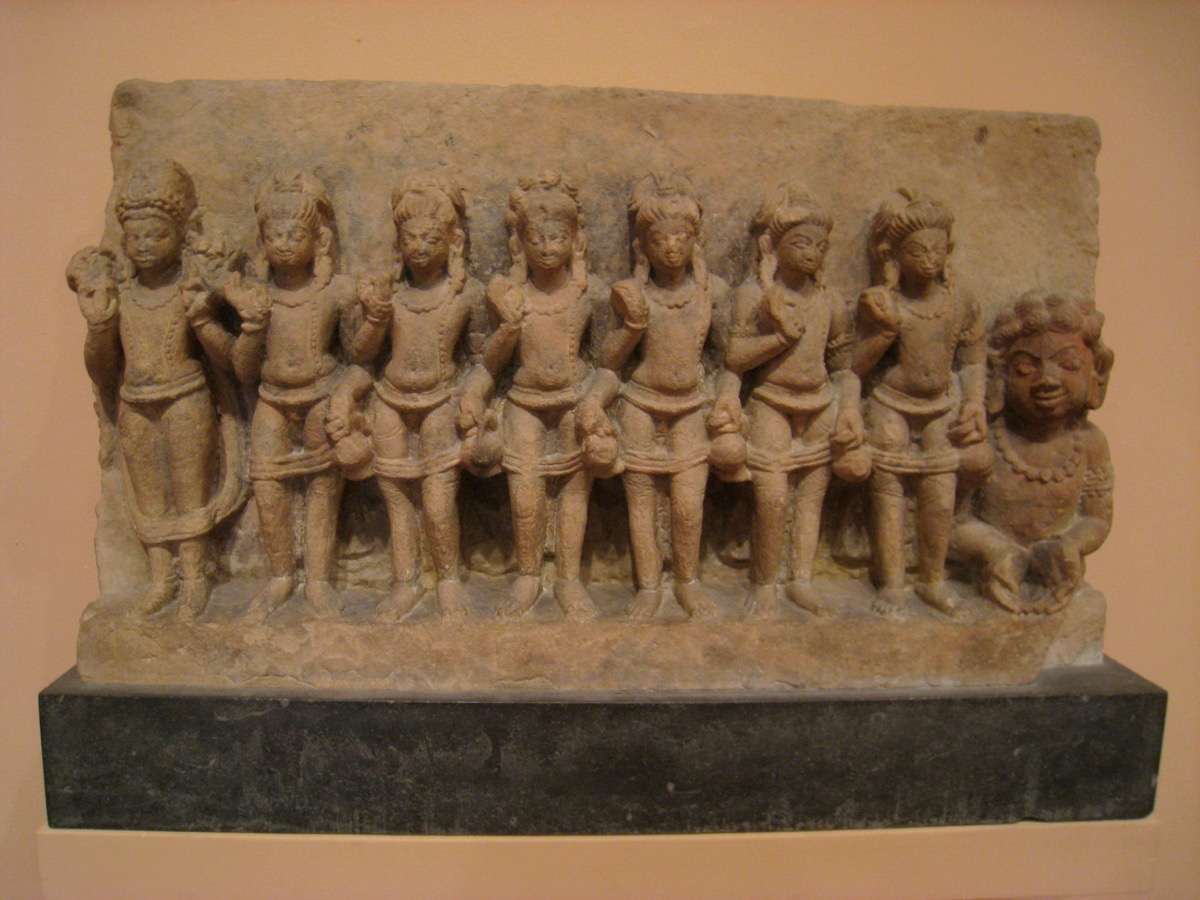
Central to Jyotiṣa is the concept of the Navagraha (नवग्रह, “nine planets” or more accurately, “nine seizers”) — celestial bodies personified as deities who exert powerful influences on human affairs. The Navagraha are:
- Sūrya (Sun) — the soul (ātmā-kāraka), king of the planets, associated with authority, vitality, and the father
- Chandra (Moon) — the mind (mano-kāraka), associated with emotions, the mother, and public perception
- Maṅgala (Mars) — courage and energy, associated with brothers, warfare, and property
- Budha (Mercury) — intellect and communication, associated with learning, speech, and commerce
- Bṛhaspati/Guru (Jupiter) — wisdom and expansion, the guru among planets, associated with dharma, children, and fortune
- Śukra (Venus) — love, beauty, and pleasure, associated with arts, marriage, and material comforts
- Śani (Saturn) — discipline, karma, and suffering, associated with longevity, servitude, and spiritual lessons
- Rāhu (North Lunar Node) — the shadow planet of obsession, illusion, and worldly desire
- Ketu (South Lunar Node) — the shadow planet of detachment, spirituality, and liberation
The Rāhu and Ketu are unique to Hindu astrology — they represent the ascending and descending nodes of the Moon’s orbit, where eclipses occur. Mythologically, they are the severed head and torso of the asura Svarbhānu, who disguised himself to drink the amṛta (nectar of immortality) during the Samudra Manthana (churning of the ocean, Bhāgavata Purāṇa 8.9). Viṣṇu, in his Mohinī form, discovered the deception and severed Svarbhānu’s head with the Sudarśana Cakra — but since the asura had already swallowed the nectar, both halves survived as the immortal shadow planets.
Navagraha shrines are a standard feature of South Indian temples, where devotees circumambulate the nine planetary deities to mitigate negative planetary influences and strengthen positive ones.
The Kuṇḍalī: The Birth Horoscope
The kuṇḍalī (कुण्डली) or janma-patrī (birth chart) is the central tool of predictive Jyotiṣa. It is a diagrammatic representation of the positions of the Navagraha at the exact moment and location of a person’s birth, mapped against the twelve rāśis and twenty-seven nakṣatras.
The kuṇḍalī is constructed around twelve bhāvas (houses), each governing specific areas of life:
- First bhāva (Lagna/Ascendant): self, personality, physical body
- Second bhāva: wealth, family, speech
- Third bhāva: siblings, courage, communication
- Fourth bhāva: mother, home, emotional security
- Fifth bhāva: children, intelligence, pūrvapuṇya (past merit)
- Sixth bhāva: enemies, disease, service
- Seventh bhāva: marriage, partnerships, business
- Eighth bhāva: longevity, occult, transformations
- Ninth bhāva: dharma, fortune, father, guru
- Tenth bhāva: karma, career, public status
- Eleventh bhāva: gains, aspirations, elder siblings
- Twelfth bhāva: mokṣa, losses, foreign travel
The classical texts Bṛhat Parāśara Horā Śāstra (attributed to Sage Parāśara) and Sārāvalī by Kalyāṇavarman provide exhaustive rules for interpreting planetary placements, aspects (dṛṣṭi), conjunctions (yuti), and strengths (bala) within the horoscope.
Muhūrta: The Science of Auspicious Timing
Muhūrta (मुहूर्त) is the branch of Jyotiṣa devoted to selecting the most auspicious time for important activities — from the momentous (marriage, gṛhapraveśa or housewarming, upanayana or sacred thread ceremony) to the everyday (starting a journey, beginning a new venture, planting crops). The pañcāṅga (Hindu almanac, literally “five limbs”) provides the daily astrological data needed for muhūrta calculations, comprising:
- Tithi — the lunar day (one of 30 in a lunar month)
- Vāra — the weekday (each ruled by a planet)
- Nakṣatra — the Moon’s asterism that day
- Yoga — a luni-solar calculation (27 yogas)
- Karaṇa — half a tithi (11 types)
The selection of muhūrta is not mere superstition but a sophisticated application of astronomical data to identify moments of celestial harmony. The Muhūrta Cintāmaṇi of Rāma Daivajña and the Muhūrta Mārtaṇḍa are among the classical texts devoted to this science.
The Three Branches of Jyotiṣa
Classical Jyotiṣa is traditionally divided into three main branches or skandhas:
-
Siddhānta (Astronomical Jyotiṣa): The mathematical and observational science of astronomy — calculating planetary positions, eclipses, rising and setting times, and calendar construction. This is the gaṇita (computational) foundation upon which all astrological interpretation rests.
-
Saṁhitā (Mundane Astrology): The interpretation of celestial phenomena as they affect nations, kingdoms, weather, agriculture, earthquakes, and collective human affairs. Varāhamihira’s Bṛhat Saṁhitā is the definitive text in this branch, covering everything from the effects of comets to the significance of animal behaviour.
-
Horā (Horoscopic Astrology): The analysis of individual birth charts and their predictive interpretation. This branch includes jātaka (natal astrology), praśna (horary or question-based astrology), and muhūrta (electional astrology for timing). The term horā itself derives from ahorātra (day and night), with the first and last syllables dropped.
Jyotiṣa in Daily Hindu Life
The influence of Jyotiṣa on Hindu daily life is pervasive and profound. Virtually every significant event in a Hindu’s life is timed according to astrological considerations:
- Birth: The child’s janma-kuṇḍalī is cast immediately, determining the child’s name (based on the janma-nakṣatra), temperament, and life trajectory
- Education: The Vidyārambha (commencement of learning) ceremony is performed on an auspicious muhūrta, often on Vasant Pañchamī
- Marriage: The guṇa-milāna (compatibility matching) system compares the bride and groom’s horoscopes across 36 points; a minimum score of 18 is typically required
- Career: The daśā system — particularly the Viṁśottarī Daśā (120-year planetary period cycle) — is consulted for career and financial decisions
- Death: The antya-kriyā (funeral rites) are performed at astrologically determined times; the annual śrāddha (ancestral rites) follows the tithi of death
Hindu temples maintain their own pañcāṅga and conduct festivals according to precise astronomical calculations. The great Kumbha Melā — the largest religious gathering on Earth — occurs when Jupiter enters specific zodiac signs, with the location rotating among four sacred rivers based on planetary configurations.
Philosophical Foundations: Karma and Free Will
Jyotiṣa operates within the broader Hindu philosophical framework of karma — the cosmic law of cause and effect. The planetary positions at birth are understood not as arbitrary impositions but as reflections of the soul’s accumulated karma from previous lives. The kuṇḍalī is thus a karmic map — revealing the soul’s strengths, challenges, debts, and opportunities in the current incarnation.
Crucially, classical Jyotiṣa does not advocate fatalism. The texts prescribe upāya (remedial measures) — specific mantras, gemstones, charitable acts, rituals, and worship of particular deities — to mitigate negative planetary influences. The Bṛhat Parāśara Horā Śāstra states that just as a skilled physician can treat disease, a knowledgeable astrologer can prescribe remedies for karmic afflictions. The Navagraha temples of South India, the recitation of the Navagraha Stotram, and the wearing of planetary gemstones (navaratna) are all expressions of this remedial tradition.
The sage Vasiṣṭha is credited with the teaching: “daivam tu pauruṣeṇaiva” — that destiny is conquered by human effort. Jyotiṣa, in this understanding, is not a deterministic prison but a navigational tool that helps the individual exercise puruṣārtha (self-effort) wisely within the framework of karmic reality.
Legacy and Contemporary Practice
Today, Jyotiṣa remains one of the most widely practised traditional knowledge systems in the world. India has numerous universities offering formal degrees in Jyotiṣa, and the discipline continues to be transmitted through traditional guru-śiṣya paramparā (teacher-student lineages). The Banaras Hindu University, Sampurnanand Sanskrit Vishwavidyalaya, and numerous traditional pāṭhaśālās maintain rigorous curricula in both the computational and interpretive branches of the science.
Whether understood as a profound spiritual science, a sophisticated cultural system, or a living link to the Vedic past, Jyotiṣa continues to illuminate the Hindu understanding of the cosmos as a living, interconnected whole — where the movements of distant planets and the choices of individual souls are woven together in the grand tapestry of ṛta (cosmic order) that the Vedic seers first perceived in the light of the heavens.