In Hindu tradition, time is not a mere sequence of ticking seconds but a living, sacred reality governed by cosmic rhythms. The Pañcāṅga (पञ्चाङ्ग, “five limbs”) is the traditional Hindu almanac that maps these rhythms into a practical calendar. Far more than a tool for scheduling, the Pañcāṅga reveals which moments are auspicious for worship, marriage, travel, and other life events. Understanding the Hindu calendar means grasping a worldview in which every sunrise, every lunar phase, and every stellar alignment carries spiritual significance.
The Pañcāṅga: Five Limbs of Time
The word Pañcāṅga derives from pañca (five) and aṅga (limb). These five elements together determine the quality of any given moment:
1. Tithi (तिथि) — Lunar Day
A tithi is one-thirtieth of the synodic lunar month, defined by the angular distance between the Sun and the Moon (each 12 degrees of elongation equals one tithi). There are 30 tithis in a complete lunar cycle: 15 in the bright half (Śukla Pakṣa) and 15 in the dark half (Kṛṣṇa Pakṣa). Because the Moon’s speed varies, tithis are not equal in clock-time duration — some span as little as 19 hours, others over 26 hours.
Key tithis observed across Hindu traditions include:
- Pratipada (1st tithi) — beginning of each fortnight
- Ekādaśī (11th tithi) — the sacred fasting day dedicated to Lord Viṣṇu
- Amāvasyā (new moon) — associated with pitṛ (ancestor) rites
- Pūrṇimā (full moon) — many major festivals fall on this tithi
2. Vāra (वार) — Weekday
The seven-day week (saptāha) is named after the seven classical celestial bodies (Navagraha minus Rāhu and Ketu):
| Day | Sanskrit | Presiding Body |
|---|---|---|
| Sunday | Ravivāra | Sūrya (Sun) |
| Monday | Somavāra | Candra (Moon) |
| Tuesday | Maṅgalavāra | Maṅgala (Mars) |
| Wednesday | Budhavāra | Budha (Mercury) |
| Thursday | Guruvāra | Bṛhaspati (Jupiter) |
| Friday | Śukravāra | Śukra (Venus) |
| Saturday | Śanivāra | Śani (Saturn) |
Each vāra has its own spiritual associations: Monday for Śiva worship, Tuesday and Saturday for Hanumān, Thursday for the Guru, and so on.
3. Nakṣatra (नक्षत्र) — Lunar Mansion
The ecliptic is divided into 27 nakṣatras (sometimes 28, counting Abhijit), each spanning 13°20’ of celestial longitude. The Moon passes through one nakṣatra roughly every day, and its position at the time of birth determines a person’s janma nakṣatra (birth star), which is central to Vedic astrology (Jyotiṣa). The nakṣatras appear in the Ṛg Veda itself — the hymn to the nakṣatras in the Taittirīya Saṃhitā (4.4.10) lists them systematically. Each nakṣatra has a presiding deity: Aśvinī is ruled by the Aśvin twins, Rohiṇī by Brahmā, Mṛgaśīrṣa by Soma, and so forth.
4. Yoga (योग) — Luni-Solar Combination
A yoga is computed by adding the longitudes of the Sun and Moon and dividing by 13°20’. There are 27 yogas, each with its own character — some auspicious (like Siddha and Amṛta), others inauspicious (like Vyāghāta and Vajra). Yogas are particularly important for determining the fitness of a time for rituals, ceremonies, and new ventures.
5. Karaṇa (करण) — Half-Tithi
A karaṇa is half a tithi, giving 60 karaṇas in a month. Of these, 7 are cara (movable), cycling eight times through the month, and 4 are sthira (fixed), occurring once each at specific positions. Karaṇas further refine the auspiciousness of a given moment.
Lunar and Solar Reckoning
The Hindu calendar is fundamentally lunisolar: months are lunar, but periodic adjustments keep the calendar aligned with the solar year.
The Lunar Month
Each month begins either at the new moon (amānta system, followed in South India, Gujarat, and Maharashtra) or at the full moon (pūrṇimānta system, followed in North India). The 12 lunar months are named after the nakṣatra in which the full moon falls:
Caitra, Vaiśākha, Jyeṣṭha, Āṣāḍha, Śrāvaṇa, Bhādrapada, Āśvina, Kārtika, Mārgaśīrṣa, Pauṣa, Māgha, and Phālguna.
The Solar Year and Intercalary Months
A lunar year of 12 months totals roughly 354 days, falling about 11 days short of the solar year. To correct this, an adhika māsa (intercalary month) is inserted approximately every 32.5 months. This extra month ensures that festivals remain in their proper seasons. The Sūrya Siddhānta (c. 4th-5th century CE), one of the most important astronomical texts, provides the mathematical framework for these calculations.
Conversely, solar months (saura māsa) are defined by the Sun’s transit through the twelve rāśis (zodiac signs). The solar new year — Meṣa Saṅkrānti — occurs when the Sun enters Aries, while Makara Saṅkrānti marks its entry into Capricorn and is one of the most widely celebrated Hindu festivals.
The Muhūrta: Auspicious Moments
A muhūrta is a unit of time equal to 48 minutes (one-thirtieth of a day). The Muhūrta Śāstra (science of auspicious timing) examines all five limbs of the Pañcāṅga, along with planetary positions and other factors, to determine the optimal moment for important actions: weddings (vivāha muhūrta), housewarming (gṛha praveśa), starting a business, and undertaking pilgrimages.
The concept of Rāhu Kāla (an inauspicious period of approximately 90 minutes each day, ruled by the shadow planet Rāhu) and Abhijit Muhūrta (a universally auspicious midday period) are integral to daily planning in many Hindu households.
Yuga: The Grand Cycles of Cosmic Time
Hindu cosmology envisions time on a vast scale through the doctrine of yugas (ages), described in texts like the Mahābhārata (Śānti Parva 231), the Manusmṛti (1.68-86), and the Purāṇas:
- Satya Yuga (Kṛta Yuga) — 1,728,000 years. The age of truth and perfection; dharma stands on all four legs.
- Tretā Yuga — 1,296,000 years. Dharma weakens to three legs; the age of Lord Rāma.
- Dvāpara Yuga — 864,000 years. Dharma stands on two legs; the age of Lord Kṛṣṇa.
- Kali Yuga — 432,000 years. The current age, begun in 3102 BCE according to tradition; dharma stands on one leg, and spiritual practice becomes both more difficult and more urgently needed.
One complete cycle of four yugas constitutes a Mahāyuga (4,320,000 years). A thousand Mahāyugas make one Kalpa (a “day of Brahmā”), and the same duration constitutes his “night,” during which the cosmos rests in dissolution (pralaya). The Viṣṇu Purāṇa (1.3) and Bhāgavata Purāṇa (3.11) elaborate these cycles in remarkable mathematical detail.
This vast temporal vision is not merely speculative. It communicates a profound theological point: all manifested existence is cyclical, arising and dissolving endlessly, while the Divine alone (Brahman / Viṣṇu / Śiva, depending on tradition) stands beyond time.
Regional Calendar Traditions
While the Pañcāṅga framework is pan-Indian, several regional calendar systems have developed:
Vikrama Saṃvat
Founded traditionally by King Vikramāditya in 57 BCE, the Vikrama Saṃvat is widely used in North India and Nepal. The current Vikrama year (as of 2026 CE) is approximately 2083. The new year begins in Caitra (March-April) in most regions.
Śaka Era
The Śaka Saṃvat begins in 78 CE and is the basis of the Indian national civil calendar adopted after independence in 1957, following the recommendations of the Calendar Reform Committee chaired by Meghnad Saha. The Śaka calendar uses solar months and is used alongside Gregorian dates in official Indian government communications.
Bengali Calendar (Baṅgābda)
The Bengali calendar was reformed by Akbar’s court astronomer Fatehullah Shirazi in 1584 CE and further revised in 1966 by the Bangla Academy. It is a solar calendar: the first month, Baiśākh, begins on or around April 14. The Bengali New Year (Pôhela Bôishākh) is celebrated with great festivity in West Bengal and Bangladesh.
Other Regional Systems
Tamil Nadu follows the Tamil solar calendar with 60-year cycles named after the Bṛhaspati Saṃvatsara (Jupiter cycle). Kerala uses the Kollam Era (beginning 825 CE). Karnataka and Andhra Pradesh use variants of the Śaka and lunisolar calendars.
Sacred Observances Anchored in the Calendar
The Hindu calendar structures the entire rhythm of religious life:
- Ekādaśī (11th tithi) — observed twice monthly as a fast day sacred to Viṣṇu. The Padma Purāṇa enumerates 24 Ekādaśīs, each with its own name and spiritual merit.
- Amāvasyā (new moon) — a day for tarpaṇa (ancestral offerings), especially during Pitṛ Pakṣa (the fortnight of ancestors in Bhādrapada).
- Pūrṇimā (full moon) — associated with festivals like Guru Pūrṇimā, Śarad Pūrṇimā, and Holi.
- Saṅkrānti — the Sun’s transit into a new zodiac sign, observed twelve times a year. Makara Saṅkrānti (into Capricorn) is the most prominent.
- Pradoṣa (13th tithi evenings) — sacred twilight worship of Lord Śiva.
- Caturthi (4th tithi) — especially Vināyaka Caturthi, sacred to Lord Gaṇeśa.
The Astronomical Heritage
The precision of Hindu calendrical astronomy is preserved in a rich corpus of siddhānta (astronomical treatise) literature. The Sūrya Siddhānta calculates the sidereal year as 365.2587565 days — remarkably close to the modern value. Āryabhaṭa (476 CE) refined these calculations further, and Bhāskara II’s Siddhānta Śiromaṇi (1150 CE) remained the standard astronomical text for centuries.
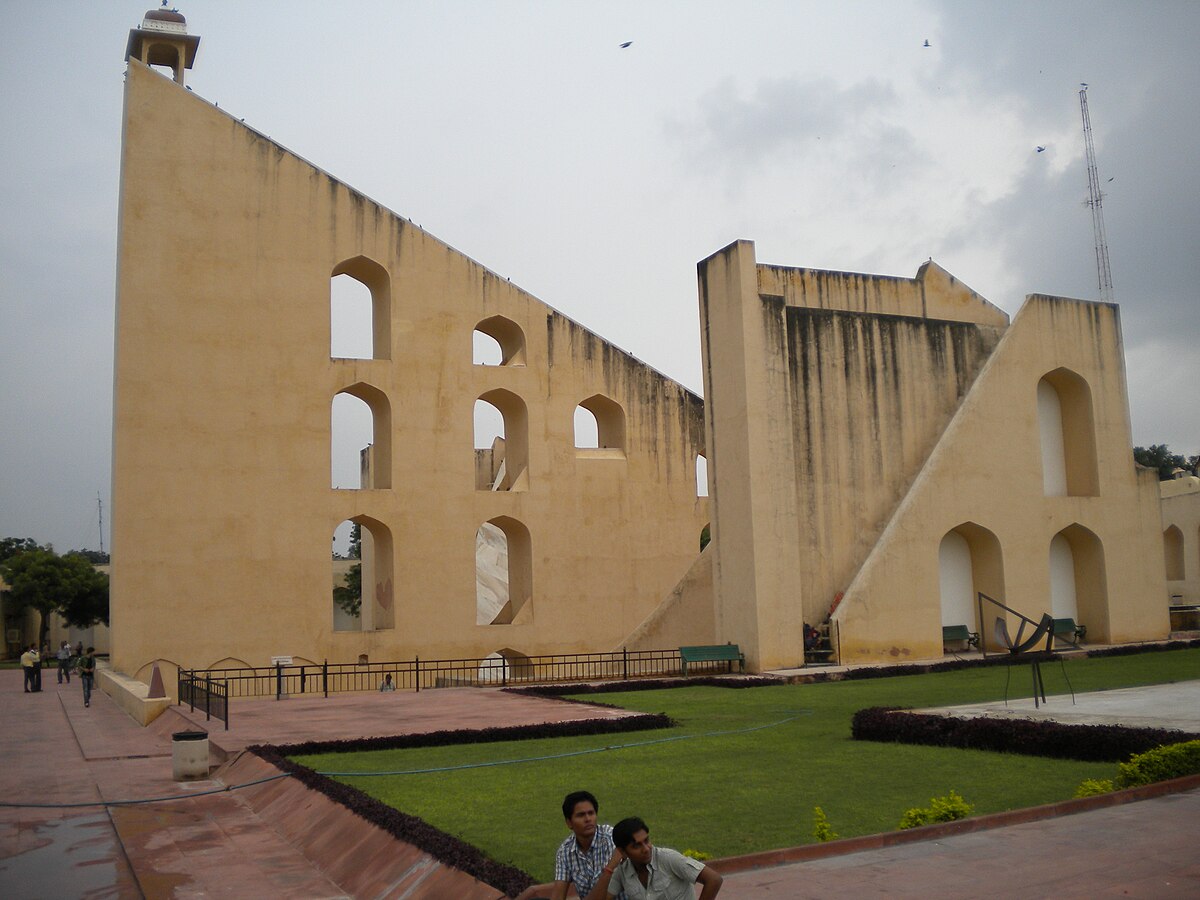
The great observatories (Jantar Mantar) built by Mahārāja Sawai Jai Singh II in the 18th century at Jaipur, Delhi, Ujjain, Varanasi, and Mathura stand as monumental testimony to this tradition. The Samrāṭ Yantra at Jaipur — the world’s largest stone sundial — can read local time to an accuracy of about two seconds.
Living Tradition
The Pañcāṅga is not a relic of the past. In homes across India and the diaspora, families consult printed or digital pañcāṅgas daily to determine auspicious times for prayers, fasts, and ceremonies. Temple priests rely on it to schedule pūjā and festival observances. Astrologers use it to cast horoscopes and recommend muhūrtas.
In this way, the Hindu calendar is far more than a system of timekeeping. It is a spiritual discipline — a constant reminder that every moment is embedded in cosmic rhythms, that time itself is a manifestation of the Divine, and that aligning one’s actions with these sacred cycles is a form of worship.