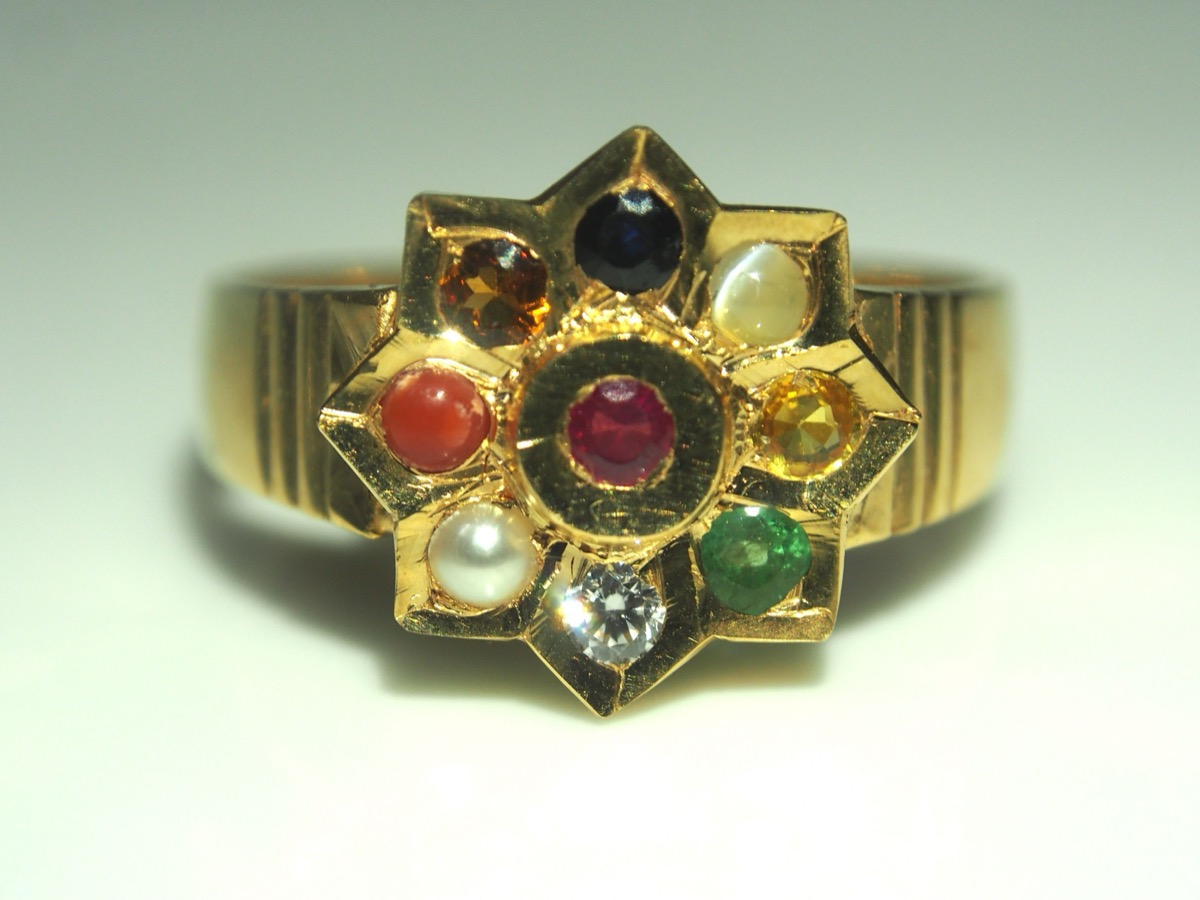
Introduction: Nine Gems, Nine Celestial Powers
The Navaratna (Sanskrit: नवरत्न, nava = nine, ratna = gem) is one of the most enduring and recognizable symbols of Hindu civilization — a set of nine precious gemstones, each corresponding to one of the Navagraha (nine celestial bodies) of Vedic astrology. Far more than mere ornaments, these nine gems represent a cosmological system in which the mineral kingdom is believed to channel and modulate planetary energies that shape human destiny.
The tradition of wearing all nine gems together — typically in a ring, pendant, or armband — is rooted in the conviction that the complete set creates a harmonious shield against all adverse planetary influences simultaneously. As the Garuḍa Purāṇa declares: “Pure, flawless gems have auspicious powers which can protect one from demons, snakes, poisons, diseases, sinful reactions, and other dangers, while flawed stones have the opposite effect” (Garuḍa Purāṇa, Chapter 68, verse 17). This single verse encapsulates the Hindu understanding that gemstones are not inert matter but living conduits of cosmic energy — powerful enough to heal or harm depending on their quality and the knowledge with which they are employed.
The Navaratna tradition spans the full breadth of Hindu intellectual culture: it draws on the Purāṇic mythology of gem origins, the empirical gemology of Varāhamihira’s Bṛhat Saṃhitā, the astrological science of Jyotiṣa, the therapeutic principles of Āyurveda, and the royal symbolism of dharmic kingship. Its influence extends far beyond India, shaping jewelry traditions across Thailand, Myanmar, Sri Lanka, Cambodia, Java, and Bali — wherever Hindu and Buddhist cosmology took root.
Textual Foundations: The Science of Gems in Sanskrit Literature
The Garuḍa Purāṇa: Mythological Origin of Gems
The most celebrated Purāṇic account of gemstone origins appears in the Garuḍa Purāṇa, one of the eighteen Mahāpurāṇas, in its Ratna Parīkṣā (examination of gems) section beginning at Chapter 68. According to this text, gems originated from the body of the demon Vala (also called Bala). When the gods performed a great sacrifice and slew Vala, “the severed limbs and members of his sanctified body were converted into the seeds of gems” (Garuḍa Purāṇa 68.1-4). These seeds scattered across the earth — into oceans, rivers, mountains, and forests — giving rise to the gem mines of the world.
The Garuḍa Purāṇa goes on to identify fourteen categories of gems and describes their qualities, testing methods, and the consequences of wearing flawless or flawed specimens. It prescribes different gem colours for different social classes: a Brāhmaṇa should wear diamonds of conch-shell whiteness, a Kṣatriya diamonds of brownish-yellow hue, a Vaiśya diamonds of tender plantain-leaf green, and kings may wear any colour provided the stone is free of defects (Garuḍa Purāṇa 68.15-20).
The Agni Purāṇa: Royal Gemology
The Agni Purāṇa, another of the eighteen Mahāpurāṇas, addresses gemology in its Chapter 246, titled Ratna Parīkṣā (testing of gems). Here, the Fire-god (Agni) himself identifies fifteen primary gems suitable for kings, including diamond (vajra), emerald (marakata), ruby (padmarāga), pearl (muktā), and sapphire (indranīla). The text establishes quality criteria that remain remarkably relevant: good gems must possess “inward lustre, freedom from impurities, and good formation of shape,” while those with cracks, embedded pebbles, or dull appearance must be avoided (Agni Purāṇa 246.7-8).
The Agni Purāṇa provides specific descriptions for each gem: diamonds must be “unbreakable, impurity-free, hexagonal, with lustre of the rainbow and sun-like brilliance”; emeralds should display “hues of the plumes of a parrot” with “minute particles resembling powdered gold”; rubies must be “extremely red and spotless”; and pearls are valued for “rotundity, whiteness, transparency, and heaviness” (Agni Purāṇa 246.9-20).
Varāhamihira’s Bṛhat Saṃhitā: Empirical Gemology
The systematic codification of gem-planet associations is most clearly established in the Bṛhat Saṃhitā of Varāhamihira (c. 505-587 CE), the great astronomer-astrologer of Ujjain. Chapter 80 of this encyclopedic work, also titled Ratna Parīkṣā, identifies twenty-two to twenty-three varieties of gems but highlights the nine most important — the navaratna — and establishes their planetary correspondences.
Varāhamihira opens with a statement of the stakes involved: “Since a gem endowed with good characteristics ensures good luck, prosperity, and success to kings, and one with bad characteristics brings disaster and misfortune, connoisseurs ought to examine their fortune as depending on gems” (Bṛhat Saṃhitā 80.1-3). This framing — that gemstones are instruments of destiny, not merely decorative objects — is foundational to the entire Hindu gemological tradition.
The Nine Gems and Their Planetary Associations
The canonical Navaratna set pairs each gemstone with a specific Navagraha (planetary deity). The arrangement, standardized by the medieval Jyotiṣa tradition, places the Sun’s gem (ruby) at the centre, with the remaining eight arranged around it:
1. Māṇikya (Ruby) — Sūrya (Sun)
The ruby (māṇikya or padmarāga) occupies the central and most exalted position in the Navaratna arrangement, corresponding to Sūrya, the Sun-god who presides over the soul (ātman), vitality, authority, and fame. The Garuḍa Purāṇa describes the finest rubies as possessing the colour of “pigeon’s blood” or the heart of a lotus flower. In Jyotiṣa, ruby is prescribed for individuals with a weak or afflicted Sun in their horoscope (kuṇḍalī), particularly to strengthen leadership qualities, health, and self-confidence. The ruling deity is Sūrya, and the direction is east.
2. Muktā (Pearl) — Chandra (Moon)
The pearl (muktā or muktāphala, literally “fruit of liberation”) represents Chandra, the Moon-god who governs the mind (manas), emotions, fertility, and maternal instincts. Unlike other gems that are mined from the earth, the pearl is an organic gem formed within a living creature — a fact that the Purāṇas interpret as reflecting the Moon’s intimate connection with biological life. The Agni Purāṇa prizes pearls for “rotundity, whiteness, transparency, and heaviness.” Pearl is recommended for those with a debilitated or afflicted Moon, particularly to calm anxiety, improve emotional stability, and enhance intuition.
3. Vidruma (Red Coral) — Maṅgala (Mars)
Red coral (vidruma or pravāla) corresponds to Maṅgala (Mars), the war-god who governs courage, energy, siblings, and landed property. Coral is unique among the Navaratna as it is neither a mineral crystal nor an organic pearl but the calcified skeleton of marine organisms — a substance the ancients classified as a gem despite its biological origin. Mars being a fiery and assertive planet, red coral is prescribed to strengthen resolve, physical stamina, and protection against accidents and enemies.
4. Marakata (Emerald) — Budha (Mercury)
The emerald (marakata) represents Budha (Mercury), the planet of intelligence, speech, commerce, and learning. Varāhamihira describes the ideal emerald as displaying “hues of the plumes of a parrot” with an inner glow containing “minute particles resembling powdered gold” (Bṛhat Saṃhitā 80). Emerald is the gem prescribed for students, writers, merchants, and anyone whose livelihood depends on communication and analytical thinking. A strong Mercury is considered essential for success in education, diplomacy, and business.
5. Puṣparāga (Yellow Sapphire) — Bṛhaspati (Jupiter)
Yellow sapphire (puṣparāga, literally “flower-coloured”) corresponds to Bṛhaspati (Jupiter), the guru of the gods and the planet of wisdom, dharma, prosperity, and progeny. Jupiter is the most benefic planet in Jyotiṣa, and yellow sapphire is accordingly regarded as the most auspicious of all Navaratna gems. It is prescribed for those seeking spiritual growth, academic achievement, marital harmony, and the blessings of children. Tradition holds that a flawless yellow sapphire worn on the index finger can transform one’s fortune within forty days.
6. Vajra (Diamond) — Śukra (Venus)
The diamond (vajra, also hīra) represents Śukra (Venus), the planet of love, beauty, luxury, artistic expression, and material comforts. The name vajra — meaning “thunderbolt” — connects the diamond to Indra’s weapon, reflecting the stone’s legendary hardness. The Garuḍa Purāṇa devotes extensive attention to diamond evaluation, noting that diamonds must be tested for “shape, colour, defects, and lustre” and that genuine specimens possess “clear prismatic light” free of “scratches, dot-like impressions, marks of crow’s feet, or clouding impurities” (Garuḍa Purāṇa 68.21-25). Diamond is prescribed for those with a weak Venus to enhance romantic relationships, artistic talent, and material prosperity.
7. Nīlam (Blue Sapphire) — Śani (Saturn)
Blue sapphire (nīlam or indranīla, “Indra’s blue”) corresponds to Śani (Saturn), the most feared yet most transformative of the Navagraha. Saturn governs discipline, longevity, karma, suffering, and spiritual detachment. Blue sapphire is considered the most powerful and dangerous of all Navaratna gems — a stone that can either bring spectacular fortune or devastating misfortune depending on its compatibility with the wearer’s horoscope. Traditional Jyotiṣa practice therefore mandates a careful testing period: the gem is first kept under the pillow for three nights, and only if no adverse dreams or events occur is it deemed safe to wear.
8. Gomedha (Hessonite Garnet) — Rāhu
Hessonite garnet (gomedha or gomeda, literally “cow’s fat,” referring to its brownish-yellow colour) represents Rāhu, the north lunar node — a shadow planet (chāyā graha) with no physical body. Rāhu is associated with illusion, obsession, foreign influences, and sudden upheavals. In mythology, Rāhu is the severed head of the demon Svarbhānu who drank the nectar of immortality and now eternally pursues the Sun and Moon, causing eclipses. Hessonite is prescribed for those afflicted by Rāhu’s malefic influences — including confusion, phobias, legal entanglements, and addiction.
9. Vaidūrya (Cat’s Eye Chrysoberyl) — Ketu
Cat’s eye chrysoberyl (vaidūrya or lehsuniyā) represents Ketu, the south lunar node — Rāhu’s counterpart and the tail of the demon Svarbhānu. Ketu governs spirituality, mokṣa (liberation), occult knowledge, and sudden, karmic events. Cat’s eye displays a distinctive chatoyant band of light that moves across its surface — a phenomenon the ancients associated with Ketu’s mysterious, otherworldly nature. The gem is prescribed to counter Ketu’s adverse effects such as anxiety, supernatural disturbances, and obstacles to spiritual progress.
The Navaratna Arrangement and Ritual Practice
Traditional Setting Pattern
The canonical arrangement of the nine gems follows a fixed pattern prescribed in Jyotiṣa texts. The ruby (Sun) always occupies the centre — reflecting the Sun’s position as the king of the planetary system. The remaining eight gems are arranged around it in a specific order that maps the astronomical positions of the planets:
- Top: Diamond (Venus)
- Top-right: Pearl (Moon)
- Right: Red Coral (Mars)
- Bottom-right: Hessonite (Rahu)
- Bottom: Blue Sapphire (Saturn)
- Bottom-left: Cat’s Eye (Ketu)
- Left: Yellow Sapphire (Jupiter)
- Top-left: Emerald (Mercury)
This arrangement is not arbitrary but reflects the spatial logic of Jyotiṣa: the benefic planets (Jupiter, Venus, Mercury, Moon) occupy the cardinal and ordinal positions on one side, while the malefic planets (Saturn, Mars, Rahu, Ketu) occupy the other — with the Sun at the centre mediating all forces.
Jyotiṣa Remedial Measures
In Vedic astrology, gemstones function as upāya (remedial measures) — prescribed by an astrologer (jyotiṣī) after careful analysis of the individual’s birth chart. The operative principle is that each gemstone absorbs and transmits the specific wavelength of cosmic energy associated with its ruling planet. A gem is typically set in a specific metal (gold for benefic planets, silver or mixed alloys for malefic ones), worn on a specific finger, and consecrated on a day and time governed by the relevant planet.
The full Navaratna set, worn as a ring or pendant, is considered a universal talisman because it simultaneously strengthens all nine planetary influences — creating what the tradition calls a graha-śānti (planetary pacification) effect. Unlike single-gem prescriptions, which target specific planetary weaknesses, the Navaratna harmonizes the entire celestial spectrum.
Royal Regalia and Cultural Significance
Indian Royal Traditions
The Navaratna has been integral to Indian royal symbolism for centuries. The navaratna bāzūband (armband) was a standard element of Hindu and Mughal royal regalia, symbolizing the king’s cosmic authority over all nine planetary forces. By wearing the complete set, the king declared himself to be in harmony with the entire celestial order — a living embodiment of dharmic rule.
The Mughal emperors, while Muslim, enthusiastically adopted the Navaratna tradition, incorporating it into their elaborate jewelry and court regalia. Emperor Akbar and Shah Jahan were renowned patrons who commissioned Navaratna pieces combining Persian, Indian, and Central Asian design influences. The tradition transcended religious boundaries — a testament to the Navaratna’s deep integration into South Asian civilization.
The term “Navaratna” also came to denote the nine most brilliant scholars or courtiers at a royal court. The most famous example is the Navaratna of Emperor Vikramāditya’s court at Ujjain, which included the poet Kālidāsa, the astronomer Varāhamihira himself, the physician Dhanvantari, and six other luminaries. Emperor Akbar similarly had his own “Nine Jewels” (Naw Ratan), including Tānsen, Bīrbal, and Toḍar Mal.
Southeast Asian Traditions
The Navaratna tradition spread across Southeast Asia with the expansion of Hindu and Buddhist culture. In Thailand, the Order of the Nine Gems (Noppharat Ratchawaraphon) is the highest order of royal decoration, and Navaratna jewelry is integral to Thai coronation ceremonies. The Thai royal crown incorporates nine gems in the prescribed arrangement, and the tradition has been maintained continuously from the Sukhothai period (13th century) through the present Chakri dynasty.
In Myanmar, Cambodia, Java, and Bali, Navaratna traditions shaped royal regalia, temple consecration rituals, and personal talismanic practice. The prasāda (temple consecration) rituals described in texts like the Kāmikāgama prescribe the burial of nine gems at specific points within the temple foundation — a practice observed in Hindu temple construction to this day.
Āyurvedic and Therapeutic Dimensions
The use of gemstones in Hindu healing traditions extends beyond astrological remedy into Āyurveda and the allied science of Ratna Cikitsā (gem therapy). The Rasa Ratna Samuccaya, a medieval text on Āyurvedic pharmacology, describes the preparation of bhasma (calcined ash) from various gems for medicinal use. Pearl bhasma (muktā bhasma) is used to treat digestive disorders and to improve calcium absorption; coral bhasma (pravāla bhasma) is prescribed for bone weakness; and diamond bhasma (vajra bhasma) — prepared through an elaborate process of purification and calcination — is used in the treatment of chronic diseases.
Modern Āyurvedic practitioners continue to prepare and prescribe gem bhasmas, though the tradition is controversial from a scientific standpoint. What is not in doubt is the deep historical integration of gemstone knowledge into the Hindu medical tradition — a fact that underscores the comprehensiveness of the ancient Indian understanding of minerals.
Scientific and Cultural Perspectives
From a modern mineralogical standpoint, the nine gems of the Navaratna span a remarkable range of mineral families: corundum (ruby and sapphire), beryl (emerald), diamond (pure carbon), garnet (hessonite), chrysoberyl (cat’s eye), calcium carbonate (coral and pearl). The ancients’ ability to identify, classify, and distinguish these minerals — centuries before modern chemistry — is itself a testament to the sophistication of Hindu gemological knowledge.
The colour-planet associations of the Navaratna show a consistent internal logic: the ruby’s deep red corresponds to the Sun’s fiery energy; the pearl’s cool white to the Moon’s silvery light; coral’s red to Mars’s martial fire; emerald’s green to Mercury’s youthful vitality; yellow sapphire’s gold to Jupiter’s regal wisdom; diamond’s brilliant clarity to Venus’s aesthetic perfection; blue sapphire’s deep indigo to Saturn’s solemn gravity; hessonite’s smoky brown to Rahu’s shadowy nature; and cat’s eye’s mysterious chatoyance to Ketu’s otherworldly energy.
Whether one accepts the astrological premises or not, the Navaratna system represents an extraordinary synthesis of empirical observation, cosmological theory, and aesthetic sensibility. It is a tradition that has adorned kings and commoners, consecrated temples, healed the sick, and connected the human realm to the celestial order for over two millennia — a living testament to Hinduism’s vision of a cosmos in which every level of reality, from the subtlest planetary vibration to the densest mineral crystal, is woven into a single, interconnected whole.
Conclusion: The Living Tradition
The Navaratna tradition remains vibrantly alive in contemporary Hindu practice. Navaratna rings and pendants are among the most popular items in Indian jewelry, worn both as astrological remedies and as cultural statements. Jyotiṣa consultations routinely prescribe specific gems, and the gemstone industry in cities like Jaipur — India’s historic gem-cutting capital — continues to serve a vast domestic and international market.
Yet the deepest significance of the Navaratna lies not in its commercial value but in the worldview it embodies: a cosmos in which the heavens and the earth are not separate realms but a continuous field of energy, where the light of distant planets finds its echo in the lustre of earthly stones, and where the wearing of nine gems is an act not merely of adornment but of alignment with the cosmic order itself. As the Garuḍa Purāṇa reminds us, “Pure, flawless gems have auspicious powers” — and in the Hindu understanding, that auspiciousness flows from the fundamental unity of all creation.