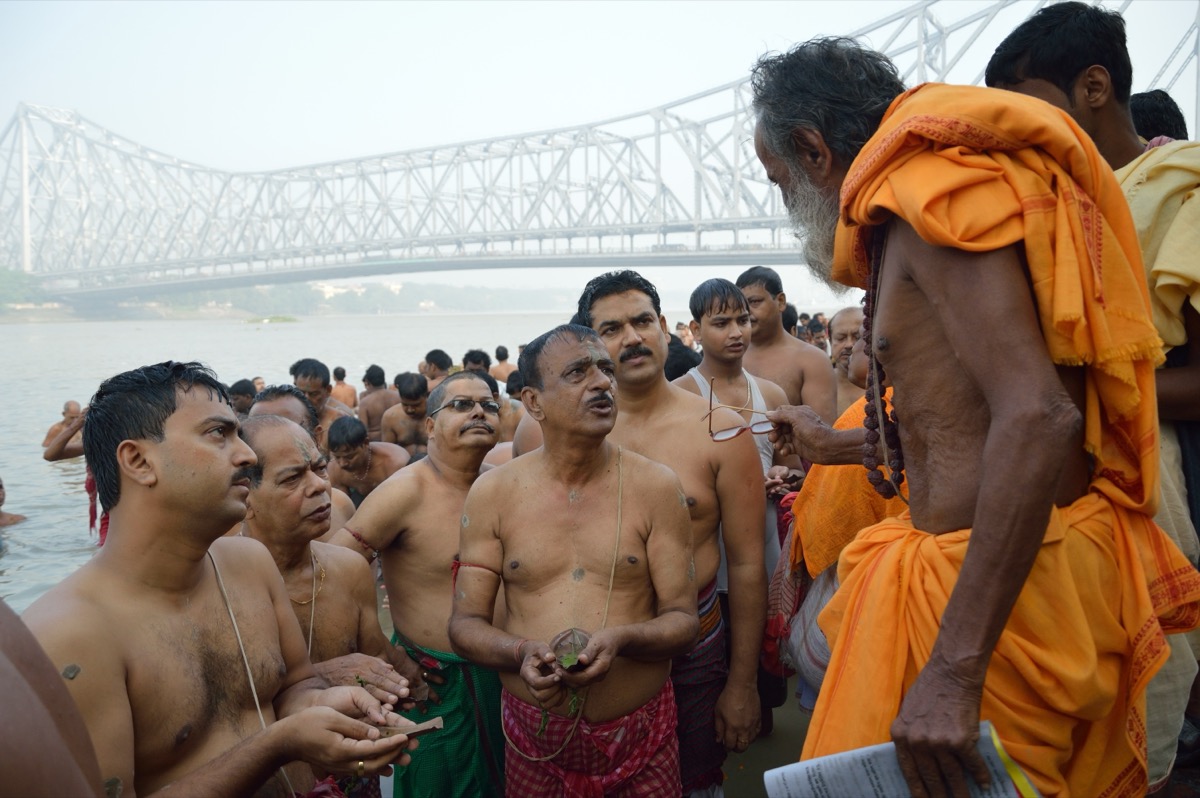
Pitṛ Pakṣa (पितृ पक्ष, literally “fortnight of the ancestors”) is a sixteen-day lunar period in the Hindu calendar during which Hindus pay homage to their departed ancestors (pitṛs) through elaborate ritual offerings known as Śrāddha (श्राद्ध). Falling during the dark fortnight (kṛṣṇa pakṣa) of the month of Āśvina (September-October), this period is considered the most auspicious time of the entire year for performing ancestral rites. The observance rests on a profound theological conviction: that the living bear a sacred debt (pitṛ ṛṇa) to their forebears, and that the well-being of departed souls in the afterlife depends directly upon the rituals performed by their descendants on earth.
Unlike most Hindu festivals that celebrate divine play, cosmic victory, or seasonal renewal, Pitṛ Pakṣa is a solemn, introspective period. No new ventures are begun, no weddings are celebrated, and no joyous ceremonies are undertaken. The entire fortnight is devoted to remembrance, gratitude, and the spiritual nourishment of those who have passed beyond the threshold of death.
The Legend of Karṇa: Why Gold Cannot Feed the Dead
The origin of Pitṛ Pakṣa is most commonly traced to the story of Karṇa from the Mahābhārata. Karṇa, the legendary warrior and son of Sūrya (the Sun God), was renowned throughout his life for extraordinary generosity — he never turned away anyone who asked for a gift, famously giving away even his divine armour (kavaca) and earrings (kuṇḍala) to Indra. However, despite his unmatched charitable nature, Karṇa had one critical oversight: he had never offered food or water to his ancestors through Śrāddha rituals.
When Karṇa died in the great war at Kurukṣetra and ascended to Svarga (heaven), he found that instead of food, he was served gold and jewels on plates. Bewildered and hungry, Karṇa approached Indra, the king of the gods, and asked why he could not eat. Indra explained that while Karṇa had donated immense wealth — gold, cattle, land — throughout his earthly life, he had never once performed anna dāna (the gift of food) to his pitṛs. In heaven, one receives the fruits of one’s earthly actions, and since Karṇa had given only material wealth, material wealth alone was returned to him.
Moved by Karṇa’s plight, Indra (in some versions, Yama, the god of death) granted him a period of fifteen days to return to earth and perform the Śrāddha rites he had neglected. Karṇa descended to the mortal world and offered piṇḍas (rice balls), water, and food to his ancestors with great devotion. This fifteen-day period of atonement became the basis for Pitṛ Pakṣa, and the tradition has been observed by Hindus ever since. The story carries a powerful moral: no amount of material generosity can substitute for the sacred duty of feeding one’s ancestors — the gift of food (anna dāna) transcends even the gift of gold.
Timing: The Āśvina Kṛṣṇa Pakṣa
Pitṛ Pakṣa occupies the dark fortnight (waning moon) of the Hindu month Āśvina (called Kunya or Bhādrapada in some regional calendars), typically falling in September or October. The period begins on the full moon day (pūrṇimā) following the bright fortnight and extends through sixteen lunar days (tithis) to the new moon day (amāvasyā). This final day — Mahālayā Amāvasyā (also called Sarvapitṛ Amāvasyā) — is the most sacred day of the entire fortnight and holds special significance in both North and South Indian traditions.
The choice of the dark fortnight is theologically significant. The waning moon symbolizes the descent into darkness, mirroring the journey of the soul after death. The decreasing light represents the transition from the visible world of the living to the invisible realm of the ancestors. In Vedic cosmology, the Pitṛyāna (“path of the ancestors”) is associated with the moon, darkness, and the southern direction — all of which converge during Pitṛ Pakṣa.
Each of the sixteen tithis corresponds to a specific category of ancestor. Devotees perform Śrāddha on the particular tithi that matches the lunar day of death (tithi) of the ancestor being honoured. For example, if a father died on the dvitīyā (second day) of any lunar fortnight, his Śrāddha is performed on the dvitīyā of Pitṛ Pakṣa. Those who do not know the exact tithi of a relative’s death, or who wish to honour all ancestors collectively, perform rites on Mahālayā Amāvasyā, which covers all categories.
The Three Classes of Pitṛs
Hindu scriptures, particularly the Manu Smṛti (3.194-199) and the Vāyu Purāṇa, describe a hierarchical classification of Pitṛs into distinct orders. The Pitṛs are not merely deceased human relatives — they are elevated spiritual beings who inhabit a specific cosmic realm. The tradition identifies two broad categories:
Incorporeal (Amūrtā) Pitṛs — The Divine Ancestors
These are exalted beings who serve as archetypal ancestors of the gods themselves:
-
Agniṣvāttāḥ (अग्निष्वात्ताः) — “Tasted by fire.” These are the Pitṛs of the Devas (gods). They are said to have maintained the sacrificial fire during their lifetimes and are the most elevated class. The Manu Smṛti identifies them as the ancestors of the gods.
-
Barhiṣadaḥ (बर्हिषदः) — “Seated on the sacred grass.” These Pitṛs are associated with the kuśa grass used in Vedic rituals. They are the ancestors of the Daityas, Dānavas, Yakṣas, Gandharvas, and other celestial beings.
-
Somapāḥ (सोमपाः) — “Drinkers of Soma.” These are the Pitṛs of the Brāhmaṇas, who partook of the sacred Soma juice in Vedic sacrifices.
Corporeal (Mūrtā) Pitṛs — The Human Ancestors
These are the more immediate ancestors — the deceased parents, grandparents, and great-grandparents of living families. According to the Garuḍa Purāṇa and the Mārkaṇḍeya Purāṇa, the souls of the three preceding generations of one’s family reside in Pitṛ Loka — a distinct cosmic realm situated between heaven (svarga) and earth (bhūloka). It is specifically these three generations — father (pitā), grandfather (pitāmaha), and great-grandfather (prapitāmaha) — who are the primary recipients of Śrāddha offerings.
In the Śrāddha ritual, the fire god Agni serves a dual role: in divine worship (deva yajña), he is called Havyavāhana (“carrier of oblations to the gods”), while in ancestral rites (pitṛ yajña), he becomes Kavyavāhana (“carrier of oblations to the Pitṛs”). This distinction underscores that ancestor worship operates through its own sacred channels, parallel to but distinct from worship of the gods.
The Concept of Pitṛ Loka
Pitṛ Loka (पितृ लोक) is the intermediate realm where the souls of the recently deceased reside before they either ascend to higher realms or return to the cycle of rebirth. The Garuḍa Purāṇa (chapters 10-15) provides the most detailed description of this realm and the journey of the soul after death.
According to this text, when a person dies, the soul (jīva) embarks on a year-long journey through various intermediate states. During this period, the soul is sustained entirely by the offerings made by its living descendants. The monthly Śrāddha ceremonies performed during the first year after death are believed to gradually construct a new subtle body (sūkṣma śarīra) for the departed soul, with each monthly offering forming a different body part — the first month creating the head, the second the neck and shoulders, and so on through twelve months.
Once this subtle body is complete, the soul enters Pitṛ Loka, where it resides for the remainder of its sojourn between lives. The annual Śrāddha performed during Pitṛ Pakṣa is believed to provide nourishment and comfort to these souls. The Garuḍa Purāṇa explicitly warns that neglecting Śrāddha causes the ancestors to suffer hunger and thirst in Pitṛ Loka, and that the resulting ancestral displeasure — known as Pitṛ Doṣa — can bring misfortune, illness, and obstacles to the living family.
Śrāddha Rituals: Piṇḍa Dāna and Tarpaṇa
The two central ritual acts of Śrāddha are Piṇḍa Dāna (the offering of rice balls) and Tarpaṇa (the offering of water).
Piṇḍa Dāna (पिण्ड दान)
Piṇḍa literally means “a lump” or “a ball.” In the Śrāddha context, piṇḍas are balls made from cooked rice mixed with black sesame seeds (tila), barley flour, ghee (clarified butter), and honey. These piṇḍas symbolize the physical body of the deceased ancestor. The act of offering them represents the nourishment of the ancestor’s subtle form in Pitṛ Loka.
The ritual is typically performed at noon, considered the most auspicious time for ancestral rites. The performer (usually the eldest son or a male member of the paternal line) faces south — the direction associated with Yama, the lord of death, and with the Pitṛyāna. Three piṇḍas are offered, one each for the father, grandfather, and great-grandfather. The piṇḍas are placed on darbha (kuśa) grass, and mantras from the Ṛg Veda and Yajur Veda are recited during the offering.
Tarpaṇa (तर्पण)
Tarpaṇa derives from the Sanskrit root tṛp (“to satisfy” or “to satiate”). It involves offering water mixed with black sesame seeds, barley, and kuśa grass tips while reciting the names and lineage (gotra) of the ancestors. The water is released from the cupped right hand, flowing over the tips of the fingers (specifically between the thumb and index finger, the region called Pitṛ Tīrtha on the hand).
The performer recites: “I offer this water to [name], of [gotra] lineage, who has departed. May this satiate them.” Tarpaṇa is believed to quench the thirst of departed souls and carry the spiritual essence of the offering across the boundary between the living and the dead.
Sacred Foods and Offerings
The foods used in Śrāddha are carefully prescribed by the Dharmaśāstras:
- Tila (तिल, black sesame seeds) — Considered the most sacred ingredient in Śrāddha. The Garuḍa Purāṇa states that sesame seeds have the power to purify and protect against negative forces. They are mixed into piṇḍas, scattered during tarpaṇa, and used to sanctify the ritual space.
- Khīr (खीर, rice pudding cooked with milk and sugar) — One of the most favoured offerings, representing sweetness and nourishment.
- Rice (anna) — The primary ingredient of piṇḍas, symbolizing sustenance.
- Ghee (ghṛta) — Clarified butter, the quintessential Vedic offering.
- Urad dāl (black gram) — Commonly prepared during Pitṛ Pakṣa and offered to ancestors.
- Barley (yava) — An ancient Vedic grain with purificatory significance.
Certain foods are prohibited during Śrāddha: masoor dāl (red lentils), chana dāl (chickpeas), onion, garlic, and certain gourds are avoided as they are considered tāmasic (spiritually dulling) and unsuitable for ancestral offerings.
Brāhmaṇa Bhojana: Feeding the Learned
A crucial component of Śrāddha is Brāhmaṇa bhojana — the feeding of Brāhmaṇas (learned priests). The Dharmaśāstras prescribe that after the piṇḍa offering, the performer must invite an odd number of Brāhmaṇas (typically one or three) and serve them a full meal. The theological reasoning is that the Brāhmaṇas serve as living vessels through whom the food reaches the ancestors. The Manu Smṛti (3.189) states that the ancestors are “satisfied for one month” by a properly conducted Śrāddha with Brāhmaṇa feeding.
The Brāhmaṇas must be treated with utmost respect — they are seated facing south, served on plantain leaves or metal plates, and given dakṣiṇā (monetary offering) along with the meal. The food served to them is considered to be directly consumed by the Pitṛs in their subtle realm.
Gayā: The Supreme Tīrtha for Śrāddha
Gayā in Bihar is considered the holiest site in all of Hinduism for performing Śrāddha and Piṇḍa Dāna. The Vāyu Purāṇa (chapters 105-112) devotes extensive sections to the glory of Gayā as the pre-eminent pitṛ tīrtha (pilgrimage site for ancestral rites). According to the Purāṇic narrative, Gayā is where Lord Viṣṇu himself resides as Gadādhara (the mace-bearer) at the Viṣṇupada Temple, and where he is worshipped specifically as Pitṛ Devatā — the deity of the ancestors.
The mythology relates that a demon named Gayāsura performed such intense austerities that his body became supremely pure. Lord Viṣṇu placed his foot upon Gayāsura’s body to hold him in place, and the spot became the Viṣṇupada (“footprint of Viṣṇu”). The Vāyu Purāṇa declares that performing Piṇḍa Dāna at Gayā liberates not merely one’s immediate ancestors but seven generations on the paternal side and, according to some texts, up to twenty-one or even one hundred and one generations on both paternal and maternal sides.
During Pitṛ Pakṣa, Gayā attracts hundreds of thousands of pilgrims from across India who come specifically to perform the Śrāddha rites at the Viṣṇupada Temple and along the banks of the Phalgu River. The Gayā Śrāddha involves performing piṇḍa dāna at multiple sacred spots (vedīs) within the temple complex and along the river, often over several days.
Other Sacred Sites for Śrāddha
While Gayā holds the supreme position, several other sacred sites are renowned for Śrāddha:
- Vārāṇasī (Kāśī) — Performing Śrāddha at the ghats of the Gaṅgā in Vārāṇasī, especially at Maṇikarṇikā Ghāt and Daśāśvamedha Ghāt, is considered highly efficacious.
- Prayāgrāj (the confluence of Gaṅgā, Yamunā, and the invisible Sarasvatī) — The Trivēṇī Saṅgama is a powerful site for tarpaṇa and piṇḍa dāna.
- Rāmeśvaram — The southernmost of the four dhāmas, where Śrī Rāma himself is said to have performed Śrāddha for his father Daśaratha.
- Haridvār — At Hari-kī-Pauṛī, the sacred steps where the Gaṅgā enters the plains.
- Kurukṣetra — During a solar eclipse, Śrāddha performed here is considered equivalent to that performed at Gayā.
Mahālayā Amāvasyā: The Most Sacred Day
Mahālayā Amāvasyā (also called Sarvapitṛ Amāvasyā) is the new moon day that concludes Pitṛ Pakṣa, and it is the single most important day for ancestral rites in the Hindu calendar. The word mahālaya means “the great dissolution” or “the great resting place,” signifying the moment when the boundary between the world of the living and the realm of the ancestors is thinnest.
On this day, Śrāddha can be performed for all ancestors regardless of their tithi of death, making it the universal day of ancestral remembrance. Those who could not perform rites on the specific tithi of their ancestor’s death, or those who do not know the death tithi, consider Mahālayā Amāvasyā their primary observance. In Bengal, Mahālayā holds particular cultural significance — it marks the end of Pitṛ Pakṣa and the beginning of Devī Pakṣa, the bright fortnight leading to Durgā Pūjā. Early-morning radio broadcasts of the Mahālayā programme — Birendra Krishna Bhadra’s iconic recitation of the Caṇḍī — have been a beloved Bengali tradition since 1931.
Restrictions During Pitṛ Pakṣa
Pitṛ Pakṣa is governed by a set of prohibitions (niṣedha) that reflect its solemn, introspective character:
- No new beginnings: Starting a new business, buying property, entering a new home, or beginning a new project is strictly avoided.
- No weddings or engagements: Marriages are never scheduled during this period.
- No auspicious ceremonies: Naming ceremonies (nāmakaraṇa), sacred thread ceremonies (upanayana), and house-warming ceremonies (gṛha praveśa) are postponed.
- No consumption of non-vegetarian food: Strict vegetarianism is observed throughout the fortnight.
- No cutting of hair or nails: Some traditions observe this restriction, particularly on the specific tithi when Śrāddha is performed.
- No purchase of new items: Buying new clothes, jewellery, or major goods is discouraged.
These restrictions stem from the belief that the period is governed by the energy of the ancestors, and the vibrations of joy, celebration, or material acquisition are incompatible with the solemn purpose of ancestral appeasement.
Garuḍa Purāṇa: The Scriptural Foundation
The Garuḍa Purāṇa, a Vaiṣṇava text narrated as a dialogue between Lord Viṣṇu and his vehicle Garuḍa (the divine eagle), is the primary scriptural authority on death, the afterlife, and Śrāddha rites. Its second section, the Pretakhaṇḍa (“Section on the Departed”), provides detailed descriptions of:
- The journey of the soul after death through the realm of Yama
- The construction of the subtle body through monthly Śrāddha
- The specific mantras, offerings, and procedures for Śrāddha
- The consequences of neglecting ancestral rites (Pitṛ Doṣa)
- The cosmic hierarchy of Pitṛ Loka
The text states (Garuḍa Purāṇa, Pretakhaṇḍa 10.56-58): “He who performs Śrāddha with devotion, using sesame seeds, kuśa grass, and water, brings satisfaction to his ancestors for a full year. But he who neglects the Śrāddha condemns his forebears to wander in hunger and thirst.”
Other key texts on Śrāddha include the Manu Smṛti (chapter 3), the Vāyu Purāṇa, the Viṣṇu Purāṇa, the Padma Purāṇa, and the Mārkaṇḍeya Purāṇa — each offering complementary perspectives on the rituals, their timing, and their spiritual efficacy.
Ancestor Veneration in Comparative Perspective
The Hindu practice of Pitṛ Pakṣa and Śrāddha belongs to a widespread human tradition of ancestor worship found across cultures:
- Chinese Qīngmíng Festival (清明节, “Tomb Sweeping Day”) — Families clean ancestral graves and offer food, paper money, and incense. Like Pitṛ Pakṣa, it occurs at a specific calendrical period and involves offerings to three generations of ancestors.
- Japanese Obon (お盆) — A Buddhist festival when spirits of ancestors return to visit the living. Families prepare food offerings, light lanterns, and perform ritual dances (bon odori) — strikingly parallel to the Hindu belief that ancestors descend to the earthly plane during Pitṛ Pakṣa.
- Mexican Día de los Muertos — Families create ofrendas (altars) with the favourite foods and belongings of the deceased, believing the spirits return to enjoy them — a concept remarkably similar to the Hindu piṇḍa offering.
- Roman Parentalia — An ancient nine-day Roman festival (February 13-21) honouring deceased ancestors with food offerings at tombs, during which temples were closed and marriages forbidden — closely mirroring the restrictions of Pitṛ Pakṣa.
What distinguishes the Hindu tradition is its elaborate scriptural foundation, the cosmic geography of Pitṛ Loka, and the systematic ritual technology of piṇḍa and tarpaṇa that claims to directly nourish the subtle bodies of the departed.
Living Significance
Pitṛ Pakṣa remains one of the most widely observed ritual periods in contemporary Hinduism, transcending regional, caste, and sectarian boundaries. While modern urban life has simplified many of the elaborate Dharmaśāstra prescriptions, the core practices — performing tarpaṇa at a river or water body, offering piṇḍas, feeding Brāhmaṇas or the poor, and avoiding auspicious events — continue to be observed by millions.
The underlying philosophy of Pitṛ Pakṣa speaks to something deeper than ritual obligation: it affirms the continuity of relationship beyond death, the ethical principle that we owe a debt to those who came before us, and the recognition that the living and the dead remain bound in an unbroken web of reciprocal care. In the words of the Taittirīya Upaniṣad (1.11.2): “Mātṛ devo bhava, Pitṛ devo bhava” — “Let your mother be a god to you, let your father be a god to you.” Pitṛ Pakṣa extends this reverence beyond the boundary of death itself, honouring parents and ancestors as divine presences whose blessings continue to shape the destiny of the living.