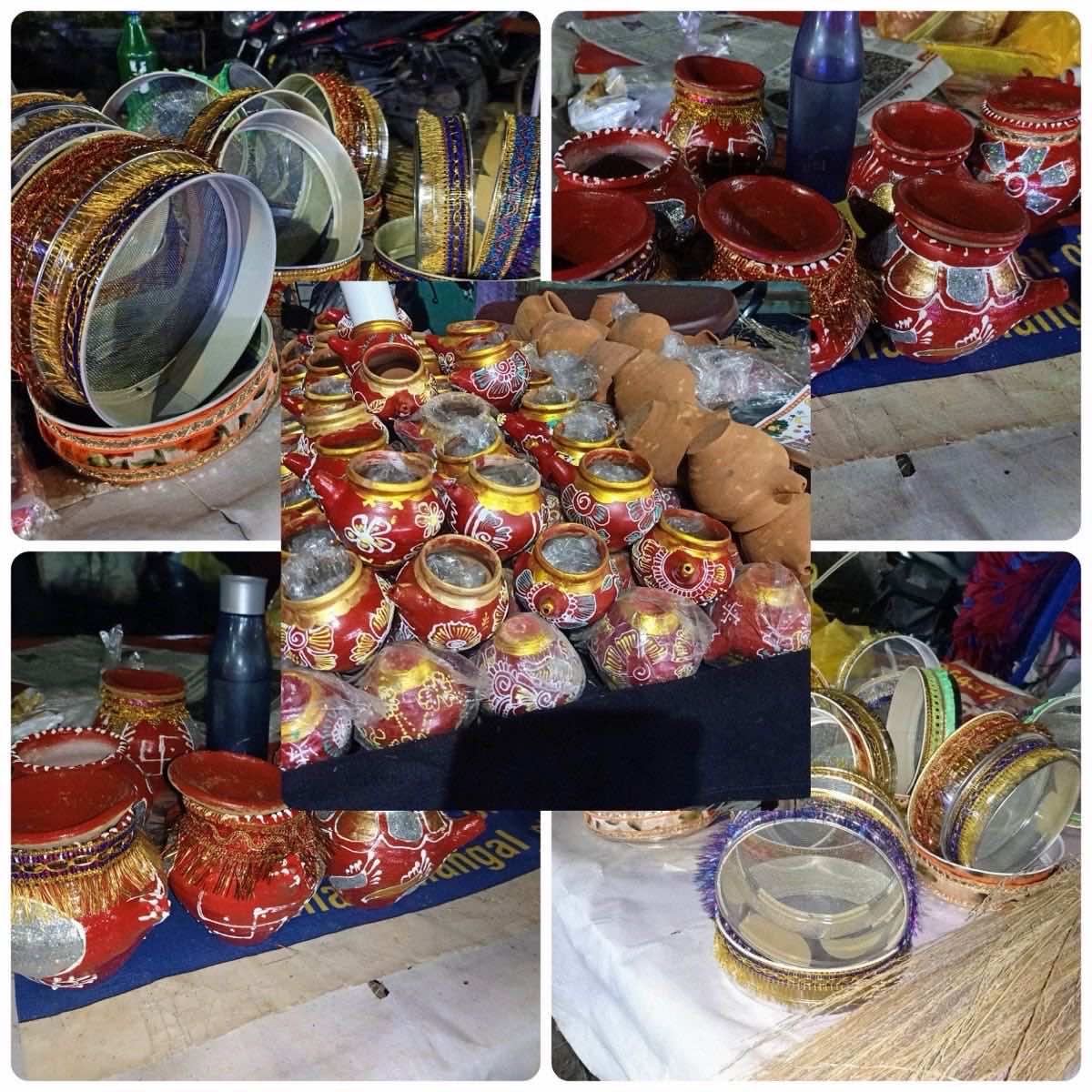
Karva Chauth (करवा चौथ) is one of the most beloved and widely observed fasting festivals in North Indian Hindu tradition. Celebrated on the Kṛṣṇa Pakṣa Chatuthī (fourth day of the waning moon) in the Hindu month of Kārtik (October–November), it is a day-long nirjalā vrata (waterless fast) observed by married women (suhāginīs) for the longevity, prosperity, and well-being of their husbands. The fast begins before sunrise and is broken only after sighting the moon at night — a ritual framework that weaves together elements of moon worship, marital devotion, and the profound Hindu theology of vrata (sacred vow) as a transformative spiritual discipline.
Etymology and Components
The name Karva Chauth combines two terms: karva (करवा), an earthen pot with a spout used in the ritual, and chauth (चौथ), derived from Sanskrit chatuthī — the fourth day of the lunar fortnight. The karva is not merely a vessel but a sacred ritual object: it symbolizes the fullness of married life, the containment and distribution of blessings, and the wife’s role as the gṛhiṇī (mistress of the household) who sustains the family through her devotion and tapas (spiritual austerity).
The practice of fasting on a chatuthī connects Karva Chauth to the broader tradition of Chatuthī vratas in Hinduism, many of which are associated with Gaṇeśa (the remover of obstacles) and Chandra (the Moon God). The specific association with marital well-being, however, is distinctive to Karva Chauth and is grounded in narratives from the Mahābhārata and Purāṇic literature.
The Savitri-Satyavan Connection
The foundational mythological narrative underlying Karva Chauth is the story of Sāvitrī and Satyavān, told in the Mahābhārata (Vana Parva, chapters 293–299). Princess Sāvitrī, daughter of King Aśvapati, chose to marry Satyavān despite knowing — through the sage Nārada’s prophecy — that her husband was destined to die exactly one year after their marriage.
When the fateful day arrived, Sāvitrī accompanied Satyavān into the forest. As he collapsed while chopping wood, Yama, the god of death, appeared to claim his soul. Sāvitrī followed Yama as he carried Satyavān’s soul southward, engaging the god of death in a remarkable philosophical dialogue. Impressed by her wisdom, devotion, and the power of her pativratā dharma (devotion to her husband), Yama offered her boons — any wish except her husband’s life. Through her cleverness, Sāvitrī asked for sons by Satyavān, compelling Yama to release her husband to fulfil the boon.
The Mahābhārata (Vana Parva 297.63) records Yama’s final words: “bhadre gaccha vinivarta dharmajñe sādhu-sammata / prīto ‘smi tava dharmajñe nivarta bhadram astu te” — “Go, noble one, turn back; O knower of dharma, approved by the righteous, I am pleased with you; turn back, may it be well with you.” Sāvitrī’s triumph over death through the power of marital devotion and spiritual discipline establishes the paradigmatic model for the Karva Chauth vrata.
The Karvā Chauth Kathā
Central to the Karva Chauth observance is the kathā (ritual narrative) recited during the evening pūjā. The most popular version tells the story of Queen Vīrāvatī, the beautiful and devoted wife of a king. Vīrāvatī observed the Karva Chauth fast with great sincerity, but her seven brothers, unable to bear seeing their sister’s suffering from hunger and thirst, devised a trick. They lit a fire behind a tree and told her it was the rising moon. Vīrāvatī broke her fast prematurely, and her husband immediately fell gravely ill.
Realizing the deception, Vīrāvatī undertook severe tapas, fasting and praying with absolute devotion for an entire year. Her austerity pleased the goddess Pārvatī (in some versions, Śivā or the celestial wives), who revealed the truth and instructed Vīrāvatī to observe Karva Chauth again with proper ritual discipline. When Vīrāvatī performed the vrata correctly — breaking her fast only after sighting the actual moon — her husband recovered completely.
The kathā teaches several theological principles: the power of vrata (sacred vow) as a form of tapas; the danger of spiritual shortcuts and deception; the necessity of completing a vow with proper vidhi (ritual procedure); and the compassion of the divine feminine (Devī) toward devoted wives.
The Ritual Sequence
Pre-Dawn: Sargi
The Karva Chauth fast traditionally begins with the pre-dawn meal called sargi (सरगी), prepared and sent by the mother-in-law. Sargi is consumed before the first light of dawn (aruṇodaya) and typically includes pheniyan (vermicelli cooked in milk), mathri (savory fried pastries), fresh fruits, nuts, sweets, and a special dish of sēviyān (sweetened vermicelli). The sargi is much more than a practical pre-fast meal — it is a ritual gift that embodies the mother-in-law’s blessings upon her daughter-in-law and symbolizes the harmony of the extended family (saṃyukta parivāra).
The Day-Long Fast
After consuming sargi, the fasting woman observes a complete nirjalā vrata — neither eating food nor drinking water for the entire day until moonrise. This extreme form of fasting is understood as tapas (spiritual austerity) whose merit (puṇya) is transferred to the husband, protecting him from illness, misfortune, and untimely death.
The Devī Bhāgavata Purāṇa (9.1) describes the power of feminine tapas: a devoted wife’s austerity generates a spiritual force capable of altering destiny (prārabdha karma) itself. The nirjalā fast of Karva Chauth is thus not mere deprivation but a conscious act of spiritual power — a wife’s voluntary suffering that creates a field of divine protection around her husband.
During the day, fasting women typically gather in groups to apply mehndī (henna designs) on their hands, dress in their finest clothes and jewellery (especially red and gold — the colours of saubhāgya, the auspicious married state), and share songs and stories related to the festival.
Evening Pūjā
As evening approaches, women gather in a communal space — a courtyard, a temple, or an elder’s home — for the pūjā ceremony. A senior woman (often the mother-in-law or the eldest married woman) leads the ritual:
-
Gauri (Pārvatī) worship: A clay or metal image of Goddess Gaurī (Pārvatī as the ideal wife) is installed and worshipped with flowers, kumkum, turmeric, and rice.
-
Karva arrangement: Each woman arranges her karva (earthen pot) filled with water, decorated with kumkum and mehndī, and placed before the Gaurī image along with offerings of sweets and fruits.
-
Kathā recitation: The Karvā Chauth kathā is recited. Women pass their karvas in a circle (phernī) as the narrative unfolds — seven rounds for each section of the story.
-
The vow: At the conclusion of the kathā, women pray for the seven lifetimes of unbroken saubhāgya (auspicious married state) — a vow that extends the spiritual bond of marriage beyond the present life into the cycle of future births.
Moonrise: Breaking the Fast
The emotional climax of Karva Chauth arrives with the rising of the moon. Women eagerly watch the eastern horizon, and the moment the moon appears, a specific ritual sequence is performed:
-
The woman offers arghya (water offering) to the moon, pouring water from the karva while reciting prayers to Chandra (the Moon God).
-
She views the moon through a chālnī (sieve) — an act symbolizing the filtering of negative energy and the purification of vision. The sieve’s mesh transforms the moonlight into a pattern of blessings that falls upon the fasting woman.
-
She then views her husband’s face through the same sieve — connecting the husband to the divine light of the moon and symbolically seeing him through the lens of sacred devotion.
-
The husband offers the first sip of water and the first morsel of food to his wife, formally breaking the fast. This act of mutual nurturing — the wife’s daylong fast for the husband’s well-being, the husband’s act of feeding his wife — embodies the reciprocal nature of the Hindu marital bond.
Moon Worship in Hindu Tradition
The centrality of Chandra (Moon) worship in Karva Chauth connects the festival to a deep vein of lunar theology in Hinduism. The Ṛg Veda (10.85) — the foundational hymn of the Hindu wedding ceremony — describes the Moon as the bride of the Sun, establishing a cosmic parallel between celestial and human marriage. The Chāndogya Upaniṣad (5.10.4) describes the Moon as the gateway through which souls pass on the path of rebirth (pitṛyāna), connecting lunar worship with ancestral blessings and the continuity of the family lineage.
The Moon is also associated with Soma, the divine nectar mentioned extensively in the Vedas. As Soma-nātha (Lord of Soma), the Moon governs growth, fertility, the tides, and the rhythms of biological life. A wife’s worship of the Moon on Karva Chauth invokes these generative, nurturing energies on behalf of her husband and family.
The Śiva Purāṇa narrates that Chandra was cursed by Dakṣa to wane (for showing partiality among his twenty-seven wives, the nakṣatras), but Śiva placed the Moon on his head, granting him the boon of periodic renewal — the waxing and waning cycle. This narrative connects moon worship with themes of impermanence, renewal, and divine grace that resonate deeply with Karva Chauth’s theology.
Regional Practices Across North India
Punjab and Haryana
In Punjab and Haryana, Karva Chauth is celebrated with maximum fervour. The sargi tradition is especially elaborate, and the mother-in-law’s gift of sargi is considered one of the most important exchanges in the extended family system. Punjabi women dress in their wedding choōṛā (red and white bangles) or new red bangles, and grand community gatherings for the evening pūjā are common. The festival has strong associations with the agricultural communities, where a husband’s health directly impacts the family’s economic survival.
Rajasthan
Rajasthani Karva Chauth traditions include the preparation of special bāyā (gifts) exchanged between married women, and the festival is closely connected to the cult of Sāvitrī, who is venerated as the supreme pativratā. Rajput traditions link the fast to historical accounts of warrior wives whose fasts were believed to protect their husbands in battle.
Uttar Pradesh and Madhya Pradesh
In the Hindi heartland, Karva Chauth is observed alongside related fasts such as Ahoi Aṣṭamī (for the well-being of sons). The evening pūjā often includes the worship of Karvā Mātā — a mother goddess associated specifically with the festival. In many households, the kathā recitation is followed by the exchange of karvas containing money and gifts between women.
Gujarat
In Gujarat, the corresponding fast is known as Karvā Cauth and is observed with similar rituals but with regional variations in the kathā and the specific foods prepared for sargi. Gujarati women often combine the fast with prayers to Gaṇeśa on the chatuthī day.
The Theology of Vrata
Karva Chauth belongs to the vast Hindu tradition of vrata — sacred vows involving fasting, prayer, and ritual observance undertaken for specific spiritual or material ends. The Matsya Purāṇa (chapters 55–101) contains extensive discussions of various vratas, explaining that the spiritual merit (puṇya) generated by a vrata can be transferred to others — a principle that underlies the wife’s fast for her husband’s well-being.
The Dharma-śāstra literature (particularly the Vrata-rāja sections of the Hemādri and Nirṇaya-sindhu) classifies vratas into kāmya (desire-driven) and naimittika (occasion-based) categories. Karva Chauth is a kāmya vrata — undertaken with the specific desire (kāma) for the husband’s longevity. However, the depth of devotion it requires — the willingness to endure physical deprivation for another’s benefit — transforms it from mere desire into genuine tapas.
The Skanda Purāṇa observes that a pativratā (devoted wife) generates spiritual power (tejas) through her devotion that is comparable to the tapas of sages and ascetics. This theology gives Karva Chauth its transformative power: it is not merely a social custom but a spiritual discipline through which a wife participates in the cosmic order by generating protective merit for her husband and family.
Contemporary Dimensions
Karva Chauth has undergone significant cultural evolution in recent decades. Bollywood films — notably Dilwale Dulhania Le Jayenge (1995) and Kabhi Khushi Kabhie Gham (2001) — have popularized the festival far beyond its traditional North Indian heartland, making it an icon of romantic love in modern Indian culture.
This popularization has prompted a spectrum of responses. Many modern couples have reinterpreted the festival: husbands now frequently fast alongside their wives, transforming the vrata from a one-sided act of wifely devotion into a mutual expression of marital commitment. Some feminist scholars critique the festival’s traditional framework as reinforcing patriarchal structures, while others argue that the voluntary assumption of tapas represents a form of spiritual agency and power that is distinctly feminine.
What remains constant across these contemporary debates is the festival’s core teaching: that love, expressed through voluntary sacrifice and spiritual discipline, generates a force capable of transcending the ordinary boundaries of human existence. Whether understood traditionally as a wife’s dharma or reinterpreted as a mutual celebration of marital love, Karva Chauth affirms the Hindu conviction that human relationships, when consecrated through ritual and devotion, participate in the eternal dance of the divine.
The Bṛhadāraṇyaka Upaniṣad (4.5.6) teaches: “na vā are patyuḥ kāmāya patiḥ priyo bhavati, ātmanastu kāmāya patiḥ priyo bhavati” — “It is not for the husband’s sake that the husband is dear, but for the sake of the Self that the husband is dear.” The deepest reading of Karva Chauth thus suggests that the love a wife expresses through her fast is ultimately a recognition of the Ātman (Supreme Self) in her partner — a perception that transforms ordinary domestic life into a field of spiritual realization.