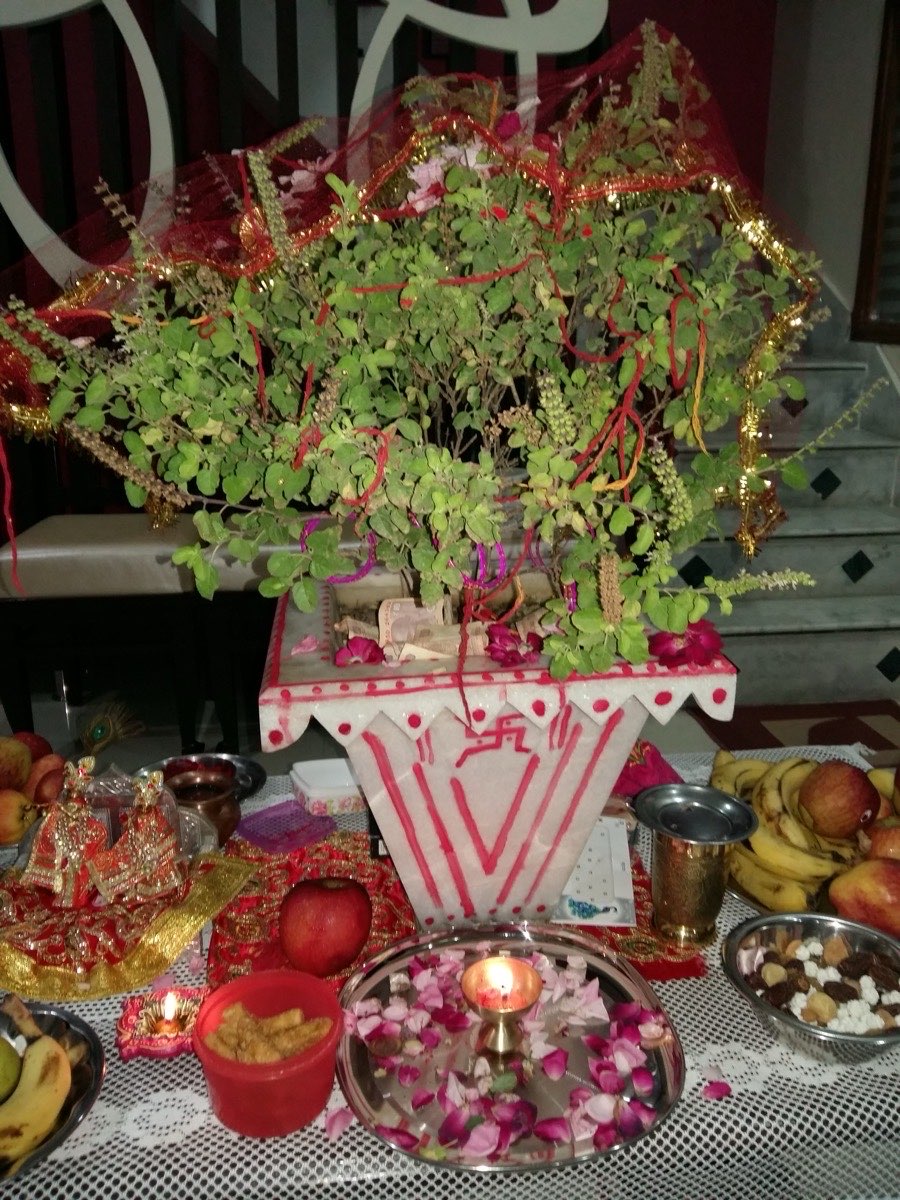
Tulasī Vivāha (तुलसी विवाह) is one of the most distinctive and beloved rituals in Hindu tradition — a ceremonial marriage of the sacred Tulasī (holy basil, Ocimum tenuiflorum) plant to Lord Viṣṇu, typically represented by a Śāligrāma stone (a fossilized ammonite considered a natural manifestation of Viṣṇu) or an image of Śrī Kṛṣṇa. Observed annually on Prabodhini Ekādaśī (also called Dev Utthānī Ekādaśī, the eleventh day of the bright fortnight of the Hindu month of Kārtika) or on the following Dvādaśī (twelfth day), Tulasī Vivāha carries a significance that extends far beyond its charming ceremonial surface. It marks the end of Cāturmāsa — the four sacred months during which Lord Viṣṇu is believed to be in yogic sleep (yoga-nidrā) — and signals the resumption of all auspicious activities, most importantly the Hindu wedding season. From the decorated courtyards of Mahārāṣṭra to the temple precincts of Karṇāṭaka and the villages of Uttar Pradesh, millions of Hindu families celebrate this ritual with the full solemnity and joy of an actual wedding.
Mythological Origins: The Story of Vṛndā
The mythological foundation of Tulasī Vivāha is rooted primarily in the Padma Purāṇa and related texts, through the poignant and complex story of Vṛndā (also called Tulasī), a woman of extraordinary devotion whose fate became inseparable from that of Lord Viṣṇu.
Jālandhara and the Power of Pativratā Dharma
According to the Padma Purāṇa, the demon king Jālandhara was born from the wrathful energy of Lord Śiva’s third eye when it struck the ocean. Jālandhara grew to become an immensely powerful Asura who conquered the three worlds and even challenged the Devas. His invincibility, however, did not rest on his own martial prowess alone — it was sustained by the pativratā dharma (the power of wifely devotion and chastity) of his wife, Vṛndā.
Vṛndā was a devoted worshipper of Lord Viṣṇu. Her unwavering fidelity to Jālandhara created an impenetrable shield of spiritual merit around him. As long as Vṛndā’s satītva (chastity) remained intact, no god or demon could defeat Jālandhara in battle. Even Lord Śiva, who fought Jālandhara directly, could not overpower him.
Viṣṇu’s Deception and Vṛndā’s Curse
The Devas, desperate to defeat Jālandhara, appealed to Lord Viṣṇu for help. Viṣṇu, recognizing that Jālandhara’s power was rooted in Vṛndā’s devotion, assumed the form of Jālandhara himself and approached Vṛndā. Deceived by this disguise, Vṛndā unknowingly violated her pativratā vrata. The moment her spiritual shield broke, Lord Śiva was able to slay Jālandhara in battle.
When Vṛndā discovered the deception, she was consumed with grief and rage. She cursed Lord Viṣṇu to become a stone — hence Viṣṇu’s manifestation as the Śāligrāma (the black stone found in the Gaṇḍakī River in Nepal). Vṛndā then immolated herself on her husband’s funeral pyre, performing satī. From the site where she perished, a Tulasī plant grew — her devotion and purity transmuted into botanical form.
Viṣṇu’s Promise
Moved by Vṛndā’s devotion and accepting her curse, Lord Viṣṇu declared that he would marry Vṛndā in her next birth — as the Tulasī plant — and that the Tulasī would be the most sacred of all plants, dearer to him than even Lakṣmī herself. The Padma Purāṇa (Uttara Khaṇḍa) states:
tulasī-dala-mātreṇa jalasya culukena ca | vikrīṇīte svam ātmānaṃ bhaktebhyo bhakta-vatsalaḥ — “The Lord, who is devoted to His devotees, sells Himself for a mere Tulasī leaf and a palmful of water.”
This verse encapsulates why Tulasī occupies such an exalted position in Vaiṣṇava worship — it is not merely a sacred plant but the embodied devotion of Vṛndā herself. The Tulasī Vivāha ceremony thus re-enacts the divine promise: Viṣṇu fulfilling his word by marrying Tulasī-Vṛndā on Prabodhini Ekādaśī.
The Sacredness of Tulasī in Hindu Life
Tulasī as a Living Deity
The Tulasī plant occupies a unique position in Hinduism — it is simultaneously a botanical organism, a goddess (Tulasī Devī), and an essential component of worship. No Hindu household is considered complete without a Tulasī Vṛndāvana — an ornate, raised platform or pot (often made of stone, brick, or clay, and sometimes elaborately decorated) in the courtyard where the Tulasī plant is grown and worshipped daily.
The Skanda Purāṇa declares that wherever the Tulasī plant grows, that place becomes a tīrtha (sacred pilgrimage site). The Brahma Vaivarta Purāṇa states that the mere sight of Tulasī removes sins, touching it purifies the body, offering salutations to it wards off disease, and watering it destroys the fear of Yama (the god of death).
Daily Tulasī Worship
In traditional Hindu households, particularly among Vaiṣṇava families, daily Tulasī pūjā is a cornerstone of domestic worship. Each evening (and in many homes, morning and evening both), the lady of the house lights a dīyā (oil lamp) before the Tulasī plant, offers water at its base, circumambulates it, and chants prayers such as:
yanmūle sarvacatīrthāni yannagre sarvadevatāḥ | yanmadhye sarvavedāśca tulasīṃ taṃ namāmyaham — “I bow to the Tulasī in whose roots dwell all the sacred pilgrimage places, at whose crown reside all the gods, and in whose middle abide all the Vedas.”
This daily ritual ensures that the Tulasī plant is not merely a decorative element but a living altar — a constant divine presence in the domestic space. The practice of placing Tulasī leaves on all naivedya (food offerings to deities) before serving prasāda is universal in Vaiṣṇava worship; without Tulasī, the offering is considered incomplete.
Timing: Prabodhini Ekādaśī and the End of Cāturmāsa
The Cosmic Context
Tulasī Vivāha is performed on Prabodhini Ekādaśī — literally “the Ekādaśī of Awakening” — which falls on the eleventh day of the bright fortnight (śukla pakṣa) of Kārtika (October-November). This date carries extraordinary theological weight because it marks the moment when Lord Viṣṇu awakens from his four-month yogic sleep (yoga-nidrā) that began on Śayanī Ekādaśī (also called Devśayanī Ekādaśī) in the month of Āṣāḍha (June-July).
The period between Śayanī and Prabodhini Ekādaśī — approximately four months — constitutes Cāturmāsa (the “four months”), during which Viṣṇu is believed to rest on the cosmic serpent Śeṣanāga in the Kṣīrasāgara (Ocean of Milk). During Cāturmāsa, all maṅgala kārya (auspicious activities) — weddings, housewarming ceremonies, thread ceremonies, and new ventures — are traditionally suspended. The logic is both theological (the sustainer of the cosmos is in repose) and practical (the monsoon season makes travel, celebrations, and agricultural activity difficult).
The Gateway to the Wedding Season
When Viṣṇu awakens on Prabodhini Ekādaśī, the cosmic order is restored and auspicious activities may resume. The first “wedding” celebrated is that of Tulasī and Viṣṇu himself — Tulasī Vivāha thus serves as the inaugural marriage that opens the Hindu wedding season. This is why families who wish to arrange marriages for their children often begin the process immediately after Tulasī Vivāha, and the period from late Kārtika through Māgha (November through February) is considered the most auspicious window for Hindu weddings.
Some communities observe the ceremony on Kārtika Śukla Dvādaśī (the twelfth day) rather than Ekādaśī, and in certain traditions the wedding can be performed on any day between Prabodhini Ekādaśī and Kārtika Pūrṇimā (the full moon of Kārtika, also known as Dev Dīpāvalī in Vārāṇasī).
The Ceremony: A Complete Hindu Wedding for a Plant
What makes Tulasī Vivāha remarkable is that the entire ceremony replicates a full Hindu wedding — with every ritual element faithfully observed as though two human beings were being married. The Tulasī plant is the bride; Śāligrāma (or an image of Viṣṇu/Kṛṣṇa) is the groom. The head of the household typically performs the role of kanyādāna — the father giving away the bride.
Preparations
The Tulasī plant — ideally a well-maintained plant in a Vṛndāvana (the dedicated planter) in the household courtyard — is decorated as a bride. The preparations include:
- Maṇḍapa: A small wedding canopy (maṇḍapa) is erected over the Tulasī plant using sugarcane stalks, mango leaves, and marigold garlands. The five sugarcane stalks represent the five elements (pañca-bhūta).
- Bridal adornment: The Tulasī plant is draped in a sāṛī (typically red or yellow), adorned with flower garlands, and decorated with haldī (turmeric) and kumkuma (vermillion).
- Śāligrāma placement: The Śāligrāma stone is placed at the base of the Tulasī plant or in a small cradle beside it, dressed in miniature clothes and decorated.
- Sugarcane and āṃvlā: Stalks of sugarcane and branches of the āṃvlā (Indian gooseberry) tree are tied to the maṇḍapa, as both are considered auspicious and are associated with abundance.
The Wedding Ritual
The ceremony follows the essential steps of a Hindu vivāha saṃskāra:
-
Gaṇeśa Pūjā: The ritual begins with an invocation to Lord Gaṇeśa, the remover of obstacles, as is customary before any Hindu ceremony.
-
Kanyādāna: The head of the household performs kanyādāna — the ceremonial “giving away” of the Tulasī bride to Lord Viṣṇu. This is accompanied by the recitation of Vedic mantras and the pouring of sacred water over both Tulasī and Śāligrāma.
-
Sindūradāna: Sindūra (vermillion powder) is applied to the Tulasī plant — the quintessential marker of a married Hindu woman. In some families, a thin line of sindūra is carefully placed along the main stem of the plant.
-
Maṅgalasūtra: A miniature maṅgalasūtra (the sacred marriage necklace) is tied around the base of the Tulasī plant or around its main stem. This act — tying the maṅgalasūtra — is the definitive moment of the marriage, just as it is in a human Hindu wedding.
-
Saptapadī (symbolic): In some traditions, the devotees circumambulate the Tulasī plant seven times, mirroring the saptapadī (seven steps) that constitute the legal heart of a Hindu marriage.
-
Āratī and Prasāda: The ceremony concludes with a grand āratī (waving of camphor or ghee lamps) before the wedded pair, followed by the distribution of prasāda — typically including pañcāmṛta (a mixture of milk, curd, honey, sugar, and ghee), fruits, and sweets.
The Festive Atmosphere
The celebration is not merely ritualistic but genuinely festive. Communities often celebrate with devotional singing (bhajana and kīrtana), the blowing of conch shells (śaṅkha), the beating of drums, and the bursting of firecrackers. Neighbours and relatives are invited as “wedding guests.” In many communities, the event is communal — held at a temple or community hall — and the joyous atmosphere mirrors that of an actual wedding reception.
Regional Variations
Mahārāṣṭra
In Mahārāṣṭra, Tulasī Vivāha is one of the most widely and enthusiastically observed festivals. Marāṭhī families prepare for days in advance, decorating the Tulasī Vṛndāvana with rangolī (decorative floor patterns), hanging toraṇa (door garlands) of mango leaves and marigolds, and preparing elaborate prasāda. The Marāṭhī ceremony includes the antarpaṭa ritual — a cloth held between the bride (Tulasī) and groom (Śāligrāma) that is dropped at the auspicious moment while maṅgalāṣṭaka (eight auspicious wedding verses) are chanted. Community celebrations often feature lavani and abhanga singing, and it is customary for married women to perform haldī-kumkuma (a ceremonial exchange of turmeric and vermillion) with each other to mark the occasion.
Karṇāṭaka
In Karṇāṭaka, the ceremony is known as Tulasī Kalyāṇotsava or Tulasī Habba. The Kannaḍa tradition emphasizes the role of the āṃvlā tree — in many households, the Tulasī is “married” not just to Śāligrāma but to an āṃvlā branch, reflecting a local tradition that associates the āṃvlā with Viṣṇu. Elaborate pūjā is performed in temples, and community feasts (anna-dāna) are organized. The festival often coincides with Utthāna Dvādaśī, and many Karṇāṭaka families observe a special Ekādaśī fast before the ceremony.
Uttar Pradesh and North India
In Uttar Pradesh, the festival is closely tied to the Prabodhini Ekādaśī observance. Families in Mathurā, Vṛndāvana, and Ayodhyā celebrate with particular grandeur, as these cities have deep Vaiṣṇava roots. In Vṛndāvana — the city that literally takes its name from Vṛndā (Tulasī) — the ceremony acquires special resonance. Temple complexes host large-scale Tulasī Vivāha celebrations with professional priests, musical performances, and thousands of devotees. The Kṛṣṇa-Tulasī wedding motif is particularly prominent in Braj, where Tulasī is understood as a beloved of Kṛṣṇa.
Gujarat
Gujarātī families celebrate Tulasī Vivāha as a major domestic festival, often combining it with garba dances in the evening. The Gujarātī tradition places special emphasis on the communal aspect — neighbours gather in one courtyard for a collective ceremony, and the entire lane or mohallā participates in the festivities.
Tulasī in Āyurveda: The Queen of Herbs
The reverence for Tulasī is not merely theological — it is deeply grounded in the plant’s extraordinary medicinal properties, recognized by both traditional Āyurveda and modern pharmacological research.
Āyurvedic Classification
In Āyurveda, Tulasī is classified as a rasāyana — a rejuvenating herb that promotes longevity, enhances immunity, and harmonizes the body’s vital systems. The Caraka Saṃhitā and Suśruta Saṃhitā, the foundational texts of Āyurveda, describe Tulasī as possessing the following properties:
- Rasa (taste): kaṭu (pungent), tikta (bitter)
- Vīrya (potency): uṣṇa (heating)
- Vipāka (post-digestive effect): kaṭu (pungent)
- Doṣa effect: Balances kapha and vāta; may increase pitta in excess
Medicinal Applications
Āyurvedic practitioners have used Tulasī for millennia to treat respiratory ailments (cough, cold, bronchitis, asthma), fevers, digestive disorders, skin conditions, and stress-related conditions. Modern research has confirmed many of these traditional uses, identifying Tulasī as possessing significant anti-inflammatory, antioxidant, antimicrobial, adaptogenic, and immunomodulatory properties. A comprehensive review published in the Journal of Ayurveda and Integrative Medicine (2014) described Tulasī as “a herb for all reasons,” documenting its efficacy across a remarkable range of conditions.
The daily worship of the Tulasī plant — watering it, tending it, circumambulating it — thus has a practical dimension: it ensures that every Hindu household maintains a living pharmacy in its courtyard, with fresh Tulasī leaves available for both worship and medicine.
Environmental and Ecological Significance
The Hindu tradition of growing and venerating Tulasī carries profound environmental implications that are increasingly recognized by ecologists and environmental scholars:
Air Purification: Tulasī releases significant quantities of ozone (O₃) and oxygen while absorbing carbon dioxide, carbon monoxide, and sulphur dioxide. The traditional practice of growing Tulasī near the house entrance thus functions as a natural air purifier.
Insect Repellent: The essential oils of Tulasī — particularly eugenol, methyl eugenol, and linalool — are effective natural insect repellents, particularly against mosquitoes. The ancient practice of growing Tulasī near homes served a practical public health function long before the germ theory of disease.
Biodiversity: The Tulasī plant attracts pollinators (bees and butterflies) and supports micro-ecosystems. The Hindu injunction to maintain Tulasī in every courtyard has, over millennia, contributed to urban biodiversity across the Indian subcontinent.
Sacred Ecology: The concept of vṛkṣa-pūjā (tree/plant worship) — of which Tulasī worship is the most prominent example — represents an ancient Hindu ecological ethic. By making a plant a devatā (deity), Hinduism ensured that reverence for nature was not an abstract philosophical principle but a daily lived practice. The Tulasī Vivāha ceremony, by elevating a plant to the status of the divine bride of Viṣṇu himself, provides the strongest possible cultural injunction against the thoughtless destruction of plant life.
The Deeper Theology
Tulasī Vivāha encodes several layers of philosophical and theological meaning:
Devotion Transcends Form: The story of Vṛndā teaches that true bhakti (devotion) is not destroyed even by death. Vṛndā’s devotion to Viṣṇu was so powerful that even after her death and transformation into a plant, the Lord chose to marry her — demonstrating that devotion transcends the limitations of bodily form. This theme resonates with the Bhagavad Gītā (9.26): “patraṃ puṣpaṃ phalaṃ toyaṃ yo me bhaktyā prayacchati” — “Whoever offers Me a leaf, a flower, a fruit, or water with devotion — I accept it.”
The Sacred in the Ordinary: By making a common herb — found in virtually every Indian courtyard — the bride of the Supreme Lord, Tulasī Vivāha teaches that the divine is not confined to temples, scriptures, or mountain peaks but is present in the most humble and familiar elements of daily life. The sacred is embedded in the soil, the leaf, the evening lamp.
Cosmic Renewal: The timing of Tulasī Vivāha — at the end of Cāturmāsa, when Viṣṇu awakens — symbolizes the cyclical renewal of the cosmos. Just as the monsoon gives way to the clear skies of autumn, just as the sleeping god awakens, the marriage of Tulasī and Viṣṇu inaugurates a new cycle of creation, fertility, and auspicious beginnings. The first wedding of the season is a divine one — all human weddings that follow are, in a sense, reflections of this primordial union.
Feminine Spiritual Power: The entire mythology rests on the power of Vṛndā’s tapas and pativratā dharma. It was her spiritual merit that made a demon invincible; it was her curse that transformed a god into stone. Tulasī Vivāha thus affirms the immense śakti (power) of feminine devotion — a theme central to Hindu theology, from the worship of Devī to the reverence for the gṛha-lakṣmī (the woman as the goddess of the household).
The family that gathers in its courtyard on Prabodhini Ekādaśī, drapes the Tulasī in a red sāṛī, ties a tiny maṅgalasūtra around its stem, and sings wedding songs to a basil plant and a river stone, is performing an act of profound theological sophistication — affirming that the Lord of the cosmos chooses a humble plant as His bride, that devotion outlasts death, and that the most sacred marriage is the one between the human heart and the divine presence that dwells in every leaf.