Introduction: A Day Devoted to the Sacred Serpent
Nāga Pañcamī (Sanskrit: नाग पञ्चमी) is one of Hinduism’s most distinctive festivals, dedicated to the worship of Nāgas — the divine serpent beings who occupy a singular place in Hindu cosmology, mythology, and folk tradition. Observed on the fifth day (pañcamī) of the bright fortnight (śukla pakṣa) of the month of Śrāvaṇa (July-August), this festival falls at the height of the Indian monsoon, a time when snakes emerge from flooded burrows and become especially visible in everyday life.
Far from being a simple appeasement of dangerous creatures, Nāga Pañcamī reflects a profound theological and ecological worldview. In Hindu thought, serpents are not merely animals but cosmic beings — guardians of treasures, supporters of the earth, symbols of kuṇḍalinī energy, and attendants of the greatest deities. The festival thus represents a convergence of Vedic religion, Purāṇic mythology, folk practice, and agricultural wisdom that has endured for millennia.
Serpent Worship in the Vedic and Purāṇic Tradition
Vedic Foundations
Reverence for serpents in India predates even the Vedic period, with Nāga motifs appearing on Indus Valley seals dating to approximately 2500 BCE. Within the Vedic corpus, the Atharva Veda contains several hymns (sūktas) addressed to serpents, seeking protection from their venom and invoking their blessings. Atharva Veda 6.56 is a prayer specifically for protection from snakebite, acknowledging the serpent’s lethal power while seeking peaceful coexistence.
The Ṛg Veda introduces the cosmic serpent Vṛtra, whom Indra slays to release the waters — an act that scholars interpret as both a creation myth and an allegory for the monsoon rains. This dual nature of the serpent as both adversary and life-giver runs through the entire Hindu tradition and finds its fullest expression in Nāga Pañcamī.
The Great Nāgas of Hindu Mythology
Hindu scriptures describe an elaborate hierarchy of serpent deities, each with distinct attributes:
-
Śeṣa (Ananta): The infinite serpent upon whose coils Lord Viṣṇu reclines in the cosmic ocean (kṣīra sāgara). Śeṣa supports the entire universe on his thousand hoods and is considered the foremost of all Nāgas. The Viṣṇu Purāṇa (2.5) describes him as the very foundation of creation.
-
Vāsuki: King of the Nāgas, who served as the churning rope during the Samudra Manthana (churning of the cosmic ocean). He is also Lord Śiva’s favoured serpent, adorning the great god’s neck as a garland — a powerful image of fearlessness and mastery over death.
-
Takṣaka: A powerful and sometimes wrathful Nāga king whose bite killed King Parīkṣit, setting in motion one of the Mahābhārata’s most dramatic episodes. He dwells in Pātāla (the netherworld) and is regarded as a fierce protector.
-
Kārkotaka, Padma, Mahāpadma, Śaṅkha, Kulika, Dhṛtarāṣṭra, and Airāvata: The remaining members of the Aṣṭanāga (Eight Great Serpents), each venerated in temple iconography and invoked during Nāga Pañcamī worship.
The Bhagavad Gītā (10.28-29) records Lord Kṛṣṇa declaring: “Of the Nāgas I am Ananta” (anantaś cāsmi nāgānām), elevating Śeṣa to the status of a divine manifestation (vibhūti).
The Mythology of Janamejaya’s Sarpa Satra
The most celebrated mythological narrative connected to Nāga Pañcamī comes from the Ādi Parva of the Mahābhārata. When King Parīkṣit — grandson of Arjuna — was cursed to die from Takṣaka’s bite within seven days, the curse was fulfilled despite every precaution. Parīkṣit’s son, King Janamejaya, consumed by grief and rage, vowed to annihilate the entire serpent race and initiated the Sarpa Satra — a great sacrificial fire ceremony designed to summon and immolate every serpent in existence.
As the ritual fire blazed and serpents from across the three worlds were drawn helplessly into the flames, the Nāga race faced extinction. At this desperate moment, Āstīka — a young Brahmin sage born of a human father (Jaratkāru) and a Nāga mother (Manasā, sister of Vāsuki) — intervened. Through his knowledge of the Vedas and his extraordinary eloquence, Āstīka persuaded Janamejaya to halt the sacrifice. The king, impressed by the boy’s wisdom and moved by dharmic conscience, agreed to stop the Sarpa Satra.
According to tradition, this deliverance occurred on Śrāvaṇa Śukla Pañcamī — the very day now celebrated as Nāga Pañcamī. The festival thus commemorates the survival and redemption of the Nāga race, and Āstīka’s act of compassion is remembered as a triumph of ahiṃsā (non-violence) over vengeance.
Ritual Practices and Observances
The Core Worship
On Nāga Pañcamī, devotees wake before dawn and observe a ritual fast (vrata). The central act of worship involves creating or installing an image of a serpent — traditionally drawn with turmeric paste, sandalwood, or cow dung on the wall or floor near the home’s entrance. In many regions, metal, stone, or clay Nāga images are used instead.
The serpent image is worshipped with the ṣoḍaśopacāra (sixteen-fold offering) or a simplified version including:
- Milk (kṣīra) — poured as a libation, symbolising purity and nourishment
- Rice and ghee — offered as naivedya (sacred food)
- Flowers — especially champā (frangipani) and ketakī (pandanus)
- Turmeric and vermilion (haldī-kuṅkuma) — applied as ritual adornment
- Durva grass — sacred to serpent deities
- Incense and lamps — standard components of Hindu worship
Devotees recite Nāga-specific mantras and stotras, including prayers to the Aṣṭanāga (eight principal serpents). The Nāga Gāyatrī and verses from the Nāga Stuti in the Mahābhārata are commonly chanted.
The Milk Offering Tradition
The offering of milk to serpents — both to images and, in some areas, to live snakes at anthills or termite mounds — is the most iconic ritual of Nāga Pañcamī. This practice symbolises the nourishing relationship between humans and the natural world. Anthills are considered entrances to Pātāla-loka (the serpent realm), and pouring milk at their openings is understood as sending offerings directly to the Nāga kingdom.
Dietary Observances
Many families observe a strict prohibition against frying food on this day, as the sizzling of oil is believed to resemble the sound of a snake in distress. Some communities also avoid cutting or digging the earth, out of respect for serpents dwelling underground.
Regional Celebrations Across India
Maharashtra: Nāga Pañcamī as a Major Festival
In Maharashtra, Nāga Pañcamī is one of the most widely celebrated festivals of the monsoon season. Elaborate Nāga images are drawn on walls with sandalwood paste, and women visit temples dedicated to Nāga deities. The Battis Shirala village in Sangli district is famous for its dramatic celebrations, where live cobras were historically displayed in processions — a practice now regulated by wildlife protection laws. Maharashtrian families prepare special sweets like lāhyā (puffed rice) and modaka, and newly married women visit their parents’ homes, making the day a social occasion as well as a religious one.
Karnataka and South India
In Karnataka, the festival is known as Nāga Pañcamī or Nāgara Pañcamī, and serpent stones (nāgakallu) are worshipped under sacred trees, especially the aśvattha (peepal) and nāgaliṅga (cannonball) trees. Many South Indian families have hereditary Nāga shrines (nāgabana or sarpakāvu) — sacred groves dedicated to serpent deities — where worship is performed not only on Nāga Pañcamī but throughout the year. In Kerala, the Sarpakāvu tradition maintains dedicated serpent groves within family compounds, and the Nāgārādhana (serpent worship) ceremony is an elaborate ritual conducted by specialised priests.
Bengal: Manasā Pūjā
In Bengal, the serpent festival takes on a distinctive form as Manasā Pūjā, dedicated to the goddess Manasā — the presiding deity of snakes. Manasā is worshipped as a powerful folk goddess who controls serpents and protects devotees from snakebite. The Manasā Maṅgala Kāvya, a medieval Bengali narrative poem, tells the story of the merchant Chānd Sadāgar’s resistance to Manasā worship and his eventual submission after the goddess demonstrates her power by killing his son Lakhindar on his wedding night, only to restore him when Chānd finally offers worship.
Manasā Pūjā is especially important among agricultural communities in rural Bengal, where the monsoon season brings snakes into close contact with human habitation. Clay images of Manasā seated on a lotus with a hooded serpent canopy are installed in homes and worshipped with offerings of milk, bananas, and sweets. The festival is closely linked with the Jhāpān celebration, where snake charmers traditionally displayed their skills.
Nepal
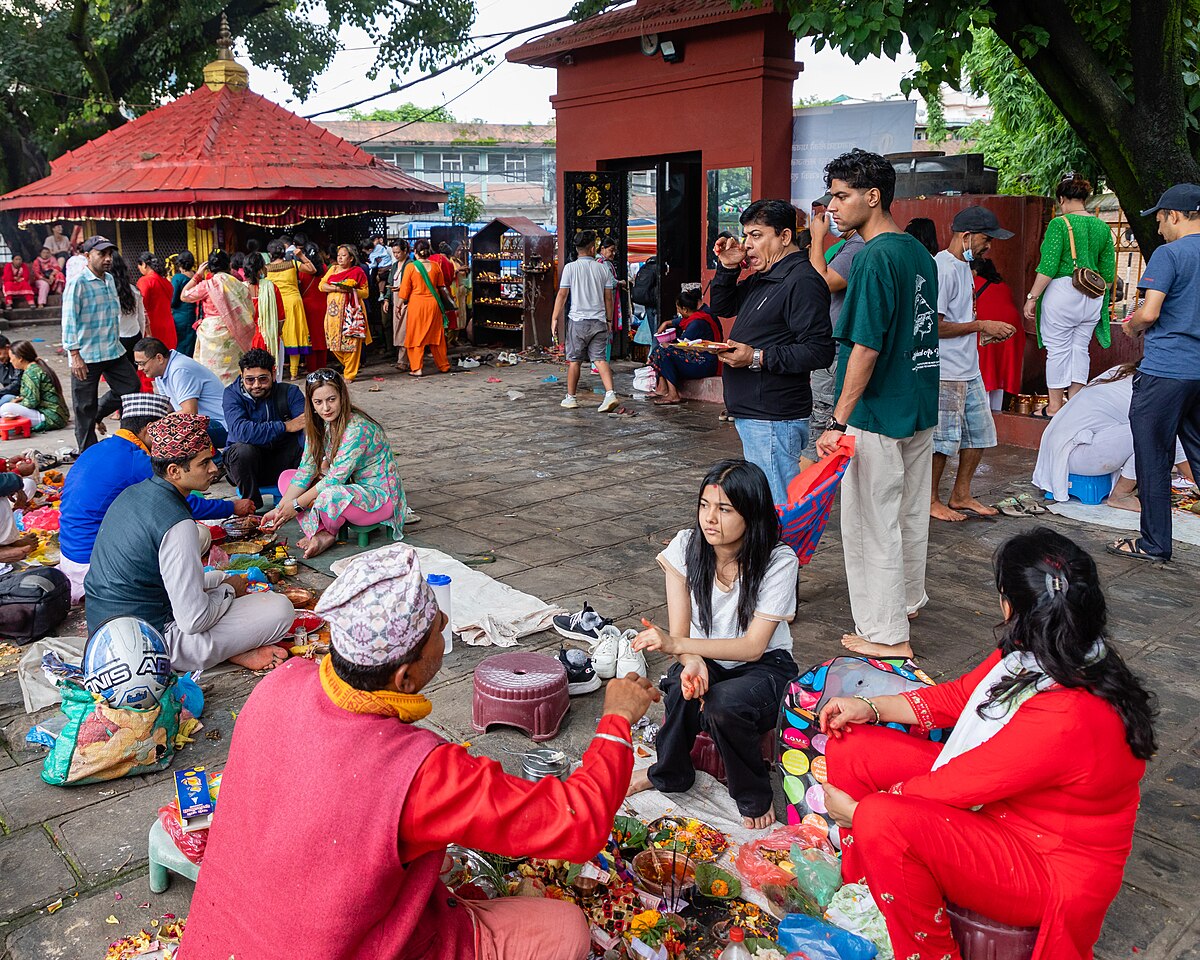
In Nepal’s Kathmandu Valley, Nāga Pañcamī is a public holiday. The centrepiece of celebrations is the famous Nāga Pokhārī (Serpent Pond) in Kathmandu, where thousands of devotees gather to offer prayers to the Nāga images surrounding the sacred pool. Devotees also paste images of the Navaṇāga (nine serpents) above the main doorways of their homes for protection during the monsoon.
Nāgas in Hindu Art and Temple Architecture
The serpent motif is one of the most ubiquitous elements in Hindu sacred art and architecture. Nāga imagery appears in virtually every era of Indian artistic production:
-
Doorway guardians (dvārapāla): Multi-hooded serpent canopies frame the entrances of countless Hindu temples, from the Pallava rock-cut shrines at Mahābalipuram to the Hoysaḷa temples at Belūr and Haḷebīḍu.
-
Nāga stones (nāgakal): Found across South India, particularly in Karnataka and Kerala, these carved stone slabs depicting intertwined serpents are installed at the base of sacred trees and worshipped as protective deities. They are also associated with fertility — couples seeking children often pray at Nāga stones.
-
Viṣṇu Anantaśayana: The iconic image of Lord Viṣṇu reclining on Śeṣa’s coils, with Lakṣmī at his feet, is one of Hindu art’s most beloved compositions. The Padmanābhaswāmy Temple in Thiruvananthapuram and the Ranganāthaswāmy Temple in Śrīraṅgam are both dedicated to this form.
-
Śiva Naṭarāja: In depictions of Śiva’s cosmic dance, serpents often appear as ornaments on his arms, neck, and waist, symbolising his mastery over fear and death.
-
Nāga-mukha (serpent-face): Water spouts carved as serpent mouths are standard features in temple tanks and sacred water channels, connecting serpent symbolism to the element of water.
Connection to Agriculture and the Monsoon
The timing of Nāga Pañcamī in the heart of the monsoon season is no coincidence. The festival reflects the intimate relationship between serpent reverence and agrarian life in India:
Ecological reality: During the heavy rains of Śrāvaṇa, snakes are displaced from their underground burrows by rising water levels. Cobras, rat snakes, and other species become highly visible in and around human settlements, rice paddies, and granaries. Nāga worship can be understood partly as a cultural mechanism for encouraging tolerance and coexistence with these displaced creatures during a vulnerable period.
Agricultural guardian: Snakes play a vital role in Indian agriculture by controlling rodent populations that damage stored grain and standing crops. Farmers have long recognised this ecological service, and serpent veneration reinforces the cultural prohibition against killing snakes — protecting a natural ally of the harvest.
Fertility symbolism: The serpent’s association with rain, water, and the earth’s fertility is universal in Indian thought. The Nāgas are said to control rainfall, and their worship during the monsoon is partly an invocation for adequate and timely rain. The intertwined serpents on Nāga stones are explicitly fertility symbols, and the connection between serpent worship and prayers for progeny remains strong in many communities.
Water guardianship: In Purāṇic cosmology, Nāgas guard underground water sources and springs. Many natural water bodies across India bear Nāga-related names (Nāga Pokhārī, Nāga Tīrtha, Nāga Kuṇḍa), reflecting the belief that serpent deities preside over water.
Modern Concerns: Animal Welfare and Evolving Practice
In recent decades, Nāga Pañcamī has become a focal point for discussions about animal welfare and wildlife protection in India. The Wildlife Protection Act of 1972 prohibits the capture, display, and trade of snakes, which has directly impacted traditional practices associated with the festival:
-
Snake charming: Once a common sight during Nāga Pañcamī celebrations, the practice of displaying live cobras has been legally restricted. Snake charmers (sapere), many from the Sapera and Jogi communities, have faced displacement from their traditional livelihood, prompting government and NGO-led rehabilitation programmes.
-
Milk feeding: Wildlife experts and veterinarians have raised concerns about the practice of offering milk to live snakes, noting that snakes are carnivorous and lactose-intolerant. Forced milk feeding can cause aspiration pneumonia and other health problems. Animal welfare organisations encourage devotees to offer milk to Nāga images rather than live snakes.
-
Temple and idol worship: Many Hindu leaders and organisations have advocated shifting the focus of Nāga Pañcamī worship toward temple rituals, Nāga stone veneration, and image worship — practices that honour the festival’s spiritual meaning without involving live animals. This evolution is widely seen as consistent with the principle of ahiṃsā that lies at the heart of the Āstīka narrative.
Philosophical and Spiritual Dimensions
Beyond its mythological and ritual aspects, Nāga Pañcamī carries several layers of philosophical meaning:
Kuṇḍalinī and spiritual transformation: In the Tantric and Yogic traditions, the serpent is the primary symbol of kuṇḍalinī śakti — the coiled spiritual energy resting at the base of the spine (mūlādhāra cakra). The awakening and ascent of this serpent energy through the suṣumnā nāḍī to the crown (sahasrāra cakra) represents the ultimate goal of yogic practice: the union of individual consciousness with cosmic consciousness. Nāga Pañcamī’s reverence for the serpent thus resonates with this inner spiritual symbolism.
Reconciliation with fear: The worship of a creature that most humans instinctively fear represents a profound spiritual act. By honouring the serpent rather than destroying it, the devotee practises transcendence of primal fear — an essential step in the Hindu path toward mokṣa (liberation). Śiva’s wearing of serpents as ornaments conveys precisely this teaching: the enlightened being is beyond the reach of fear.
Ecological dharma: Nāga Pañcamī is increasingly interpreted as an expression of ecological consciousness embedded within Hindu tradition. The festival teaches respect for creatures that share human living spaces, recognition of their role in the ecosystem, and restraint in the exercise of human power over nature — values that align with contemporary environmental ethics.
Cyclical renewal: The festival’s placement during the monsoon — a season of both destruction and renewal — mirrors the serpent’s own symbolism of cyclical regeneration through the shedding of its skin. The Nāga thus becomes an emblem of saṃsāra itself: the eternal cycle of death and rebirth that Hindu philosophy seeks to understand and ultimately transcend.
Conclusion: The Enduring Power of the Serpent
Nāga Pañcamī endures as one of Hinduism’s most evocative festivals because it touches on something fundamental in the human relationship with nature. From the Vedic hymns of the Atharva Veda to the Purāṇic narratives of Śeṣa and Vāsuki, from the agricultural wisdom of monsoon-season coexistence to the inner symbolism of kuṇḍalinī yoga, the serpent weaves through Hindu civilisation as a figure of awesome power, sacred guardianship, and spiritual potential.
As the festival continues to evolve — adapting to modern sensibilities around animal welfare while preserving its ancient spiritual core — it demonstrates the remarkable capacity of Hindu tradition to honour the past while responding to the present. Whether through a grandmother’s turmeric Nāga drawn on a village wall or an elaborate temple ritual in Kathmandu’s Nāga Pokhārī, the spirit of Nāga Pañcamī remains the same: a day to acknowledge the sacred serpent, to seek its protection, and to affirm humanity’s place within the vast, interconnected web of creation.