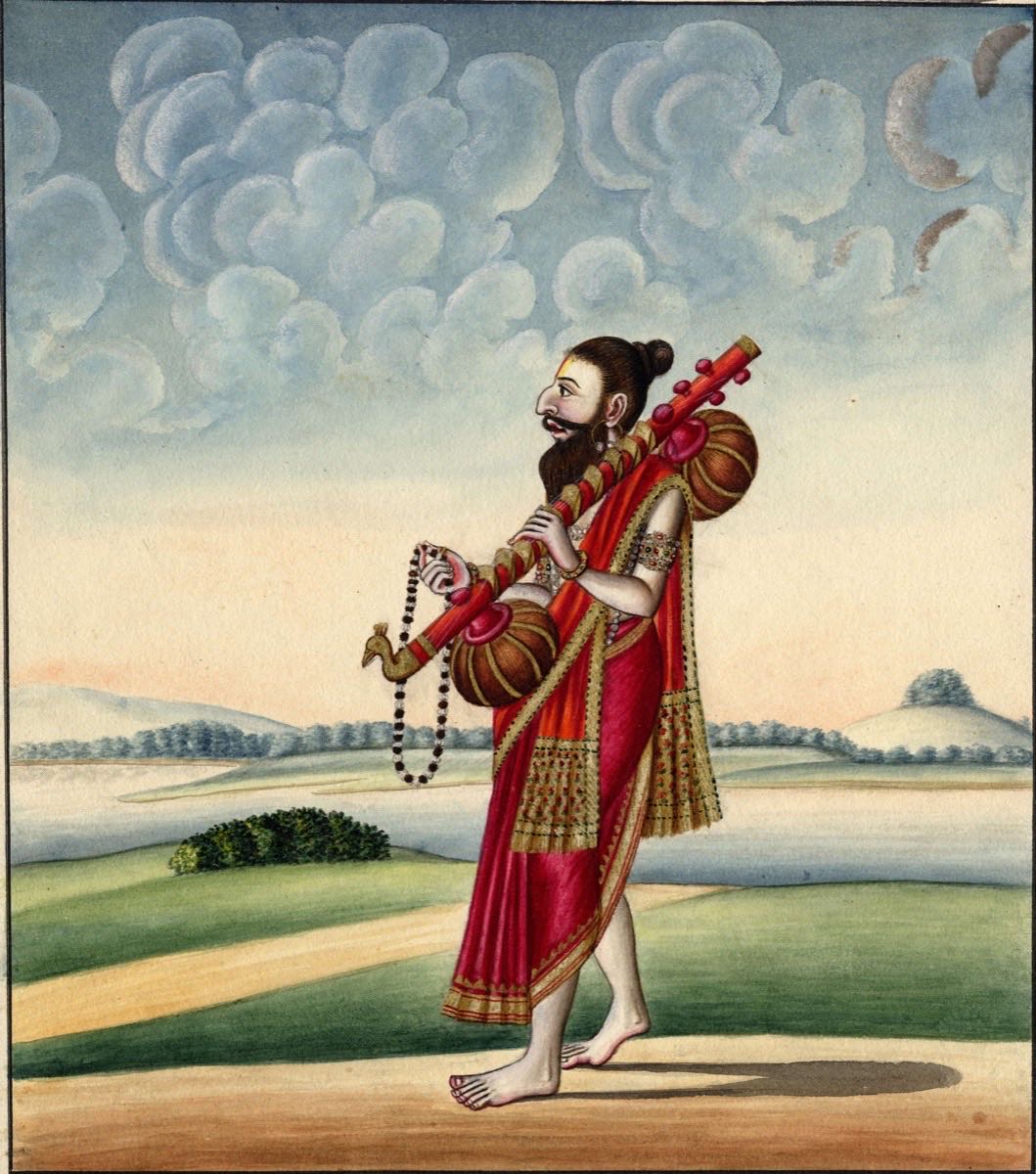
The Nārada Bhakti Sūtra (नारद भक्ति सूत्र) stands as one of the most cherished and authoritative treatises on devotional love in the Hindu philosophical tradition. Comprising 84 concise aphorisms (sūtras) attributed to the celestial sage Nārada, this text offers a systematic yet profoundly poetic exposition of bhakti—supreme, selfless love for God—as the highest path to spiritual liberation. Where the Brahma Sūtras map the terrain of metaphysics and the Yoga Sūtras chart the discipline of meditation, the Nārada Bhakti Sūtra illuminates the landscape of the heart, declaring that God is not merely to be known or controlled but to be loved with an intensity that transforms the entire being.
From its celebrated opening aphorism—athāto bhaktiṁ vyākhyāsyāmaḥ (“Now, therefore, we shall expound bhakti”)—the text unfolds a vision of devotion that has inspired saints, philosophers, and seekers across two millennia. It remains a living scripture, chanted in ashrams, debated in seminaries, and treasured by millions who find in its words a direct path to the Divine.
Authorship and Dating
The Sage Nārada
The text is attributed to Nārada Muni (नारद मुनि), one of the most beloved figures in Hindu mythology. Described in the Purāṇas as a devarṣi (divine sage) and the mind-born son of Lord Brahmā, Nārada is the eternal wanderer of the three worlds—travelling ceaselessly with his vīṇā (lute) and khartal (cymbals), chanting “Nārāyaṇa, Nārāyaṇa.” He is celebrated as the inventor of the vīṇā, the first musician, and the greatest exemplar of bhakti. In the Bhāgavata Purāṇa (1.5-6), it is Nārada who inspires Vyāsa to compose the Bhāgavata itself, urging him to write about the glories of Lord Viṣṇu rather than dry philosophy alone.
The attribution to Nārada is therefore symbolic and fitting: who better to codify the science of divine love than the sage whose every breath was a hymn to God?
Historical Dating
Scholarly consensus places the composition of the Nārada Bhakti Sūtra between the 9th and 11th centuries CE, with some analyses specifically suggesting the 10th century. The earliest known manuscripts date from the 15th century, though the text was clearly in circulation by the 11th-12th century, as the philosopher Rāmānuja (1017-1137 CE) engaged with its principles. The text’s reference to Śāṇḍilya (Sūtra 83) as an earlier authority on bhakti suggests it was composed after the Śāṇḍilya Bhakti Sūtra, which scholars consider the older of the two great bhakti treatises.
The Sanskrit root bhaj from which bhakti derives means “to share,” “partake,” or “participate”—emphasising devotion as communion with the Divine rather than mere worship from a distance.
Structure and Organisation
The Nārada Bhakti Sūtra consists of 84 short, mnemonic aphorisms in Sanskrit, characteristic of classical sūtra literature (like the Brahma Sūtras or Yoga Sūtras) designed for memorisation and expansion through oral commentary. The original text contains no inherent chapter divisions; different commentators have imposed varying organisational structures:
- Swami Sivananda divides the sutras into four thematic sections
- Swami Prabhavānanda organises them into nine chapters
- A.C. Bhaktivedanta Swami Prabhupāda uses a five-chapter structure
Despite these differences, the thematic progression is consistent across all traditions:
| Sūtras | Theme |
|---|---|
| 1-24 | Nature of Bhakti: Defining supreme devotion and its characteristics |
| 25-33 | Superiority of Bhakti: Bhakti surpasses karma, jnāna, and yoga |
| 34-50 | Cultivation: Methods, renunciation, and self-surrender |
| 51-66 | Marks of a Devotee: External signs and qualities of true devotion |
| 67-84 | Glory and Fruit: The great devotee, exemplars, and final realisation |
The Definition of Bhakti: Parama Prema Rūpā
The most celebrated and foundational teaching of the Nārada Bhakti Sūtra appears in its second aphorism:
Sūtra 2: sā tu asmin parama-prema-rūpā “That (bhakti) is of the nature of supreme love for Him (God).”
This single phrase—parama-prema-rūpā—has become the defining formula of Hindu devotionalism. Bhakti is not ritual observance, not intellectual assent, not fear of divine punishment: it is supreme love (parama prema), the most exalted form of emotional attachment, directed entirely toward the Divine. The word prema carries connotations of tender, intimate, all-consuming affection—the kind of love that transforms the lover into the beloved.
The sutras that follow elaborate this definition:
Sūtra 3: amṛta-svarūpā ca “And it is of the nature of immortal bliss.”
Sūtra 4: yallabdhvā pumān siddho bhavati, amṛto bhavati, tṛpto bhavati “Having attained which, a person becomes perfect, becomes immortal, becomes fully satisfied.”
Sūtra 5: yat prāpya na kiñcid vāñchati, na śocati, na dveṣṭi, na ramate, notsāhī bhavati “Having attained which, one desires nothing more, grieves no more, hates no more, does not revel in sense-objects, and is not driven by worldly ambition.”
Sūtra 6: yaj jñātvā matto bhavati, stabdho bhavati, ātmārāmo bhavati “Knowing which, one becomes intoxicated (with bliss), becomes stunned (in wonder), and takes delight in the Self alone.”
These opening aphorisms establish bhakti not merely as an emotion but as a transformative state of consciousness—a nectar (amṛta) that renders the devotee complete, desireless, and blissful.
The Superiority of Bhakti
One of the text’s boldest claims appears in Sūtra 25:
Sūtra 25: sā tu karma-jñāna-yogebhyo ‘py adhikatarā “Bhakti is greater than karma (action), greater than jñāna (knowledge), and greater than yoga (meditative discipline).”
This is a striking declaration in a tradition that honours multiple spiritual paths. Nārada does not dismiss karma, jñāna, or yoga—he acknowledges their validity—but he insists that bhakti stands above them all. His reasoning is elegant: karma produces results that are bound by time; jñāna requires extraordinary intellectual capacity; yoga demands rigorous self-discipline. But bhakti requires only a sincere heart. It is accessible to all, regardless of caste, gender, age, or learning.
Sūtra 26 explains why: phala-rūpatvāt—“because bhakti is both the means and the fruit.” Unlike karma or yoga, which are practised to achieve a separate goal, bhakti is self-fulfilling. The act of loving God is the liberation; the path is the destination.
The Eleven Forms of Bhakti
One of the most distinctive contributions of the Nārada Bhakti Sūtra is its enumeration of eleven modes (ākāras) through which supreme devotion manifests. These appear in Sūtra 82:
- Guṇa-māhātmya-āsakti — Attachment to glorifying God’s divine qualities and greatness
- Rūpa-āsakti — Attachment to God’s beautiful divine form
- Pūjā-āsakti — Attachment to formal worship and ritual adoration
- Smaraṇa-āsakti — Attachment to constant remembrance of the Lord
- Dāsya-āsakti — Attachment through the attitude of servitude, as exemplified by Hanumān’s devotion to Rāma
- Sakhya-āsakti — Attachment through divine friendship, as illustrated by the bond between Kṛṣṇa and Arjuna
- Vātsalya-āsakti — Attachment through parental affection, as Yaśodā loved the child Kṛṣṇa
- Kānta-āsakti — Attachment through conjugal or romantic love, illustrated by the gopīs’ love for Kṛṣṇa
- Ātma-nivedana-āsakti — Attachment through complete self-surrender and offering of one’s entire being
- Tanmayatā-āsakti — Attachment through total absorption and becoming one with the object of devotion
- Parama-viraha-āsakti — Attachment through the supreme anguish of separation from God
Nārada declares this last form—the pain of separation (viraha)—to be the highest. This is a profound insight: the devotee who feels the agony of being separated from God experiences a love so intense that even the pain becomes ecstatic. This concept deeply influenced the later Gauḍīya Vaiṣṇava tradition, where the viraha of Rādhā for Kṛṣṇa became the supreme model of devotion.
Key Sūtras and Teachings
On the Inexpressible Nature of Love
Sūtra 51: anirvachanīyaṁ prema-svarūpam “The true nature of this divine love is inexpressible.”
Sūtra 52: mūkāsvādanavat “It is like a mute person trying to describe the experience of taste.”
These verses acknowledge that bhakti, at its highest, transcends language and intellect. Just as a person who cannot speak may experience the sweetness of honey but cannot articulate it, the devotee who has tasted divine love cannot convey it in words. This idea resonates with mystical traditions worldwide.
On Renunciation and Association
Sūtra 36: narede tu tadarpitākhilācāratā tadvismṛaṇe parama-vyākulatā ca “According to Nārada, bhakti consists in offering all one’s activities to God, and feeling supreme anguish at any moment of forgetfulness of Him.”
Sūtra 38: sat-saṅgasya mahā-prabhāvam “The power of association with holy persons is immense.”
The text repeatedly emphasises sat-saṅga—the company of saints and devotees—as the most effective means of kindling and sustaining bhakti. Even a moment’s forgetfulness of God should cause the devotee intense distress, a sign that divine love has truly taken root.
On the Accessible Nature of Devotion
Sūtra 14: loke ‘pi tāvad eva bhojanādi-vyāpāras tv āśarīra-dhāraṇāvadhi “Social customs and bodily maintenance need only be followed so long as one has a body, but the focus should always remain on God.”
This sūtra reflects the practical wisdom of the text: it does not demand world-renunciation but asks that all worldly actions be performed with awareness of the Divine.
Relationship to the Śāṇḍilya Bhakti Sūtra
The Nārada Bhakti Sūtra and the Śāṇḍilya Bhakti Sūtra are the two most authoritative ancient Sanskrit treatises on bhakti. Their relationship illuminates the development of devotional theology:
| Feature | Nārada Bhakti Sūtra | Śāṇḍilya Bhakti Sūtra |
|---|---|---|
| Sūtras | 84 aphorisms | 100 aphorisms |
| Approach | Devotion as the sole means of liberation | Both knowledge and devotion as valid means |
| Audience | Ordinary seekers with sincere hearts | Both ordinary and spiritually fallen seekers |
| Style | Poetic, aphoristic, experiential | Philosophical, analytical, Mīmāṁsā-influenced |
| Priority | Bhakti surpasses jñāna and karma | Bhakti and jñāna are complementary |
The Śāṇḍilya Bhakti Sūtra is considered older, since Śāṇḍilya is quoted in the Nārada text (Sūtra 83) but Nārada is not quoted in Śāṇḍilya’s work. Nārada Sūtra 83 names its own lineage of teachers: “Kumāra, Vyāsa, Śuka, Śāṇḍilya, Garga, Viṣṇu, Kauṇḍinya, Śeṣa, Uddhava, Aruṇi, Bali, Hanumān, Vibhīṣaṇa”—a remarkable list that spans gods, sages, demons, and a monkey-warrior, emphasising that bhakti knows no boundaries.
Comparison with Patañjali’s Yoga Sūtra
While both the Nārada Bhakti Sūtra and Patañjali’s Yoga Sūtra offer systematic paths to spiritual realisation, their methods and emphases differ fundamentally:
| Aspect | Nārada Bhakti Sūtra | Patañjali Yoga Sūtra |
|---|---|---|
| Goal | Prema (divine love) and communion with God | Kaivalya (isolation of puruṣa from prakṛti) |
| Method | Surrender, love, and devotion | Eight-limbed discipline (aṣṭāṅga yoga) |
| Role of God | Central—God is the beloved | Secondary—Īśvara-praṇidhāna is one of many tools |
| Emotional engagement | Emotions are purified and directed toward God | Emotions (vṛtti) are to be stilled and transcended |
| Accessibility | Open to all; requires only a sincere heart | Requires sustained discipline and practice |
| Bhakti’s place | The supreme path | One element (Īśvara-praṇidhāna) within a larger system |
Patañjali mentions devotion to God (Īśvara-praṇidhāna) in Yoga Sūtra 1.23 and 2.45 as a powerful method, but it remains one among several. For Nārada, bhakti is not a method among methods—it is the entirety of spiritual life.
Influence on the Bhakti Movement
The Nārada Bhakti Sūtra served as a foundational systematic framework for devotional practice that profoundly shaped medieval India’s great Bhakti movements:
Rāmānuja (1017-1137 CE) integrated the text’s principles into his Viśiṣṭādvaita (qualified non-dualism) philosophy, arguing that loving surrender (prapatti) to Viṣṇu was the highest path. His Sri Vaiṣṇava tradition treats the Nārada Bhakti Sūtra as a key philosophical authority.
Chaitanya Mahāprabhu (1486-1534 CE), the founder of Gauḍīya Vaiṣṇavism, embodied the Sūtra’s teaching on parama-viraha—the ecstasy of separation—in his own life of intense, emotional devotion to Kṛṣṇa. The Gosvāmīs of Vṛndāvana (Rūpa, Sanātana, Jīva) drew extensively on the eleven forms of bhakti in developing their theology of rasa (devotional sentiment).
Vallabhācārya (1479-1531 CE) founded the Puṣṭimārga (path of grace) tradition, which emphasises vātsalya-bhakti (parental love for the child Kṛṣṇa)—one of the eleven forms enumerated in the Nārada Sūtra.
The text also democratised spiritual access: by declaring bhakti superior to ritual knowledge and yogic discipline, it affirmed that liberation was available to all, regardless of caste, gender, or learning—a revolutionary principle that fuelled the saint-poet movements of Tukārām, Kabīr, Mīrābāī, and countless others.
Modern Commentaries and Interpretations
Swami Vivekananda (1863-1902)
Vivekananda offered a free translation of the Nārada Bhakti Sūtra during his time in America, interpreting bhakti as intense, non-sectarian love for God. He described the signs of love: “When all thoughts, all words, and all deeds are given up unto the Lord, and the least forgetfulness of God makes one intensely miserable, then love has begun.” His commentary emphasised the universal, non-denominational nature of bhakti—not tied to any particular name or form of God.
Swami Sivananda (1887-1963)
Sivananda presented the Nārada Bhakti Sūtra as a practical guide, organising it into four thematic sections and emphasising daily practices such as japa (mantra repetition), kīrtana (devotional singing), and sevā (service) as means of cultivating bhakti in everyday life.
A.C. Bhaktivedanta Swami Prabhupāda (1896-1977)
In 1967, Prabhupāda began translating and writing purports for the Nārada Bhakti Sūtra, interpreting it through the lens of Gauḍīya Vaiṣṇavism. His translation of bhakti as “devotional service” was deliberate—emphasising that bhakti is both active and personal, not merely a feeling but a way of living in which every action is offered to Kṛṣṇa. His disciple Satsvarūpa dāsa Gosvāmī completed the work, organising the 84 sūtras into five chapters.
Swami Chinmayānanda (1916-1993)
Chinmayānanda integrated the Nārada Bhakti Sūtra with Advaita Vedānta, viewing bhakti not as an alternative to knowledge but as the preparatory and complementary discipline that purifies the heart for non-dual realisation. His commentary remains widely studied in Chinmaya Mission centres worldwide.
The Concluding Promise
The text closes with a powerful declaration in its final sūtra:
Sūtra 84: ya idaṁ nārada-proktaṁ śivānuśāsanaṁ viśvasiti śraddhate sa bhaktimān bhavati, sa preṣṭhaṁ labhate, sa preṣṭhaṁ labhate “Whoever believes and has faith in this auspicious teaching spoken by Nārada becomes a devotee, attains the most Beloved, attains the most Beloved.”
The repetition of sa preṣṭhaṁ labhate (“attains the most Beloved”) is deliberate and emphatic—a promise made twice for certainty. The Nārada Bhakti Sūtra does not merely theorise about love; it promises that sincere faith in its teaching will lead to the experience of divine love.
The Living Legacy
The Nārada Bhakti Sūtra endures because it speaks to something fundamental in human experience: the yearning for love that transcends the finite. In an age of competing spiritual methodologies, complex philosophical systems, and institutional religions, Nārada’s message remains disarmingly simple: love God supremely, and everything else follows.
The text’s influence extends far beyond Hinduism’s traditional boundaries. Contemporary interfaith scholars have drawn parallels between Nārada’s concept of parama prema and the Christian concept of agape—both describing selfless, unconditional love that bridges the human and the Divine. Psychologists have begun exploring bhakti as an emotional and contemplative practice with measurable benefits for mental well-being and existential meaning.
Whether one encounters the Nārada Bhakti Sūtra as a scholar, a practitioner, or a curious seeker, its eighty-four aphorisms offer a timeless map of the heart’s journey toward the infinite. As Nārada himself proclaims: the path of love is its own reward, and the Beloved awaits at every step.