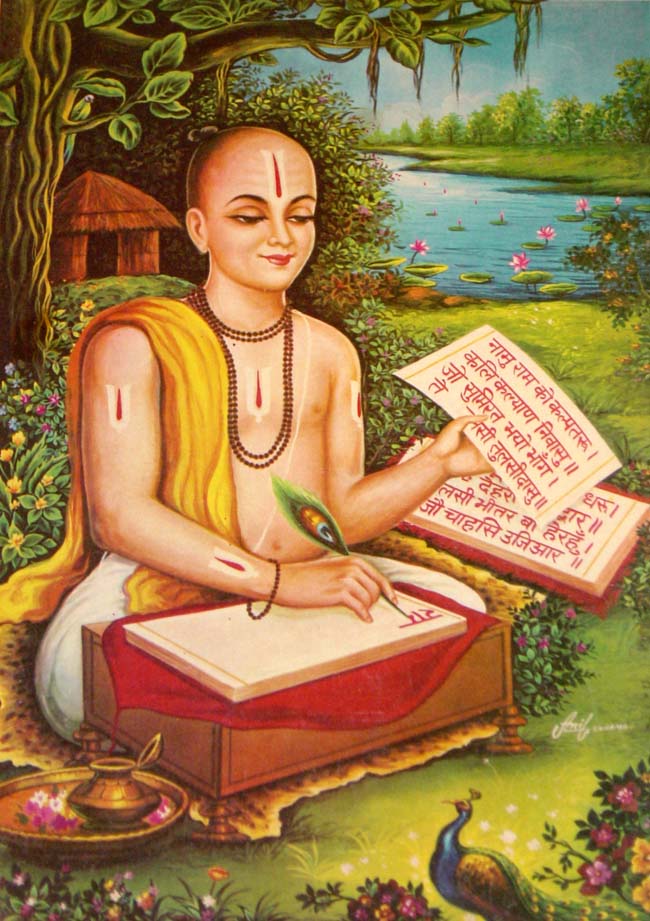
The Rāmacaritamānasa (रामचरितमानस, “The Holy Lake of the Acts of Rāma”) is one of the most beloved and influential works in all of Indian literature. Composed by the saint-poet Gosvāmī Tulasīdāsa (c. 1511-1623 CE) in the Awadhī dialect of Hindi, this monumental epic retells the story of Lord Rāma not as a historical chronicle but as a sacred lake (mānasa) in which the devotee may bathe and attain spiritual purification. Over the course of approximately 12,800 lines arranged in 1,073 stanzas across seven books (kāṇḍas), Tulasīdāsa transformed the ancient narrative of Vālmīki’s Sanskrit Rāmāyaṇa into a living scripture of devotional Hinduism that has shaped the religious consciousness of hundreds of millions of people across North India and beyond.
The Rāmacaritamānasa occupies a unique position in Indian civilisation. It is simultaneously a work of supreme poetic artistry, a theological treatise on bhakti (devotion), a manual of dharma (righteous conduct), a repository of folk wisdom, and the liturgical foundation for the Rām Līlā dramatic tradition recognised by UNESCO as Intangible Cultural Heritage of Humanity. Mahātmā Gāndhī considered it “more spiritual than Vālmīki’s Rāmāyaṇa,” while the scholar F.S. Growse called it “the living sum of Indian culture.” The Gītā Press of Gorakhpur alone has sold over 70 million copies of the text, making it arguably the most widely distributed Hindu scripture after the Bhagavad Gītā.
Tulasīdāsa: The Poet-Saint of Rāma
Early Life and Spiritual Awakening
Tulasīdāsa was born on the seventh day (saptamī) of the bright half of Śrāvaṇa (July-August) in either 1511 CE or 1532 CE — the date remains a matter of scholarly debate — in a Sarūpārīn Brāhmaṇa family. Most scholars identify Soroṅ in Kāśgañj district, Uttar Pradesh, on the banks of the Gaṅgā, as his birthplace, though the town of Rājāpur in Bāndā district also claims the honour. His parents were Hulasī and Ātmārāma Dube.
Legend records extraordinary portents at his birth: he was in his mother’s womb for twelve months, was born with all thirty-two teeth, and did not cry but instead uttered the word “Rāma” — earning him the childhood name Rāmabolā (“he who speaks Rāma”). Orphaned early, the child was raised by the ascetic Nāraharīdāsa, who initiated him into the Rāmānandī sampradāya and taught him the sacred stories of Rāma.
The Wife’s Rebuke and Renunciation
The pivotal event of Tulasīdāsa’s spiritual transformation is among the most celebrated episodes in Hindi literary tradition. As a young man, he married Ratanāvalī (also called Buddhimatī), to whom he was passionately attached. One day, when Ratanāvalī went to her father’s house without informing him, Tulasīdāsa followed her by crossing a swollen river at night, clinging to what he thought was a log but was actually a floating corpse, and climbing what he believed was a rope but was actually a serpent hanging from the wall. When Ratanāvalī discovered him, she uttered the famous words that would change the course of Hindi literature forever:
अस्थि चर्म मय देह यह, ता सों ऐसी प्रीति। वैसी जो श्रीराम महँ, होत न तो भव भीति॥ “This body is nothing but bones and flesh. If you had even half this love for Śrī Rāma, you would have no fear of worldly existence.”
These words pierced Tulasīdāsa to the core. He immediately renounced domestic life and became a wandering ascetic, spending fourteen years visiting the great pilgrimage centres of India and immersing himself in the study of scripture and the chanting of Rāma’s name.
Vision of Hanumān and Darśana of Rāma
Through years of intense devotion, Tulasīdāsa was blessed with the darśana (divine vision) of Hanumān, who became his spiritual guide. The tradition recounts that Hanumān appeared to him disguised as a leper at a temple, and upon revealing his true form, directed Tulasīdāsa to proceed to Citrakūṭa to behold Rāma himself. At Citrakūṭa, while performing circumambulation (parikramā) of the Kāmadagiri mountain, Tulasīdāsa saw two radiant princes — one dark, one fair — riding on horseback. These were Rāma and Lakṣmaṇa. So overwhelmed was Tulasīdāsa by the vision that he forgot to offer worship, but Hanumān later assured him that the Lord would grant him darśana again. The second vision, in which he saw Rāma’s complete form with bow and arrows, is said to have occurred at Vārāṇasī (or, in some accounts, Vṛndāvana), and it confirmed his life’s mission: to compose a vernacular retelling of the Rāmāyaṇa that would be accessible to all.
Composition of the Rāmacaritamānasa
Date, Place, and Circumstance
Tulasīdāsa began composing the Rāmacaritamānasa on Rāma Navamī (the ninth day of the bright half of Caitra), Vikrama Saṃvat 1631 — corresponding to 1574 CE — at Ayodhyā, the birthplace of Rāma. He completed the work approximately two years, seven months, and twenty-six days later, in 1576-77 CE. While the composition was begun at Ayodhyā, a large portion was written at Vārāṇasī (Kāśī), where Tulasīdāsa spent most of his later life, and sections were also composed at Citrakūṭa.
The choice to begin on Rāma Navamī was no accident — Tulasīdāsa saw his work as a kind of literary incarnation (avatāra) of Rāma’s deeds, born on the same sacred day as the Lord himself.
The Revolutionary Choice of Awadhī
Tulasīdāsa’s most consequential artistic decision was to compose his epic not in Sanskrit — the prestigious language of scripture and scholarship — but in Awadhī, the vernacular dialect spoken in the Avadha region of Uttar Pradesh. This was a revolutionary and controversial act. The Brahmanical establishment of Vārāṇasī reportedly condemned him for “debasing” sacred subject matter by rendering it in a common tongue. One popular tradition holds that the Brahmins of Kāśī placed the manuscript in the Viśvanātha temple overnight alongside the Vedas and the Bhagavad Gītā to test its worthiness — and the next morning found the Rāmacaritamānasa placed atop all other scriptures, with the words सत्यं शिवं सुन्दरम् (“Truth, Auspiciousness, Beauty”) inscribed upon it by the hand of Śiva himself.
Whether or not this legend is historical, its meaning is clear: Tulasīdāsa’s linguistic revolution democratised access to sacred knowledge. By writing in the language of the people, he ensured that the story of Rāma would no longer be the exclusive preserve of the Sanskrit-educated elite but would belong to farmers, traders, women, and members of all castes. This decision made the Rāmacaritamānasa the foundational text of modern Hindi literature and established Awadhī as a vehicle for the highest literary and spiritual expression.
Structure: The Seven Kāṇḍas
Tulasīdāsa compared the seven kāṇḍas of his epic to seven steps descending into the sacred waters of Mānasarovara lake — each step bringing the devotee closer to immersion in the divine story. The seven books are:
1. Bāla Kāṇḍa (The Book of Childhood)
The longest book, comprising nearly a third of the entire work. It opens with elaborate invocations to Gaṇeśa, Sarasvatī, Śiva, Pārvatī, Hanumān, Vālmīki, and Rāma’s guru Vasiṣṭha. It then establishes the three nested dialogue frameworks (discussed below) before narrating the birth of Rāma and his brothers in Ayodhyā, Rāma’s youthful adventures with the sage Viśvāmitra, the slaying of the demoness Tāḍakā, and culminates in Rāma’s marriage to Sītā at King Janaka’s court after breaking the great bow of Śiva (Śiva Dhanurbhaṅga).
2. Ayodhyā Kāṇḍa (The Book of Ayodhyā)
The second-longest and most emotionally intense section, covering King Daśaratha’s preparations for Rāma’s coronation, Queen Kaikeyī’s demand for Rāma’s exile, the heart-rending departure of Rāma, Sītā, and Lakṣmaṇa to the forest, Daśaratha’s death from grief, and Bharata’s noble refusal to accept the throne. The scene of Bharata carrying Rāma’s sandals (pādukā) back to Ayodhyā and ruling as Rāma’s regent is among the most celebrated passages in Hindi literature, illustrating the ideal of fraternal devotion and selfless dharma.
3. Araṇya Kāṇḍa (The Book of the Forest)
Covers the years of forest exile, including encounters with sages and demons, the episode of Sūrpaṇakhā’s humiliation, and the abduction of Sītā by Rāvaṇa. The death of the noble vulture Jaṭāyu, who gives his life trying to rescue Sītā, is rendered with extraordinary pathos. Rāma’s grief at Sītā’s disappearance reveals the poet’s genius for combining divine theology with deeply human emotion.
4. Kiṣkindhā Kāṇḍa (The Book of Kiṣkindhā)
The shortest kāṇḍa, narrating Rāma’s alliance with the vānara (monkey) king Sugrīva, the slaying of the usurper Vāli, and the dispatching of search parties to find Sītā. Tulasīdāsa uses this section to explore themes of friendship, trust, and political alliance in the service of dharma.
5. Sundara Kāṇḍa (The Beautiful Book)
Widely considered the most auspicious section for devotional recitation, the Sundara Kāṇḍa describes Hanumān’s heroic leap across the ocean to Laṅkā, his discovery of Sītā in the Aśoka grove, his reassurance to her that Rāma will come, his burning of Laṅkā, and his triumphant return. This kāṇḍa is a complete devotional text in its own right — millions of Hindus recite it weekly or during times of difficulty, believing in its power to remove obstacles and bestow courage. Hanumān emerges as the supreme exemplar of dāsya bhakti (devotion through service).
6. Laṅkā Kāṇḍa (The Book of Laṅkā)
The great battle between the forces of Rāma and Rāvaṇa, including the deployment of divine weapons (astra), the death of Rāvaṇa’s son Meghanāda (Indrajit) and brother Kumbhakarṇa, and the climactic duel between Rāma and Rāvaṇa. Tulasīdāsa portrays the battle as the cosmic struggle between dharma and adharma, with Rāma’s victory representing the triumph of righteousness over evil. The narrative culminates in Sītā’s liberation and the couple’s reunion.
7. Uttara Kāṇḍa (The Final Book)
Describes Rāma’s return to Ayodhyā in the celestial chariot Puṣpaka, his coronation (rājyābhiṣeka), and the establishment of Rāma Rājya — the ideal kingdom of perfect justice, prosperity, and harmony. Unlike Vālmīki’s version, Tulasīdāsa’s Uttara Kāṇḍa does not include Sītā’s banishment or the Śambūka episode, choosing instead to end on a note of transcendent joy and divine kingship. The kāṇḍa concludes with philosophical teachings on the nature of bhakti, māyā (illusion), and liberation (mokṣa).
The Nested Dialogue Framework
One of the most sophisticated structural features of the Rāmacaritamānasa is its use of multiple nested narrators. The story of Rāma is not told directly by Tulasīdāsa but is transmitted through three layers of sacred conversation:
-
Śiva and Pārvatī: The outermost frame. Lord Śiva narrates the story of Rāma to his consort Pārvatī on Mount Kailāsa, establishing the divine authority of the narrative.
-
Yājñavalkya and Bharadvāja: The sage Yājñavalkya recounts Rāma’s story to the sage Bharadvāja at the confluence of the Gaṅgā and Yamunā at Prayāga, rooting the narrative in the ṛṣi tradition of sacred knowledge transmission.
-
Kākabhuśuṇḍi and Garuḍa: The enlightened crow-sage Kākabhuśuṇḍi narrates the story to Garuḍa, the king of birds and vehicle of Viṣṇu. This is the innermost and most elaborate frame, through which the majority of the epic is told.
This layered architecture serves multiple purposes: it establishes the paramparā (lineage) of sacred transmission, allows different perspectives to illuminate different dimensions of Rāma’s story, and demonstrates that the same divine narrative can be comprehended at different levels of spiritual maturity.
Literary Style: The Music of Awadhī Verse
The Chaupāī-Dohā System
The Rāmacaritamānasa employs a distinctive metrical system that gives it its characteristic musical quality. The primary metre is the chaupāī — a quatrain of four lines, each containing sixteen mātrā (metrical units) — which carries the narrative forward. Each group of chaupāīs is punctuated by a dohā — a self-contained couplet of twenty-four mātrā per line — that serves as a summary, moral reflection, or transition. The total count is approximately 4,608 chaupāīs and 1,074 dohās.
In addition to these two primary forms, Tulasīdāsa employs eighteen different metres including soraṭhā (an inverted dohā), and various chanda forms drawn from both Sanskrit and Prākṛta prosodic traditions. This metrical variety prevents monotony and creates a rich sonic texture that makes the text supremely suited for melodious recitation and musical performance (bhajan, kirtan).
Language and Imagery
Tulasīdāsa’s Awadhī is celebrated for its remarkable blend of simplicity and profundity. His language is accessible to the unlettered villager yet contains depths that engage the most sophisticated philosopher. He draws his imagery from the everyday world of North Indian rural life — rivers, forests, monsoon clouds, lotus ponds, wedding processions — while simultaneously deploying the full apparatus of Sanskrit alaṅkāra (poetic ornamentation). The result is a style that the literary historian Rāmacandr Śukla described as unparalleled in Hindi literature for its combination of mādhurya (sweetness), ojasa (vigour), and prasāda (lucidity).
Key Themes
Bhakti: Devotion as the Supreme Path
The Rāmacaritamānasa is, above all, a scripture of bhakti. Tulasīdāsa belongs to the saguṇa (with attributes) school of the Bhakti movement, affirming that God possesses a personal form, name, and qualities to which the devotee can direct love and worship. Rāma is not merely an ideal king or a heroic warrior — he is the Supreme Brahman who has descended into the world out of compassion for his devotees. The text systematically presents nine forms of devotion (navadhā bhakti), articulated by Rāma himself in the Araṇya Kāṇḍa:
प्रथम भगति सन्तन्ह कर संगा। दूसरि रति मम कथा प्रसंगा॥ “The first devotion is the company of the saints; the second is love for my story…” (Araṇya Kāṇḍa, 35.1-4)
Dharma: The Moral Order
While bhakti is the ultimate value, the Rāmacaritamānasa is equally a treatise on dharma — the duties of king, son, wife, brother, servant, and friend. The characters of the epic serve as archetypes: Rāma as the ideal ruler (maryādā puruṣottama), Sītā as the ideal wife, Bharata as the ideal brother, Hanumān as the ideal devotee-servant, and Lakṣmaṇa as the ideal companion. The text’s moral vision extends to governance through the concept of Rāma Rājya — a kingdom where “no one suffers from bodily affliction, ill fortune, or spiritual disturbance” (Uttara Kāṇḍa).
Māyā and Mokṣa
Tulasīdāsa weaves profound Vedāntic philosophy into his narrative fabric. The concept of māyā — the divine power of illusion that causes beings to forget their true nature — is explored through multiple episodes, including Pārvatī’s initial doubt about Rāma’s divinity and the ocean’s refusal to part. Mokṣa (liberation) is presented not as an abstract philosophical state but as the natural fruit of loving devotion to Rāma’s name and form.
Rāmacaritamānasa and Vālmīki’s Rāmāyaṇa: A Comparison
The relationship between Tulasīdāsa’s work and Vālmīki’s Sanskrit original is one of creative transformation, not mere translation. Key differences include:
Portrayal of Rāma: Vālmīki presents Rāma primarily as a human prince — maryādā puruṣottama — who gradually reveals his divine nature. Tulasīdāsa presents Rāma as the Supreme Lord from the very opening verses, with his human actions being a divine līlā (play) performed for the benefit of devotees.
Theological Framework: Vālmīki’s epic is centred on dharma — the consequences of upholding or violating righteous duty. Tulasīdāsa’s epic, while honouring dharma, is centred on bhakti — the transformative power of devotional love. In the Rāmacaritamānasa, even Rāvaṇa attains liberation because he is slain by Rāma’s own hand.
Treatment of Sītā: Vālmīki’s Uttara Kāṇḍa includes Sītā’s banishment and her trial by fire (agniparīkṣā), episodes that later commentators found deeply troubling. Tulasīdāsa omits these episodes entirely, ending his narrative with Rāma and Sītā reigning together in blissful harmony.
Language of Sūrpaṇakhā and Śambūka: Vālmīki’s narrative includes episodes (such as the killing of Śambūka for performing penance above his caste) that reflect the social norms of its era. Tulasīdāsa either omits or softens such episodes, reflecting the more egalitarian ethos of the Bhakti movement.
Narrative Structure: Vālmīki tells the story in a relatively linear fashion. Tulasīdāsa employs the triple-nested dialogue framework, giving his narrative a philosophical and pedagogical depth that transforms storytelling into spiritual instruction.
Rām Līlā: The Living Performance Tradition
The composition of the Rāmacaritamānasa gave birth to one of the most magnificent theatrical traditions in the world: the Rām Līlā (literally, “Rāma’s Play”). These dramatic enactments of the Rāmacaritamānasa are performed across North India during the autumn festival of Dussehrā (Vijayā Daśamī), typically spanning ten to twelve days, with some elaborate versions lasting an entire month.
The most renowned Rām Līlā is the Rāmanagar Rām Līlā, performed in the former kingdom of Rāmanagar near Vārāṇasī under the patronage of the Maharaja of Kāśī since the early nineteenth century. This month-long production uses the entire landscape of Rāmanagar as its stage — different episodes are performed in different locations across the town, and audiences of tens of thousands move with the performers through forests, riverbanks, and fortifications. In 2005, UNESCO inscribed the Rām Līlā tradition on its Representative List of the Intangible Cultural Heritage of Humanity, recognising it as a performance tradition that “brings the whole population together, without distinction of caste, religion, or age.”
Other celebrated Rām Līlā traditions include those of Ayodhyā, Vṛndāvana, Almorā, and Satanā. In each case, the text of the Rāmacaritamānasa provides the liturgical foundation: performers recite or sing Tulasīdāsa’s verses while enacting the scenes, and audiences who know the text by heart join in the recitation, creating a communal experience of devotion that dissolves the boundary between performer and spectator.
Influence on Hindi Literature and Culture
The Rāmacaritamānasa is not merely a religious text — it is the foundational pillar of Hindi literary culture. Its influence can be traced along several dimensions:
Linguistic: By demonstrating that Awadhī could serve as the vehicle for the highest literary and spiritual expression, Tulasīdāsa elevated the status of vernacular languages and paved the way for the development of modern Hindi literature. The literary historian Ācārya Rāmacandra Śukla placed Tulasīdāsa at the pinnacle of the bhakti kāla (devotional period) of Hindi literature.
Musical: The chaupāī-dohā metre has become the standard form for devotional singing (bhajan) across North India. Countless musical compositions — from folk songs to classical dhrupad — draw on the verses of the Rāmacaritamānasa.
Proverbial: Verses and couplets from the Rāmacaritamānasa have entered everyday Hindi speech as proverbs and moral maxims. Phrases like “dhīraja dharma mitra aru nārī, āpada kāla parakhie cārī” (“Patience, dharma, friends, and wife — these four are tested in times of adversity”) are quoted in daily conversation across the Hindi-speaking world.
Social: The text has served as a moral and ethical guide for personal, family, and community life. Its recitation (pāṭha) is a standard feature of Hindu households in North India, performed during auspicious occasions, festivals, and times of difficulty. The complete recitation of the Rāmacaritamānasa over nine days during Navarātra (Rāmacaritamānasa Navarāha Pāṭha) is a widespread devotional practice.
Major Commentaries and Editions
The Rāmacaritamānasa has been the subject of extensive scholarly commentary. The most widely circulated edition is that of Gītā Press, Gorakhpur, first published in the early twentieth century with a saṭīka (annotated) commentary by Hanumān Prasād Poddār — the founder of Gītā Press and editor of the celebrated Kalyāṇa magazine. The Gītā Press edition has sold over 70 million copies and remains the standard text used in homes, temples, and Rām Līlā performances across India.
Other notable commentaries include:
- Mānasa-Pīyūṣa by Viśvanātha Prasāda Miśra
- Mānasa-Rahasyam by Rāmacandra Śukla
- The IIT Kanpur digital edition with searchable text and scholarly apparatus
- Numerous English translations, including those by R.C. Prasad (Motilal Banarsidass) and F.S. Growse (first complete English translation, 1877)
The Name of the Epic
The title Rāmacaritamānasa itself encodes the poet’s theological vision. Rāmacarita means “the deeds/character of Rāma,” and mānasa means “lake” (specifically referring to the sacred Mānasarovara lake at the foot of Mount Kailāsa in Tibet). Tulasīdāsa conceived his poem not as a book to be read but as a sacred lake into which the devotee descends step by step — each of the seven kāṇḍas being a step (sopāna) — to bathe in the purifying waters of Rāma’s story. Just as the waters of Mānasarovara cleanse the body and soul simultaneously, so the verses of the Rāmacaritamānasa are believed to purify the mind of the reader or listener through the power of Rāma’s name and deeds.
Living Scripture
Nearly five centuries after its composition, the Rāmacaritamānasa remains a living, breathing scripture. It is recited in homes and temples every day; it provides the text for Rām Līlā performances watched by millions; its verses are set to music by classical and folk singers; its moral teachings guide personal conduct; and its vision of Rāma Rājya continues to inspire political and social idealism. In an age when many classical texts survive only in libraries and universities, the Rāmacaritamānasa endures as what the great Hindi critic Hazārīprasād Dvivedī called “the greatest single force in North Indian devotional life” — a lake of divine deeds whose waters show no sign of running dry.