Introduction
Sāṃkhya (Sanskrit: सांख्य, literally “enumeration” or “count”) is one of the oldest and most influential of the six orthodox schools (āstika darśana) of Hindu philosophy. At its core lies a radical metaphysical dualism: reality consists of two eternal, independent principles — Puruṣa (pure consciousness, spirit) and Prakṛti (primordial matter, nature). From the interaction of these two arises the entire manifest universe, explained through a systematic enumeration of twenty-five tattvas (fundamental principles). Two millennia ago, Sāṃkhya was arguably the representative philosophy of Hindu thought, its ideas pervading the Mahābhārata, the Upaniṣads, the Purāṇas, and, most famously, the Bhagavad Gītā.
The name Sāṃkhya derives from the Sanskrit root saṃkhyā, meaning “to count” or “to enumerate,” reflecting the school’s signature method of cataloguing the categories of existence. Unlike many Western dualisms, classical Sāṃkhya is notably atheistic (nirīśvara) — it does not posit a creator God, instead explaining cosmic evolution through the inherent dynamics of Prakṛti stirred by the mere proximity of Puruṣa.
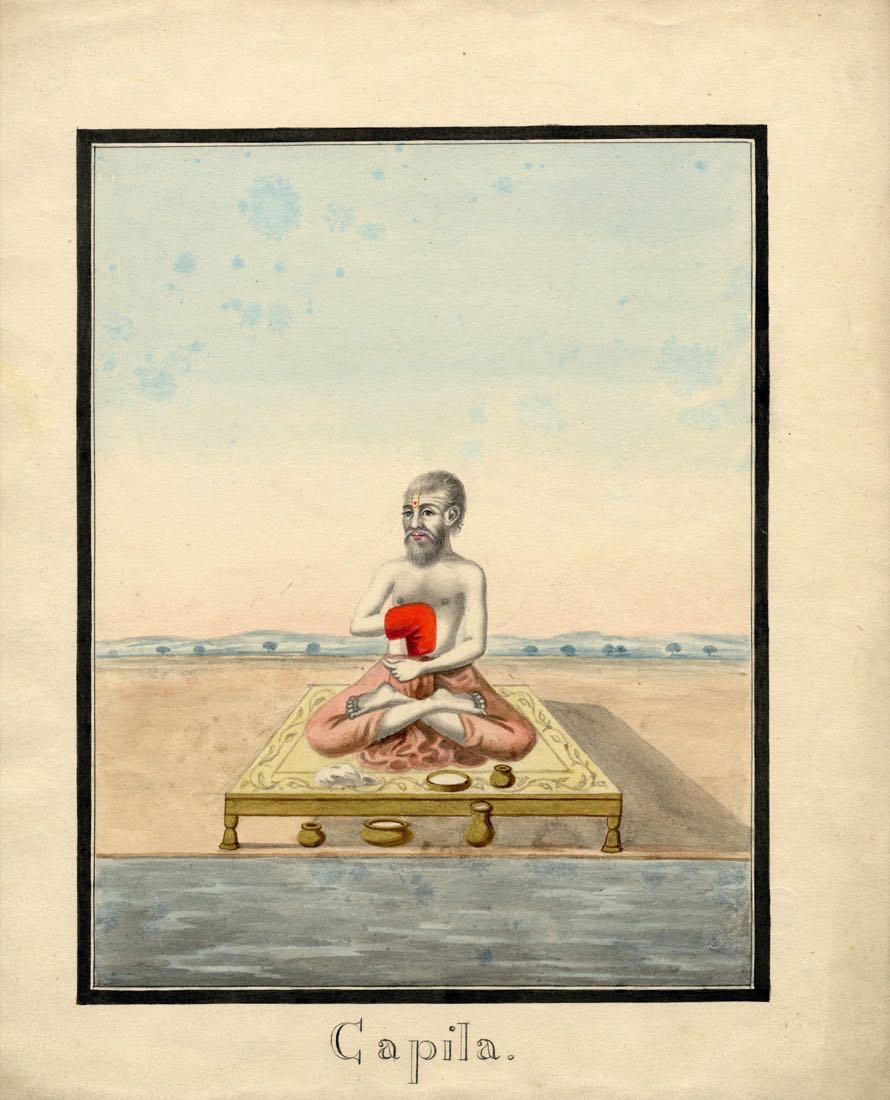
Sage Kapila: The Legendary Founder
Indian tradition unanimously credits the founding of Sāṃkhya to the sage Kapila (Sanskrit: कपिल), a figure shrouded in the mists of antiquity. The Śvetāśvatara Upaniṣad (5.2) refers to Kapila as a ṛṣi whom Brahman endowed with knowledge at the beginning of creation. The Bhāgavata Purāṇa (3.25-33) presents an elaborate account of Kapila as an incarnation of Viṣṇu who teaches the Sāṃkhya doctrine to his mother Devahūti, explaining the path of devotion intertwined with philosophical discrimination.
Kapila’s disciple Āsuri and Āsuri’s student Pañcaśikha are mentioned in classical sources as early transmitters of the tradition. However, no surviving text can be definitively attributed to Kapila himself. The Sāṃkhya Sūtras attributed to him are now generally regarded by scholars as a later medieval compilation (c. 14th-15th century CE) rather than an archaic original.
The Sāṃkhyakārikā of Īśvarakṛṣṇa
The earliest surviving systematic text of classical Sāṃkhya is the Sāṃkhyakārikā (सांख्यकारिका), composed by Īśvarakṛṣṇa (ईश्वरकृष्ण). Scholars date it broadly between the 3rd and 5th century CE, with many favouring c. 350 CE. Written in seventy-two concise verses (kārikā) in the āryā metre, it distils the entire Sāṃkhya system into a remarkably compact form.
Īśvarakṛṣṇa himself states at the end of his work that he has summarised the teachings of the Ṣaṣṭitantra (“Treatise of Sixty Topics”), an earlier comprehensive work now lost. The Sāṃkhyakārikā became the foundational text upon which all subsequent commentaries were built, including the Sāṃkhyatattvakaumudī of Vācaspati Miśra (9th century), the Yuktidīpikā (an anonymous early commentary rediscovered in the 20th century), and the Gauḍapādabhāṣya attributed to Gauḍapāda.
The Two Eternal Realities
Puruṣa: Pure Consciousness
Puruṣa (पुरुष) is pure, inactive, witnessing consciousness. It is eternal, unchanging, without qualities (nirguṇa), and utterly distinct from matter. Crucially, Sāṃkhya posits a plurality of Puruṣas — there is not one universal consciousness but innumerable individual spirits, each an independent witness. The Sāṃkhyakārikā (kārikā 18) argues for the multiplicity of Puruṣas from the diversity of births, deaths, and individual capacities observed in the world.
Puruṣa does not act, create, or undergo modification. It is the eternal seer (draṣṭṛ), the subject for whom all experience exists. The analogy often given is that of a lame person (Puruṣa, who sees but cannot move) mounted on a blind person (Prakṛti, who moves but cannot see) — together they navigate the world, though their natures remain fundamentally different.
Prakṛti: Primordial Nature
Prakṛti (प्रकृति) is the uncaused, eternal, unconscious material principle from which the entire manifest universe evolves. In its unmanifest state (avyakta or pradhāna), Prakṛti is a state of perfect equilibrium of three constituent qualities called guṇas. It is real, singular, and independent of Puruṣa, yet it “awakens” into creative activity only through proximity to consciousness.
Prakṛti is not inert dead matter in the Western sense; it is dynamic, creative, and contains within itself the blueprint of all possible manifestation. It is the source of both the physical world and the psychological apparatus — mind, ego, and intellect are all products of Prakṛti.
The Three Guṇas
The three guṇas are the fundamental constituents of Prakṛti. They are not substances but dynamic tendencies or qualities that are always present in varying proportions in all manifest reality:
- Sattva (सत्त्व) — the quality of lightness, illumination, clarity, and joy. It tends toward knowledge, purity, and equilibrium.
- Rajas (रजस्) — the quality of activity, passion, restlessness, and energy. It drives motion, desire, and exertion.
- Tamas (तमस्) — the quality of heaviness, inertia, darkness, and delusion. It tends toward ignorance, lethargy, and obstruction.
In the unmanifest state of Prakṛti, the three guṇas exist in perfect balance (sāmyāvasthā). Creation begins when this equilibrium is disturbed by the proximity of Puruṣa, causing the guṇas to interact in ever-changing combinations. Every manifest entity — from the subtlest intellect to the grossest physical element — is a particular configuration of these three qualities.
The Twenty-Five Tattvas
The systematic enumeration of twenty-five tattvas is the hallmark of Sāṃkhya. The first two are the eternal, unproduced realities:
- Puruṣa — consciousness (neither producer nor product)
- Prakṛti (pradhāna) — primordial nature (the ultimate producer, itself unproduced)
From Prakṛti, the following evolutes (vikāra) emerge in sequence:
- Mahat (or Buddhi) — the Great Principle, cosmic intellect, the capacity for discernment and determination
- Ahaṃkāra — ego-principle, the sense of individual identity (“I-maker”)
From Ahaṃkāra, evolution branches in three directions according to the predominance of each guṇa:
Sāttvika branch (from Ahaṃkāra influenced by Sattva):
5-9. Five Jñānendriyas (sense capacities) — hearing, touch, sight, taste, smell 10-14. Five Karmendriyas (action capacities) — speech, grasping, locomotion, excretion, reproduction 15. Manas — the coordinating mind
Tāmasika branch (from Ahaṃkāra influenced by Tamas):
16-20. Five Tanmātras (subtle elements) — sound, touch, form, taste, odour 21-25. Five Mahābhūtas (gross elements) — ether (ākāśa), air (vāyu), fire (tejas), water (āpas), earth (pṛthivī)
Rajas provides the energy necessary for both the sāttvika and tāmasika transformations but does not produce a separate class of evolutes.
This scheme of cosmic evolution (sṛṣṭi-krama) is not creation ex nihilo but transformation — the effect pre-exists in its cause, a doctrine known as satkāryavāda (the theory of the pre-existent effect). Specifically, Sāṃkhya upholds pariṇāmavāda — real transformation — asserting that Prakṛti genuinely transforms into its evolutes, unlike the Advaita Vedānta position of vivartavāda (illusory appearance).
Bondage and Liberation
The Problem: Misidentification
Suffering (duḥkha) arises because Puruṣa, though intrinsically free, becomes entangled with the products of Prakṛti through a fundamental confusion. The witnessing consciousness mistakes itself for the experienced — identifying with the body, the senses, the mind, and the ego. This misidentification is not a moral failing but a metaphysical error, comparable to the confusion between a crystal and the coloured flower placed near it: the crystal appears red though its nature is unchanged.
The Solution: Discriminative Knowledge
Liberation (kaivalya, literally “aloneness” or “isolation”) is achieved through viveka-jñāna — the discriminative knowledge that clearly distinguishes Puruṣa from Prakṛti. When this discrimination dawns, Puruṣa recognises itself as the ever-free witness, and Prakṛti, having fulfilled its purpose of providing experience and ultimately liberation, withdraws from manifestation with respect to that particular Puruṣa.
The Sāṃkhyakārikā (kārikā 59) offers a celebrated analogy: just as a dancer ceases to dance after having been seen by the audience, so Prakṛti ceases to manifest before Puruṣa once discrimination has been achieved. Liberation is not the destruction of Prakṛti or the merging of Puruṣa into some Absolute; it is the permanent cessation of misidentification — a return to the Puruṣa’s own nature of pure, contentless awareness.
Sāṃkhya’s Theory of Causation: Satkāryavāda
One of Sāṃkhya’s most distinctive contributions to Indian thought is its theory of causation. Satkāryavāda holds that the effect (kārya) pre-exists in its material cause (upādāna-kāraṇa) even before it is manifested. Oil exists latently in the sesame seed; curd exists latently in milk. Causation is therefore not the production of something new but the manifestation (āvirbhāva) of what was previously unmanifest (tirobhāva).
Īśvarakṛṣṇa offers five arguments for this position (Sāṃkhyakārikā 9): (1) what is non-existent cannot be produced; (2) there must be a material cause for the effect; (3) not everything can come from everything; (4) a cause can only produce what it is capable of; (5) the effect has the same nature as its cause.
Sāṃkhya and the Yoga School
Sāṃkhya and Yoga are traditionally regarded as twin or allied systems (samāna-tantra). Patañjali’s Yoga Sūtras adopt the Sāṃkhya metaphysical framework almost entirely — the dualism of Puruṣa and Prakṛti, the three guṇas, the enumeration of tattvas, and the goal of discriminative knowledge. The crucial difference is that Yoga introduces Īśvara (the Lord) as a special Puruṣa untouched by afflictions, karma, and its fruits (Yoga Sūtra 1.24), and it emphasises a practical discipline of meditation (dhyāna) and eight-limbed practice (aṣṭāṅga) rather than purely intellectual discrimination.
This pairing led to the common expression Sāṃkhya-Yoga in many classical texts, where the two are treated as complementary: Sāṃkhya provides the theoretical foundation and Yoga the practical method. The Bhagavad Gītā frequently invokes both together, as when Kṛṣṇa tells Arjuna: “Sāṃkhya and Yoga, the ignorant regard as distinct, not the wise. He who is established in even one of them obtains the fruit of both” (Gītā 5.4).
Sāṃkhya in the Bhagavad Gītā
The Bhagavad Gītā is deeply infused with Sāṃkhya thought. The very second chapter, titled Sāṃkhya Yoga, presents Kṛṣṇa’s initial teaching to Arjuna using distinctly Sāṃkhya language: the eternal, indestructible nature of the self (Puruṣa), the transient character of the body (a product of Prakṛti), and the need for discriminative understanding.
Chapter 13 (Kṣetra-Kṣetrajña Vibhāga Yoga) elaborates the distinction between the “field” (kṣetra — corresponding to Prakṛti and its evolutes) and the “knower of the field” (kṣetrajña — corresponding to Puruṣa). Chapter 14 offers an extended analysis of the three guṇas, describing their respective effects on character and conduct.
However, the Gītā ultimately transcends classical Sāṃkhya by incorporating theism (Kṛṣṇa as the Supreme Lord beyond both Puruṣa and Prakṛti) and by proposing bhakti (devotion) as a path alongside jñāna (knowledge) and karma (action) — elements absent from the original atheistic Sāṃkhya system.
Sāṃkhya’s Epistemology
Sāṃkhya accepts three valid means of knowledge (pramāṇa):
- Pratyakṣa (perception) — direct sensory apprehension of objects
- Anumāna (inference) — logical reasoning from the perceived to the unperceived (e.g., inferring fire from smoke)
- Āptavacana (reliable testimony) — the word of authoritative sources, including scripture (śabda)
This threefold epistemology is more restricted than that of, say, the Nyāya school (which accepts six pramāṇas) but broader than the Buddhist schools that often accept only perception and inference. The inclusion of testimony is essential for Sāṃkhya because the nature of Puruṣa and unmanifest Prakṛti lies beyond the reach of perception and inference alone — they must be known partly through the testimony of scripture and enlightened sages.
Historical Influence and Legacy
Sāṃkhya’s influence on Indian intellectual history is immense. Its concepts permeate virtually every area of Hindu thought:
- Medicine: Āyurveda draws on the Sāṃkhya framework, particularly the five mahābhūtas and the three guṇas, in its analysis of health and disease.
- Tantra: The tattva schemes of Śaiva and Śākta Tantra expand the original twenty-five tattvas of Sāṃkhya to thirty-six, adding categories to accommodate a theistic metaphysics.
- Vedānta: While Advaita Vedānta explicitly rejects Sāṃkhya’s dualism, it appropriates and reinterprets many Sāṃkhya concepts — guṇas, māyā (reconceived from Prakṛti), and the distinction between the self and the not-self.
- Modern Yoga: The understanding of the guṇas in diet, lifestyle, and psychology popularised in modern yoga culture traces directly to Sāṃkhya.
Though Sāṃkhya eventually declined as an independent school — absorbed on one side by Vedānta and on the other by Yoga — its conceptual vocabulary remains the shared inheritance of Indian philosophy. Whenever a Hindu text speaks of sattva, rajas, and tamas, of Puruṣa and Prakṛti, of the five elements and the sense faculties, it speaks the language of Sāṃkhya.
As the Mahābhārata (Śāntiparvan 301.110) declares: “There is no knowledge equal to Sāṃkhya, and no power equal to Yoga.”