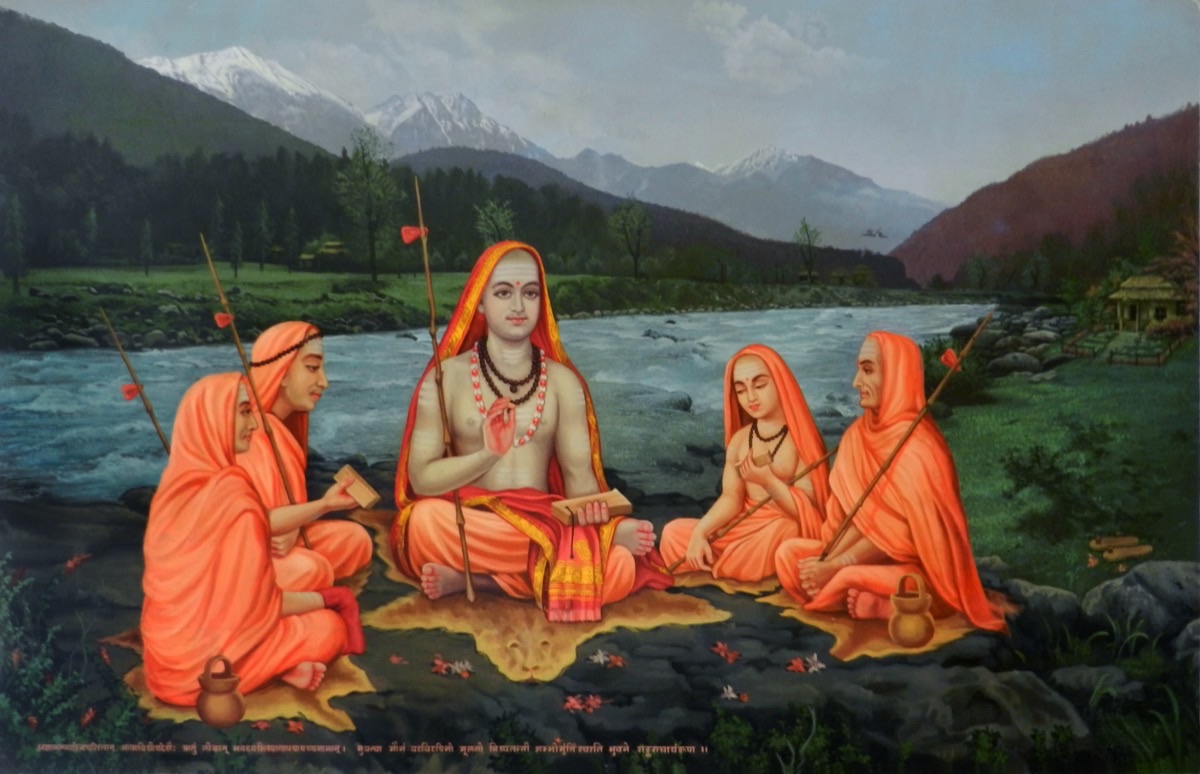
Introduction: The Crown Jewel Among Spiritual Texts
The Vivekacūḍāmaṇi (Sanskrit: विवेकचूडामणि) — literally “The Crest-Jewel of Discrimination” — is one of the most celebrated and widely studied texts in the Advaita Vedānta tradition of Hinduism. Traditionally attributed to Ādi Śaṅkarācārya (c. 788-820 CE), this luminous Sanskrit poem of 580 verses presents a comprehensive guide to self-realisation through the cultivation of viveka, the faculty of discrimination between the Real (sat) and the unreal (asat).
The title itself is deeply symbolic. In classical Indian culture, the cūḍāmaṇi — the jewel worn upon the crest of the head — was the most precious ornament a king or noble could possess. By naming discrimination the “crest-jewel,” the text declares that viveka is the supreme adornment of the human intellect and the single most important quality a spiritual aspirant can develop. Without discrimination, no amount of ritual, austerity, or learning can lead to liberation. With it, the seeker possesses the master key to all spiritual attainment.
Swami Chinmayananda, one of the foremost modern commentators, declared that the Vivekacūḍāmaṇi “contains the distilled wisdom from the Upaniṣads and Bhagavad Gītā and presents it in a systematic readable form for a seeker of liberation,” adding that “no other help is needed” beyond this single text for the quest to mokṣa.
Authorship and Dating: A Scholarly Debate
The Traditional View
Hindu tradition universally attributes the Vivekacūḍāmaṇi to Ādi Śaṅkarācārya, the great philosopher-saint who revitalised Vedāntic thought across the Indian subcontinent in the 8th century CE. The Śṛṅgeri, Kāñcī, and other Śaṅkara maṭhas (monastic institutions) treat it as an authentic work of their founding ācārya, and for centuries it has been studied alongside his commentaries (bhāṣyas) on the Prasthānatrayī — the Upaniṣads, Brahma Sūtras, and Bhagavad Gītā.
Modern Scholarly Challenges
Modern academic scholarship, however, has raised significant questions about this attribution. Michael Comans, a specialist in Advaita Vedānta, identifies several reasons for doubt:
-
Poetic style: The highly ornate, lyrical style of the Vivekacūḍāmaṇi, composed primarily in the elaborate śārdūlavikrīḍita (tiger’s play) metre, is markedly different from the sober, analytical prose of Śaṅkara’s authenticated commentaries.
-
Absence of early commentaries: Unlike Śaṅkara’s bhāṣyas, which generated extensive sub-commentaries (ṭīkās and vārttikas) soon after their composition, the Vivekacūḍāmaṇi lacks such early commentarial traditions.
-
Emphasis on nirvikalpa samādhi: The text places special importance on nirvikalpa samādhi (objectless meditative absorption) as a means to liberation — a theme largely absent from Śaṅkara’s authenticated works, which emphasise jñāna (knowledge) alone as the direct means to mokṣa.
Professor John Grimes, known for his translation and study of the text, notes that “modern scholars tend to reject that Ādi Śaṅkara composed the Vivekacūḍāmaṇi, while traditionalists tend to accept it.” Comans concludes that it is “probably the work of a later Śaṅkara” — perhaps one of the later pontiffs of the Śaṅkara monastic lineages who bore the same title. Another scholarly theory suggests it may be “a corporately authored work of Advaita monasteries that went through revisions.”
Grimes himself, however, argues that a strong case can still be made for Śaṅkara’s authorship, noting that the text “addresses a different audience and has a different emphasis and purpose” compared to the formal commentaries — it is a practical guide for seekers, not an academic philosophical treatise.
Whatever its precise origin, the Vivekacūḍāmaṇi remains one of the most authoritative prakaraṇa granthas (introductory treatises) of the Advaita tradition, and its philosophical content is entirely consistent with Śaṅkara’s core teachings.
Structure: A Transformative Dialogue
The Vivekacūḍāmaṇi unfolds as a dialogue between two characters: a guru (spiritual teacher) and a śiṣya (disciple). The disciple, tormented by the suffering of worldly existence (saṃsāra), approaches the teacher in utter humility and pleads for guidance on how to cross the ocean of birth and death.
The text can be broadly divided into several thematic sections:
- Verses 1-19: Salutation, the rarity of human birth, and the qualifications required of a seeker.
- Verses 20-71: The nature of bondage; what must be known before inquiry can begin.
- Verses 72-198: Discrimination of the Self from the body, the prāṇas, the senses, the mind, and the five sheaths.
- Verses 199-319: The nature of Brahman, the meaning of tat tvam asi (“Thou art That”), and the analysis of the three states of consciousness.
- Verses 320-445: The process of meditation, samādhi, and the dissolution of ignorance.
- Verses 446-555: The characteristics of a jīvanmukta (one liberated while living) and the nature of ultimate freedom.
- Verses 556-580: The disciple’s awakening, his song of realisation, and the teacher’s final blessing.
This structure mirrors the traditional Vedāntic process of śravaṇa (hearing), manana (reflection), and nididhyāsana (deep meditation) that leads a qualified student from ignorance to enlightenment.
Sādhana Catuṣṭaya: The Four Prerequisites
Before plunging into the philosophical depths, the Vivekacūḍāmaṇi insists that a seeker must first develop certain qualifications. In verse 19, the text enumerates the sādhana catuṣṭaya — the “fourfold means” or four prerequisites:
1. Viveka (Discrimination)
The capacity to distinguish between the eternal (nitya) and the ephemeral (anitya). Verse 20 provides the classic definition:
brahma satyaṃ jaganmithyā ityevaṃrūpo viniścayaḥ | so’yaṃ nityānityavastuvivekaḥ samudāhṛtaḥ ||
“A firm conviction of the mind that Brahman is real and the universe unreal — this is designated as the discrimination between the Real and the unreal.”
2. Vairāgya (Dispassion)
Detachment from the enjoyment of the fruits of action, both in this world and in higher realms. This is not hatred of the world but a natural loosening of dependence upon it, born of the recognition that no external gain can confer lasting fulfilment.
3. Śamādi-Ṣaṭka-Sampatti (The Sixfold Discipline)
A collection of six inner virtues:
- Śama: Mastery of the mind, the ability to withdraw it from sense objects.
- Dama: Control of the external sense organs.
- Uparati: Cessation from worldly activities; natural withdrawal from distractions.
- Titikṣā: Endurance of dualities — heat and cold, pleasure and pain, praise and censure — without agitation.
- Śraddhā: Faith in the words of the guru and the scriptures.
- Samādhāna: One-pointedness of the mind; the ability to remain steadily focused on the object of inquiry.
4. Mumukṣutva (Burning Desire for Liberation)
An intense, consuming longing for freedom from the cycle of birth and death. Without this driving force, the other qualifications remain inert.
The text further declares in verse 3 that three things are supremely rare and come only by divine grace:
durlabhaṃ trayamevaitaddevānugrahahetukam | manuṣyatvaṃ mumukṣutvaṃ mahāpuruṣasaṃśrayaḥ ||
“Three things are rare indeed and come only by the grace of God: a human birth, the longing for liberation, and the protecting care of a perfected sage.”
Core Philosophy: Discrimination Between the Real and the Unreal
The philosophical heart of the Vivekacūḍāmaṇi rests on the foundational Advaita insight that Brahman alone is real (satyam), the world is appearance (mithyā), and the individual self is none other than Brahman (jīvo brahmaiva nāparaḥ). Every verse in the text either establishes, illustrates, or draws out the consequences of this triple declaration.
Māyā and Avidyā: The Veil of Ignorance
The text explains that māyā (cosmic illusion) is the creative power of Brahman, beginningless and composed of the three guṇas — sattva, rajas, and tamas. It is neither real nor unreal, and it is this māyā that projects the entire phenomenal universe upon the substratum of Brahman.
At the individual level, māyā operates as avidyā (nescience or ignorance). The text draws an important distinction: māyā is the cosmic determining factor (upādhi) that makes Brahman appear as Īśvara (the Lord), while avidyā is the individual determining factor that makes Brahman appear as the jīva (individual soul). The crucial teaching is that apart from the mind, there is no ignorance. The mind itself is the ignorance that causes the bondage of rebirth.
The Famous Rope-Snake Analogy
Perhaps the most celebrated illustration in all of Advaita Vedānta appears prominently in the Vivekacūḍāmaṇi: the rajju-sarpa (rope-snake) analogy. A traveller walking along a path at dusk perceives a coiled rope and mistakes it for a snake. Terrified, he experiences genuine suffering — trembling, racing heart, the impulse to flee. Yet the snake never existed. The moment someone brings a lamp and the traveller sees the rope for what it truly is, the snake vanishes instantaneously, and with it all the fear and suffering.
The text states:
“One who mistakes a rope for a serpent is cast into fear thereby, and his fear and distress can be removed only by the knowledge that it is a rope.”
So too does the jīva superimpose the world of multiplicity, birth, death, and suffering upon the non-dual Brahman. This superimposition (adhyāsa) is not a deliberate act but the natural operation of avidyā. And just as the rope does not become a snake, Brahman never truly becomes the world. The cure is not action but knowledge — the direct, immediate recognition (aparokṣa jñāna) of one’s true nature as Brahman.
The Five Sheaths (Pañca Kośa): Peeling Away the Layers
One of the most systematic sections of the Vivekacūḍāmaṇi is its analysis of the pañca kośa (five sheaths) that envelope the Self, originally described in the Taittirīya Upaniṣad. The guru leads the disciple through each sheath, demonstrating that none of them is the true Self:
1. Annamaya Kośa (The Food Sheath)
The physical body, made of food, sustained by food, and returning to food (earth) at death. It is inert matter and cannot be the Self, which is pure consciousness.
2. Prāṇamaya Kośa (The Vital Air Sheath)
The five prāṇas (vital airs) that animate the body. Though they give the body the appearance of life, they are unconscious forces and cannot be the knowing Self.
3. Manomaya Kośa (The Mental Sheath)
The mind (manas) together with the five organs of knowledge. This sheath is responsible for the sense of “I” and “mine” and permeates the two outer sheaths. Despite its capacity for thought, it is subject to constant change and therefore cannot be the immutable Self.
4. Vijñānamaya Kośa (The Intellectual Sheath)
The intellect (buddhi) combined with the organs of knowledge. It reflects the light of consciousness most clearly and is often mistaken for the Self itself. Yet it too is an object of awareness, subject to modification, and therefore not the ultimate witness.
5. Ānandamaya Kośa (The Bliss Sheath)
The causal body, associated with deep sleep and the experience of bliss. Though closest to the Self, it is still a modification of avidyā conditioned by sattva guṇa. The Self transcends even bliss as an experience, being bliss itself (ānanda svarūpa).
Through this systematic negation (neti neti — “not this, not this”), the seeker arrives at what remains when all five sheaths are set aside: pure, unconditioned Awareness — the Ātman that is identical with Brahman.
The Path to Liberation
The Vivekacūḍāmaṇi outlines a clear soteriological path:
-
Recognition of bondage: The seeker must first acknowledge that worldly existence, however comfortable, is ultimately characterised by suffering and impermanence.
-
Approach a qualified guru: The text is emphatic that self-realisation cannot be achieved through books alone. A living teacher who has directly realised Brahman is essential.
-
Śravaṇa (Hearing): The disciple hears the teaching of the mahāvākyas — the great utterances of the Upaniṣads such as tat tvam asi (“Thou art That”) and ahaṃ brahmāsmi (“I am Brahman”).
-
Manana (Reflection): Through rational inquiry and the removal of doubts, the seeker establishes the teaching firmly in the intellect.
-
Nididhyāsana (Meditation): Sustained contemplation dissolves the deep-seated impressions (vāsanās) that obstruct direct experience.
-
Aparokṣa Jñāna (Direct Knowledge): The dawn of immediate, non-mediated Self-knowledge. This is not a new acquisition but the removal of ignorance that was concealing what was always present.
The culmination is jīvanmukti — liberation while still embodied. The Vivekacūḍāmaṇi devotes many beautiful verses to describing the state of the jīvanmukta: one who moves through the world like a person who has awakened from a dream, untouched by the play of the guṇas, established permanently in the awareness that “I am Brahman.”
Selected Key Verses
Beyond those already cited, several verses stand out for their crystalline clarity:
On the rarity of this opportunity (Verse 2):
“Among sentient creatures, birth as a human being is rare; among human beings, the inclination towards the path of Vedic dharma is rarer; among these, scholarship is still rarer; discrimination between the Self and the not-Self, direct experience of one’s identity with Brahman, and liberation — these are not to be attained without the meritorious deeds of a hundred crore births.”
On the futility of action without knowledge (Verse 6):
“Reading the scriptures is useless as long as the highest Truth is unknown, and it is equally useless when the highest Truth has already been known. The scriptures are like a dense forest in which the mind loses its way.”
On the nature of bondage (Verse 137):
“The bondage of a man arises from nothing other than his sense of ‘I’ in relation to things that are not the Self.”
On the nature of Brahman (Verse 263):
“Brahman is the one Reality that remains after the negation of names and forms. It is non-dual, complete, infinite, beginningless and endless — Existence-Consciousness-Bliss Absolute.”
Influence on Modern Vedānta Teachers
The Vivekacūḍāmaṇi has exerted a profound influence on the modern Hindu renaissance and on teachers who brought Vedāntic wisdom to a global audience.
Śrī Ramaṇa Maharṣi (1879-1950) held the text in the highest regard, translating the entire Vivekacūḍāmaṇi into Tamil for the benefit of devotees who could not read Sanskrit. He stated that the text “contains in detail all the points required for a seeker of liberation” and frequently recommended it to those who sought his guidance on self-inquiry (ātma-vicāra).
Swami Vivekānanda (1863-1902) drew deeply on the text’s teachings about discrimination and dispassion. The later Advaita tradition’s emphasis on samādhi as a liberative means, strongly present in the Vivekacūḍāmaṇi, shaped Vivekānanda’s teaching significantly.
Swami Chinmayānanda (1916-1993) wrote an extensive verse-by-verse commentary and conducted numerous lecture series on the text, making it one of the foundational study texts of the Chinmaya Mission worldwide. His commentary remains one of the most accessible introductions to the work.
Swami Sarvapriyananda and other contemporary Vedāntic teachers continue to offer systematic expositions of the Vivekacūḍāmaṇi, testifying to its enduring pedagogical power.
Comparison with the Upadeśa Sāhasrī
The Upadeśa Sāhasrī (“A Thousand Teachings”) is the one independent treatise (prakaraṇa grantha) universally accepted by scholars as an authentic work of Ādi Śaṅkarācārya. Comparing the two texts illuminates their distinct characters:
| Aspect | Vivekacūḍāmaṇi | Upadeśa Sāhasrī |
|---|---|---|
| Authorship | Debated | Universally accepted as Śaṅkara’s |
| Style | Highly poetic, śārdūlavikrīḍita metre | Partly verse, partly prose; analytical |
| Format | Continuous guru-disciple dialogue | Non-systematic; addresses topics from multiple angles |
| Emphasis | Practical sādhana; nirvikalpa samādhi | Jñāna (knowledge) as the sole means |
| Audience | Seekers wanting a step-by-step path | Students of philosophical inquiry |
| Length | 580 verses | ~1,000 verses + 3 prose chapters |
Where the Upadeśa Sāhasrī is concerned primarily with how to teach the means of liberation, the Vivekacūḍāmaṇi is a self-teaching manual that walks alongside the seeker from initial despair to final freedom. The two texts complement each other beautifully: the Upadeśa Sāhasrī provides the rigorous philosophical foundation, while the Vivekacūḍāmaṇi offers the passionate, experiential dimension.
Conclusion: The Living Jewel
The Vivekacūḍāmaṇi endures because it speaks to a universal human condition: the search for lasting peace amid the transience of worldly experience. Its opening verse reminds us that a human birth is a rare gift, and its final verses describe the boundless freedom that awaits when the seeker recognises the Self as it truly is — not the body, not the mind, not the five sheaths, but the infinite, non-dual Brahman.
As the disciple, having received the teaching, declares in one of the text’s most moving passages:
“Where has this universe gone? By whom has it been taken away? Into what has it been dissolved? This is wonderful! In this ocean of Brahman, filled with the nectar of absolute bliss, what is to be accepted and what to be rejected? Nothing other than the Self exists here, and nothing different from It is perceived.”
For seekers in every age, the Vivekacūḍāmaṇi remains what its name declares it to be — the crest-jewel among spiritual texts, illuminating the supreme discrimination by which the Self is known and the chains of ignorance are dissolved forever.