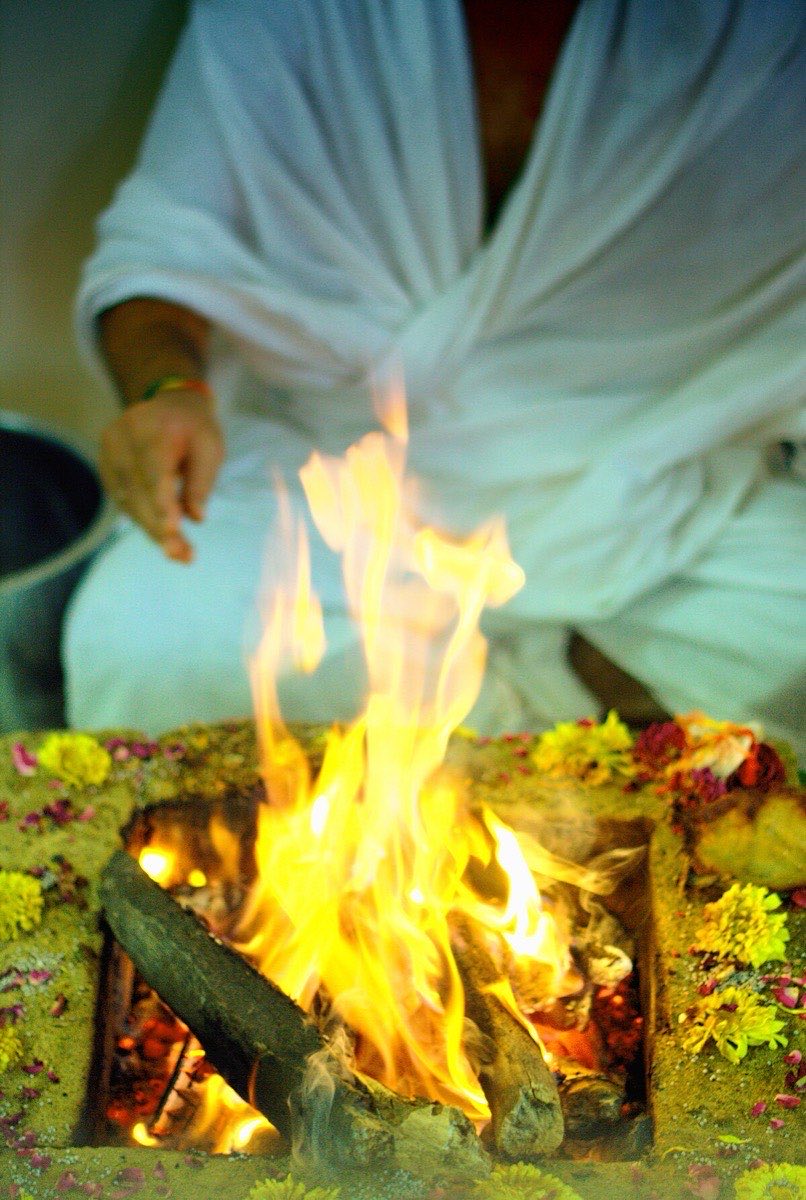
Yajña (यज्ञ, “sacrifice, worship, offering”) stands as one of the most ancient and enduring ritual practices in Hinduism. From the earliest hymns of the Ṛg Veda to the havan ceremonies performed in Indian homes today, the act of making offerings into a consecrated fire has remained central to Hindu religious life for over three millennia. The yajña is not merely a ritual procedure; it is a profound theological act — a bridge between the human and the divine, mediated by Agni, the sacred fire who serves as the messenger of the gods.
Etymology and Meaning
The Sanskrit word yajña derives from the root yaj, meaning “to worship, to sacrifice, to offer.” It is cognate with the Avestan yasna (the central Zoroastrian liturgy), reflecting a shared Indo-Iranian heritage of fire worship that predates both traditions. The related terms homa (होम), havana (हवन), and āhuti (आहुति, “oblation”) all describe aspects of the fire offering, though in modern usage havan and homa have become the most common words for domestic and temple fire ceremonies respectively.
In its broadest sense, yajña encompasses any act of worship or devotional offering. The Śatapatha Brāhmaṇa (1.7.1.5) declares: “Yajña is Viṣṇu” (yajño vai Viṣṇuḥ), identifying the sacrifice itself with the supreme deity and elevating it from a ritual act to a cosmic principle. The Taittirīya Saṃhitā further states that yajña is the navel (nābhi) of the universe — the central axis around which the cosmic order revolves.
Vedic Origins: Fire as the Heart of Worship
The practice of yajña is as old as the Vedas themselves. The Ṛg Veda, the earliest of the four Vedas (composed approximately 1500-1200 BCE), opens with a hymn to Agni:
Agním īḷe puróhitaṃ yajñásya devám ṛtvíjam — “I praise Agni, the chosen priest, the divine minister of the sacrifice” (Ṛg Veda 1.1.1).
This opening verse establishes the foundational relationship between fire, sacrifice, and divine communication. In the Vedic worldview, Agni (अग्नि) occupies a unique position among the deities. He is simultaneously the fire on the altar, the fire in the belly that digests food, the fire of the sun, and the cosmic fire of creation. As the priest (purohita) of the gods, Agni receives the oblations poured into the fire and carries them upward to the celestial realm, making him the indispensable intermediary between mortals and devas (Britannica - Agni).
The Vedic yajña was an elaborate communal affair. Major śrauta (solemn, public) sacrifices required a team of specialized priests, each with distinct roles:
- Hotṛ (होतृ) — the reciter of Ṛg Veda hymns, who invokes the gods
- Adhvaryu (अध्वर्यु) — the officiant who performs the physical ritual actions, guided by the Yajur Veda
- Udgātṛ (उद्गातृ) — the chanter of Sāma Veda melodies
- Brahmā (ब्रह्मा) — the supervising priest who silently oversees the entire ceremony, correcting errors through the power of the Atharva Veda
The ritual space itself was meticulously constructed, with three sacred fires maintained throughout: the Gārhapatya (household fire, circular), the Āhavanīya (offering fire, square, facing east), and the Dakṣiṇa (southern fire, semicircular, for protection against malevolent forces) (Wikipedia - Śrauta).
Major Types of Yajña
The Vedic tradition classifies fire sacrifices into numerous categories, from simple daily offerings to grand imperial ceremonies spanning months or years.
Agnihotra: The Daily Fire Offering
The Agnihotra (अग्निहोत्र) is the simplest and most fundamental of all Vedic fire rituals. Performed twice daily — at sunrise and sunset — by a householder who maintains the sacred fires, it involves the offering of milk (or ghee) into the fire while reciting specific mantras. The Śatapatha Brāhmaṇa (2.3.1.1) describes the Agnihotra as the foundation upon which all other sacrifices rest. Despite its simplicity, it embodies the core principle of yajña: a disciplined, daily act of giving that sustains the cosmic order (ṛta) (Britannica - Agnihotra).
Darśapūrṇamāsa: New and Full Moon Sacrifices
The Darśapūrṇamāsa rites were performed on the new moon (darśa) and full moon (pūrṇamāsa) days. These fortnightly ceremonies, more elaborate than the Agnihotra, involved offerings of grain cakes (puroḍāśa), milk, and butter into the sacred fires. They represent the basic model for all iṣṭi (offering) rituals.
Soma Yajña: The Soma Sacrifice
Among the most celebrated Vedic rituals, the Soma Yajña involved the pressing, purification, and offering of the sacred soma juice — an intoxicating ritual beverage praised extensively in the Ṛg Veda (the entire ninth maṇḍala is devoted to soma). The Agniṣṭoma, the simplest form of soma sacrifice, lasted one day and required the participation of all four categories of priests. More elaborate soma rituals — such as the Atirātra (overnight) and Dvādaśāha (twelve-day) — extended the ceremony over progressively longer periods.
Aśvamedha: The Horse Sacrifice
The Aśvamedha (अश्वमेध, “horse sacrifice”) was the grandest of all Vedic royal rituals, undertaken only by the most powerful kings to assert sovereign authority over an entire realm. A consecrated stallion was set free to roam for one year, followed by the king’s army. Any territory the horse traversed unchallenged became part of the king’s dominion. At the year’s end, the horse was sacrificed in an elaborate three-day ceremony accompanied by extensive recitations and offerings. The Śatapatha Brāhmaṇa (13.1-5) devotes extensive sections to the Aśvamedha, describing its power to absolve the king of all sins and establish universal sovereignty. The ritual is memorably described in the Rāmāyaṇa, where King Daśaratha performs the Aśvamedha to obtain sons.
Rājasūya: The Royal Consecration
The Rājasūya (राजसूय) was a consecration sacrifice performed to establish a king’s supremacy. It involved a series of rituals spanning over a year, including ceremonial chariot races, cattle raids, and offerings to multiple deities. The Mahābhārata’s account of Yudhiṣṭhira’s Rājasūya sacrifice — and Duryodhana’s burning jealousy upon witnessing it — is one of the pivotal episodes that sets the great war in motion.
Vājapeya: The Drink of Strength
The Vājapeya (वाजपेय, “drink of strength”) was a one-day soma sacrifice featuring a chariot race among seventeen chariots, symbolizing the sun’s supremacy. It was performed by both kings and brāhmaṇas seeking spiritual and temporal power.
The Procedure of Havan: A Living Tradition
While the grand śrauta sacrifices have largely faded from practice, the havan (हवन) or homa (होम) — the simpler domestic fire ceremony — remains vibrantly alive across Hindu households and temples. A typical havan follows a structured sequence:
-
Saṅkalpa (संकल्प) — Declaration of intent, in which the performer states the purpose, time, place, and recipient deities of the offering.
-
Agni Pratiṣṭhā (अग्नि प्रतिष्ठा) — Establishment of the sacred fire in the kuṇḍa (fire pit), typically using dried cow-dung cakes, camphor, and ghee.
-
Āvāhana (आवाहन) — Invocation of Agni and the presiding deities into the fire.
-
Pradhāna Āhuti (प्रधान आहुति) — The main offerings, which may include ghee (ghṛta), grains (anna), sesame seeds (tila), sacred herbs (samidh), and fragrant materials. Each offering is accompanied by a mantra concluding with the word svāhā (स्वाहा, “well offered!”), the ritual exclamation that consecrates the oblation.
-
Pūrṇāhuti (पूर्णाहुति) — The final, complete offering, often a coconut or large measure of ghee, symbolizing the total surrender of the self.
-
Śānti Pāṭha (शान्ति पाठ) — Concluding peace invocations, typically including the chanting of Oṃ śāntiḥ śāntiḥ śāntiḥ.
The fire pit (kuṇḍa) itself carries symbolic significance. The traditional yajña kuṇḍa is an inverted pyramid shape, though square, circular, and lotus-shaped kuṇḍas are also prescribed for specific purposes (Sanskrit.org).
Philosophical Transformation: Yajña in the Bhagavad Gītā
The concept of yajña underwent a profound philosophical transformation in the post-Vedic period. The Upaniṣads began to internalize the fire sacrifice, reinterpreting external ritual as metaphor for inner spiritual processes. The Chāndogya Upaniṣad (5.4-8) describes the pañcāgnividyā (“doctrine of five fires”), in which the entire cosmos — from the heavenly world to the human body — is understood as a series of sacrificial fires.
This interiorization reaches its fullest expression in the Bhagavad Gītā, Chapter 4 (Jñāna Yoga), where Śrī Kṛṣṇa radically expands the meaning of yajña beyond the fire altar:
brahmārpaṇaṃ brahma havir brahmāgnau brahmaṇā hutam / brahmaiva tena gantavyaṃ brahmakarmasamādhinā — “The act of offering is Brahman, the offering itself is Brahman, offered by Brahman into the fire of Brahman. Brahman alone is attained by one who is absorbed in Brahman through action.” (Gītā 4.24)
In verses 4.25-33, Kṛṣṇa enumerates twelve types of yajña that transcend the literal fire ritual:
- Deva-yajña — worship of the gods through ritual offerings
- Brahma-yajña — offering the self into the fire of the Absolute
- Indriya-yajña — offering the senses into the fire of self-restraint
- Prāṇa-yajña — breath control (prāṇāyāma) as sacrifice
- Dravya-yajña — sacrifice through material charity
- Tapo-yajña — sacrifice through austerity and penance
- Yoga-yajña — sacrifice through the discipline of yoga
- Svādhyāya-yajña — sacrifice through the study of scripture
- Jñāna-yajña — the sacrifice of knowledge, declared by Kṛṣṇa as the highest of all sacrifices (4.33)
This teaching transformed yajña from an exclusively priestly, ritual act into a universal spiritual principle: any disciplined act of self-offering, performed with devotion and detachment, constitutes a true sacrifice (Vedabase - BG Chapter 4).
The Five Great Sacrifices (Pañca Mahāyajña)
The Dharmasūtras and Manusmṛti (3.67-71) prescribe five daily sacrifices that every householder should perform, known as the Pañca Mahāyajña:
- Brahma Yajña (ब्रह्मयज्ञ) — Teaching and studying the Vedas, honouring the ṛṣis
- Deva Yajña (देवयज्ञ) — Offerings to the gods through the homa fire
- Pitṛ Yajña (पितृयज्ञ) — Offerings of water and food (tarpaṇa) to the ancestors
- Manuṣya Yajña (मनुष्ययज्ञ) — Hospitality to guests (atithi-satkhāra)
- Bhūta Yajña (भूतयज्ञ) — Offerings to all living beings, including animals and nature
These five daily sacrifices reflect the Hindu understanding that human life is sustained by a web of debts (ṛṇa) — to the gods, sages, ancestors, fellow humans, and all creatures — and that yajña is the means by which these debts are honoured.
Scientific and Environmental Perspectives
Modern research has explored the potential environmental and health effects of havan ceremonies. The burning of specific herbs and medicinal plants prescribed in the Vedic tradition — including mango wood (āmra), guggulu (Indian bdellium), sandalwood, and camphor — releases volatile organic compounds that have been studied for antimicrobial properties. A 2007 study published in the journal Ethnopharmacology found that a one-hour havan using a traditional medicinal herb mixture reduced airborne bacterial counts by up to 94% in a closed room, with effects persisting for over 24 hours.
The Agni Purāṇa and Suśruta Saṃhitā both describe the purification of the atmosphere through ritual fire as a means of preventing disease — an understanding that, while expressed in theological language, anticipates modern fumigation science.
However, these findings remain subjects of ongoing scientific debate. Environmental concerns about smoke emissions from large-scale yajñas have also emerged, prompting some communities to adopt eco-friendly modifications, such as using smaller kuṇḍas, reducing ghee quantities, and incorporating air-purifying herbs.
Yajña in Contemporary Practice
The fire ritual continues to occupy a central place in Hindu religious life across the world:
-
Saṃskāras (life-cycle rituals): The sacred fire is indispensable in Hindu weddings (vivāha), where the couple takes the seven steps (saptapadī) around the fire. It is also present in the naming ceremony (nāmakaraṇa), sacred thread ceremony (upanayana), and last rites (antyeṣṭi).
-
Temple rituals: Daily homa ceremonies are performed in temples across India, particularly in the South Indian Āgamic tradition. The Atharva Veda-based agnicayana (fire altar construction) tradition survives in parts of Kerala, where Nambūdiri Brahmins perform this elaborate twelve-day Vedic ritual — recognized by UNESCO scholars as one of the world’s oldest surviving ritual traditions.
-
Navagrahā Homa: Fire rituals to propitiate the nine planetary deities remain popular for astrological purposes.
-
Gaṇapati Homa, Mṛtyuñjaya Homa, Sudarśana Homa: Specific fire rituals dedicated to particular deities or purposes continue to be performed by priests and households alike.
-
Global diaspora: Hindu communities in the Americas, Europe, Africa, and Southeast Asia regularly perform havan ceremonies, adapting the tradition to apartment settings with portable kuṇḍas and reduced-smoke techniques.
The Eternal Fire
From the first hymn of the Ṛg Veda to the havans performed in living rooms across the globe today, the sacred fire has burned continuously in Hindu consciousness for over three thousand years. The yajña embodies a fundamental insight of Vedic wisdom: that the universe itself is sustained by sacrifice, by the mutual giving between the human and the divine, between the visible and the invisible. As the Bhagavad Gītā (3.14-15) declares:
annād bhavanti bhūtāni parjanyād annasambhavaḥ / yajñād bhavati parjanyo yajñaḥ karmasamudbhavaḥ — “All beings arise from food; food arises from rain; rain arises from sacrifice; sacrifice arises from action.”
In this vision, yajña is not merely a ritual — it is the cosmic engine of existence, the sacred cycle of offering and receiving that keeps the worlds in motion. Whether performed as an elaborate Vedic ceremony with four priests and three fires, or as a simple havan in a household courtyard with a handful of ghee and a whispered svāhā, the yajña remains what it has always been: humanity’s oldest and most enduring conversation with the divine.