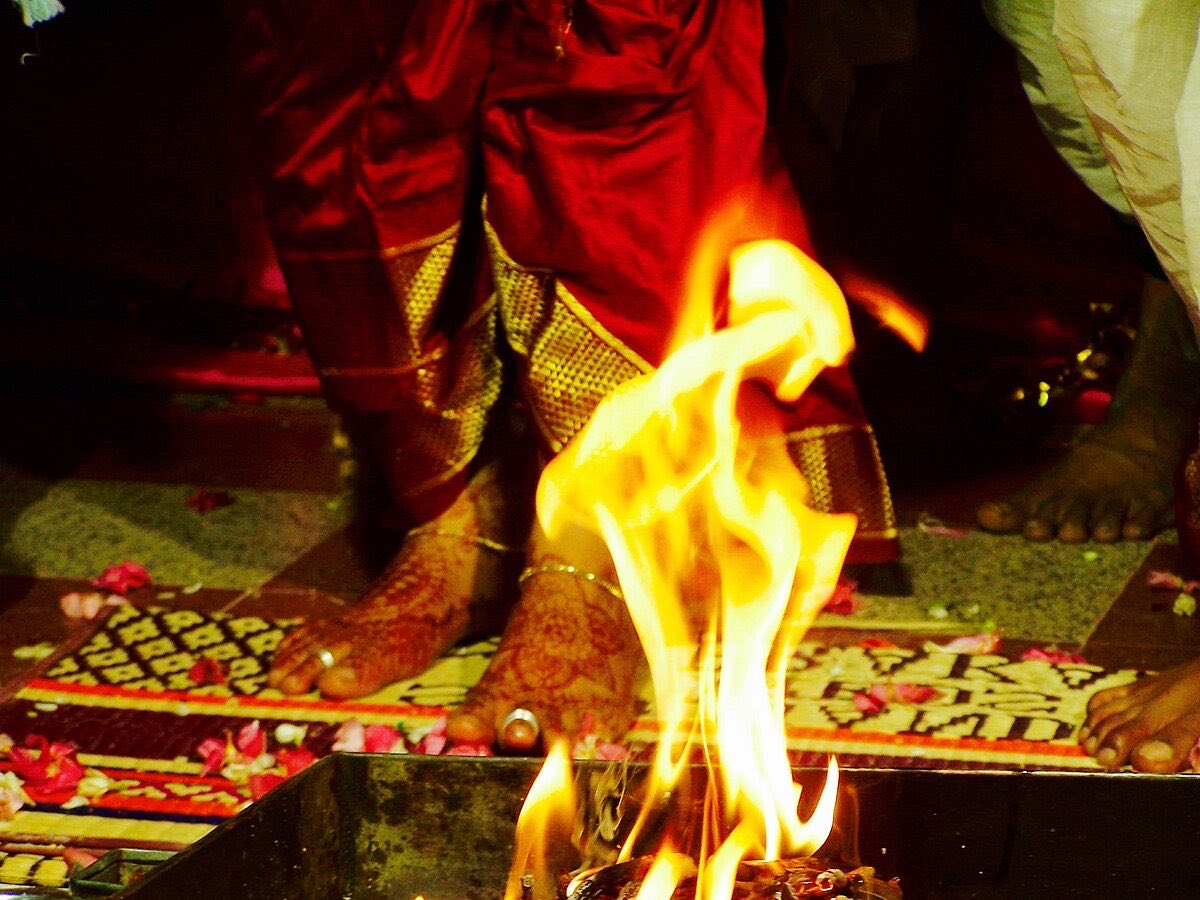
Vivāha (विवाह, “marriage”) is one of the most sacred and elaborate of the sixteen saṃskāras (life-cycle sacraments) in Hinduism. Far more than a legal contract or social agreement, a Hindu wedding is a spiritual covenant — a sacred fire ceremony in which the couple takes vows before Agni (the fire god) as the eternal divine witness. The marriage bond, once sealed through the Saptapadī (seven steps around the sacred fire), is considered inviolable and, in many Hindu traditions, extends beyond a single lifetime.
The roots of Hindu marriage rituals extend back over three millennia to the Vedic period. The procedures are prescribed in the Gṛhyasūtras — domestic ritual manuals composed by sages such as Āśvalāyana, Āpastamba, Baudhāyana, and Gobhila — and elaborated upon in the Dharmaśāstras, particularly the Manusmṛti. Yet despite this ancient and codified heritage, Hindu wedding rituals display remarkable regional diversity, with traditions in Tamil Nadu, Bengal, Maharashtra, Kashmir, and other regions each contributing their own distinctive ceremonies, customs, and aesthetic expressions.
Marriage as Saṃskāra: The Philosophical Foundation
In Hindu thought, marriage is not merely a social institution but a dharmic obligation and a path to spiritual growth. The Taittirīya Brāhmaṇa (2.2.2.6) declares that a man is incomplete without a wife: jāyā ardhaṃ vā eṣa ātmanaḥ — “The wife is half of a man’s very self.” The Śatapatha Brāhmaṇa echoes this sentiment, stating that the husband and wife together constitute a complete sacrificial unit, and that no ritual can be performed by an unmarried person.
The Gṛhastha āśrama (householder stage) is considered the cornerstone of Hindu society. The Manusmṛti (3.77-78) states that all other āśramas depend upon the householder, just as all living beings depend upon air. Marriage, as the gateway to this stage, is therefore not merely a personal choice but a cosmic duty — the means by which the debt to the ancestors (pitṛ-ṛṇa) is discharged through the continuation of the family line, and the debt to the gods (deva-ṛṇa) is honoured through the daily performance of the Pañca Mahāyajña (five daily sacrifices).
The Eight Forms of Vivāha
The Manusmṛti (3.21-35) classifies eight types of marriage, named after deities and beings:
The Four Approved Forms (Dharma Vivāha)
-
Brāhma Vivāha — The most honoured form. The father gives his daughter, adorned with ornaments and garments, to a man of learning and good character, invited by the father himself. No exchange of money or gifts is involved. The bride is given freely as an act of dharma. Manu declares this the highest form of marriage (Manusmṛti 3.27).
-
Daiva Vivāha — The father gives his daughter as a gift (dakṣiṇā) to a priest who has officiated well during a Vedic sacrifice. This form honours the sacred relationship between the yajamāna (sacrificer) and the ṛtvij (priest).
-
Ārṣa Vivāha — The bridegroom gives a cow and a bull (or two pairs) to the bride’s father — not as a purchase price but as a symbolic gift honouring the ṛṣi tradition. The Manusmṛti specifies that this is not a sale but a ritual exchange (dharma-artha).
-
Prājāpatya Vivāha — The father gives his daughter to the groom with the simple benediction: sahobhau caratāṃ dharmam — “May you both practice dharma together.” No gifts are exchanged. This form emphasizes the joint spiritual mission of the couple.
The Four Unapproved Forms (Adharma Vivāha)
-
Gāndharva Vivāha — A love marriage based on mutual consent between the couple, without parental approval or religious ceremony. The Mahābhārata’s account of Duṣyanta and Śakuntalā is the classic example. While not approved by Manu, the Kāmasūtra of Vātsyāyana considers it the best form of marriage because it arises from genuine affection.
-
Āsura Vivāha — A marriage in which the groom pays a bride-price to the father. Manu condemns this as a form of purchase (Manusmṛti 3.31).
-
Rākṣasa Vivāha — Marriage by forcible abduction, associated with the warrior class. The Kṣatriya tradition of capturing a bride from a rival clan is described in the epics — Bhīṣma’s abduction of Ambā, Ambikā, and Ambālikā in the Mahābhārata being a famous instance.
-
Paiśāca Vivāha — The lowest form, involving deception or taking advantage of a woman who is intoxicated, asleep, or otherwise incapacitated. All Dharmaśāstras unanimously condemn this form.
Pre-Wedding Ceremonies
Vāgdāna and Vāṅniścaya: The Betrothal
The formal engagement begins with vāgdāna (वाग्दान, “gift of the word”), in which the fathers of the bride and groom make a verbal commitment in the presence of elders and a sacred fire. This is followed by vāṅniścaya (वाङ्निश्चय), the formal fixing of the wedding date, typically determined by a jyotiṣa (astrologer) who matches the horoscopes (kuṇḍalī milāna) of the bride and groom.
Gaṇeśa Pūjā: Invoking the Remover of Obstacles
Every Hindu wedding begins with the worship of Lord Gaṇeśa, the deity who removes obstacles and ensures auspicious beginnings. The families perform a Gaṇeśa Pūjā to seek his blessings for a smooth and prosperous ceremony.
Haldi and Mehndi: The Beautification Rites
The haldī (turmeric) ceremony involves applying a paste of turmeric, sandalwood, and rose water to the bride’s and groom’s skin in their respective homes. Turmeric is considered purifying and auspicious. The mehndi (henna) ceremony, in which elaborate designs are applied to the bride’s hands and feet, is both a beautification ritual and a symbol of the depth of marital love — tradition holds that the deeper the colour, the stronger the bond.
The Wedding Day Ceremonies
Bārāt: The Groom’s Procession
In North Indian weddings, the groom arrives at the bride’s family home or the wedding venue in a grand procession called the bārāt (बारात). Riding a horse or an ornate vehicle, accompanied by family, friends, music, and dancing, the groom approaches the wedding site. The bride’s mother performs āratī (welcoming ritual) at the entrance.
Jaimāla (Varmāla): The Exchange of Garlands
The bride and groom exchange floral garlands — the jaimāla or varmāla (वरमाला) — signifying their mutual acceptance. This act symbolizes that the union is based on the free consent of both parties. The garlands also invoke the blessings of the deities associated with the flowers.
Kaṇyādāna: The Gift of the Maiden
Kaṇyādāna (कन्यादान) is one of the most emotionally charged moments of a Hindu wedding. The bride’s father places her right hand into the groom’s right hand, symbolically entrusting his daughter to the groom’s care. The Manusmṛti considers kaṇyādāna the highest form of charity (mahādāna), surpassing even gifts of land, gold, or cattle.
The father recites: kanyāṃ kanakasampannām… viṣṇave tubhyam aham dadāmi — “This daughter, adorned with gold… I give to you, O Viṣṇu,” recognizing the groom as a representative of the divine. The bride’s parents perform this ritual with reverence, washing the groom’s feet as an act of honour.
Maṅgalphera (Agni Parikramā): Circumambulation of the Sacred Fire
The Maṅgalphera (मंगलफेरा) or Agni Parikramā is among the most sacred moments of the ceremony. The couple circumambulates the sacred fire — typically four or seven times — while the priest recites Vedic mantras. In the first three rounds, the groom leads, praying for dharma, artha, and progeny. In the final round, the bride leads, symbolizing her equal role in the spiritual partnership.
The fire serves as Agni, the divine witness and messenger. Every offering made into the fire — ghee, grains, sacred herbs — is carried by Agni to the gods, sanctifying the union at the cosmic level.
Saptapadī: The Seven Sacred Steps
The Saptapadī (सप्तपदी, “seven steps”) is the single most important ritual of a Hindu wedding. By Indian law and tradition, no Hindu marriage is legally complete until the seven steps are taken around the sacred fire. Each step is accompanied by a vow:
- First step — for nourishment and food: “With this first step, we will provide for and support each other.”
- Second step — for strength and vitality: “With this second step, we will develop physical, mental, and spiritual strength.”
- Third step — for prosperity and wealth: “With this third step, we will share in our worldly possessions.”
- Fourth step — for happiness and harmony: “With this fourth step, we will acquire knowledge and share our joys and sorrows.”
- Fifth step — for progeny: “With this fifth step, we pray for virtuous and noble children.”
- Sixth step — for health and longevity: “With this sixth step, we will enjoy the fruits of all seasons.”
- Seventh step — for friendship and devotion: “With this seventh step, we will remain true companions and lifelong friends.”
The Āśvalāyana Gṛhyasūtra (1.7.19) declares: sakhā saptapadā bhava — “Be a friend through the seventh step.” After the seventh step, the couple is irrevocably joined.
Sindūradāna and Maṅgalasūtra
The groom applies sindūra (vermilion) to the parting of the bride’s hair, marking her as a married woman — a practice with deep cultural significance across North India. Simultaneously (or in South Indian traditions as a separate ceremony), the groom ties the maṅgalasūtra (मङ्गलसूत्र, “auspicious thread”), a necklace of black and gold beads, around the bride’s neck. The maṅgalasūtra symbolizes the marital bond and is considered deeply sacred.
Aśīrvāda: The Blessings
Elders from both families bless the newlywed couple, placing their hands on the couple’s heads and reciting blessings for long life, prosperity, and progeny. The couple touches the feet of all elders (praṇāma), receiving their āśīrvāda (blessings).
Post-Wedding Rituals
Vidāi: The Farewell
The vidāi (विदाई) is the emotional departure of the bride from her parental home. As she leaves with her husband, the bride throws handfuls of rice and coins over her shoulders — a gesture of gratitude and a prayer for continued prosperity in her parents’ home.
Gṛhapraveśa: Entering the Husband’s Home
The bride enters her new home through a series of auspicious rituals. She may topple a vessel of rice with her foot (symbolizing abundance), leave her footprints in red alta (lac dye) on a white cloth, or be greeted with āratī by her mother-in-law. The specific customs vary widely by region.
Regional Variations
South Indian (Tamil/Telugu/Kannada) Weddings
South Indian weddings emphasize the tāli (equivalent of the maṅgalasūtra), which the groom ties around the bride’s neck to three knots. The Tēr ceremony involves the couple sitting on a swing while guests throw coloured rice. The Kāśī Yātrā is a playful ritual in Tamil and Telugu weddings where the groom pretends to leave for Kāśī (Varanasi) to become a sannyāsin, and the bride’s father persuades him to return by offering his daughter’s hand.
Bengali Weddings
Bengali weddings feature unique rituals including Āīburo Bhāt (the bride’s last meal in her parents’ home), Dodhi Maṅgal (a pre-dawn milk ritual), Gāye Holud (the Bengali haldī ceremony), and Śubho Dṛṣṭi (the first exchanged glance between bride and groom, during which the bride is lifted on a wooden stool by her brothers and carried around the groom seven times). The Śaṅkha (conch) and Pola (red and white bangles) worn by the bride are distinctive markers of Bengali marriage.
Maharashtrian Weddings
Maharashtrian weddings are known for their relative simplicity. The antarpāṭ (a cloth held between the bride and groom during the initial mantras) is dramatically removed at the auspicious moment. The bride’s mother performs abhyaṅga snāna (oil bath) for the groom, and the wedding includes the distinctive Mangalāṣṭaka — eight Vedic verses recited by a Brāhmaṇa priest.
Kashmiri Pandits
Kashmiri Pandit weddings include the extraordinary Lagan ceremony with its distinctive fire rituals, the Devagōn (deity procession), and the pouring of milk into the fire by the bride’s parents. The rituals extend over several days and are among the most elaborate in Hindu tradition.
The Sacred Fire: Agni as Witness
The single most distinctive feature of a Hindu wedding is the centrality of Agni — the sacred fire. Unlike other religious traditions where a priest or official solemnizes the marriage, in Hindu tradition it is the fire itself — the oldest god of the Vedas — that stands as the eternal witness. The Ṛg Veda (10.85), in the famous Sūryā Sūkta (the hymn of the Sun-maiden’s wedding), describes the divine marriage of Sūryā and Soma as the archetype for all human marriages.
This choice of fire as the divine witness is theologically profound. Fire purifies, transforms, and illuminates. Fire carries offerings upward to the gods. Fire is never extinguished — like the marriage bond, it endures. As the couple walks around the fire, they are not merely performing a ceremony; they are enacting a cosmic ritual, inserting their union into the eternal cycle of sacrifice and blessing that sustains the universe.
Marriage in Modern Context
Contemporary Hindu weddings, while preserving the core Vedic rituals, have evolved to reflect modern sensibilities. Many couples now choose to include explanations of each ritual in the language of the guests, making the ceremony both accessible and meaningful. The emphasis has shifted from the transactional elements (such as dowry, which is now illegal in India) to the spiritual and emotional dimensions of the partnership.
The fundamental teaching of the Vedic marriage remains as relevant as ever: that marriage is not merely a union of two individuals but a spiritual partnership, consecrated by the highest and most ancient of all witnesses — the sacred fire — and directed toward the shared pursuit of dharma, prosperity, joy, and ultimate liberation.
As the final mantra of many Hindu wedding ceremonies proclaims:
dharmeca artheca kāmeca nāticarāmi — “In dharma, in artha, and in kāma, I shall not transgress against you.”
This threefold vow, spoken before the eternal fire, has bound Hindu couples in sacred partnership for more than three thousand years.