Introduction
In the modern world, the word “yoga” overwhelmingly evokes images of physical postures — āsanas performed on a mat. Yet this understanding represents only a slender fraction of an extraordinarily vast tradition. In its original Hindu context, Yoga (Sanskrit: योग, from the root yuj-, “to yoke” or “to unite”) designates an entire science of consciousness — a systematic discipline for realising the identity of the individual self (ātman) with the supreme reality (Brahman or Puruṣa).
The Bhagavad Gītā (6.23) defines yoga as “the severance of union with suffering” (duḥkha-saṃyoga-viyogaṃ yoga-saṃjñitam). The Yoga Sūtras of Patañjali (1.2) offer the celebrated definition: yogaś citta-vṛtti-nirodhaḥ — “Yoga is the cessation of the fluctuations of the mind.” The Kaṭha Upaniṣad (2.3.11) describes it as “the steady holding of the senses” (sthirāṃ indriya-dhāraṇām).
This article surveys the major yogic traditions of Hinduism, revealing a tapestry far richer than any single practice.
The Four Classical Paths
Hindu tradition recognises four primary paths of yoga, each suited to a different temperament. These are not mutually exclusive but complementary dimensions of a single spiritual life.
Jñāna Yoga: The Path of Knowledge
Jñāna Yoga (ज्ञान योग) is the path of discriminative wisdom, suited to those of intellectual temperament. Its goal is the direct realisation that the individual self and Brahman are one (ātma-jñāna). The method, elaborated by Ādi Śaṅkarācārya in the Advaita Vedānta tradition, proceeds through:
- Śravaṇa — hearing the scriptures from a qualified guru
- Manana — rational reflection to remove intellectual doubts
- Nididhyāsana — sustained contemplative meditation
The Vivekacūḍāmaṇi (verse 56) declares: “Neither by yoga, nor by Sāṅkhya, nor by action, nor by learning, but by the realisation of one’s identity with Brahman is liberation possible, and by no other means.” Jñāna Yoga does not reject practice but insists that all practice ultimately serves the dawn of self-knowledge.
Bhakti Yoga: The Path of Devotion
Bhakti Yoga (भक्ति योग) is the yoga of loving surrender to a personal God (Iṣṭa Devatā). The Nārada Bhakti Sūtras (1.2) define bhakti as parama-prema-rūpā — “of the nature of supreme love.” The Bhagavad Gītā (9.34) prescribes its essentials: “Fix your mind on Me, be devoted to Me, sacrifice to Me, bow down to Me.”
The tradition distinguishes nine modes of devotion (navadhā bhakti), enumerated in the Bhāgavata Purāṇa (7.5.23): hearing (śravaṇa), chanting (kīrtana), remembering (smaraṇa), serving the Lord’s feet (pāda-sevana), worship (arcana), salutation (vandana), servitude (dāsya), friendship (sakhya), and self-surrender (ātma-nivedana).
The Bhakti movement, flourishing from the 6th century in South India through the Āḻvārs and Nāyanārs and spreading north through Kabīr, Mīrābāī, Tulsīdās, and Caitanya Mahāprabhu, made yoga accessible to all regardless of caste, gender, or learning.
Karma Yoga: The Path of Selfless Action
Karma Yoga (कर्म योग) is the yoga of disinterested action. The Bhagavad Gītā (2.47) enunciates its foundational principle: karmaṇy evādhikāras te mā phaleṣu kadācana — “You have the right to action alone, never to its fruits.” By performing one’s duties without attachment to results, the practitioner purifies the mind and exhausts karmic bondage.
Karma Yoga does not require renunciation of action but the renunciation of selfish motive. Svāmī Vivekānanda interpreted this path broadly: any work performed with total concentration and without ego-investment becomes yoga — the teacher teaching, the sweeper sweeping, the ruler governing.
Rāja Yoga: The Royal Path
Rāja Yoga (राज योग), also called Aṣṭāṅga Yoga (“eight-limbed yoga”), is the systematic discipline codified by Patañjali in the Yoga Sūtras (c. 2nd century BCE - 4th century CE). Its eight limbs are:
- Yama — ethical restraints: non-violence (ahiṃsā), truthfulness (satya), non-stealing (asteya), celibacy (brahmacarya), non-possessiveness (aparigraha)
- Niyama — observances: purity (śauca), contentment (santoṣa), austerity (tapas), self-study (svādhyāya), surrender to God (Īśvara-praṇidhāna)
- Āsana — steady, comfortable posture
- Prāṇāyāma — regulation of breath and vital energy
- Pratyāhāra — withdrawal of senses from external objects
- Dhāraṇā — concentration on a single point
- Dhyāna — sustained meditation
- Samādhi — absorption; the mind becomes one with the object of meditation
Note that āsana, the component most emphasised today, is merely the third of eight limbs — and Patañjali devotes only three verses to it (2.46-48), defining it simply as sthira-sukham āsanam (“a posture that is steady and comfortable”).
Sāṅkhya: The Philosophical Foundation
Yoga is traditionally paired with Sāṅkhya (सांख्य) as complementary darśanas (philosophical systems). Sāṅkhya, attributed to the sage Kapila, provides the theoretical framework; Yoga supplies the practice. Sāṅkhya enumerates twenty-five tattvas (cosmic principles), from Puruṣa (pure consciousness) through Prakṛti (primordial matter) and its evolutes (intellect, ego, mind, senses, elements). Yoga’s goal is the discrimination (viveka) of Puruṣa from Prakṛti, leading to kaivalya — the absolute isolation and freedom of consciousness.
The Yoga Sūtras (2.20-26) explicitly adopt the Sāṅkhya framework: “The seer is pure consciousness alone; though pure, it witnesses through the intellect” (draṣṭā dṛśimātraḥ śuddho ‘pi pratyayānupaśyaḥ).
Haṭha Yoga: The Yoga of Force
Haṭha Yoga (हठ योग) is the tradition that most directly concerns the body, though always in service of spiritual liberation. The word haṭha is often interpreted as “force” or “effort,” but the tradition also reads it as the union of ha (sun/prāṇa) and ṭha (moon/apāna) — the balancing of solar and lunar energies in the subtle body.
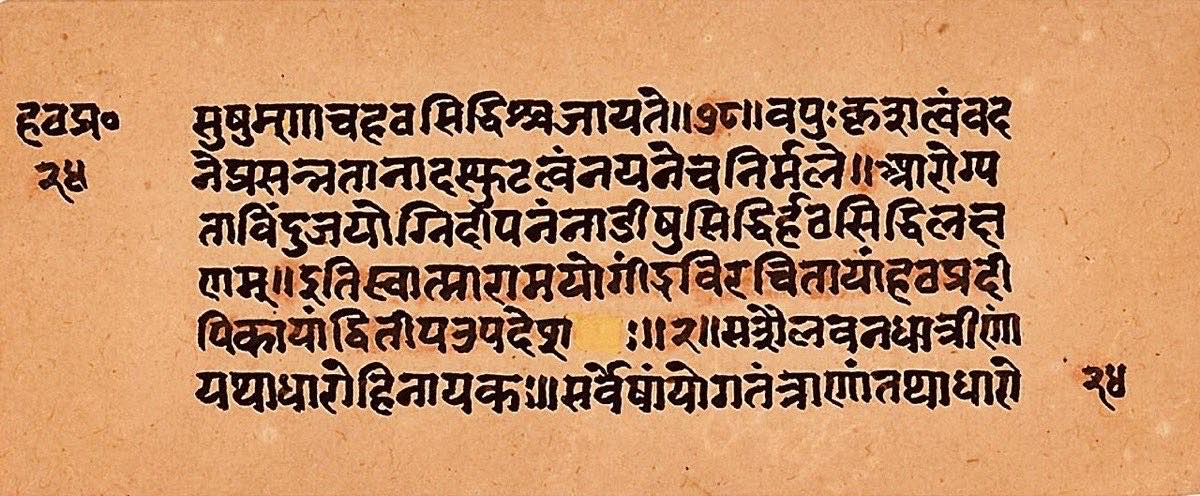
The Haṭha Yoga Pradīpikā
The Haṭha Yoga Pradīpikā (हठयोग प्रदीपिका, “Light on Haṭha Yoga”), composed by Svātmārāma in the 15th century CE, is the most influential text of the Haṭha tradition. It describes:
- 15 āsanas (including Siddhāsana, Padmāsana, Matsyendrāsana)
- 8 prāṇāyāmas (including Sūrya Bhedana, Ujjāyī, Bhastrīkā, and the celebrated Nāḍī Śodhana)
- 10 mudrās (including Mahāmudrā, Khecarī, Viparītakaraṇī)
- Nāda anusandhāna — meditation on the inner sound (nāda) as the final stage
Critically, Svātmārāma states that Haṭha Yoga exists solely as a staircase to Rāja Yoga (1.1-2): “Svātmārāma Yogī, having saluted his Lord, teaches the science of Haṭha solely for the attainment of Rāja Yoga.” This makes clear that the physical practices are means, not ends.
Other Key Haṭha Texts
- Śiva Saṃhitā (15th-17th century) — a more Tantric perspective, describing 84 āsanas and the physiology of cakras and nāḍīs
- Gheraṇḍa Saṃhitā (17th-18th century) — the most comprehensive āsana manual, describing 32 postures and the “seven-fold yoga” (sapta-sādhana)
- Gorakṣa Śataka — attributed to Gorakṣanātha, foundational short text on breath and meditation
The Nāth Sampradāya: Masters of Haṭha
The Nāth Sampradāya (नाथ सम्प्रदाय) is the yogic lineage most responsible for systematising Haṭha Yoga. Founded by Matsyendranātha (10th century CE) and consolidated by his disciple Gorakṣanātha (Gorakhnāth, 11th-12th century), the Nāth yogis developed a distinctive synthesis of Śaiva philosophy, Tantric practice, and physical yoga.
Gorakṣanātha is credited with founding the Kānphaṭā (“split-ear”) order, whose members wore large earrings as a sign of initiation. He is traditionally regarded as the author of the Gorakṣa Śataka, Siddha Siddhānta Paddhati, and other foundational texts. The Nāth tradition emphasised the mastery of the body as a vehicle for spiritual transformation, pioneering the practices of āsana, prāṇāyāma, mudrā, and bandha that would later be codified in the Haṭha Yoga Pradīpikā.
The Nāth tradition had an enormous cultural impact across India, influencing Sikh and Sufi traditions in Punjab, the Mahānubhāva and Vārkarī movements in Maharashtra, and the Bāul tradition in Bengal.
Kuṇḍalinī Yoga
Kuṇḍalinī Yoga (कुण्डलिनी योग) centres on the awakening of the dormant spiritual energy (kuṇḍalinī śakti) at the base of the spine and its ascent through the cakras to union with Śiva at the sahasrāra. While sharing techniques with Haṭha Yoga, Kuṇḍalinī Yoga places particular emphasis on:
- Śakticālana — specific techniques to stir the dormant Kuṇḍalinī
- Bandhas — energy locks (mūla bandha, uḍḍīyāna bandha, jālandhara bandha) that direct prāṇa into the suṣumnā nāḍī
- Mantras — especially bīja mantras associated with each cakra
- Guru’s grace (śaktipāta) — the transmission of spiritual energy from master to disciple
The Śiva Saṃhitā (5.48) warns: “The great goddess Kuṇḍalinī, the primordial energy of the Self, sleeps in the mūlādhāra. She has the form of a serpent, having three and a half coils.”
Nāda Yoga: The Yoga of Sound
Nāda Yoga (नाद योग) is the contemplative practice of tracing sound (nāda) from its gross manifestation (external music, chanting) through subtle internal vibrations to the ultimate soundless sound (anāhata nāda). The Haṭha Yoga Pradīpikā (4.65-102) devotes extensive attention to nāda, describing four stages of inner sound: the initial (ārambha), the pitcher (ghaṭa), the accumulation (paricaya), and the final (niṣpatti).
The Nāda tradition connects to the Vedic understanding of Śabda Brahman — the ultimate reality as sound. The Ṛg Veda (1.164.39) declares: “In the supreme space, where all the gods reside, for one who knows not this, what use is the verse?” — pointing to the direct experience of primordial vibration beyond conceptual knowledge.
Kriyā Yoga
Kriyā Yoga (क्रिया योग) has both an ancient and a modern dimension. Patañjali (Yoga Sūtras 2.1) defines it as tapaḥ-svādhyāya-Iśvara-praṇidhānāni kriyā-yogaḥ — “Kriyā Yoga consists of austerity, self-study, and surrender to God.” In its modern form, Kriyā Yoga was revived by Mahāvatār Bābājī and transmitted through Lāhirī Mahāśaya (1828-1895), Svāmī Śrī Yuktēśvar (1855-1936), and Paramahaṃsa Yogānanda (1893-1952), who brought it to the West in his influential Autobiography of a Yogi (1946).
The practice centres on specific prāṇāyāma techniques that purify the nervous system and accelerate spiritual evolution. Yogānanda described Kriyā as “an advanced Rāja Yoga technique that reinforces and revitalises subtle currents of life energy in the spine and brain.”
Laya Yoga: Dissolution into the Absolute
Laya Yoga (लय योग, “yoga of dissolution”) focuses on the progressive absorption (laya) of the mind into successively subtler states of consciousness until it dissolves into pure awareness. The Haṭha Yoga Pradīpikā (4.34) states: “Laya, Laya — everyone says Laya — but what is the nature of Laya? Laya is the non-remembering of sense-objects by reason of the non-rising of past impressions.”
Laya Yoga employs cakra meditation, visualisation, mantra, and surrender to guide the practitioner through the dissolution of individual consciousness into universal consciousness.
The Modern Evolution
The modern global yoga movement traces its roots to the late 19th century, when Svāmī Vivekānanda presented Rāja Yoga to Western audiences at the 1893 Parliament of Religions in Chicago and subsequently published Rāja Yoga (1896), bringing Patañjali’s system to international attention.
Key figures in the modern evolution include:
- T. Krishnamacharya (1888-1989) — the “father of modern yoga,” who synthesised traditional Haṭha Yoga with physical culture at the Mysore Palace
- B.K.S. Iyengar (1918-2014) — founder of Iyengar Yoga, emphasising precise alignment and the therapeutic use of props
- K. Pattabhi Jois (1915-2009) — developer of Ashtanga Vinyasa Yoga, a vigorous flowing practice
- Svāmī Śivānanda (1887-1963) — whose “five points of yoga” (proper exercise, breathing, relaxation, diet, and meditation) influenced countless teachers
While these modern developments have made yoga accessible to billions, they represent a particular emphasis on the physical dimension. The complete yogic tradition, as this survey shows, encompasses the totality of human experience — body, mind, emotion, and spirit — in its quest for liberation.
Conclusion
The yogic traditions of Hinduism constitute one of humanity’s most sophisticated and comprehensive maps of consciousness. From the intellectual rigour of Jñāna Yoga to the ecstatic surrender of Bhakti, from the disciplined service of Karma Yoga to the systematic introspection of Rāja Yoga, from the body-based alchemy of Haṭha to the subtle vibrations of Nāda — each path addresses a different dimension of the human being while pointing toward the same goal: the freedom (mokṣa) that comes from knowing oneself as infinite consciousness.
As the Bhagavad Gītā (6.46) declares: “The yogi is superior to the ascetic, superior to the learned, and superior to the performer of action. Therefore, be a yogi, O Arjuna.”