Introduction
The Yoga Vāsiṣṭha (Sanskrit: योगवासिष्ठ), also known as the Mahārāmāyaṇa, Ārṣa Rāmāyaṇa, or Vasiṣṭha Rāmāyaṇa, stands as one of the most remarkable philosophical texts in the entire Hindu literary tradition. With approximately 32,000 verses (ślokas) spread across six sections, it is the longest treatise on Advaita (non-dual) philosophy in Sanskrit literature — surpassing even the Mahābhārata in the depth and concentration of its philosophical inquiry. Traditionally attributed to the sage Vālmīki, the same poet credited with the Rāmāyaṇa, this extraordinary work presents its radical metaphysical teachings through an intricate tapestry of stories within stories, parables, and dialogues that challenge every assumption about the nature of reality.
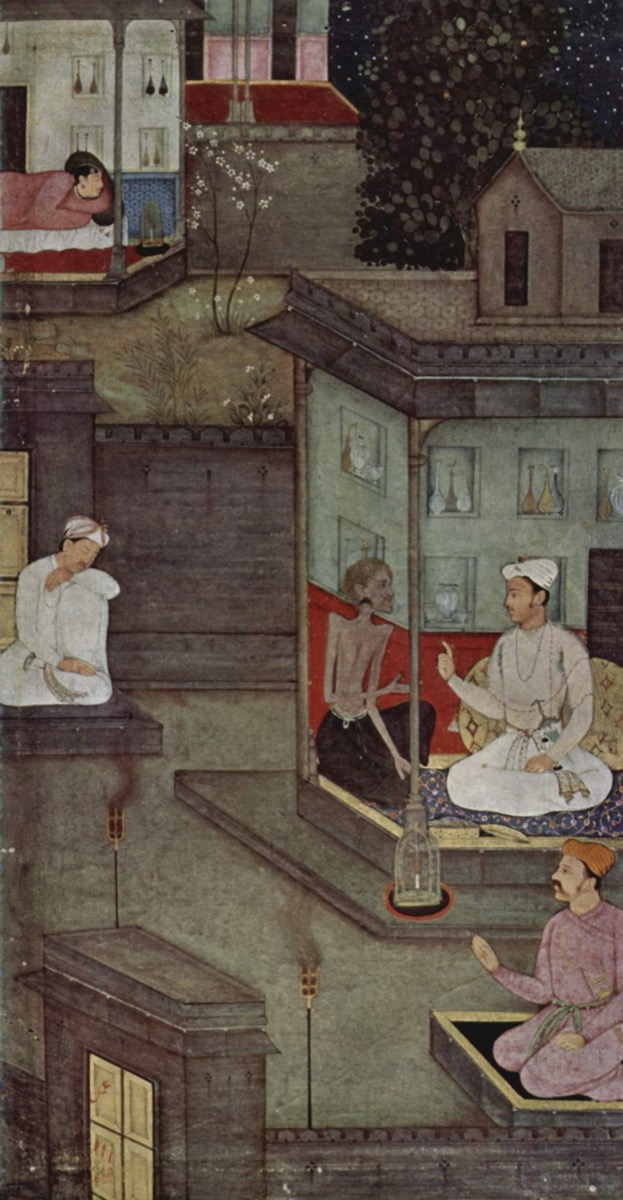
The text takes the form of a conversation between the great sage Vasiṣṭha and the young prince Rāma, set in the court of King Daśaratha at Ayodhyā. Unlike the narrative Rāmāyaṇa, which recounts Rāma’s heroic deeds, the Yoga Vāsiṣṭha portrays a young Rāma gripped by existential despair — disillusioned with the world and questioning the meaning of life, death, suffering, and the nature of the self. It is in response to this crisis that Vasiṣṭha delivers his monumental teachings, guiding Rāma from despondency to the highest wisdom of self-realisation.
Historical Context and Date
The question of the Yoga Vāsiṣṭha’s date and authorship has long occupied scholars. While tradition ascribes it to Vālmīki, the text as it has come down to us is a composite work that evolved over several centuries. Scholars generally place its composition between the 6th and 14th centuries CE, with the core philosophical teachings likely crystallising around the 7th to 10th centuries. The philosophy and ideas mirror those found in the Advaita Vedānta of Ādi Śaṅkarācārya (8th century CE), though neither text mentions the other, suggesting a shared intellectual milieu rather than direct borrowing.
Significantly, the text shows influences from multiple Indian philosophical traditions — not only Vedānta but also Yogācāra Buddhism, Jainism, and later layers incorporate elements of Kashmir Śaivism, particularly the Trika school by the 12th century. This syncretic character makes the Yoga Vāsiṣṭha a unique meeting point of diverse streams of Indian thought, unified by the overarching framework of non-dual consciousness.
The outer narrative frame presents the discourse as being related by Vālmīki to his disciple Bharadvāja, who then transmits it further. This device of nested narration — where one story contains another, which contains yet another — is not merely literary; it mirrors the text’s central philosophical point that reality itself is layered, recursive, and ultimately illusory.
The Six Prakaraṇas: Structure of the Teaching
The Yoga Vāsiṣṭha is divided into six prakaraṇas (sections or books), each representing a stage in the spiritual journey from worldly disillusionment to final liberation.
1. Vairāgya Prakaraṇa (The Book of Dispassion)
The first book introduces the young prince Rāma returning from a pilgrimage across India. Rather than returning invigorated, Rāma is consumed by a profound existential crisis. He observes the transience of all things — wealth, youth, relationships, empires — and declares that nothing in the world possesses lasting value. His despondency is so complete that he refuses to eat, speak, or carry out his princely duties. Rāma articulates his disillusionment with haunting clarity: “Everything in this world is perishing. There is nothing permanent” (Vairāgya Prakaraṇa). This radical vairāgya (dispassion) serves as the essential first step, for without genuine disenchantment with saṃsāra, the deeper teachings cannot take root.
2. Mumukṣu Prakaraṇa (The Book of the Seeker)
Concerned by Rāma’s condition, King Daśaratha summons the court sage Vasiṣṭha, who recognises that Rāma’s despair is not pathological but a sign of spiritual ripeness. Before beginning his detailed instruction, Vasiṣṭha outlines the four prerequisites for liberation — the four gatekeepers of mokṣa: śama (tranquillity of mind), vicāra (rational self-inquiry: “Who am I?”), santoṣa (contentment), and sādhusaṅgama (association with the wise). These are not sequential steps but simultaneous qualities that must be cultivated together. Vasiṣṭha emphasises that puruṣārtha (self-effort) is paramount — past karma can be overcome through present action and right understanding.
3. Utpatti Prakaraṇa (The Book of Creation)
This is the longest and most philosophically dense section. Here Vasiṣṭha explains the origin of the universe — or rather, demonstrates that the universe has no real origin at all. The text advances the doctrine of ajātivāda (non-origination), which holds that creation never truly occurred. What appears as the world is a projection of consciousness (cit), much as a dream is projected by the sleeping mind. Vasiṣṭha illustrates this through multiple embedded stories, including the famous tale of Queen Līlā and the story of the hundred Rudras. The central insight is that consciousness alone exists; the manifold world is its own luminous display, having no independent reality.
4. Sthiti Prakaraṇa (The Book of Existence)
Having explained how the world arises (or appears to arise) in consciousness, the Sthiti Prakaraṇa examines how this apparent creation sustains itself. The world persists, Vasiṣṭha teaches, through the force of habitual thought patterns (vāsanās) and mental conditioning. Just as a dream continues as long as the dreamer does not awaken, the world continues as long as ignorance (avidyā) and desire (tṛṣṇā) remain operative. The stories in this section explore how beings become trapped in cycles of existence through their own mental constructions and how the same mind, when turned toward self-inquiry, can dissolve those constructions.
5. Upaśama Prakaraṇa (The Book of Dissolution)
The fifth book addresses the dissolution of mental bondage and the subsidence of the mind into its source. Upaśama means “quiescence” or “pacification,” and this section teaches the practical methods by which the agitations of the mind are brought to rest. Vasiṣṭha teaches that the mind itself is not ultimately real — it is merely a stream of thoughts that, when traced to their origin, dissolve into pure awareness. The stories here illustrate beings who have achieved this dissolution and the transformative results. The key teaching is that liberation does not require the destruction of the world but the cessation of ignorance about its true nature.
6. Nirvāṇa Prakaraṇa (The Book of Liberation)
The final and longest section (sometimes divided into two sub-parts, pūrvārdha and uttarārdha) presents the culmination of the teaching. Rāma, having absorbed and internalised all that Vasiṣṭha has taught, attains the state of jīvanmukti — liberation while still embodied. The Nirvāṇa Prakaraṇa describes this state in vivid detail: “A jīvanmukta or a realised soul roams about happily. He has neither attractions nor attachments.” The liberated one continues to act in the world, fulfilling duties and engaging with others, but remains inwardly free, established in the knowledge that consciousness alone is real. This section contains some of the text’s most celebrated stories, including those of Queen Cūḍālā and the sage Bhuśuṇḍa.
Key Philosophical Teachings
Consciousness as the Only Reality
The Yoga Vāsiṣṭha’s central thesis is uncompromising: consciousness (cit or caitanya) is the sole reality. The Absolute is described as saccidānanda para Brahman — existence-consciousness-bliss, non-dual, partless, infinite, self-luminous, changeless, and eternal. Everything that appears — the material world, individual souls, gods, heavens, hells — is a manifestation within this one consciousness, having no more independent existence than images in a mirror or waves in an ocean.
This position is articulated through the doctrine of dṛṣṭi-sṛṣṭi-vāda — the view that perception itself creates the perceived world. There is no world “out there” waiting to be perceived; the act of perception and the perceived object arise simultaneously within consciousness. Taken to its logical conclusion, this becomes ajātivāda — the doctrine that nothing has ever been created, for creation would imply a real change in the changeless Absolute, which is impossible.
Dreams, Waking, and the Equivalence of States
One of the Yoga Vāsiṣṭha’s most radical and frequently stated teachings is that the waking state has no greater reality than the dream state. Vasiṣṭha declares: “There is no difference between the waking and dream experiences. The waking state is a long dream.” Both states are constructions of the mind; both feel real while they are being experienced; both dissolve upon awakening to a higher state. Just as one recognises a dream as unreal upon waking, the sage recognises the waking world as unreal upon the dawn of self-knowledge (jñāna).
This teaching is not mere philosophical speculation but is illustrated through elaborate narrative experiments. Characters in the text fall asleep and dream entire lifetimes, or discover that their entire perceived reality exists within an atom or inside a rock, or that multiple parallel universes coexist simultaneously within a single point of consciousness.
The Power and Illusoriness of the Mind
The mind (manas) occupies a paradoxical position in the Yoga Vāsiṣṭha. On one hand, it is the source of all bondage: “Just as objects are created by the mind in dream, so also everything is created by the mind in the waking state.” The world is born through saṅkalpa (mental ideation) and sustained by the mind’s differentiating power. On the other hand, the mind itself is not ultimately real — it is merely a flow of thoughts (vṛttis) and latent impressions (vāsanās). When the mind is traced back to its source through vicāra (self-inquiry), it dissolves, revealing the ever-present consciousness that was never truly obscured.
Jīvanmukti: Liberation While Living
Unlike traditions that locate liberation (mokṣa) only after death or the dissolution of the body, the Yoga Vāsiṣṭha emphatically teaches jīvanmukti — the possibility and indeed the ideal of attaining complete liberation while still alive in a physical body. The jīvanmukta is not a recluse who has withdrawn from the world but one who acts with full engagement while remaining inwardly established in the knowledge of non-duality. Vidyāraṇya Svāmī (1296-1386 CE), the Śaṅkarācārya of Śṛṅgeri Maṭha, drew extensively on the Yoga Vāsiṣṭha in his influential treatise Jīvanmuktiviveka, which became a cornerstone text for the Advaita Vedānta tradition’s understanding of living liberation.
The Great Stories: Parables of Consciousness
The Yoga Vāsiṣṭha is perhaps most famous for its extraordinary stories — elaborate, multi-layered narratives that function as philosophical thought experiments.
The Story of Queen Līlā
Queen Līlā, devoted wife of King Padma, pleases Goddess Sarasvatī through her devotion. When the king dies, Sarasvatī grants Līlā the ability to traverse time and consciousness. Līlā discovers that her dead husband is already living a new life in another universe — an entire world that exists within the chamber of their own palace. Travelling between these worlds, she witnesses past lives, parallel existences, and the creation of entire cosmoses within the space of a single room. The story demonstrates that space, time, and causality are constructions of consciousness, and that innumerable worlds can coexist within a single point of awareness without any of them being ultimately real.
The Story of Gādhi the Brāhmaṇa
Gādhi, a brāhmaṇa, loses consciousness while bathing and experiences an entire alternate life — being born as a tribal boy, growing up, becoming a king, ruling a kingdom, and eventually dying. The dream seems so real that Gādhi travels to the locations he experienced and, astonishingly, finds physical evidence confirming the events of his vision. Bewildered, he performs austerities to Lord Viṣṇu, who tells him it was all a projection of his mind. Yet each time Gādhi revisits the evidence, reality and illusion seem to merge. This story powerfully illustrates the Yoga Vāsiṣṭha’s teaching that the boundary between “real” and “imaginary” is itself a mental construct.
The World Within a Rock
In one of the most striking thought experiments in all of Indian philosophy, Vasiṣṭha describes a world that exists inside a rock. Within the stone’s impenetrable darkness, entire civilisations arise, flourish, and perish — complete with mountains, rivers, cities, and beings who are born, live, and die, fully convinced of the reality of their world. This image serves as a metaphor for the human condition: we live within the apparent solidity of material reality, unaware that the “rock” of our perceived world is itself a projection within boundless consciousness.
Queen Cūḍālā and King Śikhidhvaja
This remarkable narrative, found in the Nirvāṇa Prakaraṇa, features one of the most progressive portrayals of a woman in ancient Indian literature. Queen Cūḍālā practises self-inquiry and attains Self-realisation, while her husband King Śikhidhvaja, convinced that extreme asceticism is the path to liberation, abandons his kingdom to live as a hermit in the forest. When Cūḍālā attempts to share her wisdom, the king dismisses her. Undeterred, Cūḍālā uses her yogic powers to assume the form of a young brāhmaṇa boy named Kumbha, who becomes the king’s spiritual teacher. Through Kumbha’s guidance, Śikhidhvaja learns the true meaning of renunciation — not the abandonment of external possessions but the relinquishment of mental attachment — and attains enlightenment. Cūḍālā then reveals her true identity, and the couple reunite to rule the kingdom as liberated beings. The story subverts conventional hierarchies of gender and renunciation, teaching that wisdom can manifest in anyone regardless of social role.
The Sage Bhuśuṇḍa
The ancient crow-sage Bhuśuṇḍa, who has witnessed countless cycles of creation and destruction, narrates the story of Indra’s atomic world. Defeated in battle, Indra shrinks himself to the size of an atom and enters a particle of dust floating in a sunbeam. Within this atom, he imagines an entire universe — a palace, a city, a kingdom — and this imagined world takes on independent reality. Successive Indras are born and rule within this atomic universe, each unaware of the larger reality beyond. This story anticipates modern concepts of fractal reality and the philosophical implications of infinite recursion, demonstrating that the Yoga Vāsiṣṭha’s exploration of consciousness was remarkably ahead of its time.
Relationship to Advaita Vedānta and Other Traditions
The Yoga Vāsiṣṭha occupies a unique position in the landscape of Indian philosophy. While it is most closely aligned with Advaita Vedānta, it predates the systematic formulation of that school and draws from a broader range of sources. Its doctrine of ajātivāda (non-origination) resonates with the teachings of Gauḍapāda’s Māṇḍūkya Kārikā, and its emphasis on consciousness as the ground of all reality is consonant with the Upaniṣadic tradition.
However, the text also shares significant common ground with Buddhist Yogācāra (mind-only) philosophy in its analysis of mind and perception, and with Kashmir Śaivism in its understanding of spanda (the creative vibration of consciousness). Some scholars have noted parallels with Jain epistemology in its treatment of multiple perspectives (anekāntavāda). This philosophical eclecticism, far from diluting its message, enriches the Yoga Vāsiṣṭha’s exploration of consciousness from multiple angles.
In the 14th century, the text became an authoritative source within mainstream Advaita Vedānta, largely through the work of Vidyāraṇya, whose Jīvanmuktiviveka quotes the Yoga Vāsiṣṭha (in its abridged Laghu form) extensively. Since then, the text has been revered by Advaita teachers and scholars, including Svāmī Śivānanda of Rishikesh, who wrote extensively about its teachings.
The Laghu Yoga Vāsiṣṭha: An Abridged Treasure
Given the vast size of the full text (the Bṛhat Yoga Vāsiṣṭha), an abridged version known as the Laghu Yoga Vāsiṣṭha was compiled by the Kashmiri scholar Abhinanda, who lived in the 9th or 10th century CE. This condensed version reduces the approximately 32,000 verses to roughly 6,000 while preserving the essential philosophical content. Abhinanda’s method was primarily to reproduce the original verses verbatim, trimming away extended descriptions and repetitive passages to extract the quintessence of the teaching.
The Laghu Yoga Vāsiṣṭha became the more widely circulated version and the primary form through which the text influenced later thinkers. K. Narayanaswami Aiyer produced the first English translation in 1896, published in Madras, making the text accessible to a modern audience. Commentaries on the Laghu version include the Vasiṣṭha Candrikā by Ātmasukha for the first three prakaraṇas and the Saṃsārataraṇī by Mummidi Devarāya for the last three.
A further distillation, the Yoga Vāsiṣṭha Sāra (Essence of the Yoga Vāsiṣṭha), reduces the teachings to a mere handful of chapters, offering a concentrated introduction to the text’s core philosophy for those unable to undertake the full work.
Legacy and Contemporary Relevance
The Yoga Vāsiṣṭha’s influence extends far beyond the boundaries of academic philosophy. Its teachings on the nature of consciousness, the illusoriness of the perceived world, and the possibility of liberation through self-knowledge have resonated with spiritual seekers across centuries and traditions. Its exploration of parallel realities, worlds within atoms, the equivalence of dream and waking states, and the recursive nature of consciousness anticipates themes that modern physics, cognitive science, and philosophy of mind continue to grapple with.
The text’s emphasis on puruṣārtha (self-effort) over fatalistic dependence on karma offers an empowering message: the individual is not a helpless victim of past actions but a conscious agent capable of transforming understanding in the present moment. Its insistence that liberation is available here and now, in this very life, without requiring death, rebirth, or escape from the world, gives the Yoga Vāsiṣṭha a psychological immediacy that distinguishes it from more eschatologically oriented traditions.
For the modern reader, the Yoga Vāsiṣṭha remains what it has always been — a profound invitation to question the most basic assumptions about who we are, what the world is, and whether the boundary between the two is anything more than a thought. As Vasiṣṭha counsels the young Rāma: the world that appears so solid, so real, so inescapable, is in truth the shimmering display of one’s own consciousness, and the recognition of this truth is itself the doorway to freedom.