Introduction
Citragupta (IAST: Citragupta; Sanskrit: चित्रगुप्त), also known as Citragupta Mahārāja, is one of the most distinctive and philosophically significant deities in the Hindu pantheon. He is the divine scribe — the celestial record-keeper who sits beside Yama, the god of death and justice, in the great court of Yamaloka. His sacred duty is to maintain the Agrasandhānī, the cosmic ledger in which every thought, word, and deed of every living being is meticulously recorded from birth to death. When a soul arrives before Yama’s tribunal after departing the mortal world, it is Citragupta who opens the book of deeds and reads the account aloud, enabling Yama to deliver a verdict of perfect karmic justice (Wikipedia, “Chitragupta”; Dharma Pulse).
The name “Citragupta” is itself richly meaningful. It derives from two Sanskrit roots: citra (“picture” or “variegated”) and gupta (“hidden” or “secret”). Together, the name signifies “he of the hidden picture” or “rich in secrets” — a fitting epithet for the deity who sees what no mortal eye can perceive: the invisible, inner reality of human action and intention. Another interpretation connects the name to the fact that he remained hidden (gupta) within Brahmā’s body (kāya) before manifesting into the world (Rudraksha Ratna; Wikipedia).
Far from being a minor administrative deity, Citragupta occupies a position of cosmic importance. He is the living embodiment of the Hindu principle that the universe is morally ordered — that no act, however small or secret, escapes the notice of the divine. In this role, he functions as the guarantee of karma itself: the assurance that actions have consequences, that justice is inescapable, and that dharmic accountability extends beyond the boundaries of a single human life.
Creation by Brahmā
The origin narrative of Citragupta is among the most distinctive birth stories in Hindu mythology. According to the Padma Purāṇa and other Purāṇic texts, the god of death Yama (Dharmarāja) approached Lord Brahmā with a problem. As the judge of all departed souls, Yama found the burden of maintaining records of every creature’s actions across all of creation to be overwhelming. He needed an assistant — someone with supernatural wisdom and perfect impartiality — to chronicle the deeds of every being and to ensure that no soul’s account was ever lost or falsified.
In response, Brahmā entered a state of deep meditation (tapas). According to the Yama Saṃhitā and related texts, Brahmā meditated for eleven thousand years. When he finally opened his eyes, a radiant figure stood before him — fully formed, bearing an inkpot (dawāt) and a pen (kalam) in his hands, and a sword girdled to his waist. This was Citragupta, who had emerged directly from Brahmā’s body during the prolonged meditation.
Brahmā addressed the newly manifested deity with words that established both his identity and his lineage:
“Because you are sprung from my body (kāya), therefore you shall be called Kāyastha, and as you existed in my body unseen, I give you the name of Citragupta.” (Padma Purāṇa, as cited in traditional Kayastha sources)
The Padma Purāṇa further records: “Śrī Citragupta was placed near Dharmarāja to register the good and evil actions of all sentient beings, that he was possessed of supernatural wisdom and became the partaker of sacrifices offered to the gods and fire.” Thus Citragupta was not merely an attendant or servant but a deity in his own right — one who received sacrificial offerings and possessed the divine authority to participate in the most sacred Vedic rituals (Wikipedia; Rudraksha Ratna).
The Agrasandhānī: The Cosmic Ledger
The most sacred attribute associated with Citragupta is the Agrasandhānī (Sanskrit: अग्रसन्धानी) — the great book of deeds, the cosmic register in which he inscribes the complete record of every being’s actions. This is not merely a list of external behaviours; according to the Garuḍa Purāṇa and other texts, Citragupta records thoughts, intentions, words, and deeds alike. The ledger captures the full moral texture of a life — not only what a person did, but what they intended, what they said, and what they concealed.
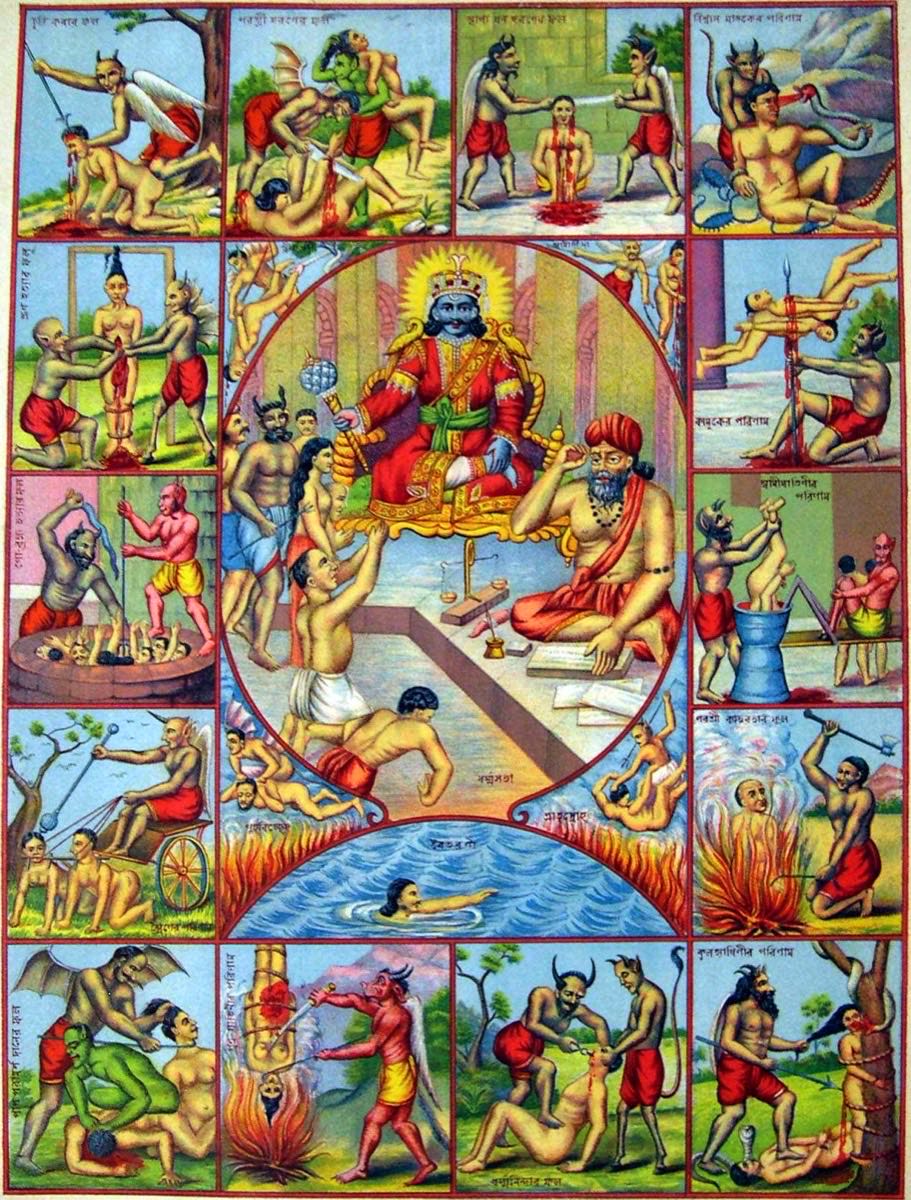
The Garuḍa Purāṇa (Pretakhaṇḍa) describes the judgment scene in vivid detail. When a soul (jīva) arrives in Yamaloka after death, it is brought before the great tribunal. Yama sits upon his throne as the sovereign judge. Citragupta sits beside him, the Agrasandhānī open before him, and reads aloud the complete account of the soul’s earthly life. The good deeds (puṇya) and sinful deeds (pāpa) are weighed on a cosmic scale. Based on this accounting, Yama assigns the soul to one of three destinations:
- Svarga (heaven) — for the predominantly virtuous, who enjoy the fruits of their merit
- Naraka (hell) — for the predominantly sinful, where various punishments purify the karmic debt before rebirth
- Punarjanma (rebirth) — return to the mortal world in a form determined by the precise balance of accumulated karma
Crucially, the Hindu understanding of this process — unlike conceptions of eternal damnation in some other traditions — holds that no soul is permanently condemned. Every punishment in Naraka has a finite duration proportional to the karma that caused it. When the debt is exhausted, the soul returns to the cycle of rebirth for another opportunity. Citragupta’s ledger, therefore, is not a tool of vengeance but of cosmic accounting — a mechanism by which the moral order of the universe maintains its integrity (Hinduvism; Dharma Pulse).
Role in Yama’s Court
In the administration of dharmic justice, Citragupta functions not merely as a clerk but as a judge in his own right. The Garuḍa Purāṇa describes Citragupta as presiding over his own court within Yamaloka, where he independently dispenses justice based on the precise records he maintains. His authority is absolute within his domain: his records cannot be questioned, altered, or overruled, for they reflect the objective truth of a soul’s moral history.
The relationship between Yama and Citragupta is one of complementary authority. Yama is the sovereign — the Dharmarāja who embodies the law of karma itself. Citragupta is the meticulous administrator — the one who translates the abstract principle of karmic law into specific, individualised judgments. Together, they form a complete system of cosmic justice: the law and its application, the principle and its implementation.
This dual authority is reflected in the Purāṇic descriptions of Yama’s court. When a newly deceased soul enters the hall, it first encounters the Yamadūtas (Yama’s messengers), who have escorted it from the mortal realm. It then faces Citragupta, who opens the Agrasandhānī and recounts the soul’s deeds. Only after Citragupta has completed his reading does Yama pronounce the verdict. The process is depicted as orderly, procedural, and scrupulously fair — a divine courtroom governed by evidence and impartial law (Rudraksha Ratna; Hinduvism).
Iconography
The iconography of Citragupta is rich in symbolic detail and directly reflects his cosmic function as the divine scribe and arbiter:
- Pen and inkpot (kalam and dawāt): The most distinctive attributes of Citragupta, these represent his primary function — the continuous recording of human deeds. In many depictions, he is shown actively writing in the Agrasandhānī, symbolising that the process of karmic accounting never ceases.
- The book or scroll (pustaka): The Agrasandhānī itself, depicted as a large bound book or a long scroll, symbolises the comprehensive nature of the karmic record — nothing is omitted, nothing is forgotten.
- Sword: Girdled to his waist, the sword represents the power of justice and his authority to enforce divine law. It signifies that Citragupta is not merely a passive recorder but an active agent of dharmic order.
- Complexion: Typically depicted with a fair or golden complexion, wearing royal garments and ornaments befitting his divine status.
- Seated posture: Usually shown seated on a throne or an elevated platform beside Yama, reflecting his judicial authority. In the famous Chore Bagan Art Studio lithographs of the 19th century, Citragupta appears seated to Yama’s right, book open, recording the deeds of souls awaiting judgment.
- Crown and ornaments: Adorned with a crown (mukuṭa), jewellery, and sacred thread (yajñopavīta), indicating his Brāhmic origin from Brahmā’s body and his status as a deity who receives sacrificial offerings.
The consistent presence of the pen, inkpot, and book in Citragupta’s iconography has made these objects sacred symbols for the Kayastha community, who revere him as their progenitor deity. The annual Kalam-Dawāt Pūjā (worship of pen and inkpot) derives directly from this iconographic tradition (Wikipedia; Dharma Pulse).
Citragupta’s Family: Wives and the Twelve Sons
The Purāṇic tradition provides a detailed genealogy for Citragupta that serves as the mythological foundation of the Kayastha community — one of the most historically prominent literate communities of the Indian subcontinent.
According to the Bhavishya Purāṇa and traditional Kayastha accounts, Citragupta married two wives:
- Irāvatī (also called Śobhāvatī) — daughter of a sage, who bore him eight sons
- Nandinī (also called Sūrya Dakṣiṇā) — who bore him four sons
The twelve sons of Citragupta are the legendary progenitors of the twelve sub-castes (upajāti) of the Chitraguptavanshi Kayastha community:
Sons of Irāvatī: Cāru (Mathur), Sucāru (Gauḍ), Citrākṣa (Bhaṭnāgar), Matibhāna (Saxena), Himvāna (Ambashṭha), Citrācāru (Nigam), Citrācaraṇa (Karṇa), Caruṇa (Kulśreṣṭha)
Sons of Nandinī: Bhānu (Śrīvāstava), Vibhānu (Sūryadhvaja), Viśvabhānu (Vālmīki), Vīryavāna (Asthānā)
Each of these twelve lineages established distinct family traditions, gotras (clan lineages), and regional identities. The Kayastha community, historically associated with writing, administration, record-keeping, and governance throughout the Indian subcontinent, traces its identity and vocation directly to Citragupta’s cosmic function as the divine scribe. The community’s traditional emphasis on literacy, learning, and public service is understood as a continuation of their divine ancestor’s sacred duty (Wikipedia, “Chitraguptavanshi Kayastha”; Kayastha sources).
Citragupta Pūjā and the Kalam-Dawāt Tradition
Citragupta Pūjā, also known as Citragupta Jayantī, is a significant Hindu festival celebrated primarily by the Kayastha community across northern India — particularly in Bihar, Uttar Pradesh, Madhya Pradesh, Jharkhand, and Delhi. The festival falls on Yama Dvitīyā (the second day of the bright fortnight of the month of Kārtika), which typically coincides with the day after Bhāī Dūj during the Dīpāvalī festival period.
The festival is characterised by a distinctive ritual known as Kalam-Dawāt Pūjā — the worship of the pen and inkpot, the sacred instruments of Citragupta. During this pūjā:
- Devotees set up a special altar with an image or idol of Citragupta Mahārāja
- A new pen and inkpot are consecrated and worshipped as sacred objects
- Account books, ledgers, and writing instruments are placed before the deity and offered prayers
- The Agrasandhānī is symbolically honoured through the worship of written records
- Prayers are offered for truthfulness, fair dealing, and accurate record-keeping in business and personal affairs
- Community gatherings (sabhā) are held where Kayastha families come together for collective worship
The theological significance of Kalam-Dawāt Pūjā is profound. By sanctifying the instruments of writing, the festival affirms the Hindu understanding that knowledge, literacy, and the truthful recording of human affairs are not merely secular activities but sacred vocations ordained by the divine. The pen of Citragupta is the instrument through which cosmic justice operates; by honouring it, devotees participate symbolically in the maintenance of the moral order of the universe (The Indian Bugle; Bihar Tourism).
Temples Dedicated to Citragupta
Several temples across India are dedicated to Citragupta, reflecting the deity’s importance in Hindu worship:
Ādi Citragupta Mandir, Patna (Bihar)
The most ancient and important Citragupta temple stands near Naujhar Ghāṭ in Patna, Bihar. Known as Kāyastha Dhām, this temple is considered the primary pilgrimage site for the Kayastha community. The temple houses a 16th-century black basalt idol of Citragupta and draws its historical origins from a tradition tracing back over 2,500 years, when the statesman Mudrārākṣasa is said to have established the original shrine. Every year on Yama Dvitīyā, thousands of devotees from the Kayastha community gather here for the annual Citragupta Pūjā celebrations (Bihar Tourism; Incredible India).
Citragupta Temple, Khajurāho (Madhya Pradesh)
Part of the renowned UNESCO World Heritage Site of the Western Group of temples at Khajurāho, this 11th-century temple built during the Chandella dynasty is dedicated to Sūrya (the sun god) but bears the name of Citragupta. The temple’s architecture reflects the Nāgara style and features exquisite sculptural panels depicting various deities and celestial figures. The association of Citragupta’s name with a sun temple underscores the theological connection between Citragupta, Brahmā (his creator), and the solar lineage in Hindu cosmology.
Other Notable Temples
Temples and shrines dedicated to Citragupta exist in Kanchipuram (Tamil Nadu), various locations in Uttar Pradesh, and at several sites in Jharkhand and Madhya Pradesh. The Kayastha community has also established Citragupta temples in urban centres across India, reflecting the diaspora of the community and the continuing devotion to their progenitor deity.
The Concept of Cosmic Accountability
Citragupta’s role in Hindu theology represents one of the most sophisticated conceptions of moral accountability in any religious tradition. The system he administers — the continuous, omniscient recording of every deed and intention — addresses several foundational questions of ethics and justice.
Nothing Is Hidden
The Agrasandhānī records not only external actions but internal states — thoughts, intentions, desires, and motivations. This reflects the Hindu understanding that dharmic judgment is not merely about what one does but about the quality of consciousness behind the action. A charitable gift made from genuine compassion carries different karmic weight than the same gift made from vanity or calculation. Citragupta’s ledger captures this distinction with perfect fidelity.
No Act Is Too Small
The cosmic accounting system makes no distinction between the great and the trivial. Every act of kindness, every moment of cruelty, every word spoken in truth or falsehood — all are recorded. This principle has had a profound influence on Hindu ethical life, encouraging the cultivation of sattva (goodness, purity) in every moment, not merely in dramatic or public situations.
Justice Is Impartial
Citragupta’s records apply equally to king and pauper, brāhmin and outcaste, man and woman. No amount of wealth, power, social status, or ritual performance can alter the record or sway the judgment. This radical impartiality — affirmed repeatedly in the Garuḍa Purāṇa and other texts — represents a profound egalitarianism at the heart of the Hindu conception of cosmic law.
Comparison with the Akashic Records
Scholars and spiritual writers have noted striking parallels between Citragupta’s Agrasandhānī and the concept of the Ākāśic Records (from Sanskrit ākāśa, “ether” or “space”) found in Theosophical and New Age traditions. Both describe a cosmic record of every event, thought, word, and emotion that has ever occurred. While the Ākāśic Records are typically conceived as an impersonal field of information, Citragupta personalises this concept — the cosmic ledger is maintained by a conscious, divine agent who bears personal responsibility for its accuracy and integrity. This personalisation reflects the broader Hindu tendency to infuse abstract cosmic principles with devotional, relational meaning (Hinduvism; Dharma Pulse).
Cultural Impact on Hindu Ethics
The figure of Citragupta has exercised an incalculable influence on Hindu moral consciousness. The awareness that every deed is being recorded — that a divine scribe with perfect knowledge sits with pen poised over the ledger of one’s life — has functioned as one of the most powerful ethical motivators in the Hindu tradition.
This influence operates on multiple levels:
Personal ethics: The knowledge that Citragupta records all deeds encourages self-examination, moral vigilance, and the cultivation of truthfulness (satya) in daily life. The concept provides an internalised mechanism of accountability that operates independent of external social enforcement.
Professional ethics: For the Kayastha community and others involved in administration, record-keeping, and governance, Citragupta serves as the divine exemplar of honest dealing and accurate accounting. The Kalam-Dawāt Pūjā sanctifies the tools of the scribe and administrator, investing their daily work with sacred significance.
Social justice: The impartiality of Citragupta’s judgment — his indifference to wealth, caste, or status — has served as a powerful theological argument for social equality. If the divine accountant makes no distinction between high and low, neither should human systems of justice.
Eschatological awareness: The certainty that one’s deeds will be read aloud in Yama’s court after death provides a continuous reminder of mortality and moral consequence — what Hindu tradition calls mṛtyu-smṛti (remembrance of death) — which functions as a catalyst for ethical living and spiritual aspiration.
Citragupta in the Broader Hindu Cosmos
Within the broader structure of Hindu cosmology, Citragupta occupies a unique position. He is neither a supreme deity (Īśvara) nor a minor attendant spirit. He is a deity of cosmic function — one whose specific role is essential to the operation of the moral universe. Without Citragupta, the law of karma would be an abstract principle without a mechanism of implementation. He is the bridge between the philosophical concept that “every action has consequences” and the mythological reality of a divine court where those consequences are actually adjudicated.
His relationship with other deities further illuminates his position:
- Brahmā: As his creator, Brahmā endowed Citragupta with supernatural wisdom and divine authority. The fact that Citragupta emerged from Brahmā’s body — like the Prajāpatis and other primal beings — elevates him to the highest category of created deities.
- Yama (Dharmarāja): Citragupta’s colleague and sovereign in the administration of justice. Their partnership represents the union of cosmic law (Yama) and meticulous record (Citragupta).
- The Yamadūtas: Yama’s messengers who bring souls to the court serve under the broader system that Citragupta’s records make possible.
Conclusion
Citragupta, the divine scribe of Yamaloka, represents one of Hinduism’s most profound and original contributions to the world’s religious imagination: the figure of a deity whose entire existence is devoted to the faithful recording and impartial adjudication of human moral life. Born from the body of Brahmā himself after eleven thousand years of cosmic meditation, equipped with pen and inkpot and the infinite Agrasandhānī, Citragupta embodies the unshakeable Hindu conviction that the universe is morally ordered — that no action, however secret, is ever truly hidden, and that every being must ultimately face the full account of its deeds.
As the progenitor of the Kayastha community, the deity honoured in the annual Kalam-Dawāt Pūjā, and the cosmic administrator whose records determine the fate of every soul, Citragupta stands as a reminder that in the Hindu understanding of reality, truth, accountability, and justice are not merely human aspirations but divine functions woven into the very fabric of creation. His message to every living being is at once humbling and empowering: your every deed is known, your every intention is recorded, and the justice that awaits you is as certain as it is impartial.