Introduction
In the vast pantheon of sages revered across Hindu tradition, few figures embody the power of devotion as dramatically as Mārkaṇḍeya. His story stands as the supreme testament to the principle that sincere bhakti transcends even the cosmic law of death. Born to devout parents who chose a brilliant but short-lived son over a dull but long-lived one, Mārkaṇḍeya was destined to die at the age of sixteen. Yet through his absolute surrender to Lord Śiva — clinging to the sacred Liṅga as Yama’s noose descended — he not only escaped death but provoked one of the most dramatic divine interventions in Hindu mythology: Śiva’s manifestation as Kālāntaka, the Conqueror of Time, who struck down Yama himself.
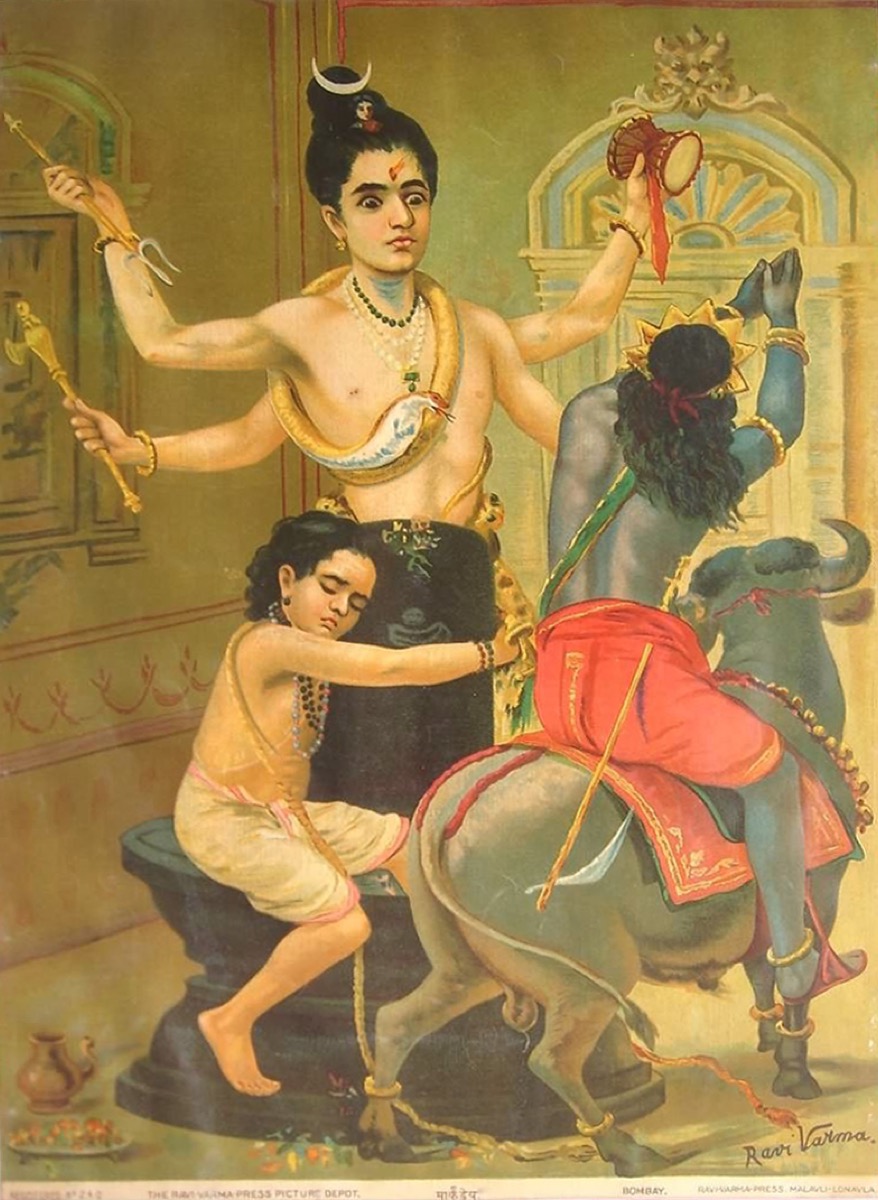
Mārkaṇḍeya holds the rare distinction of being a Cirañjīvī — one of the immortals who endure across cosmic ages. His name reverberates through the Mahābhārata, the Bhāgavata Purāṇa, and the Śiva Purāṇa, while the Mārkaṇḍeya Purāṇa — one of the eighteen Mahāpurāṇas — is attributed to his narration. He is also intimately connected with the Mahāmṛtyuñjaya Mantra, Hinduism’s most potent invocation against untimely death. From ancient temple sculptures at Ellora and Thirukkadaiyur to Raja Ravi Varma’s celebrated paintings, the image of the boy-sage embracing the Liṅga while death looms behind him has become one of Hindu art’s most enduring and emotionally powerful compositions.
Birth Story: Mṛkaṇḍu’s Fateful Choice
The story of Mārkaṇḍeya begins with his father, the sage Mṛkaṇḍu (also called Mṛkaṇḍa), and his mother Marudvatī. The couple were devoted worshippers of Lord Śiva, yet for many years they remained childless. They undertook severe penance — years of austere tapas — to propitiate Mahādeva and seek the boon of a son.
Pleased by their devotion, Śiva appeared before them and offered a choice that would become one of Hindu mythology’s most poignant moral dilemmas: they could have either a son who would be virtuous, pious, and brilliant but live only sixteen years, or a son who would be dull-witted and lacking in character but enjoy a long life. Without hesitation, Mṛkaṇḍu and Marudvatī chose the former. They preferred a brief span illuminated by wisdom and dharma over a long but spiritually barren existence.
Thus was born Mārkaṇḍeya — a child radiant with intelligence and devotion from his earliest years. He mastered the Vedas and Śāstras with astonishing speed and became a model of dharmic conduct. His parents, however, carried the secret of his fate like a stone upon their hearts, knowing each passing year brought their beloved son closer to his appointed end.
The Approach of Death
As Mārkaṇḍeya’s sixteenth year drew near, Mṛkaṇḍu and Marudvatī could no longer contain their grief. The Śiva Purāṇa describes how the boy noticed his parents weeping inconsolably and pressed them for the truth. When they revealed that his life was destined to end at sixteen, the young sage responded not with fear but with resolute determination. He declared that Lord Śiva, who had given this boon, could also transcend it.
Seeking his parents’ blessings, Mārkaṇḍeya installed a Śiva Liṅga — some versions place this at the sacred site that would become Thirukkadaiyur in Tamil Nadu — and began an intense, single-pointed worship. He performed abhiṣeka (ritual bathing of the Liṅga), offered flowers and bilva leaves, and chanted Śiva’s names with complete absorption. The Śiva Purāṇa notes that his devotion was so pure and intense that it radiated a protective aura of spiritual energy that Yama’s servants could not penetrate.
On the fateful day when Mārkaṇḍeya’s sixteenth year was to end, Yama — the Dharmarāja, lord of death and cosmic justice — dispatched his dūtas (messengers) to fetch the boy’s soul. But the messengers found themselves unable to approach the young sage. His continuous chanting of Śiva’s name created an impenetrable field of divine energy. They returned to Yama and reported their failure.
Śiva Versus Yama: The Kālāntaka Confrontation
Incensed that his will had been defied, Yama resolved to come personally. He arrived mounted on his great black buffalo (Mahiṣa), wielding the Kāladaṇḍa (the Staff of Time) and the dreaded Pāśa (noose) with which he extracts the soul from the body. The scene that follows is one of the most dramatic episodes in Śaiva literature.
Yama hurled his noose at Mārkaṇḍeya. The boy, in complete absorption, had wrapped his arms around the Śiva Liṅga, pressing his body against the sacred stone in a final act of total surrender. The noose, unable to distinguish between the devotee and the object of his devotion, encircled both Mārkaṇḍeya and the Liṅga together.
At that instant, the Liṅga burst open and Lord Śiva emerged in his most terrifying form — Kālāntaka, the Ender of Time, the Conqueror of Death itself. Ablaze with divine fury, Śiva struck Yama with his triśūla (trident) and kicked the god of death to the ground. Some accounts describe Śiva placing his foot upon Yama’s chest; others say he slew Yama outright with his trident. The Skanda Purāṇa relates that Śiva’s third eye blazed open, and from it poured a fire that consumed Yama.
The death of Yama, however, created a cosmic crisis. With the lord of death himself dead, no being in the universe could die, disrupting the entire cycle of saṃsāra. The Devas, led by Brahmā and Viṣṇu, approached Śiva and pleaded for Yama’s restoration. Śiva agreed to revive Yama, but on one absolute condition: Yama must never again approach a true devotee of Śiva. From that day, Mārkaṇḍeya was blessed with eternal youth — he would remain sixteen years old forever, untouched by death, disease, or aging.
The Title of Mṛtyuñjaya
This episode earned Śiva the celebrated epithet Mṛtyuñjaya — “Conqueror of Death” — and Kālāntaka — “Ender of Time.” Mārkaṇḍeya himself came to be known as Mṛtyuñjaya and Kālakāla (he who conquered time). The event is considered the foundational narrative behind the Mahāmṛtyuñjaya Mantra, one of the most powerful and widely chanted mantras in Hinduism.
The temple at Thirukkadaiyur, where this event is believed to have taken place, venerates Śiva specifically as Amṛtaghaṭeśvara — “Lord of the Pot of Immortality” — commemorating the nectar of immortality bestowed upon Mārkaṇḍeya. The Devī at this temple is worshipped as Abhirāmī.
Cirañjīvī: The Eternal Sage
Mārkaṇḍeya is counted among the Cirañjīvīs — the immortal beings of Hindu tradition who are believed to live through all four yugas and remain present on earth until the end of the current Kalpa (cosmic cycle). The traditional list of seven Cirañjīvīs includes Aśvatthāmā, King Bali, Vyāsa, Hanumān, Vibhīṣaṇa, Kṛpācārya, and Paraśurāma, while some traditions expand this list to include Mārkaṇḍeya himself, recognizing the explicit boon of immortality granted by Śiva.
His eternal youth distinguishes him from other immortals: while figures like Vyāsa and Hanumān are depicted as mature or aged, Mārkaṇḍeya is always portrayed as a sixteen-year-old youth, frozen at the very moment when death was to claim him. This perpetual youthfulness makes him a powerful symbol of the victory of spirit over time.
Mārkaṇḍeya in the Mahābhārata
Mārkaṇḍeya appears prominently in the Mahābhārata, particularly in the Vana Parva (Book of the Forest), in a section known as the Mārkaṇḍeya-Samasya Parva. Here, the eldest Pāṇḍava, Yudhiṣṭhira, approaches the ancient sage during the Pāṇḍavas’ exile in the forest. Yudhiṣṭhira seeks wisdom and consolation from one who has witnessed the rise and fall of countless ages.
Mārkaṇḍeya narrates to Yudhiṣṭhira his extraordinary experience of the Pralaya — the cosmic dissolution that occurs at the end of each Kalpa. He describes how, during one such dissolution, the entire universe was submerged in a limitless ocean. Every creature, every mountain, every world was destroyed. He alone survived, wandering through the vast dark waters for countless ages.
In the midst of this cosmic ocean, Mārkaṇḍeya beheld a wondrous sight: a great banyan tree (vaṭa-vṛkṣa) rising from the waters, and upon one of its leaves lay a radiant infant. This divine child bore the mark of Śrīvatsa on his chest and had eyes like lotus petals. The child drew Mārkaṇḍeya into his mouth, and within the child’s body, the sage saw the entire universe — all the rivers, mountains, kingdoms, the four varṇas performing their duties, all the ages of creation playing out in perfect order. This child was Viṣṇu in his cosmic form, known as Vāṭapatraśāyī (He who reclines on a banyan leaf).
This Mahābhārata episode connects Mārkaṇḍeya with both Śaiva and Vaiṣṇava traditions, making him a uniquely universal figure who transcends sectarian boundaries.
The Mārkaṇḍeya Purāṇa
The Mārkaṇḍeya Purāṇa, one of the eighteen Mahāpurāṇas, is framed as a narration by Sage Mārkaṇḍeya to his disciple Jaimini, the founder of the Mīmāṁsā school. Comprising approximately 9,000 verses across 137 chapters, the text covers cosmology, dharma, karma, yoga philosophy, and sacred geography.
The Purāṇa opens with Jaimini posing questions about certain unresolved matters from the Mahābhārata. Mārkaṇḍeya, about to leave for Vedic rituals, directs him to four wise birds dwelling in the Vindhya mountains, whose answers form chapters 4 through 45. The text presents its yoga philosophy in chapters 39-43, identifying yoga as the path to self-knowledge and liberation (mokṣa).
The most celebrated portion of the Mārkaṇḍeya Purāṇa is the Devī Māhātmya (also known as the Durgā Saptaśatī or Caṇḍī Pāṭha), embedded within chapters 81-93. This is the oldest extant comprehensive text on the Devī (Goddess) as the Supreme Being and creator of the universe. The Devī Māhātmya narrates the three great battles of the Goddess against the demons Madhu-Kaiṭabha, Mahiṣāsura, and Śumbha-Niśumbha, and forms the scriptural foundation of the Śākta tradition. It is recited by millions during Navarātrī and remains one of the most liturgically important texts in Hinduism.
Scholars date the core of the Mārkaṇḍeya Purāṇa to approximately the 3rd century CE, with the Devī Māhātmya section composed later, around the 5th-6th century CE.
The Mahāmṛtyuñjaya Mantra Connection
The Mahāmṛtyuñjaya Mantra — also called the Tryambaka Mantra or the Great Death-Conquering Mantra — is one of Hinduism’s most sacred and widely chanted verses. It appears in the Ṛgveda (7.59.12), the Taittirīya Saṁhitā of the Yajurveda (1.8.6), and the Vājasaneyi Saṁhitā (3.60):
Oṁ tryambakaṁ yajāmahe sugandhiṁ puṣṭi-vardhanam Urvārukam iva bandhanān mṛtyor mukṣīya māmṛtāt
(“We worship the three-eyed One who is fragrant and who nourishes all beings. As the cucumber is severed from its bondage to the vine, may we be liberated from death, not from immortality.”)
While the Vedic hymn is attributed to the ṛṣi Vasiṣṭha, Hindu tradition firmly associates this mantra with Mārkaṇḍeya’s story. According to the Śiva Purāṇa, Brahmā taught this mantra to Mārkaṇḍeya as his sixteenth birthday approached, and it was through the power of this mantra — combined with his devotion — that the young sage was able to withstand Yama’s assault. The mantra is thus considered the supreme protection against untimely death (akāla-mṛtyu), and is chanted during healing rituals, on birthdays (particularly significant anniversaries), and for longevity.
Temples Associated with Mārkaṇḍeya
Amṛtaghaṭeśvara Temple, Thirukkadaiyur (Tamil Nadu)
The most important temple associated with the Mārkaṇḍeya legend is the Amṛtaghaṭeśvara-Abhirāmī Temple at Thirukkadaiyur, on the east coast of Tamil Nadu, approximately 300 km south of Chennai and 15 km north of Karaikal. This temple, spread across 11 acres in the traditional Chola architectural style, is revered as the very site where Śiva manifested as Kālāntaka to save Mārkaṇḍeya.
Śiva is worshipped here as Amṛtaghaṭeśvara (“Lord of the Pot of Nectar”), and the Devī as Abhirāmī. The temple is one of the 276 Pāḍal Petra Sthalams — the Śiva temples glorified in the Tēvāram hymns of the Nāyanmār saints. Couples perform Śaṣṭiyabdapūrti (60th birthday celebration) and Sadābhiṣekam (80th birthday celebration) here, seeking the blessings of the same Śiva who conquered death for Mārkaṇḍeya.
Śrī Mārkaṇḍeyar Temple, T. Manalmedu
Near Thirukkadaiyur lies the Śrī Mārkaṇḍeyar Temple at T. Manalmedu, dedicated specifically to the sage. This temple is one of the rare shrines where a ṛṣi (sage) rather than a deity is the presiding figure.
Other Shrines
Mārkaṇḍeya is also venerated at the Mārkaṇḍeśvara temples across India, including sites in Uttarakhand, Maharashtra, and Karnataka. The Vakkaleri Mārkaṇḍeśvara Swamy Hill Temple near Kolar in Karnataka is another significant pilgrimage site.
Artistic Depictions
The scene of Mārkaṇḍeya embracing the Liṅga while Śiva emerges to strike down Yama has inspired artists for over a millennium. In temple sculpture, the composition typically follows an established iconographic convention: Mārkaṇḍeya is shown as a small, youthful figure clinging to the Liṅga, sometimes with folded hands or offering flowers. Śiva rises from or stands behind the Liṅga, trident in hand. Yama appears terrified, with legs spread wide as though steadying himself after being kicked, or lying prostrate on the ground.
Notable sculptural representations include:
- Dashavatara Cave (Cave 15) at Ellora (c. 8th century CE): One of the finest rock-cut depictions of the Kālāntaka scene in Indian art.
- Chola-period bronzes (10th-12th century CE): Elegant bronze processional images of Śiva as Kālāntaka from Tamil Nadu.
- Mewar and Basohli miniature paintings: Vivid depictions of the Yama-Mārkaṇḍeya-Śiva drama in Rajput painting traditions.
- Raja Ravi Varma (1848-1906): The celebrated painter produced an iconic oleograph of Mārkaṇḍeya that popularized the image across modern India, depicting the sage as a radiant youth in devotion.
Significance for Longevity Rituals
Mārkaṇḍeya’s triumph over death has made him the presiding deity of all Hindu longevity rituals and prayers. His story is recited during:
- Āyuṣya Homa: Fire rituals performed for long life, especially for children or the seriously ill, which invoke Mārkaṇḍeya’s precedent of divine intervention against untimely death.
- Birthday pūjās: Particularly on the 16th birthday and other milestone birthdays, Mārkaṇḍeya’s story is narrated as an auspicious reminder that devotion conquers even fate.
- Śaṣṭiyabdapūrti and Sadābhiṣekam: The 60th and 80th birthday celebrations performed at Thirukkadaiyur specifically invoke the Mārkaṇḍeya-Kālāntaka narrative.
- Mahāmṛtyuñjaya Japa: The systematic chanting of the Mahāmṛtyuñjaya Mantra 1,08,000 times (or multiples of 108) is performed as a remedy against serious illness or planetary afflictions, with explicit reference to Mārkaṇḍeya’s deliverance.
Philosophical and Spiritual Significance
Beyond the dramatic narrative, Mārkaṇḍeya’s story carries profound philosophical teachings. The choice faced by his parents — a short-lived wise son versus a long-lived foolish one — embodies the Hindu emphasis on the quality of life over its duration. A life illuminated by dharma, jñāna (knowledge), and bhakti is infinitely more valuable than mere biological longevity.
Mārkaṇḍeya’s act of embracing the Liṅga is interpreted by commentators as the ultimate act of śaraṇāgati (total surrender). He did not fight Yama with weapons or curses; he simply held on to God. This surrender — complete, unconditional, and without any alternative plan — is what moved Śiva to intervene. The message is clear: when the devotee has nowhere else to turn and clings to the divine with absolute faith, the divine responds with absolute protection.
The revival of Yama after his defeat also carries a crucial teaching: death itself is not evil but is a necessary part of the cosmic order. Śiva does not abolish death permanently; he simply exempts his true devotees from its premature clutch. The natural law of mortality remains, but it bends before the higher law of divine grace.
Mārkaṇḍeya in the Bhāgavata Purāṇa
The Bhāgavata Purāṇa (Book 12, chapters 8-10) presents another significant narrative involving Mārkaṇḍeya. Here, Śiva and Pārvatī, pleased by the sage’s millennia of unbroken tapas, offer him a boon. Mārkaṇḍeya requests that he be allowed to experience Viṣṇu’s Māyā. Viṣṇu then subjects him to a vision of Pralaya — the cosmic dissolution — in which the sage wanders alone through the deluge until he discovers the divine infant (Bāla-Mukunda) reclining on a banyan leaf. This Bhāgavata account harmonizes the Śaiva and Vaiṣṇava threads of Mārkaṇḍeya’s legend, presenting him as a sage honored by both Śiva and Viṣṇu.
Legacy
Sage Mārkaṇḍeya stands as one of the most beloved figures in Hindu tradition — a symbol of youthful devotion, fearlessness before death, and the infinite protective power of divine grace. His story has been told and retold for millennia, from the Vedic period through the Purāṇic era to modern devotional literature. Every time a devotee chants the Mahāmṛtyuñjaya Mantra, every time a family celebrates a milestone birthday at Thirukkadaiyur, every time an artist depicts the boy clinging to the Liṅga while death’s noose falls around him — the eternal youth of Mārkaṇḍeya lives on, reminding humanity that love of God is stronger than death itself.