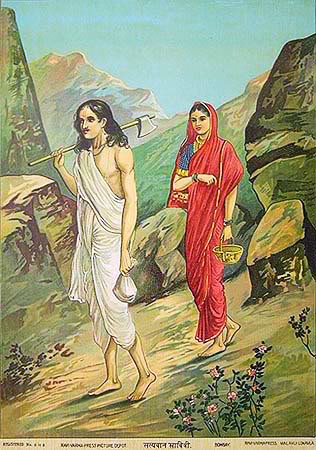
Introduction
The story of Sāvitrī and Satyavān (IAST: Sāvitrī, Satyavān; Sanskrit: सावित्री, सत्यवान्) is one of the most beloved and morally powerful narratives in Hindu literature. Narrated in the Vana Parva (Book of the Forest) of the Mahābhārata (Chapters 277–283, also numbered 291–297 in some recensions), this tale recounts how Princess Sāvitrī, through the sheer force of her devotion, wisdom, and courage, wrestled her husband’s soul from the grasp of Yama, the god of death — and won.
Unlike many mythological narratives where divine figures rescue mortals through supernatural power, the Sāvitrī story is remarkable for its celebration of human agency — specifically, feminine agency. Sāvitrī conquers death not with weapons, mantras, or divine intervention but with her own intelligence, verbal skill, and absolute refusal to accept the unacceptable. She is neither passive nor merely pious; she is a woman of extraordinary will who confronts the cosmic order itself and, through the moral power of her love, reshapes it.
The Mahābhārata places this story within a discourse by the sage Mārkaṇḍeya to Yudhiṣṭhira during the Pāṇḍavas’ forest exile. Yudhiṣṭhira, grieving over Draupadī’s suffering and his own exile, asks whether there has ever existed a woman as devoted and noble as Draupadī. Mārkaṇḍeya responds with the story of Sāvitrī — establishing it as the supreme exemplar of pātivratya (wifely devotion) and, more broadly, of the power of dharmic resolve.
The Characters
Sāvitrī: The Princess of Madra
Sāvitrī is the only daughter of King Aśvapati of the Madra kingdom (in the Punjab region). Her name derives from the Vedic solar deity Savitṛ and the sacred Sāvitrī mantra (the Gāyatrī mantra addressed to Savitṛ, Ṛg Veda 3.62.10). The Mahābhārata tells us that Aśvapati had no children for many years and performed the Sāvitrī Vrata — eighteen years of daily oblations to the goddess Sāvitrī — before a luminous girl-child was born to him. He named her Sāvitrī in honour of the goddess who granted her birth (Vana Parva 277.18–25).
Sāvitrī grows to become a woman of surpassing beauty, learning, and spiritual depth. The Mahābhārata describes her as radiant as a goddess, yet so formidable in her virtue that no prince dared to seek her hand. When King Aśvapati asks her to find her own husband — an extraordinary concession in the patriarchal framework of the epic — she sets out on a pilgrimage across the kingdoms, accompanied by aged counsellors, in search of a worthy spouse.
Satyavān: The Exiled Prince
Satyavān (“He Who Possesses Truth”) is the son of the blind, exiled King Dyumatsena of the Śālva kingdom. Once a powerful monarch, Dyumatsena was overthrown by a neighbouring king and now lives with his wife and son in a forest hermitage, subsisting as an ascetic. Satyavān, despite his reduced circumstances, is described as handsome, virtuous, generous, truthful (hence his name), and learned — a prince in character if no longer in station.
When Sāvitrī encounters Satyavān in the forest, she recognises in him the husband she has been seeking and declares her choice to her father and to the sage Nārada, who happens to be visiting Aśvapati’s court.
Nārada’s Warning and Sāvitrī’s Choice
The dramatic crux of the story occurs when Nārada, upon hearing Sāvitrī’s choice, delivers a devastating pronouncement: Satyavān possesses every virtue — truth, beauty, courage, generosity, devotion to his parents — but he suffers from a single, irreversible defect:
“Satyavān has but one fault, and no other. Within one year from this day, he shall die.” (Vana Parva 278.28)
King Aśvapati is horrified and begs Sāvitrī to choose another husband. But Sāvitrī replies with one of the most famous speeches in the Mahābhārata:
“Whether his life be long or short, whether he be endowed with virtues or devoid of them — I have chosen my husband once, and I shall not choose a second time. The mind decides, the speech declares, and the act follows. My mind is my witness.” (Vana Parva 278.32–34)
This declaration — sakṛd hi kanyā dīyate (“a maiden is given but once”) — establishes Sāvitrī not as a victim of fate but as its conscious challenger. She marries Satyavān with full knowledge that he will die in one year, choosing love and dharma over safety and self-preservation.
The Year of Waiting
After the marriage, Sāvitrī goes to live with Satyavān and his parents in the forest hermitage. She lays aside her royal garments, dons the bark cloth and deerskin of an ascetic, and devotes herself to serving her husband and parents-in-law with unfailing tenderness. The Mahābhārata describes her as winning the hearts of all in the āśrama through her gentleness, service, and self-effacement (Vana Parva 279).
But as the months pass, the appointed day of Satyavān’s death draws closer. Sāvitrī counts the days, and when only three days remain, she undertakes the Trirātra Vrata — a three-day fast during which she stands motionless, neither eating nor sleeping, in meditation and prayer. Her father-in-law, alarmed by her austerity, urges her to break her fast, but she gently refuses, saying that she has taken a vow that must be fulfilled.
The Day of Death
On the fateful day, Sāvitrī insists on accompanying Satyavān into the forest as he goes to gather wood and fruits. Despite his protests that the forest is difficult terrain for one weakened by fasting, she persuades him with quiet determination. The couple enters the deep forest together.
As Satyavān climbs a tree to cut wood, he is suddenly seized by an excruciating pain in his head. He descends and collapses in Sāvitrī’s lap, saying, “My head is on fire, my limbs are failing. I wish to sleep.” Sāvitrī cradles his head in her lap and watches as his life ebbs away. Then she sees a figure approaching — dark, radiant, dressed in red, carrying a noose.
The Confrontation with Yama
Yama Appears
The figure is Yama (Sanskrit: यम), the god of death and the lord of dharma. Yama has come personally — rather than sending his messengers (Yamadūtas) — because Satyavān’s virtue is so great that only the lord of death himself is worthy of extracting his soul. Yama binds Satyavān’s soul (described as a figure the size of a thumb, the aṅguṣṭha-mātra puruṣa of Upaniṣadic description) in his noose and turns southward toward his realm.
Sāvitrī Follows
Sāvitrī rises and follows Yama. When Yama tells her to turn back — her duties to the dead are complete, and mortal feet cannot walk the path of death — she refuses:
“Wherever my husband is taken, wherever he goes, there I must go. This is the eternal dharma.” (Vana Parva 281.13)
What follows is one of the most extraordinary dialogues in Sanskrit literature — a theological and philosophical debate between a mortal woman and the god of death, conducted as they walk together along the southern road.
The Three Boons
Impressed by Sāvitrī’s wisdom, eloquence, and devotion, Yama offers her boons — but stipulates that she may not ask for Satyavān’s life. Sāvitrī, however, proves herself a master of nīti (statecraft and verbal strategy):
First Boon: Sāvitrī asks that her father-in-law Dyumatsena regain his eyesight and his kingdom. Yama grants this readily. (Vana Parva 281.22–24)
Second Boon: She asks that her own father, King Aśvapati, who is childless of sons, be blessed with a hundred sons. Yama grants this. (Vana Parva 281.28–30)
Third Boon: In her masterstroke of wisdom, Sāvitrī asks that she herself be blessed with a hundred sons by Satyavān. Yama, bound by his own word, has no choice — for Sāvitrī cannot bear Satyavān’s sons unless Satyavān lives. Caught in the logic of his own promise, Yama releases Satyavān’s soul and praises Sāvitrī as the ideal of wifely devotion and moral courage. (Vana Parva 281.33–40)
Some recensions of the Mahābhārata present the boon sequence differently, with Sāvitrī winning progressively through multiple rounds of conversation. In all versions, the essential dynamic is the same: Sāvitrī’s intelligence and verbal skill, not supernatural power, defeat death.
The Return to Life
Yama releases Satyavān and departs, blessing Sāvitrī. She returns to the spot where Satyavān’s body lies, places his head in her lap, and watches as life returns to him. He awakens as from a deep sleep, remembering nothing of death but describing a vision of a dark, powerful figure who carried him away until “a radiant woman” brought him back.
The couple returns to the hermitage, where they find that Dyumatsena has miraculously regained his sight. Shortly afterward, messengers arrive announcing that the usurper of the Śālva kingdom has died and the people wish Dyumatsena to return as their king. All of Sāvitrī’s boons are fulfilled in sequence, confirming the cosmic validity of her triumph over death.
Symbolism and Theological Significance
Pātivratya: Beyond Simple Obedience
The Sāvitrī narrative is often cited as the supreme example of pātivratya — the ideal of wifely devotion. However, the text itself reveals a far more complex and empowering vision than the word “obedience” suggests. Sāvitrī does not passively accept her husband’s fate; she actively defies the cosmic order. She does not obey Yama; she argues with him. She does not merely pray for divine intervention; she engineers her own solution through intellectual brilliance.
The pātivratā in the Sāvitrī story is thus not a submissive wife but a heroic agent — one whose moral authority is so great that even the god of death must yield to it. This reading, present in the text itself, offers a powerful counter-narrative to reductive modern interpretations that dismiss the pātivratā ideal as mere patriarchal subjugation.
Feminine Power (Strī Śakti)
Sāvitrī’s confrontation with Yama is a dramatic assertion of strī śakti — feminine power. The Mahābhārata’s placement of this story in Mārkaṇḍeya’s mouth, as a response to Yudhiṣṭhira’s question about women’s nobility, is significant: the greatest feat in the entire discourse — conquering death itself — is accomplished not by a warrior, a king, or a sage, but by a woman armed with nothing but her love, her intelligence, and her moral courage.
Truth and Satya
The name “Satyavān” — “possessor of truth” — resonates with the Mahābhārata’s deepest theme: satyam eva jayate (“truth alone triumphs”; also Muṇḍaka Upaniṣad 3.1.6). Sāvitrī’s devotion to Satyavān is, at the symbolic level, devotion to Truth itself. By refusing to let Truth die, she upholds the cosmic order.
The Dialogue Form
The theological debate between Sāvitrī and Yama draws on the ancient Upaniṣadic tradition of knowledge gained through dialogue — recalling the famous colloquy between Naciketā and Yama in the Kaṭha Upaniṣad. In both texts, a mortal confronts the lord of death and, through persistent questioning and moral courage, wins knowledge and transcendence. Sāvitrī thus joins Naciketā in the exalted company of those who have faced death and prevailed through wisdom.
The Sāvitrī Vrata
Observance
The Vat Sāvitrī Vrata (also Savitri Puja) is a religious observance practised by married Hindu women, primarily in North India, on the amāvasyā (new moon day) or pūrṇimā (full moon day) of the month of Jyeṣṭha (May–June). The exact date varies by regional tradition:
- In Maharashtra, Gujarat, and parts of Karnataka: observed on Jyeṣṭha amāvasyā
- In Bihar, Uttar Pradesh, and Madhya Pradesh: observed on Jyeṣṭha pūrṇimā
Ritual Practice
Women observe a fast (either full-day or partial), worship the vaṭa vṛkṣa (banyan tree), and circumambulate it seven times, tying sacred threads around its trunk. The banyan tree is chosen because of its legendary longevity and its association with Yama (under whose banyan tree the dead are said to rest). Some traditions hold that Sāvitrī herself rested under a banyan tree during her vigil.
Married women pray for the long life and well-being of their husbands, recite the Sāvitrī narrative (or have it read by a priest), and offer vermillion, turmeric, flowers, fruits, and sweets to the tree. The vrata is considered especially powerful for conjugal happiness and family prosperity.
Regional Variations
- In Bengal, the Sāvitrī Vrata (সাবিত্রী ব্রত) is observed with particular devotion, often accompanied by recitation of the Sāvitrī Upākhyāna in Bengali verse. Bengali women tie threads to the banyan tree and share ritual foods.
- In Maharashtra, the Vat Purnima (वट पूर्णिमा) festival involves women dressing in their wedding finery, gathering at banyan trees, and performing elaborate pūjā with special foods.
- In North India, the vrata is often combined with other auspicious observances for married women during the month of Jyeṣṭha.
Literary Legacy
Sri Aurobindo’s Savitri
The most extraordinary literary treatment of the Sāvitrī legend is Sri Aurobindo’s Savitri: A Legend and a Symbol (composed 1916–1950, published posthumously in 1954). This monumental epic poem of approximately 24,000 lines in English blank verse transforms the Mahābhārata story into a vast philosophical allegory of the soul’s evolution, the conquest of death, and the divinisation of earthly life. Aurobindo described it as “a legend and a symbol” — the legend being the Mahābhārata narrative, and the symbol being the spiritual journey of humanity from darkness to light, from death to immortality.
Other Retellings
The Sāvitrī story has been retold in virtually every Indian literary tradition:
- Kālidāsa alludes to it in the Kumārasaṃbhava
- Vyāsa’s own rendering in the Mahābhārata remains the canonical version
- Modern retellings include works by Rabindranath Tagore, Premchand, and numerous regional writers
- In dance traditions, the Sāvitrī-Yama encounter is a staple of Bharatanāṭyam, Kuchipudi, and Odissi repertoires
Sāvitrī and Satyavān in Art
The subject of Sāvitrī confronting Yama has been a favourite of Indian artists for centuries:
- Raja Ravi Varma (1848–1906) painted several versions, the most famous showing Sāvitrī pleading before Yama as he carries Satyavān’s soul
- Abanindranath Tagore depicted the scene in the Bengal School style
- Temple sculptures at Halebidu and other Hoysala-era sites depict episodes from the narrative
- Modern calendar art has made the image of Sāvitrī following Yama one of the most recognisable in Hindu popular culture
Philosophical and Moral Significance
The Sāvitrī-Satyavān narrative carries several enduring moral and philosophical lessons:
- Love transcends death: The story affirms the Hindu conviction that genuine devotion (bhakti) and love (prema) are cosmic forces that can overcome even mortality.
- Wisdom is the highest weapon: Sāvitrī defeats death not through force but through prajñā (wisdom) and vāk (speech) — affirming the Bṛhadāraṇyaka Upaniṣad’s teaching that speech and mind are the supreme powers.
- Conscious choice matters: Sāvitrī’s deliberate, eyes-open choice of Satyavān — knowing he will die — elevates her from a victim of fate to its conscious master.
- Dharma protects those who uphold it: Dharmo rakṣati rakṣitaḥ — “Dharma protects those who protect dharma” (Manusmṛti 8.15). Sāvitrī’s unswerving adherence to dharma generates a moral force that even Yama must respect.
Conclusion
The story of Sāvitrī and Satyavān endures because it speaks to the deepest human longing: the desire that love might be stronger than death. In Sāvitrī, the Hindu tradition presents not a passive ideal of wifely submission but a blazing exemplar of feminine courage, intellectual brilliance, and moral authority. She is the woman who followed death to the edge of the world, argued with the lord of dharma on his own terms, and brought her beloved back to life — not through miracles or divine weapons, but through the unconquerable power of a heart that refused to let go. As the Mahābhārata itself declares through Mārkaṇḍeya’s voice: “There is no dharma higher than truth, no austerity greater than patience, no power superior to devotion, and no wealth more precious than the gift of fearlessness” (Vana Parva 283). Sāvitrī embodies them all.